

Over the years, spot Bitcoin ETFs have become the “holy grail” of the crypto industry.
An ETF is a publicly traded investment vehicle that tracks the value of an underlying asset; in the case of the Bitcoin ETF, that asset is Bitcoin. Advocates of Bitcoin ETFs argue that the complexity of exchanges, crypto wallets, and private keys still poses a huge barrier to newcomers entering the crypto space, and Bitcoin ETFs will allow ordinary users to obtain investments in Bitcoin without actually holding it. Own cryptocurrency.
Bitcoin ETFs have sprung up around the world, including Canada, Brazil, and Dubai. In October 2021, ProShares’ Bitcoin Futures ETF was listed on the New York Stock Exchange. However, so far, the U.S. Securities and Exchange Commission (SEC) has rejected all applications for spot Bitcoin ETFs, which offer the opportunity to invest directly in Bitcoin rather than futures contracts. The SEC has repeatedly pointed out possible market manipulation by cryptocurrency traders.
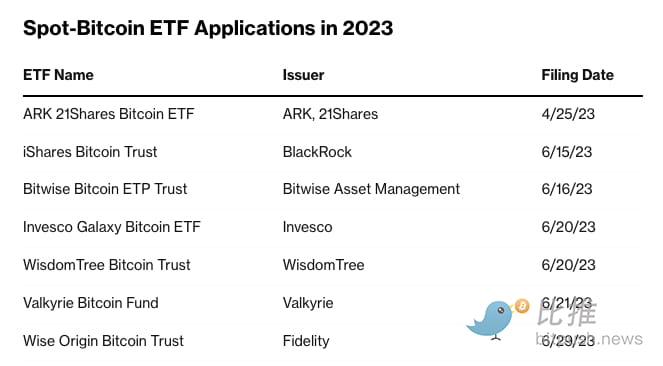
However, spurred by the asset management giant BlackRock, many financial companies have joined the competition for new spot ETF applications. The following are the spot Bitcoin ETFs currently queued for approval (public data as of June 29, 2023):
1、Ark Invest
Ark Invest, an investment company led by Cathie Wood, submitted an application for the Ark21Shares ETF in June 2021. ARK Invest has partnered with Swiss ETF provider 21Shares AG to launch the ARK 21Shares Bitcoin ETF; if approved, it will trade on Cboe’s BZX exchange under the ticker ARKB.
The company was also the first to disclose fees for its Bitcoin ETF, with the filing revealing plans to pay 21Shares a 0.95% fee, which the company will use to cover operating expenses.
Ark Invest has invested in cryptocurrency exchange Coinbase, Grayscale Bitcoin Trust and payments processor Square, which holds more than 8,000 bitcoins on its balance sheet. Cathie Wood is a passionate advocate of Bitcoin, arguing that the cryptocurrency represents “a new asset class” and can become a reserve currency.

Ark Invest’s ETF was rejected in early 2022. The company immediately reapplied and was rejected in January 2023, and Ark Invest is currently in the process of applying for a third time.
2. BlackRock
On June 15, BlackRock, the world’s largest asset manager (with over $9 trillion in assets under management as of the first quarter of 2023), shocked the TradFi and crypto industries by filing an application for a Bitcoin spot ETF. The filing proposes Coinbase as a cryptocurrency custodian and spot market data provider, and BNY Mellon as a cash custodian.
Eric Balchunas, senior ETF analyst at Bloomberg, said the investment product is technically a trust but is functionally a “real deal” — a spot market ETF. Balchunas said BlackRock has repeatedly fought with the U.S. Securities and Exchange Commission (SEC) over the launch of ETFs, but it has been successful in getting approval at a ratio of 575 to 1.
BlackRock’s ETF application was endorsed by former Barclays CEO Bob Diamond. It also led WisdomTree, Invesco and Valkyrie to file new applications with the SEC, while helping Bitcoin prices return to $30,000 in June 2023. above.
3、Bitwise
Bitwise Asset Management has submitted a new application document to the U.S. SEC on June 16, requesting rule changes to accommodate its planned Bitwise Bitcoin ETP Trust.
The U.S. SEC rejected the Bitcoin spot ETF application submitted by Bitwise in June 2022, and believed that the ETF could not achieve sufficient supervision sharing, nor could it provide protection measures against market manipulation and prove that the relevant market was large.
In April this year, Bitwise Chief Investment Officer Matt Hougan said that while a spot Bitcoin ETF would be “excellent” for investors in the long term, Bitwise may wait until there is more regulatory clarity before launching another ETF.
In the new filing, BitWise said the U.S. SEC should approve, deny or initiate other proceedings surrounding its proposed rule changes within 45-90 days. It is reported that the application was released by the New York Stock Exchange (NYSE), but has not yet been processed by the U.S. SEC, which means that the actual deadline for the relevant application is not yet known.
4、Invesco Galaxy Bitcoin ETF
Galaxy Digital and Invesco jointly filed a Bitcoin ETF on September 22, 2021, called the Invesco Galaxy Bitcoin ETF. Its ETF will also be “physically backed” by Bitcoin, rather than through derivatives such as futures, according to the filing. Invesco Capital Management LLC is the sponsor of the application, but it is unclear which company will host the application’s Bitcoin.
The sponsor is a wholly-owned subsidiary of Invesco Ltd, the fourth-largest ETF provider in the United States, a qualification that may aid submissions. "For people who have been in the ETF business for a long time, this is very similar to the early days of ETFs (late 1990s, early 2000s)," said John Hoffman, head of U.S. ETF strategy at Invesco.
The product is the first in a series of crypto ETFs the companies hope to list on the U.S. market.
5、WisdomTree

New York-based asset manager WisdomTree already has experience operating a Bitcoin ETF; it launched a Bitcoin ETF on Switzerland’s SIX exchange in 2019. In March 2021, it joined the ranks of candidates for a U.S. Bitcoin ETF and submitted an S-1 document to the SEC, proposing to list the WisdomTree Bitcoin Trust on the Cboe bZx exchange with the stock code BTCW.
Since then, the SEC has repeatedly delayed, first soliciting public feedback on the proposal and then announcing that it needed more time to consider "the issues raised" in the comment letter.
The SEC rejected WisdomTree’s application in late 2021, and around the same time, it rejected similar applications from Valkyrie and Kryptoin. WisdomTree filed a new application in mid-2023, shortly after BlackRock filed.
6、Valkyrie Investments
A newer player, asset manager Valkyrie filed its first Bitcoin ETF application in January 2021. The ETF, which will reference the Chicago Mercantile Exchange’s (CME) Bitcoin reference price and trade on the New York Stock Exchange Arca, “provides investors with an efficient means to implement a variety of investment strategies,” the company wrote in the proposal. ” Cryptocurrency custodian Xapo is responsible for custody and cold storage of the fund’s Bitcoins.
In the filing, Valkyrie cited the cryptocurrency’s volatility — one of the SEC’s main concerns about a Bitcoin ETF. "The potential consequences of a Bitcoin exchange failure could adversely affect the value of the shares," it said in its risk assessment.
Unsurprisingly, the SEC delayed its ruling on Valkyrie’s application, along with those of Kryptoin, WisdomTree, and Global X, ultimately rejecting Valkyrie and Kryptoin’s applications around Christmas 2021.
In early 2022, Valkyrie’s Bitcoin Mining ETF successfully received SEC approval. The tool is backed by holdings in companies that use an average of 77% renewable energy, including industry heavyweights such as Argo Blockchain, Bitfarms, Cleanspark, Hive Blockchain and Stronghold Digital Mining.
In June 2023, Valkyrie submitted another Bitcoin spot ETF application to the SEC.
7. Fidelity
Financial services giant Fidelity, which manages about $11 trillion in assets, filed on June 29 for the ETF, which was filed under the name Wise Origin Bitcoin Trust. According to the filing, Fidelity Digital Asset Services will be “responsible for custody of the trust’s Bitcoin.”
Unlike BlackRock, Fidelity has previously attempted to launch a spot Bitcoin ETF. The company filed in 2021 for the Wise Origin Bitcoin Trust, a proposed ETF that was ultimately rejected by the SEC in January 2022. The rejection comes nearly two months after Fidelity successfully launched a spot Bitcoin ETF in Canada.
Fidelity has been involved in the crypto space for many years. It launched Fidelity Digital Assets in 2018 to provide cryptocurrency custody and trade execution services to institutional investors such as hedge funds, family offices and market intermediaries. And in April 2022, it launched the Crypto Industry and Digital Payments ETF (FDIG) and the Fidelity Metaverse ETF (FMET).
Failure case
There are many examples of failed spot Bitcoin ETF applications; to date, the SEC has rejected all related applications. Here are all the applications that have been rejected so far:
1、Global X
Global X Digital Assets, a fund management company with $31 billion in assets under management, filed with the SEC in July 2021. The proposed Global X Bitcoin Trust will trade on the Cboe BZX exchange.
GlobalX's portfolio covers 84 ETFs covering disruptive technology, equity income, commodities and emerging markets. The proposed trust does not disclose the identity of the custodian responsible for the safekeeping of Bitcoin, identifying only as a limited purpose trust company authorized to provide digital asset custody services in New York State.
In September 2021, the GlobalX Bitcoin Trust was one of four Bitcoin ETF applications (including a Bitcoin futures ETF application) to have the SEC postpone its deadline. Extended to November 21, 2021. In March 2021, the proposal was rejected by the SEC and NYDIG.
2、Kryptoin
Delaware-based Kryptoin first attempted to apply for a Bitcoin ETF in October 2019 and planned to list the Kryptoin Bitcoin ETF Trust on NYSE Arca. The financial services firm made its second attempt at launching a Bitcoin ETF in April 2021, with a revised proposal to list the trust on Cboe’s BZX exchange. Its revised filing lists service providers assisting in the launch of the ETF, including cryptocurrency exchange Gemini, which will provide custody of the bitcoin held by the trust.
By the end of the month, the application was officially up for review by the SEC, which subsequently postponed its decision on the application until July 27, 2021.
In September 2021, the SEC once again postponed the deadline for a decision on the Kryptoin Bitcoin ETF Trust, changing the date to December 24, 2021. At this point, the SEC’s announcement, which rejected Kryptoin and Valkyrie’s applications in late 2021, emphasized the need for more time “to consider the proposed rule changes and the issues raised in the comment letters related thereto.”
3、Fidelity/Wise Origin
March 2021 saw a surge in applications for Bitcoin ETFs, including Fidelity’s Wise Origin Bitcoin Trust, which was unsurprising given that just a few weeks ago, its global macro director Jurrien Timmer said Bitcoin relative Gold has "unique advantages". The application for the Wise Origin Bitcoin Trust will have Fidelity Service Company Inc as administrator, with Fidelity Digital Assets custody of the Bitcoin underlying the ETF.
In May 2021, Cboe Global Markets submitted a proposal to list a Fidelity Bitcoin ETF, arguing that due to increased investor participation and institutional adoption of cryptocurrencies, the SEC Concerns about market manipulation have been "sufficiently mitigated." This “promotes the maturation of the Bitcoin trading ecosystem.” That same month, the SEC began reviewing Fidelity's application.
In January 2022, Fidelity’s ETF was rejected.
4、First Trust/SkyBridge
In March 2021, hedge fund SkyBridge Capital submitted a Bitcoin ETF application to the SEC. The company, run by former White House communications director Anthony Scaramucci, already operates a Bitcoin fund open to accredited investors with a minimum investment of $50,000; within weeks of opening in January 2021, sales grew to more than $3.7 One hundred million U.S. dollars.
In the same month, Scaramucci was optimistic that a Bitcoin ETF could be approved by the end of 2021, publicly stating: “I’m hopeful that with Gary Gensler now entering regulatory compliance and what I know about his background, it’s possible that we can launch an ETF by the end of the year. ."
In May 2021, NYSE Arca filed a proposed rule change that would see SkyBridge Capital’s Bitcoin ETF listed on the exchange. In July of the same year, the SEC delayed the review period of the Skybridge Bitcoin ETF, ultimately rejecting the ETF in January 2022.
5、New YorkDIG/Stone Ridge
New York Digital Investment Group and advisory firm Stone Ridge were quick to seize the opportunity presented by the SEC leadership change, becoming the second potential ETF to file with the regulator in 2021. The filing was made on February 16, as Bitcoin topped $50,000 for the first time.
In March 2022, the SEC rejected the applications of NYDIG and Global X.
6、One River
One River Asset Management launched a bid for a Bitcoin ETF in May 2021 and filed for a carbon-neutral Bitcoin exchange-traded fund. As Bitcoin’s energy consumption and carbon footprint come under increasing scrutiny, One River has committed to “purchasing and reclaiming the necessary carbon credits through environmental platform Moss Earth to account for the estimated carbon emissions associated with Bitcoin held in trust” amount" thereby offsetting its carbon footprint.
In an effort to win over the SEC, One River dropped a bombshell and hired former SEC Chairman Jay Clayton as a consultant. In May 2022, his application was rejected.
7、Galaxy Digital
In April 2021, cryptocurrency investment company Galaxy Digital filed for a Bitcoin ETF; at the time, the eighth such application had been filed with the SEC. The proposed Galaxy Bitcoin ETF will be listed on the New York Stock Exchange Arca. Galaxy Digital manages over $2.5 billion in assets and is one of the largest institutional holders of Bitcoin, with 16,400 Bitcoins in its inventory (worth nearly $500 million at current prices).
Billionaire Galaxy Digital founder Mike Novogratz expressed his views on the SEC’s reluctance to approve Bitcoin ETFs at the 2021 Ethereal Summit. He believes that under the Trump administration, the SEC instead allowed the Grayscale Bitcoin Trust (GBTC) ) is booming, which is “not that great” for consumers. Novogratz believes that GBTC allows consumers to "buy Bitcoin at a 20-30% premium and be arbitraged by hedge funds into closed-end funds. ETFs would be a more elegant solution."
Like all other ETF proposals, nothing came of Galaxy Digital's separate application, but later, in September 2021, the company filed for a joint ETF with Invesco, as mentioned above, after BlackRock submitted its application. They submitted a new application jointly.
8. Grayscale
Cryptocurrency investment fund manager Grayscale’s GBTC Bitcoin Trust, which manages more than 600,000 BTC (worth nearly $20 billion at today’s prices), began formally filing applications to convert to a spot ETF in October 2021.

If its application is successful, Grayscale will be able to charge lower management fees and make it easier to get money in and out. Grayscale first submitted an application to launch a Bitcoin ETF in 2016 but withdrew its application a year later, saying, "We believe the regulatory environment for digital assets has not evolved to the extent that such a product can be successfully brought to market."
The lack of a mature Bitcoin ETF poses problems for Grayscale and the broader Bitcoin market. GBTC replaced such products and satisfied the majority of U.S. institutional demand for Bitcoin. However, its shares sometimes trade at a negative premium, below the value of the underlying Bitcoin per share, but the fund does not allow shares to be redeemed for Bitcoin itself, so the market cannot resolve this organically. If the Bitcoin ETF is approved, investors will be able to redeem their shares at any time. This may prevent negative premiums from occurring and help keep shares in line with the value of the underlying token.
Grayscale has been laying the groundwork for a Bitcoin ETF for some time, hiring ETF experts and signing an agreement with BNY Mellon that will see the global investment firm become a service provider for GBTC. If it is converted to an ETF, BNY Mellon will provide transfer agent and ETF services.
In June 2022, the SEC rejected Grayscale's application, saying the company did not do enough to prevent potential fraud. Grayscale immediately filed a lawsuit with the regulator, saying its reasons for the rejection were "illogical."
9、VanEck
VanEck was one of the earliest applicants for a Bitcoin ETF. Back in 2018, it first attempted to launch a Bitcoin ETF – the VanEck SolidX Bitcoin Trust – in partnership with SolidX.
Although the application was withdrawn in September 2019, VanEck made another attempt to launch a Bitcoin ETF, submitting an application to the SEC for the VanEck Bitcoin Trust in December 2020, with shares of the trust to be traded on Cboe BZX.
It is worth noting that VanEck submitted the second application just days after former SEC Chairman Jay Clayton resigned. In a 2019 interview with CNBC, Clayton was dismissive of the prospect of a Bitcoin ETF, noting that despite “progress” around custody concerns, cryptocurrencies are still vulnerable to price manipulation and that overseas exchanges “do not offer the same Same level of protection for U.S. equities.”
The SEC repeatedly delayed a decision on VanEck’s second Bitcoin ETF application, rejecting it in November 2021. The company then filed a third application in mid-2022, but the SEC again prevaricated and was ultimately denied in March 2023.
a long and winding road
The road to a Bitcoin ETF is long. The U.S. Securities and Exchange Commission (SEC) has been stalling on the idea since the Winklevoss brothers first filed for a Bitcoin ETF-like trust in 2013. It has repeatedly delayed decisions on multiple Bitcoin ETFs over the past few years, leading firms such as VanEck to withdraw applications out of fear that the SEC would reject them.
The SEC’s main concerns about approving a Bitcoin ETF involve a lack of transparency in trading information, market manipulation, and the different properties of Bitcoin from other financial assets (such as what would happen in the event of a hard fork). It is also concerned about a lack of liquidity in the market.
Sui Chung, CEO of cryptocurrency index provider CF Benchmarks, pointed out in an interview with Decrypt that early companies that applied for Bitcoin ETFs (such as the Winklevoss brothers) were from startups, although they were all well-funded startups. But now, these applications are coming from a new generation of applicants who are ready to meet these challenges.
“I think many of the areas where the SEC has expressed concerns before, filers don’t have extensive experience in the ETF market, particularly in terms of the vagaries of the crypto market and how they synchronize with the stock market through ETF structures,” Sui Chung said. He added that if structured in the right way, a Bitcoin ETF is no different than any other ETF listed on a stock exchange.

In August 2021, SEC Chairman Gary Gensler stated during the hearing that he was “particularly looking forward” to the SEC’s review of “Bitcoin futures ETFs limited to trading on CME”, implying that the SEC is more inclined to Bitcoin futures ETFs. ETFs that physically hold Bitcoin have triggered a rush of applications for Bitcoin futures ETFs, with companies such as Galaxy Digital and VanEck applying.
Gensler again expressed interest in a Bitcoin futures ETF in September 2021 in remarks prepared for the Financial Times’ “The Future of Asset Management in North America” conference. Earlier this year, Gensler said, “a number of open-end mutual funds launched investments in Bitcoin futures traded on the Chicago Mercantile Exchange (CME).”
The SEC chairman noted that the regulator has received numerous filings for Bitcoin futures ETFs under the Investment Company Act of 1940, known as the “40 Act.” "Combined with other federal securities laws, Act 40 provides important investor protections for mutual funds and ETFs," Gensler said, adding, "I look forward to the staff's review of such filings."
In October 2021, the long wait finally came to an end, and the first Bitcoin futures ETF was listed on the New York Stock Exchange. The ProShares BTC Futures ETF broke nearly all trading records for debut ETFs, with first-day trading volume of nearly $1 billion.
Global Bitcoin ETF
While the United States has been slow to act, other countries are forging ahead. There are now multiple Bitcoin ETFs operating in countries such as Canada and Brazil. There are many Exchange Traded Notes (ETNs) in Europe, which are very similar financial instruments.
Despite multiple rejections and delays, the crypto industry remains optimistic, with BlackRock’s June 2023 filing reigniting hopes. After BlackRock submitted its application, Bloomberg senior ETF analyst Eric Balchunas said that BlackRock’s move “certainly injects new energy and new optimism into the entire Bitcoin ETF race.”