


2024.03.14
Project Introduction
Grass was launched in June last year. It builds a decentralized web scraping network that focuses on transforming public web data into artificial intelligence datasets. The network is a user-owned and operated network and is the easiest way for anyone to get in touch with AI. Everyone can quickly set up their own Grass node. For details, you can check out the tutorials that Goose has posted before. You can also use your mobile phone!
Currently, the price on Whales has reached 4.6U/1000 points. Under 75% network conditions, a single device IP can mine about 50,000 points per month, which is 240U. A long time ago, Goose asked you to mine, but many people were lazy and didn't mine. Now I tell you that you can mine 240u in a month by turning on your computer or mobile phone. As long as you go to relatives and friends' homes during the Chinese New Year, you can mine several 240u. Do you regret it a little bit? If you regret it, come and make up for it! !
Currently, Grass plans to launch the first Layer 2 data Rollup on SOL. Geege has specially divided it into a "too long to read" version and an official article version for your reading and understanding.
Too long to read
Before proposing this plan, Grass only had the concept of DEPIN plus AI, but now it plans to build its own AI public chain. This means that Grass has expanded to another completely different business model from before, adding data ledger function and ZK processor function from the previous simple business of helping AI companies clean data. Once Layer 2 is built, its concept will become SOL+DEPIN+AI+the first data Rollup concept. I won’t tell you how much gold content these four concepts have when they are superimposed. Why don’t you hurry up and dig in?
Computer version tutorial:
https://weibo.com/ttarticle/p/show?id=2309404997006383775962
Mobile version tutorial:
https://weibo.com/ttarticle/p/show?id=2309404998038614573232
positive
Grass: The first Layer 2 data rollup in history
Over the past few weeks, we’ve published content explaining the role of GRASS in the AI stack. By now, you’ve learned that the protocol performs many functions to help builders access network data for training their models. This is a critical first stage in the AI process and the starting point for all development.
In the case of Grass, a group of nodes hosted on resident devices scrape and process raw data from the web. It cleans and transforms data into structured datasets for use in AI training. Most importantly, it ingests web data in a way that involves and rewards nearly a million people around the world for participating. It single-handedly created the category of AI data provision and is why some of the largest AI companies in the world choose to work with us. It is the data layer for AI.
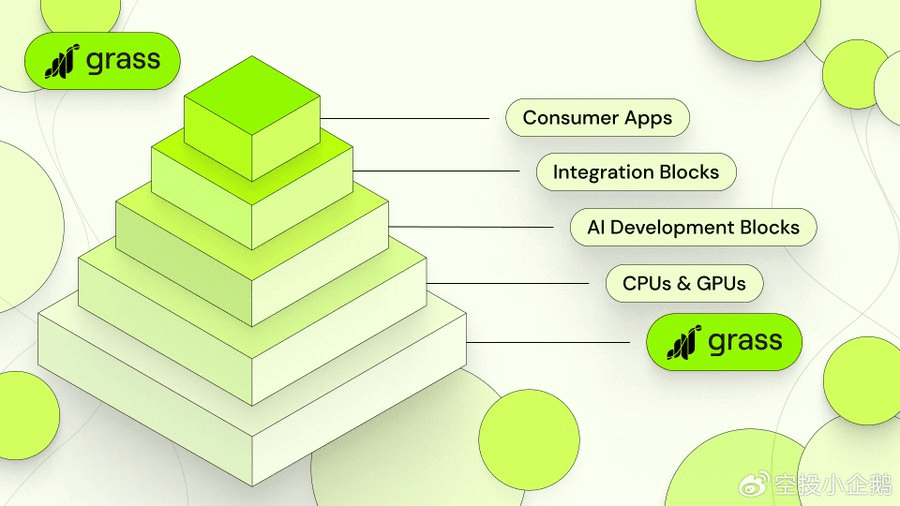
At the same time, we’ve also spent the past few weeks thinking about the current state of AI. We asked ourselves what the most pressing problems are and what we, as an important part of AI infrastructure, can do to address them.
Our conclusion is that the biggest problem facing AI today is a lack of data transparency. Just look at the news. Ask yourself, why would an AI model compare Elon Musk to Hitler? Or erase an entire ethnic group from world history? Was it trained with bad data? Or worse, good data that was selectively chosen to give the wrong answer?
The answer is, we don’t know. And we don’t know because there is no way to know. We don’t know what data these models were trained on because there is no mechanism to prove it. There is no way for users to verify the source of the data because there is no way for the builders to verify it themselves.
This is what GRASS is designed to solve, and we are now building a Layer 2 Data Rollup to solve this problem. How, you might ask?
Allow us to explain.
How to establish data source in Layer Two
The world needs a way to prove the provenance of AI training data, and that’s what GRASS is building now. Soon, every time data is scraped by a GRASS node, metadata will be recorded to verify the website from which the data was scraped. This metadata will then be permanently embedded in every dataset, allowing builders to be completely certain of its provenance. They can then share this pedigree with users, who can rest assured that the AI model they’re interacting with hasn’t been intentionally trained to give misleading answers.
This is a significant amount of work, and will require major expansion of our protocol in preparation for scaling scraping to tens of millions of network requests per minute. Each request will need to be validated, which will be greater throughput than any L1 can provide. That’s why we’re announcing plans to build a Layer 2 solution to handle this major upgrade in our capabilities. This L2 will be a sovereign Rollup, equipped with a ZK processor so that metadata can be batched for validation, and used to provide persistent lineage for every dataset we produce. This is necessary to enable the foundational layer for all AI development to move to the next stage.
The benefits of doing so are numerous: it will combat data pollution, empower open source AI, and provide transparency into the models we interact with every day.
Next, we describe the basic design of the system.
Grass Architecture
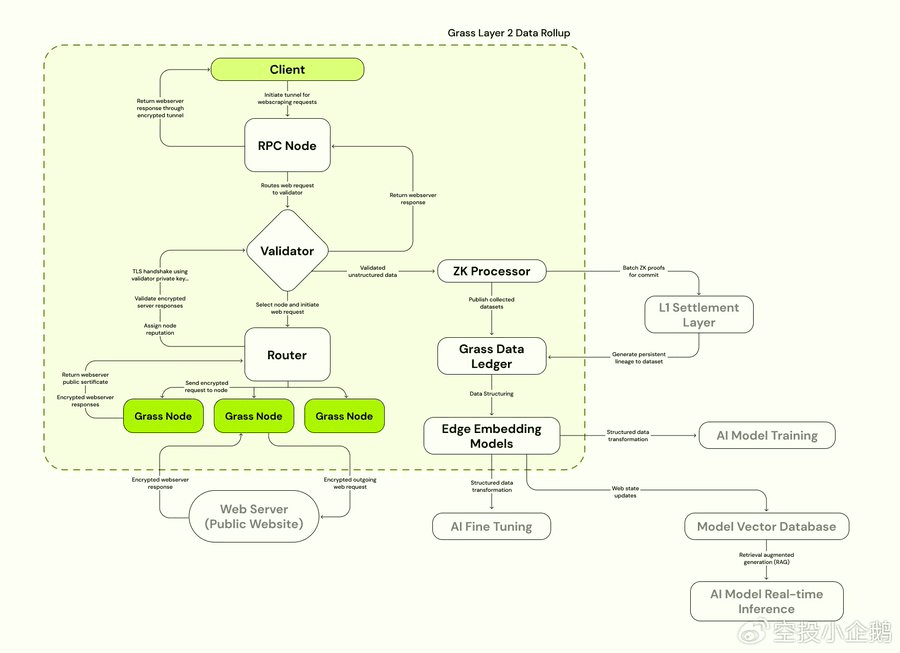
The easiest way to understand these upgrades is to look at a diagram of the GRASS Data Rollup. On the left, between the clients and the web servers, you see GRASS’s network, as it’s traditionally defined. The client makes a network request, which passes through a validator and is ultimately routed through a GRASS node. The server for the website requested by the client will respond to the network request, allowing its data to be scraped and sent back across the wire. The data is then cleaned, processed, and prepared for use in training the next generation of AI models.
In the L2 diagram, you will see two major additional parts on the right that will be added with the launch of GRASS’s sovereign Layer 2: the GRASS data ledger and the ZK processor.
Each of these has its own functions, so we will explain them one by one.
Grass Data Ledger
The data ledger is the ultimate storage place for all data on GRASS. It is a permanent ledger of every dataset scraped on GRASS, now embedded with metadata to record its lineage from the moment of origin. Metadata proofs for each dataset will be stored on Solana’s settlement layer, and the settlement data itself will also be accessible through the ledger. The importance of GRASS having a place to store the data it scrapes is important to note, although we will get to that shortly.
ZK Processor
As we described above, the purpose of a ZK Processor is to assist in recording the provenance of datasets scraped on the Grass network. Imagine this process.
When a node on the network — in other words, a user using the Grass extension — sends a network request to a given website, it returns an encrypted response containing all the data the node requested. For all purposes, this is the moment our dataset is born, the moment of origin that needs to be recorded.
And that’s exactly the moment we capture when we log metadata. It contains many fields — session keys, the URL of the scraped website, the IP address of the target website, timestamps of the transaction, and of course the data itself. This is all the necessary information to know beyond a reasonable doubt that a particular dataset came from the website it claims to have come from, and therefore a particular AI model was correctly — and faithfully — trained.
The role of a ZK processor is because this data needs to be settled on-chain, but we don’t want all of this data visible to Solana validators. Moreover, the sheer volume of network requests that will be executed on Grass in the future will inevitably exceed the throughput capabilities of any L1 - even one as powerful as Solana. Grass will soon scale to the point where it executes tens of millions of network requests per minute, and the metadata for each of these requests will need to be settled on-chain. There is no way we can submit these transactions to L1 without a ZK processor making proofs and batching them first. Therefore, L2- is the only possible way to achieve the goals we have set.
Now, why is this a big deal?
Benefits of Layer 2
Data Ledger
The importance of the data ledger is that it advances GRASS’s expansion into another — and fundamentally different — business model. While the protocol will continue to vet buyers who send their own network requests and scrape their own data on the web, a growing portion of its activity will involve data already stored on the ledger. With this capability, GRASS can now strategically scrape data for LLM training and host it in an ever-expanding data repository.
This repository is the data layer of the modular AI stack, from which builders can pick and choose components to train an infinite number of different models. It is essentially a miniature model of the Internet, providing training data that is already structured and ready for AI ingestion.
ZK Processor
We’ve covered why ZK processors are important in detail. By enabling us to create proofs of metadata that record the provenance of a Grass dataset, it provides a mechanism for builders and users to verify that an AI model was in fact trained correctly. That in itself is a big deal.
However, there is one thing we didn't mention before.
In addition to recording the website from which the dataset originated, metadata also indicates the nodes through which the dataset traveled on the network. Remarkably, this means that every time a node crawls the network, they can get credit for their work without revealing any identifying information about themselves.
Now, why is this important?
This is important because once you can prove which nodes did which work, you can start rewarding them proportionally. Some nodes are more valuable than others. Some nodes crawl more data than their peers. And these are exactly the nodes we need to incentivize to continue the rapid expansion of the network we have seen over the past few months. We believe this mechanism will significantly increase rewards for the most needy areas around the world, ultimately encouraging people in these places to sign up and exponentially increase the capacity of the network.
Needless to say, the larger the network, the greater our ability to crawl, and the larger our repository of network data will be. A positive feedback loop will inevitably result, as more data means more we can provide to AI labs that need training data - thereby providing incentives for the network to continue to grow.
in conclusion
In general, most of the outstanding problems in AI today stem from a lack of visibility into how models are trained, and we believe this can be solved by empowering open source AI with a system for verifying the provenance of data. Our solution is to build the first-ever Layer 2 data rollup, which will make it possible to introduce a mechanism to record metadata about the provenance of all datasets.
ZK proofs for this data will be stored on the L1 settlement layer, and the metadata itself will eventually be associated with its underlying datasets as those datasets themselves are stored on our own data ledger. GRASS provides the data layer for the modular AI stack, and these developments will bring greater transparency and rewards to node providers that are proportional to the amount of work they perform.
This update should help communicate some of our upcoming projects and clarify the thinking driving our decisions. We’re glad to play a role in making AI more transparent, and are excited about the many use cases that may emerge for our products in the future. These upgrades will open up a wide range of opportunities for developers, so if you or your team is interested in building on Grass, please reach out to us on Discord. Thank you for your support, and stay tuned.
Get a piece of the AI revolution.