

Original author: 0x26
Original editor: Jack
In June 2023, with the issuance of TUSD (TrueUSD) once again, its issuance has exceeded 3 billion, and its market value is close to BUSD, becoming the 5th largest stablecoin. In 2023, the issuance of TUSD increased by more than 200%. It can be said that it is the only stablecoin whose issuance has grown rapidly during the cryptocurrency bear market.
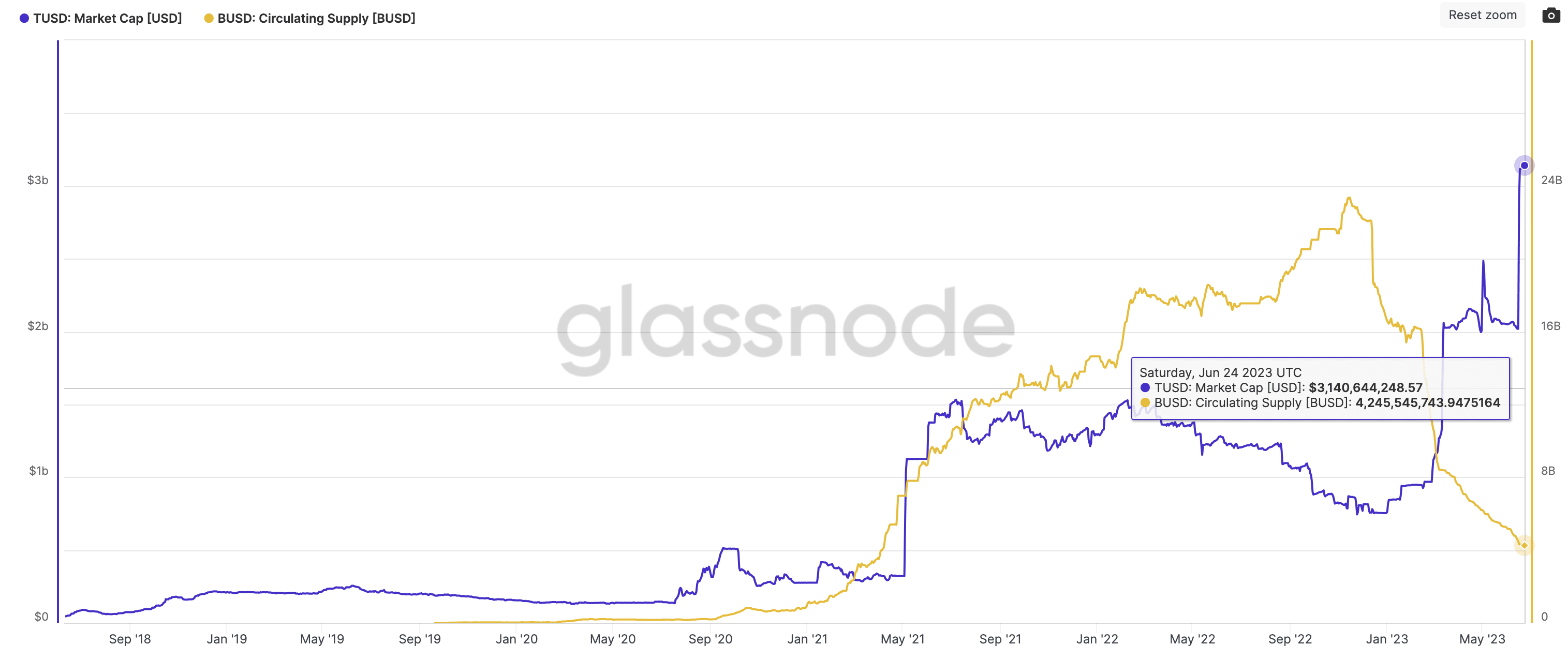
Due to different coordinate systems, the chart only represents the trend. Data source: glassnode
It seems that everyone in the industry knows that the reason why TUSD thrives in the bear market is inseparable from the promotion of Binance. Looking back on the development history of TUSD, we can find that TUSD, which seems to be "early rise and late arrival", has a different experience from most other centralized stablecoins, including the mysterious departure of TrustToken co-founder and CEO and the change of company ownership, as well as the original team's creation of the uncollateralized lending agreement TrueFi and the issuance of coins, etc.
It seems that TUSD is a foregone conclusion as Binance's new "official" stablecoin. But why did Binance choose TUSD, and who is the actual controller and beneficiary of TUSD now? How will Binance prevent TUSD from becoming the next BUSD? With these questions, we have conducted a detailed review of the history of TUSD and restored the entire development history of TUSD through clues.
Who is Techteryx? The Secret of TUSD
Looking back on the six years from 2018 to 2023, after experiencing initial glory, mid-term decline, and the subsequent change of ownership and going with the flow, TUSD has become what it is today.
Born with a silver spoon in my mouth
Although it has a weak presence in the DeFi Summer, TrustToken actually issued TUSD (TrueUSD) earlier than USDC (USD Coin), USDP (Pax Dollar) and BUSD. According to the official website, TUSD was launched in April 2018 and is the first US dollar stablecoin operated by a regulated operator.
When it was founded in 2018, TrustToken received a total of US$20 million in investment, including a16z and Founders Fund, which have experienced both bull and bear markets, GGV Capital, a well-known Chinese institution, as well as Jump Trading Capital and BlockTower Capital, which are now well-known market makers, as well as Danhua Capital and ZhenFund, which were very popular in the cryptocurrency circle at that time.
As early as the year of its launch, its circulation exceeded 200 million US dollars. However, in January 2020, the circulation dropped to about 150 million US dollars, surpassed by USDC's 500 million US dollars and USDP's 200 million US dollars. Although it was born with a golden key and quickly landed on many mainstream trading platforms such as Binance, Bittrex, and Upbit after its launch. However, judging from the circulation, number of trading pairs, and trading volume, TUSD was not successful in its early years.
Mysterious change of ownership
According to Linkedin information, Jai An, co-founder and CEO of TrustToken, the issuing company of TUSD, resigned in July 2020. He has almost withdrawn from the Internet and has never updated his information since then. Since then, it has been difficult to find information about the former CEO of TUSD on various online platforms.
Coincidentally, starting from July 2020, TUSD, which had not been issued for a long time, began to be issued intensively from then on, and soon the issuance volume exceeded the previous highest value, reaching US$500 million.
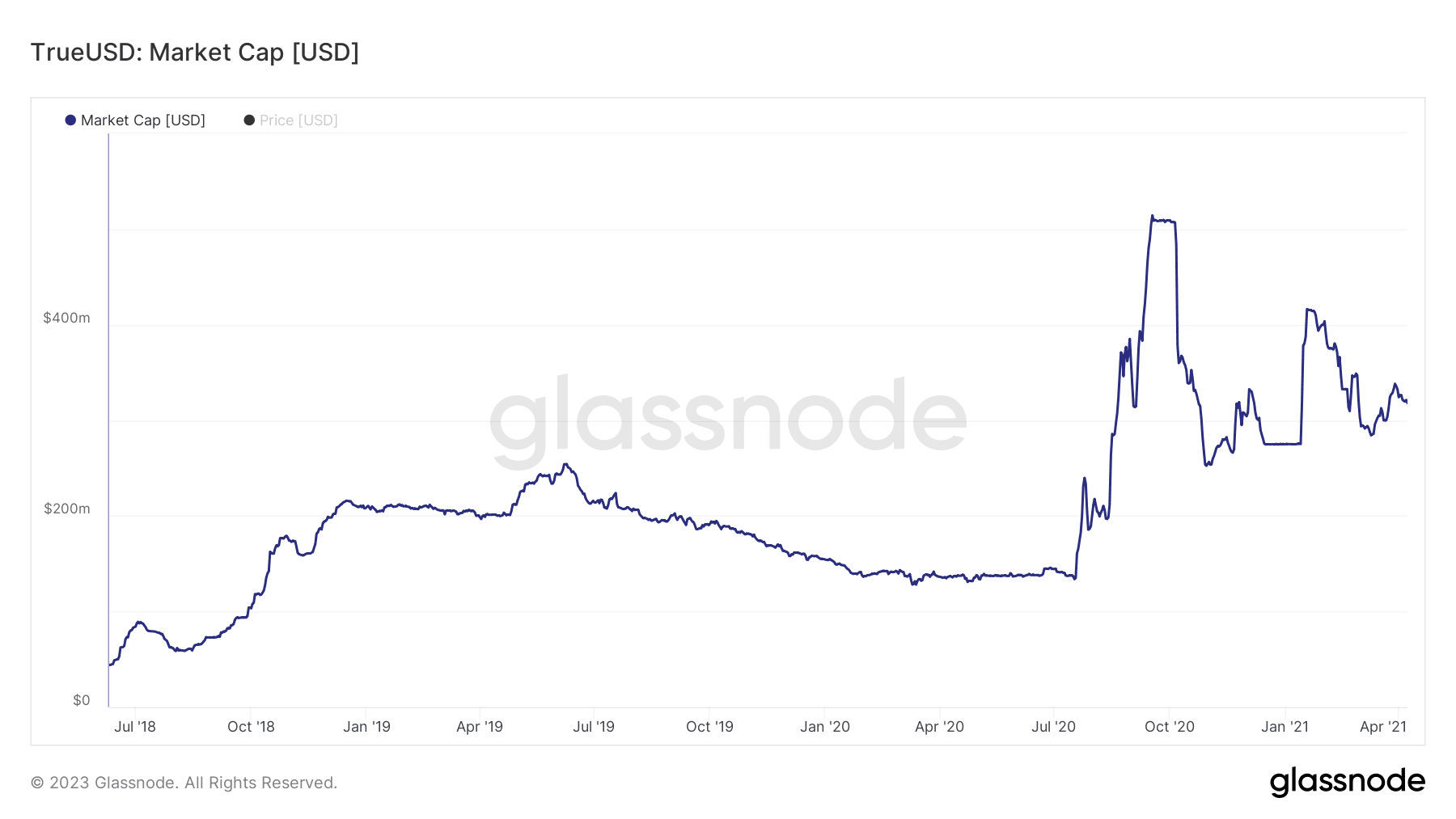
Data source: glassnode
TrustToken officially announced in December 2020 that it would transfer the ownership of TUSD to the Asian consortium Techteryx. TUSD will have financial and operational resources independent of TrustToken Inc. The TrustToken team will continue to manage the product's operations, compliance, and banking relationships. TUSD will continue to exist on the Ethereum blockchain and support the Binance blockchain, and will soon be natively introduced to Tron and other chains.
This means that at the public level, the formal handover has been completed.
Another co-founder and CTO Rafael Cosman became the CEO of TrustToken in the announcement and continued to be the CEO until the Archblock period. At the same time, TUSD's official Medium was transferred to a new account, and all articles previously published by TUSD were retained in the TrueFi account. This is why clicking on some early announcements now jumps to the TrueFi page.
It was probably from this time that the identity of the Asian consortium Techteryx and the true owner of TUSD became confusing.
After TUSD announced the change of ownership, it triggered a heated discussion in the Makerdao community about the risks of TUSD, where we got "very detailed invalid information" from the official. Techteryx is a large joint venture distributed in Hong Kong, Singapore, Guangzhou, Shenzhen and Beijing, led by Jennifer Jiang (the largest owner), who has a deep traditional industry background and has led the acquisition of more than a dozen companies...
This answer is easy to make people confused. In the process of further questioning, community members said that they could not find any information about Techteryx in the above-mentioned areas. The only information that can be found about Jennifer Jiang is that she is the CEO of a blockchain company in Boston and has published a paper on the blockchain consensus mechanism. However, the TUSD official who released the above information did not answer this question.
Interestingly, for many players, the question of who is the owner behind TUSD has become an "open secret" in the currency circle.
The reason why it is public is that although Techteryx and the people behind it are good at hiding themselves, large-scale on-chain data cannot deceive people. Observing from the current on-chain data, the answer seems to be more obvious.
1) Not only did TUSD’s use cases during the DeFi Summer period come from Tron. According to official data, TUSD’s issuance on the Tron chain was approximately $2.37 billion, accounting for approximately 76% of the total issuance, and its issuance on the Ethereum chain was approximately $730 million, accounting for approximately 23% of the total.
As of June 2023, the main circulation data shown on the TUSD official website
2) Not only that, when ZachXBT publicly accepted fundraising due to Huang Licheng’s lawsuit, only three users donated TUSD, and Justin Sun was not only the first among them, but also the user with the largest donation amount among the three.
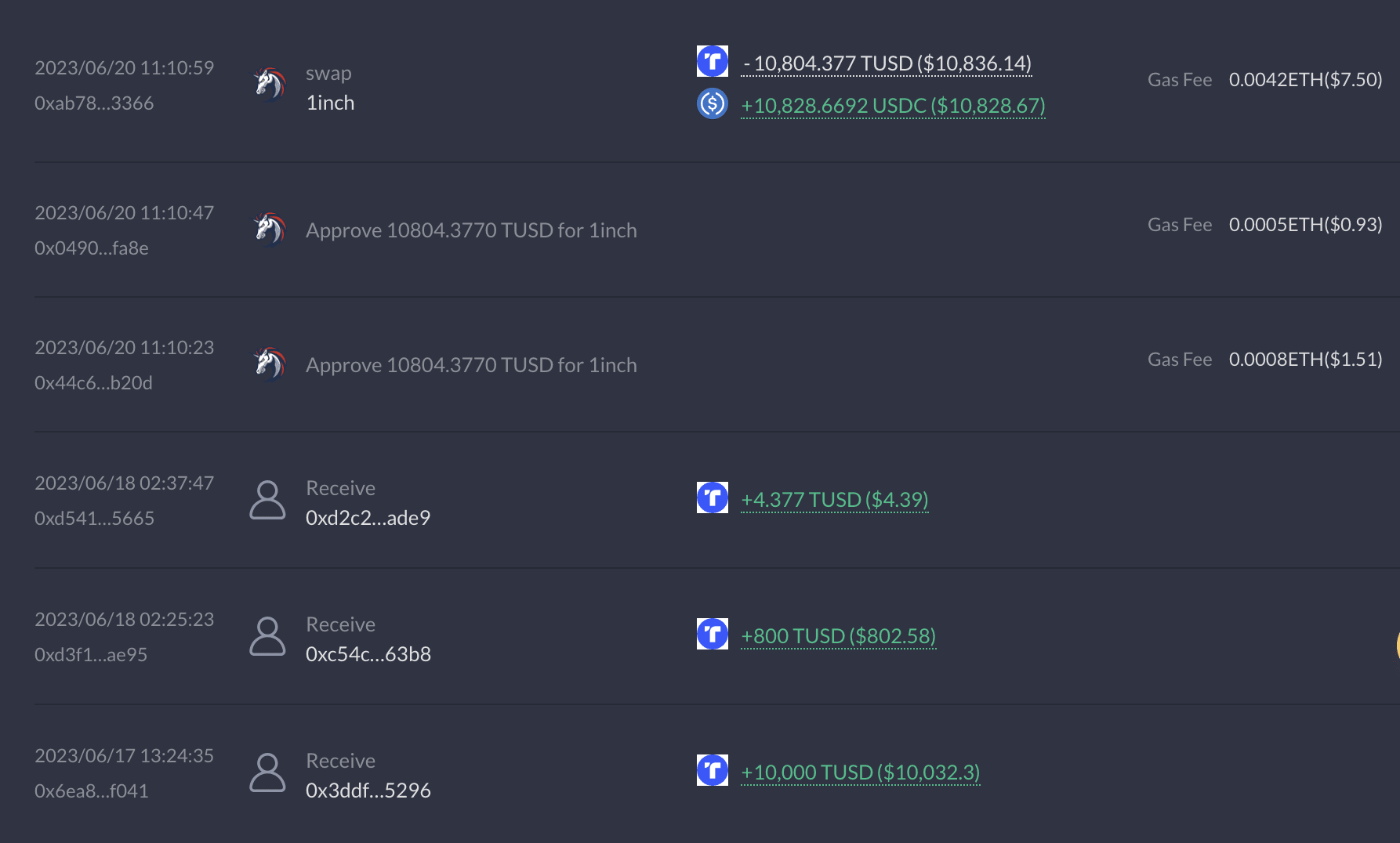
Justin Sun’s address donated 10,000 TUSD, source: DeBank
3) Combined with the fact that Justin Sun transferred more than 56 million TUSD to Binance during Binance SUI’s LaunchPool, he was warned by CZ.
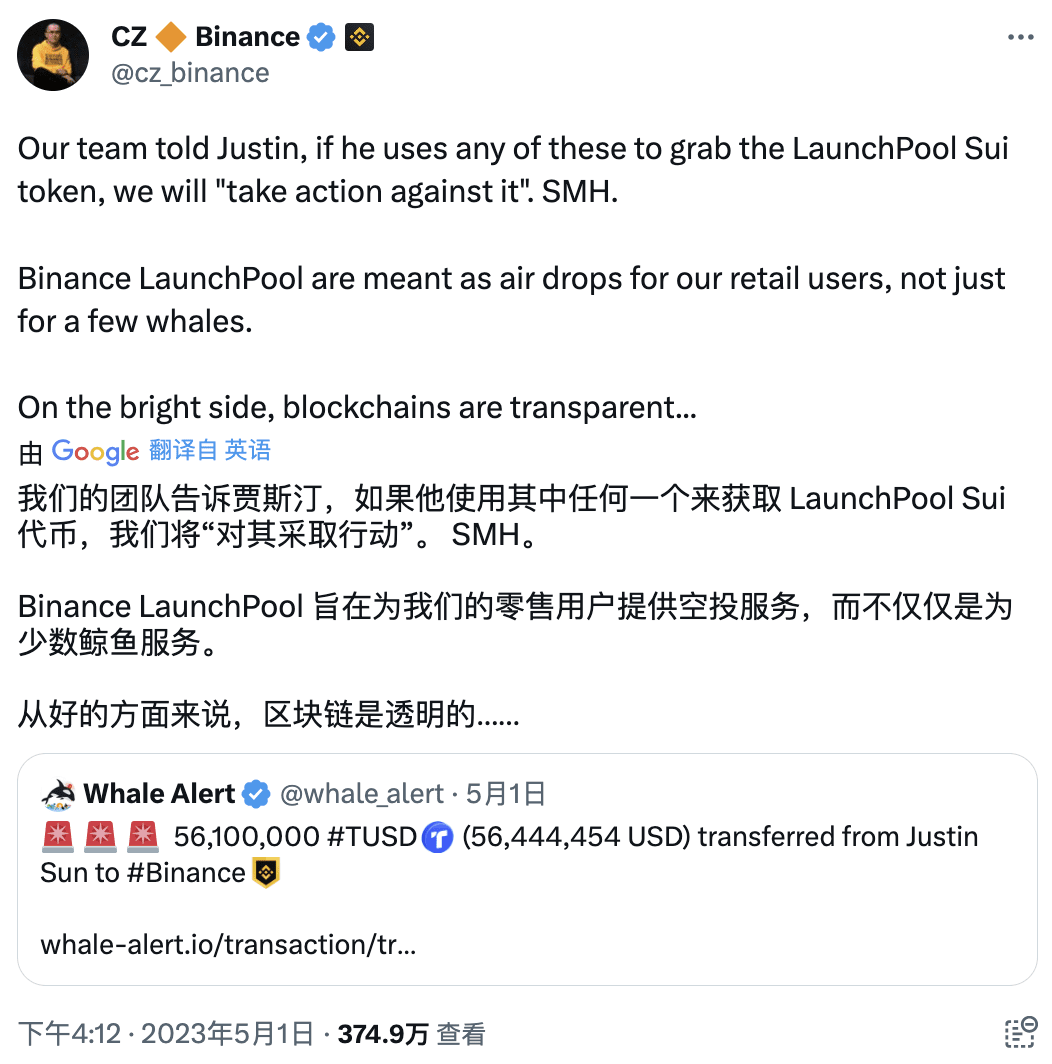
Combining the above clues, whether explicit or implicit, we seem to be able to find some answers to the question of the actual owner of TUSD. Why is this called a secret?
First of all, TUSD has always belonged to Techteryx in name, and Ms. Jennifer Jiang did not come forward in the public media to explain the matter. No Techteryx staff member has publicly stated that TUSD is related to Sun.
Not only that, Adam Cochran (@adamscochran) once summarized the actual situation of TUSD, "Justin Sun's conglomerate bought TrueUSD, but still pays management fees to the original American owner. Then it was transferred to an offshore bank, and now as the market value grows, control of the private key has also been transferred, but there is no real evidence to support it..."
Adam is like the little boy in the story of the emperor’s new clothes, saying what many people want to say. However, the subsequent development of the situation is very different from the fairy tale. He received a warning from TUSD officials:
1) TrueUSD never belonged to Justin Sun;
2) We reserve the right to seek legal remedies against you for defamation.
The official "rumor refutation" and lawyer's letter further cleared the relationship between Justin Sun and TUSD from the public and legal perspectives, making the ownership of TUSD continue to be a "secret that cannot be told."
In response to the tweet about "but they just won't admit it," Adma said that in reality, when taking over a business worth more than $1 billion, most legitimate business groups want the public to know who they are - not to hide it.
Crypto has always been the Wild West. Under the influence of various internal and external factors, it is also common for many Chinese companies to use offshore companies, "white gloves" and outsourcing companies. Just like, Justin Sun is only a consultant to Huobi now.
TUSD and TrueFi, brothers from the same origin but different species
In fact, CZ has clarified that TrueFi has nothing to do with TUSD. But by clarifying the timeline of events related to TrueFi, we can better understand the relationship between the original TUSD team, investors, and the acquirer Techteryx:
In 2018, TrustToken received a total of $20 million in investment from institutions such as a16z, BlockTower, and Jump;
In July 2020, TrustToken was suspected of having an ownership transfer transaction, and the original CEO resigned;
On November 6 of the same year, TrustToken launched the first unsecured lending protocol TrueFi, with the platform's main loan use case being TUSD;
In December, TrustToken officially announced the transfer of TUSD ownership.
In August 2021, TrustToekn announced that it had completed a US$12.5 million financing by selling TrueFi's native token TRU. Blocktower led the investment, with participation from a16z and Alameda Research.
In March 2022, TrustToken added two new senior executives, Wall Street veteran Bill Wolf and senior product manager Ryan Christensen, who served as chief investment officer and chief product officer respectively;
In September of the same year, TrustToken was renamed Archblock, and Ryan Christensen, who had joined earlier, was promoted to CEO. Former CEO Rafael Cosman served as a board member and advisor, and founded the AI company Protogon Research in 2023.
Combined with the timeline above, we can clearly see that TUSD and TrueFi have had the same origin but different attributes from the beginning. From the TrustToekn team selling TUSD ownership, to the creation of TureFi based on TUSD and raising funds to issue tokens, to the creation of a new company, and even the introduction of executives with good backgrounds for the founder's exit. A series of hidden and delicate chain operations are amazing. Without careful sorting, it is difficult to distinguish the relationship between the two parties. This is probably the reason why every TUSD issuance has caused a surge in the TrueFi token TRU.
Indifferent and ambiguous, why did Binance choose TUSD?
Binance is an early trading platform that supports TUSD. It planned to launch TUSD in May 2018 and launched trading pairs with BTC, ETH and BNB. However, perhaps due to liquidity issues, Binance eventually delayed the launch of TUSD by 4 days.
Later, in most of 2019, Binance gradually launched some TUSD trading pairs for projects with large market capitalization and good liquidity. However, Binance was still in the stage of looking for a reliable stablecoin at this time. The stablecoins launched were not only TUSD, but also USDC and PAX. Although the announcement mentioned more, TUSD was not unique among many stablecoins.
In order to fully understand the changes in the relationship between Binance and TUSD in detail, we collected the English announcements related to TUSD released by Binance.
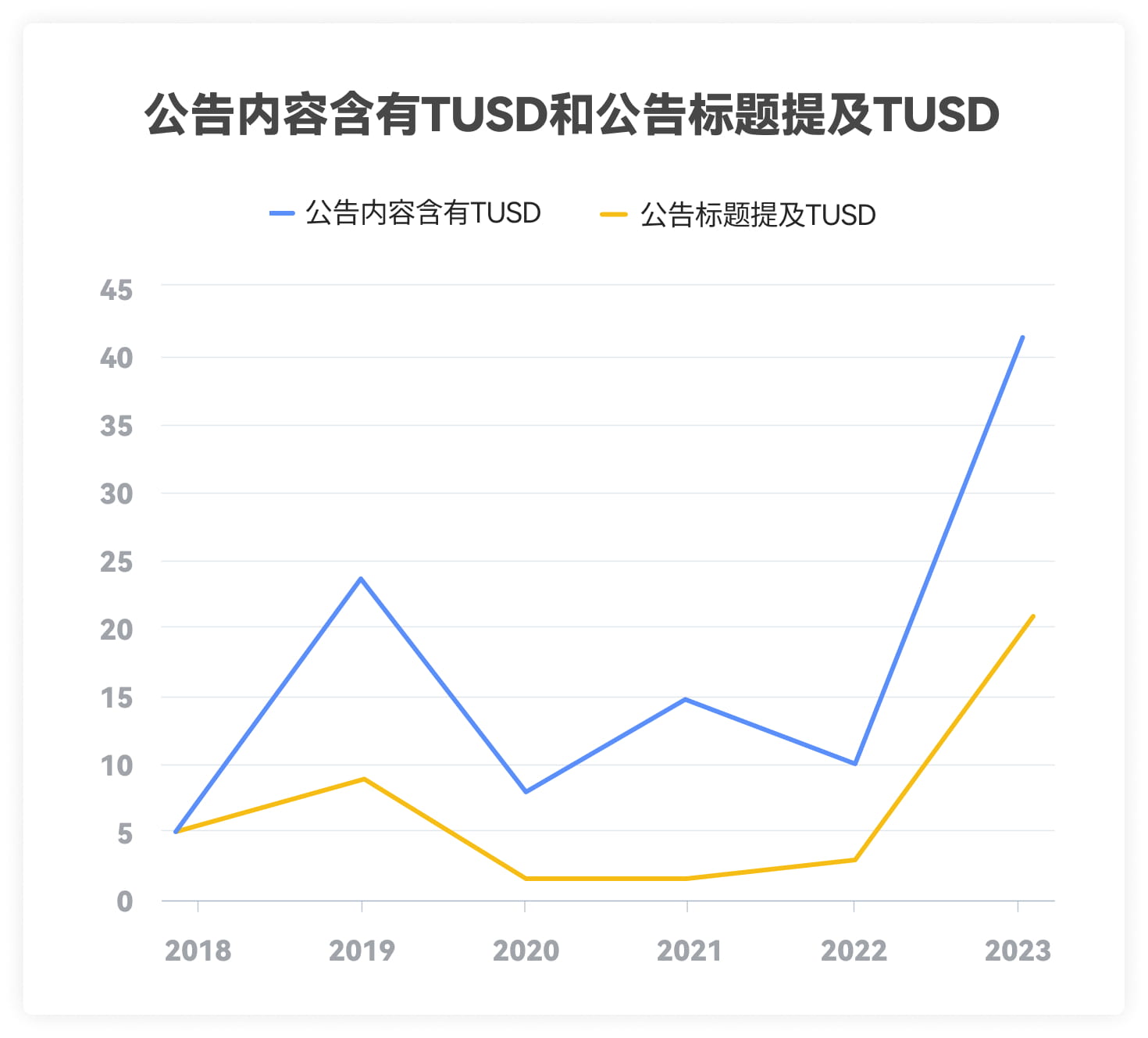
TUSD's "good days" on Binance temporarily ended in October 2019. Since then, Binance has had almost no new TUSD trading pairs. From April to October 2020, for 7 months, TUSD only had announcements of being removed from Binance trading pairs. In the following period, TUSD became the least visible stablecoin on Binance. Until 2022, Binance is still continuously removing TUSD trading pairs.
In contrast to the continuous decline of TUSD, Binance USD, or BUSD, was launched in September 2019 in cooperation between Binance and crypto financial institution Paxos Trust Co., a U.S. dollar-backed stablecoin.
Transition
The circulation of BUSD exceeded TUSD in early 2020, and in September, it surpassed PAX's USDP through BSC (now BNB Chain), and has been far ahead ever since. At its peak, Binance followed FTX's strategy and automatically converted USDC, USDP, and TUSD to BUSD, achieving the unification of compliant stablecoins on Binance. It can be said that at that time, the only centralized stablecoins that everyone knew were USDT, USDC, and BUSD.
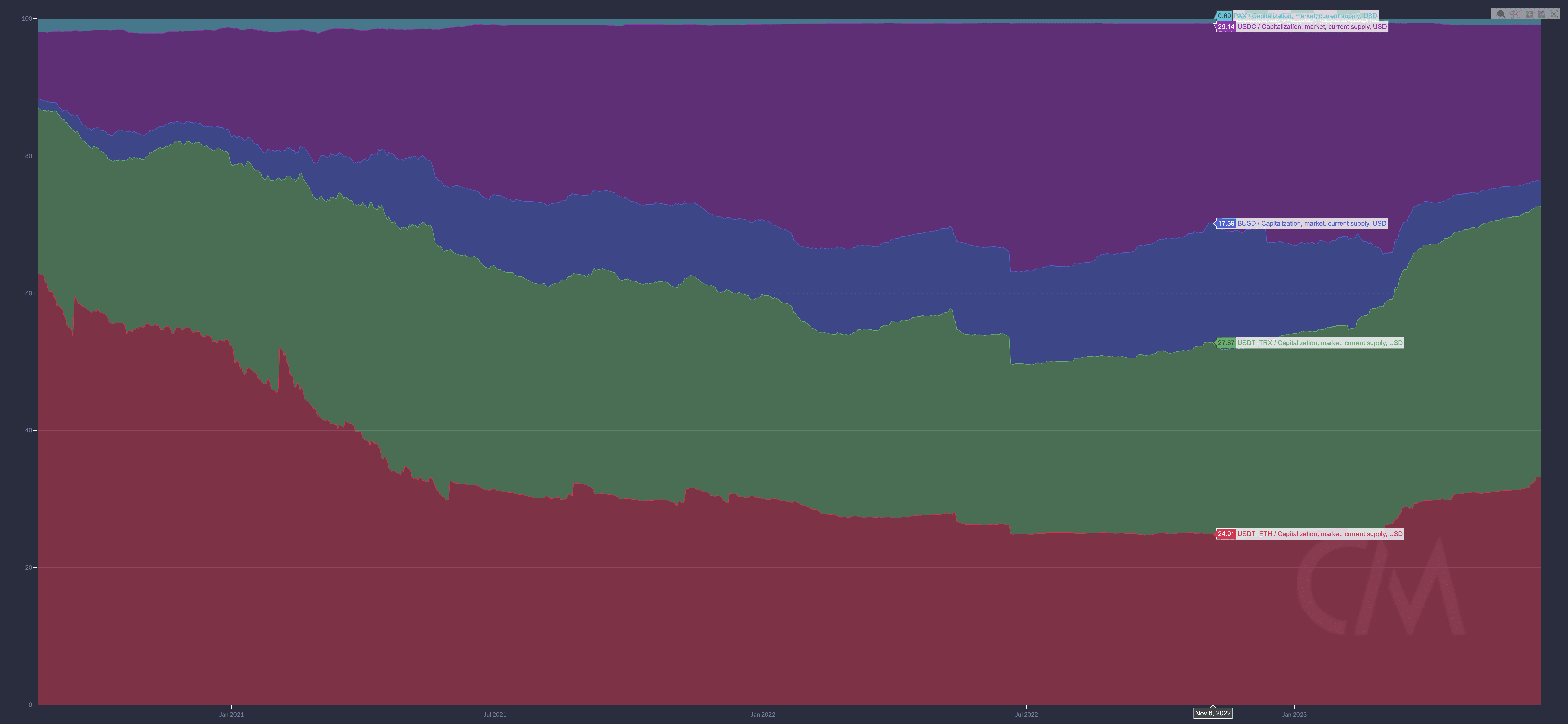
Since September 2020, the market share of BUSD (represented by blue) has increased rapidly. Data source: Coin Metrics
But on February 13, 2023, the New York State Department of Financial Services (NYDFS) ordered Paxos to stop issuing more BUSD. TUSD’s fate took a turn for the better.
NYDFS emphasized that it authorized Paxos to issue BUSD on the Ethereum blockchain, but the department has not authorized Binance-Peg BUSD on any blockchain. Paxos responded that as of February 21, Paxos will stop issuing new BUSD tokens in accordance with the instructions of NYDFS and in close cooperation with it. BUSD will continue to be fully supported by Paxos and can be redeemed until at least February 2024.
Subsequently, BUSD, which once had a market value of up to US$22 billion, gradually faded out of history.
Related reading: The four-year rise and fall of the $15 billion stablecoin empire: BUSD’s ambitions and regrets
At that time, few people thought that Binance would choose TUSD. Because at that time, the market value of USDT was 69 billion US dollars, the market value of USDC was 41 billion US dollars, and the market value of MakerDAO's DAI was 5 billion US dollars. However, the market value of TUSD was only 900 million US dollars, even less than the 1 billion US dollars of Frax Finance's native stablecoin FRAX.
However, the small issuance volume seems to be the easiest problem to solve for Binance. Since September 2019, TUSD has been "banned" by Binance. In the five months from September 2022 to March 2023, TUSD even completely disappeared from Binance's announcements. In the past five years, Binance has only issued 62 announcements for TUSD.
From March to June 2023, Binance issued 41 announcements related to TUSD in 3 months. Since then, the circulating market value of TUSD has increased by 220%.
What did Binance do after choosing TUSD?
In order to protect its own rights and interests and those of BUSD holders, Binance first chose to add stablecoin spot trading pairs on March 11, launched preferential rates and stopped the automatic conversion of stablecoins. At the same time, BNB, ETH and TUSD trading pairs were free of transaction fees. One detail in the announcement is that the window for BUSD to be automatically converted 1:1 to TUSD is nearly 2 weeks longer than that of USDC and USDP, and the closeness of the relationship is self-evident.
In addition, Binance will add TUSD trading pairs to popular trading currencies and enable isolated margin for some TUSD trading pairs. Taking RDNT, which was launched on Binance Innovation Zone on March 31, as an example, the three trading pairs are BTC, USDT and TUSD.
If the above strategy is just an appetizer, then the launch of TUSD Pool on Launchpool and the BTC/TUSD trading pair with no transaction fees can be said to be the feast that Binance has prepared for TUSD. It should be noted that the regular customers of Launchpool before were only BNB and BUSD, and since March, all Launchpools of Binance have only BNB and TUSD. This shows the status of TUSD in Binance.
On March 15, Binance announced that it would stop offering zero-fee trading for BTC in all trading pairs, and only BTC/TUSD would enjoy zero-fee trading for both maker and taker orders. This strong incentive made the BTC/TUSD trading pair surpass the BTC/USDT trading pair and become the trading pair with the largest trading volume on Binance.
TUSD’s hidden concerns
Although Binance supports TUSD like it does BUSD, the foundation of TUSD, which has been running all the way, is still slightly unstable.
When TUSD was not supported by Binance Launchpool, its exchange rate against USDT was negative for a long time. Not only that, it was often unpegged in the Curve pool, accounting for nearly 70% of the liquidity pools in 3 Pools and TUSD.
TUSD has a serious skewed share in the Curve 3 Pool/TUSD liquidity pool
TUSD has very little circulation outside of the Tron and Ethereum chains. TUSD, which had few use cases during the DeFi Summer, is now even more stretched, except for its previous use on TruFi and USDD.
Although Binance launched the TUSD zero order fee campaign, except for BTC, the trading volume of other trading pairs is dismal. Even when ETH/TUSD has free order fees, the trading volume is far less than that of the USDT trading pair. And trading platforms other than Binance are even less likely to strongly support the TUSD trading pair. OKX does not have a TUSD trading pair, and Huobi has only launched two trading pairs, USDT and USDD.
Not only are there few use cases, but TUSD's reserves of more than 3 billion U.S. dollars also seem to be a big problem in the community.
TUSD has always claimed that Chainlink provides proof of reserves for TUSD, but the data displayed by Chainlink is obtained from a company called The Network Firm, which regularly reviews TrustToken's custodial bank accounts. It is worth noting that some members of The Network Firm are from Armanino, who audited FTX in 2020 and 2021, and previously TUSD's proof of reserves was also audited by Armanino.
It is not just the reserve data that proves this aspect. Prime Trust, the custodian that holds the reserve for TUSD, is also deeply troubled by the bankruptcy crisis. On June 28, the Nevada Financial Institutions Department (FID) filed a petition with the Eighth Judicial District Court of Nevada, requesting the appointment of a receiver to take over the daily operations of the cryptocurrency custodian Prime Trust and examine all its financial conditions.
FID documents show that Prime Trust lost access to old wallets as early as 2021 and used customers' assets to buy back cryptocurrencies. Even TUSD officials have repeatedly stated through different channels that they will suspend minting through Prime Trust.
Why TUSD?
Even though there are many hidden dangers, why did Binance still choose TUSD?
Regulatory issues are an inevitable issue. By reviewing the development history of BUSD, we may be able to find some clues. Binance chose to cooperate with Paxos in September 2019. The experienced Paxos plays the role of BUSD issuing entity on Ethereum. BUSD is its ERC-20 Token issued on Ethereum, and BUSD reserves are stored in Paxos's US bank account.
But BSC (now BNB Chain) is both its success and its failure. This is also one of the reasons why BUSD was accused of regulation. Paxos issued BUSD with the authorization of NYDFS, but it was limited to Ethereum. BUSD issued on the BSC chain is a completely different matter.
Although Binance’s collaboration with Paxos is well known for BUSD, Binance announced its partnership with TrustToken as early as June of the same year. Jai An, who was CEO at the time, said that Binance users can mint and redeem TUSD seamlessly. He will work with Binance to make it easier for users to enter and exit the cryptocurrency market.
You know, in June 2019, the issuance volume of TUSD was higher than that of PAX. Although I don’t know why Binance finally chose Paxos, it can be said that the fate of Binance and TUSD started from then. Not to mention that TUSD now has "Asian origin", which seems to be very consistent with Binance.
As for Binance, which now sits firmly in the top position in the industry, it did not choose to enter the market in a high-profile manner because of the previous experience of BUSD.
Although there were joint challenges from USDC and BUSD supported by Binance, the past is like a passing cloud, and USDT continues to maintain its dominant position in the field of centralized stablecoins. Multi-dimensional data such as liquidity, trading volume and trading pairs all show a crushing attitude. The parent company Tether's net profit in the first quarter of 2023 alone was US$1.48 billion.
USDT, which is sitting firmly on the Diaoyutai, not only does not need support. It has also been fined by regulators many times due to its opaque reserves, which has always been criticized. USDT, which has been plagued by regulation, has previously been unable to automatically exchange 1:1 with compliant stablecoins on many trading platforms.
Thanks to FTX and DeFi, USDC (Circle) has achieved full development in the last bull market. Not only has it firmly established itself as the second largest stablecoin, it has also received a total of US$400 million in financing from traditional US financial giants such as BlackRock and Fidelity in 2021. However, whether it is its close relationship with FTX as a minority shareholder, or the rumor that Circle reported to NYDFS in 2022 that "Binance reserves are insufficient to support assets such as BUSD", as reported by Bloomberg, coupled with the fact that Binance US has been hindered in its development in the United States, Binance may have concerns about the large-scale adoption of USDC.
On the other hand, TUSD is unique among the existing options, whether in terms of its "Asian origin", long history, compliance and infrastructure construction. In addition, the relationship between Binance and Tron is not as bad as many people imagine. Not only did Tron conduct an ICO on Bianance. In 2019, after experiencing regulation, Binance restarted Launchpad and ignited the market with a strong money-making effect. Since the announcement of the restart of Launchpad, the price of BNB has risen from US$6 to nearly US$40 that year, an increase of more than 500%. At that time, the first project of Launchpad was BitTorrent, which was acquired by Tron founder Justin Sun in 2018.
Importantly, under heavy regulatory pressure, Binance is likely to need a trustworthy and "stable" stablecoin partner from a reasonable and legal third-party perspective.
References:
TUSD Official Website
A16z Leads Investors in $ 20 Million Token Presale for Crypto Assets Platform
Scaling Trust: Announcing TUSD』s Next Stage of Growth
Crypto stablecoin TrustToken receives $12.5 million in financing
What is TrueUSD (TUSD)? Overview FAQ
TrustToken Partners with Binance to Enable Easier Access to Stablecoins
TrueUSD Integrates with Signature Bank』s Blockchain-based Payments Platform, Signet
TrustToken Rebrands as Archblock, to Modernize Global Financial Infrastructure Under New Leadership
TUSD is undergoing a material change to its ownership structure. Is there a process for reducing exposure in the event of a material change?
What』s up with TrueUSD and the rest of TrustToken』s stablecoins?
In-depth investigation | How did Tron become a marketing-oriented public chain?