

Just now, Maverick tokens were officially listed on Binance for trading. Three days ago, Alvin, the co-founder of the project, shared with Foresight News the story of his journey from the team to the start-up, from the track to the project itself, and how it became the first project of Founders Fund to return to Web3 investment and won the favor of a number of leading institutions.
Edited by: Babywhale, Foresight News
Recently, Founders Fund, Binance Labs, Coinbase Ventures and other well-known institutions have invested $9 million in Maverick Protocol, which has attracted the attention of the market. Foresight News also invited Maverick co-founder Alvin to be a guest in the "Dialogue with Founders" series of Twitter Spaces last weekend to unveil the mystery of the project. Before Binance officially launches Maverick token trading, let's review the characteristics of the project and the story behind it.
This article excerpts the more important information from this Twitter Spaces. Readers who want to know the full content can go to https://twitter.com/Foresight_News/status/1672935225452818435 to listen to the recording.
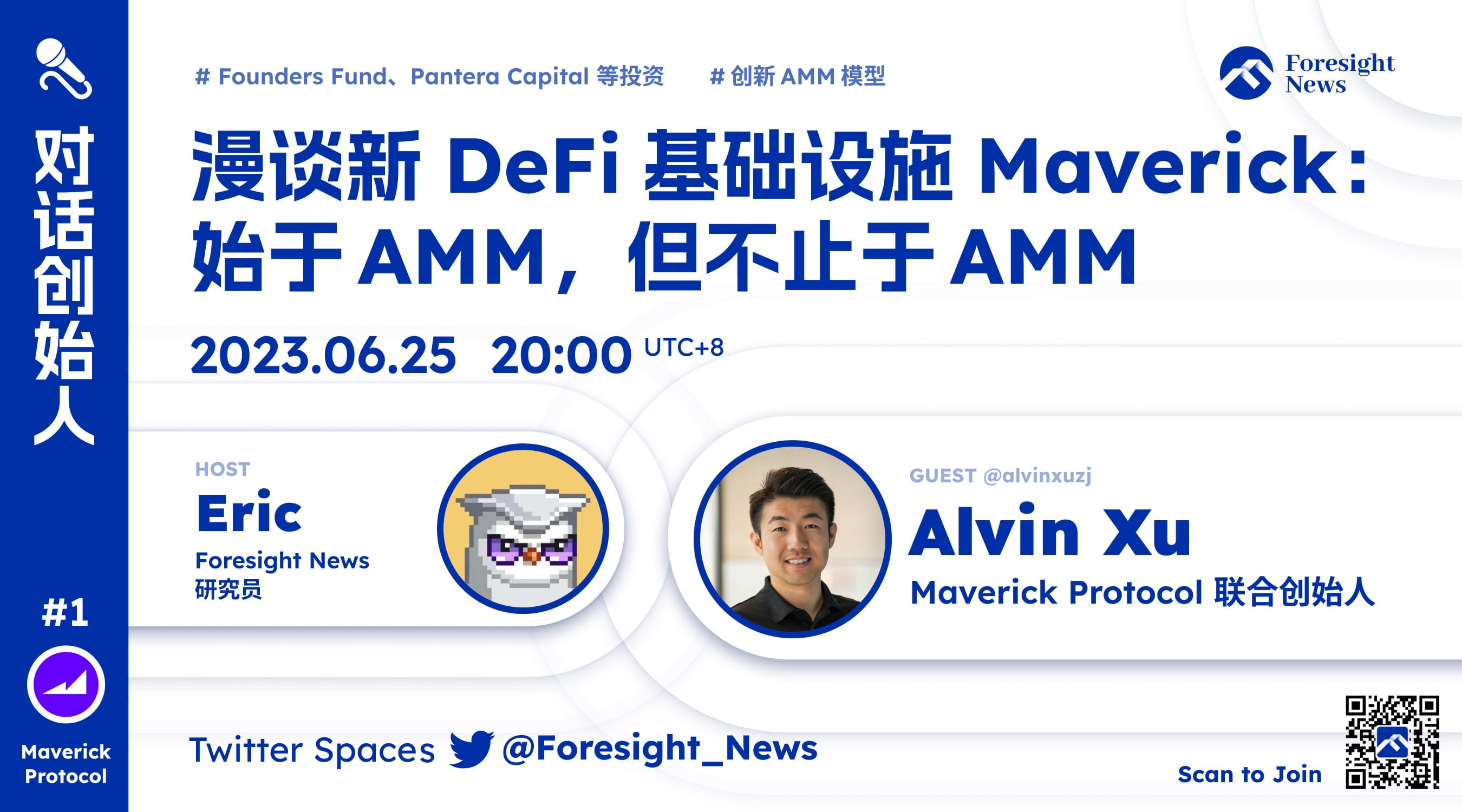
Host: Welcome to the Foresight News Dialogue with Founders series. Today, our guest is Alvin, the co-founder of Maverick. Let Alvin talk to us about how Maverick attracted the attention of investors, especially Founders Fund, in the bear market and the story behind the establishment of the Maverick project. First, let Alvin briefly introduce himself and then introduce the team.
Alvin: Let me quickly introduce myself. I entered the blockchain industry in 2018 and was responsible for TRON's overseas ecosystem. Since then, I have worked on many products, including DEX products and aggregator products. Before founding Maverick, I was the person in charge of the Swap product in the MetaMask wallet. At that time, MetaMask's Swap had a daily transaction volume of 100 million US dollars and a net profit of about 1 million US dollars.
This is some background. The team also has a co-founder who is the CTO in charge of technology. His name is Baxley. He is responsible for the logic construction behind the entire project and leads the team to do research and development. His background is a PhD from Georgia Tech. Our team has 4 PhDs or postdocs from Georgia Tech, Cambridge, etc. It is a more research-oriented team.
Maverick has innovated on the AMM underlying DEX, and the research and development of the underlying technology took 14 months. Currently, Maverick's TVL is only tens of millions of dollars, but its actual trading volume often ranks among the top three on Ethereum.
Moderator: Let's talk about the project itself. I believe everyone's focus should be similar to mine. The two main questions are: What are the innovations of Maverick on AMM? The second is what is the economic model of the project?
Alvin: In terms of technology, everyone knows that the AMM model used by Uniswap is a simple model of xy=k. The biggest problem with such a model is that the capital utilization rate is extremely low, because the funds are evenly distributed throughout the range, and the liquidity that can be truly utilized is very small, and the returns are also very low. Although the subsequent v3 has centralized liquidity, the liquidity itself is "dead". Once the price deviates from the liquidity range, this part of the liquidity is actually invalid.
Maverick’s idea is that since it is difficult to manually gather liquidity at any price, it helps users put liquidity near the current transaction price and move it with the transaction price. This ensures that liquidity will be better utilized at any price. The significance of this for LP is that the utilization rate of liquidity is increased.
We originally planned to launch it last summer, but later we found that the higher your capital utilization rate, the greater your responsibility, because the slippage, uncompensated losses or paid losses that may occur are higher. So we created four modes based on this, which allow LPs to choose whether your liquidity only goes in the direction of high prices, or only goes in the direction of low prices, or both. The fourth mode is similar to the liquidity addition method of Uniswap v3.
Then we also found in actual practice that the situation where both sides can move is actually very friendly to retail investors. Because you don’t have to worry too much about it, after putting it in, it will come back and follow the price fluctuations. It is more suitable for stablecoins or quasi-stablecoins, such as the stETH/ETH trading pair, which is relatively stable and has an annual growth of 4%~5%, but it is not suitable for Ethereum or longer-tail assets, because its price changes too quickly, and there is a risk of loss for LPs.
For detailed information about Maverick’s liquidity addition mechanism, please refer to "Dialogue with Maverick: Two years of accumulation brings more than just DEX".
Moderator: In addition to cooperating with issuers such as LUSD and stETH, what other projects does Maverick cooperate with? What kind of communication do you have with these project parties? Why did they choose Maverick?
Alvin: I think it can be divided into the following categories: one is the liquidity staking track, one is the stablecoin track, then there is the aggregator track, and of course the last one is some ecological track, a total of four aspects of cooperation.
Then the liquidity staking is equivalent to one of our main tracks in the early days and up to now, because we think that projects like Uniswap and Curve have obvious first-mover advantages. If a new underlying technology wants to shake up their market or compete with them, it must have a track where it can gain a foothold and then expand horizontally.
This track is the liquidity pledge track. We are doing pretty well. Although the TVL of the stETH/ETH trading pair is not very high, it may be more than 10 million US dollars, but our trading volume is basically the first in the entire network, because the capital utilization rate is particularly high. Then the partners include Lido, Frax, Swell, and Coinbase's cbETH. Although Coinbase does not actually incentivize liquidity, it also has certain support in the ecosystem. In addition, Rocket Pool also has cooperation, and some newer liquidity pledge projects are also cooperating. This area is still quite well-developed.
The next track is stablecoins, and our partners include Liquity, Frax, etc. In addition, we have different levels of cooperation with Circle, the issuer of USDC, as our investor and MakerDAO (DAI). In the aggregator field, we have a lot of in-depth cooperation, because we are relatively new and it is difficult to find a good way to promote users to directly use our protocol for transactions.
Our trading is not particularly easy to use now, because it is not our top priority. So before the launch of Binance Launchpool, 90%-99% of the trading volume was achieved through aggregators, including 1inch, ParaSwap, CowSwap, OpenOcean, etc. If your transaction price is better and the gas fee is lower, you can get more transactions on the aggregator. So this is one of our early strategies, which is why we can get these trading volumes. If more people use our UI to trade later, the trading volume should be even higher.
Because there are many institutions that provide liquidity on Ethereum, including some European hedge funds, which can help some projects or family offices manage part of the funds and earn a relatively stable income. They have done more on Uniswap v3 before, and now they may continue to expand their TVL and business on Maverick.
Then launching zkSync can make up for the shortcomings of our users, because the gas fee of the transaction is much lower than that of the main network. In addition, zkSync is also the main battlefield of LST. For example, Lido and Rocket Pool will expand to zkSync, so Maverick also chose zkSync as the first network to be launched after the Ethereum mainnet.
In terms of projects, the liquidity protocol Tokemak has also integrated Maverick. In addition to Maverick, the liquidity protocols it integrates now include Uniswap and Balancer. In fact, Tokemak suffered serious losses during the bear market, mainly because the losses from providing liquidity on Uniswap were too high, so it has always been interested in Maverick. Finally, we have also recently cooperated with LayerZero, and may expand cross-chain liquidity in the future.
Host: As the first project of Founders Fund's return to Web3 investment, what kind of communication did Maverick have with Founders Fund?
Alvin: The Founders Fund was also a coincidence, and then I felt that they were actually a bit like the larger capitals such as a16z, Sequoia or Tiger Fund in the previous round. When the cryptocurrency circle was at a low point, they still wanted to enter some projects to invest at a relatively low valuation.
So after talking to each other, they first recognized the underlying technology of Maverick, and then they would invest more in infrastructure. They believed that DeFi is a confirmed track, and the underlying technology of AMM is still relatively early. Their original words were that we would give resources to Maverick so that Maverick could have the ability to shake the position of Uniswap. So I believe that they are very serious about entering the cryptocurrency circle to invest, rather than just investing casually. Secondly, they also value DeFi very much. If there are entrepreneurs here, it would be best if they have a slightly later project, and then they can communicate with Funders Fund to see what kind of support they have.
Host: The last question is, how does Alvin view the future of DeFi? What plans does Maverick have for the future? What new possibilities can it bring to DeFi?
Alvin: I would like to talk about my personal understanding first. The essence of DeFi is to eliminate the need for middlemen, so that users can become market makers to earn profits. Because digital assets do not have opening and closing times, they are traded 24 hours a day, and it is difficult to make markets manually. Therefore, there needs to be an automated market-making mechanism on the chain to ensure that transactions are supported at all times. This is AMM, and AMM technology also allows LP to replace centralized market makers to provide liquidity and earn relatively high returns. I think this is the essence.
I hope that DeFi can cooperate with each other, for example, build on each other, instead of everyone making their own system, which is very fragmented, and it is difficult for everyone to compete with Western finance together. So I am more in favor of DeFi. Everyone has some original things, and then continue to cooperate, and then form a very large system on this basis, whether it is the amount of funds or the efficiency, so that it can compete with the real traditional financial market.
As for the roadmap after Maverick, from the perspective of technical development, the new AMM can better drive some products, such as leveraged trading and perpetual contract trading. One of the pain points of perpetual contracts is that the capital utilization rate of AMM is too low. When users trade on it, there is no leverage, even normal transactions have certain slippage. If there is 10x or 25x leverage, it is basically impossible to trade.
The significance of Maverick is that when conducting perpetual contracts or leveraged transactions, the trader is the LP and the counterparty. If the traders are both shorting and long, then the LP's loss will be very high, so the LP must also have a direction. Therefore, Maverick's AMM is very meaningful for perpetual contracts and leveraged transactions. We are also actively cooperating and connecting with some projects to become their underlying AMM.
Audience: Hello, I would like to ask what kind of security mechanism does Maverick have? Are there some better mechanisms to prevent security issues such as hacker attacks?
Alvin: First, some members of the core team have a background in Internet security. Their company previously raised $50 million to help giants such as Amazon with security protection. So with such a background, we think that whether it is writing code, architecture, or building the entire system, there will be a lot of reference and help.
Second, we conducted 7 audits, 5 of which were external audits, and we also found relatively good audits. In addition, we also had internal audits and an audit by a trading company.
Third, we also have some mechanisms to prevent such external malicious attacks. For example, if asset prices fluctuate drastically in a short period of time, the user's liquidity may move back and forth in a short period of time, resulting in large losses. Therefore, the protocol will automatically lock liquidity when certain parameters are met, and then guide users to withdraw assets.