

Author: MooMs, Crypto KOL
Compiled by: Felix, PANews
Currently, over 97% of derivatives trading volume is executed on CEX. Derivatives DEX only accounts for 2.72% of the total trading volume, so there is huge room for growth for derivatives DEX, which may dominate the next bull market. This article is about the derivatives DEX track.
Head Project
Comparison of Fee Structures
Indicator comparison
Growth Potential
The most promising derivatives DEX
 Head Project GMX
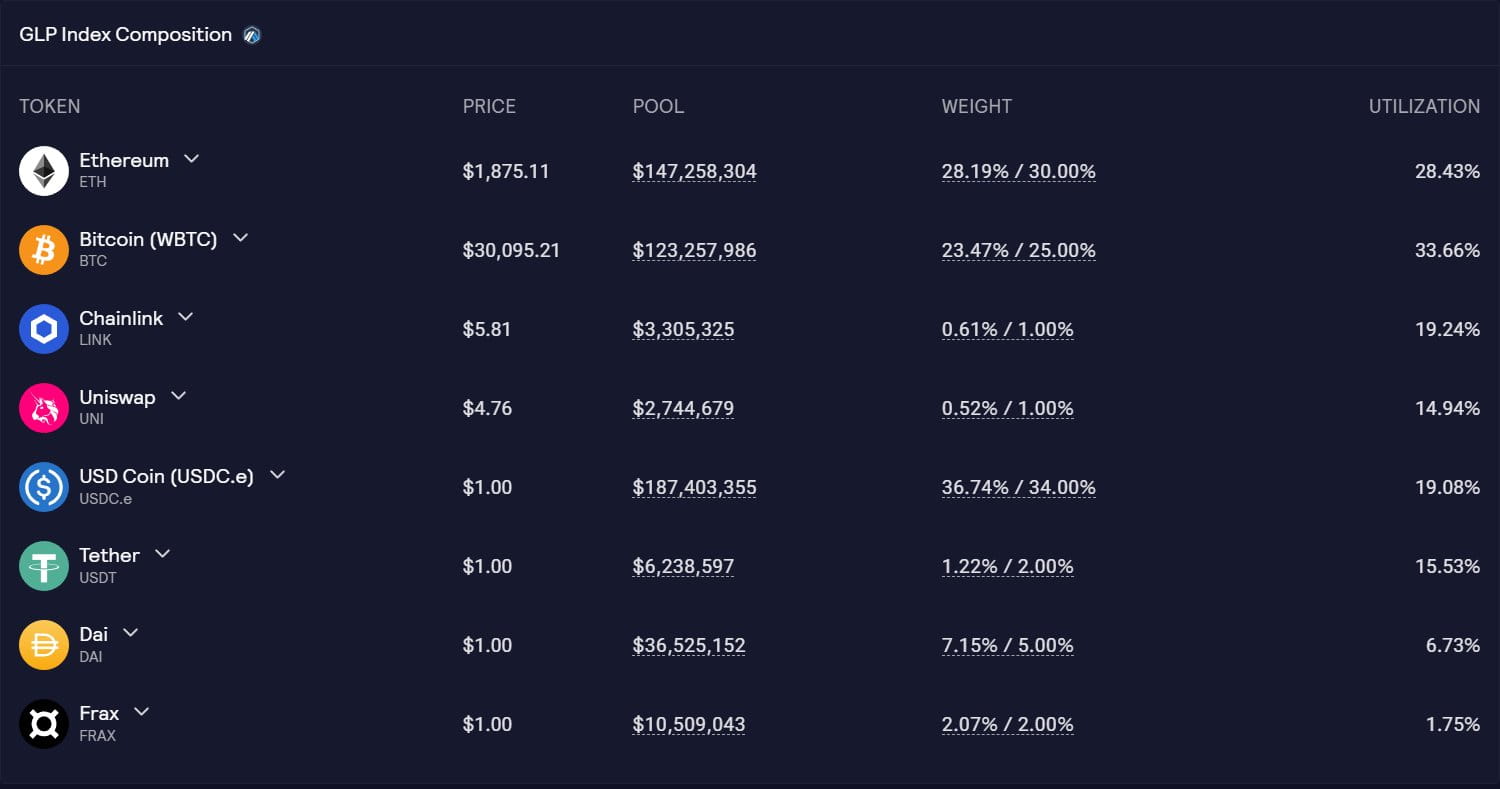
GMX allows users to trade GLP pools, providing spot and margin trading with zero slippage. GLP is GMX's capital pool, including BTC, ETH, UNI, LINK and 4 stablecoins. The great advantage of this model is its composability; some protocols are beginning to create investment products that use GLP and its returns to generate additional returns.

Online assets
Cryptocurrency: Up to 50x leverage
Token Economics
Supply: 8,813,076
XVIX and Gambit Migration: 45.3% (Note: GMX’s anonymous team has developed two other protocols, XVIX and Gambit)
Floor Price Fund: 15.1%
Reserves: 15.1%
Liquidity: 15.1%:
Pre-sale round: 7.6%
Marketing and partnerships: 1.9%

Although the platform only offered four currency pairs, the launch of GMX V2 introduced synthetic markets, offering a variety of new currency pairs, including stocks and forex. In addition, segregated pools and lower fees were introduced to provide a better trading user experience.
Gains Network
Gains provides a trading platform with multiple asset classes and high leverage. The platform utilizes gDAI vaults as counterparties, where the amount of DAI is constantly changing.
When traders win, they receive their winnings from the treasury.
When traders lose money, their losses are deposited into the vault.
Similar to GMX, Gains’ model is highly composable, allowing other protocols to integrate gDAI and build products on top of it.

Online assets
Cryptocurrency: Up to 150x leverage
Commodities: Up to 150x/250x leverage
Forex: Up to 1000x leverage
Token Economics
Total supply: 100 million
Initial supply: 38.5 million
Developers: 5%
Governance: 5%
Circulation: 90%
No seed rounds, no venture capital, no token lock-ups.
dYdX
dYdX is the first derivatives trading platform to offer leveraged trading (up to 20x) on 36 crypto pairs. dYdX is the only platform to use off-chain order books, which improves liquidity depth at the expense of decentralization. However, the team is working hard to release v4 as soon as possible. dYdX v4 will be released on Cosmos and aims to make the protocol fully decentralized. The new version will also introduce a highly anticipated feature: revenue sharing. DYDX stakers will earn a percentage of the platform's revenue.
Token Economics
Total supply: 1 billion
Investors: 27.7%
Trading Rewards: 20.2%
Employees and consultants: 15.3%
Airdrop: 5%
Liquidity provider rewards: 7.5%
Future employees: 7.0%
Finance: 16.2%
Liquidity staking pool: 0.6%
Security staking pool: 0.5%
Related reading: dYdX vs. GMX: Who can lead the next bull market derivatives DEX narrative?
 Account
Kwenta is a decentralized derivatives trading platform that provides perpetual futures and options trading on Optimism. Currently, the platform offers more than 42 pairs of cryptocurrencies, forex, and commodities with up to 50x leverage.
Kwenta has established a partnership with Synthetix, which provides the underlying protocol for managing liquidity and directly providing Perps. This partnership allows Kwenta to focus on user experience and interface design while Synthetix focuses on liquidity mechanisms.
Similar to dYdX and GMX, Synthetix will release a new version of the platform in September. The new version has been in development for more than a year and will provide features such as permissionless markets, full margin mode, and multi-collateral staking.
Token Economics
Total supply: 1 million
Synthetix stakers: 30%
Synthetix + early Kwenta traders: 5%
Investment: 5%
Community Development Fund: 25%
Core Contributors: 15%
Treasury Account:20%
 Level Finance
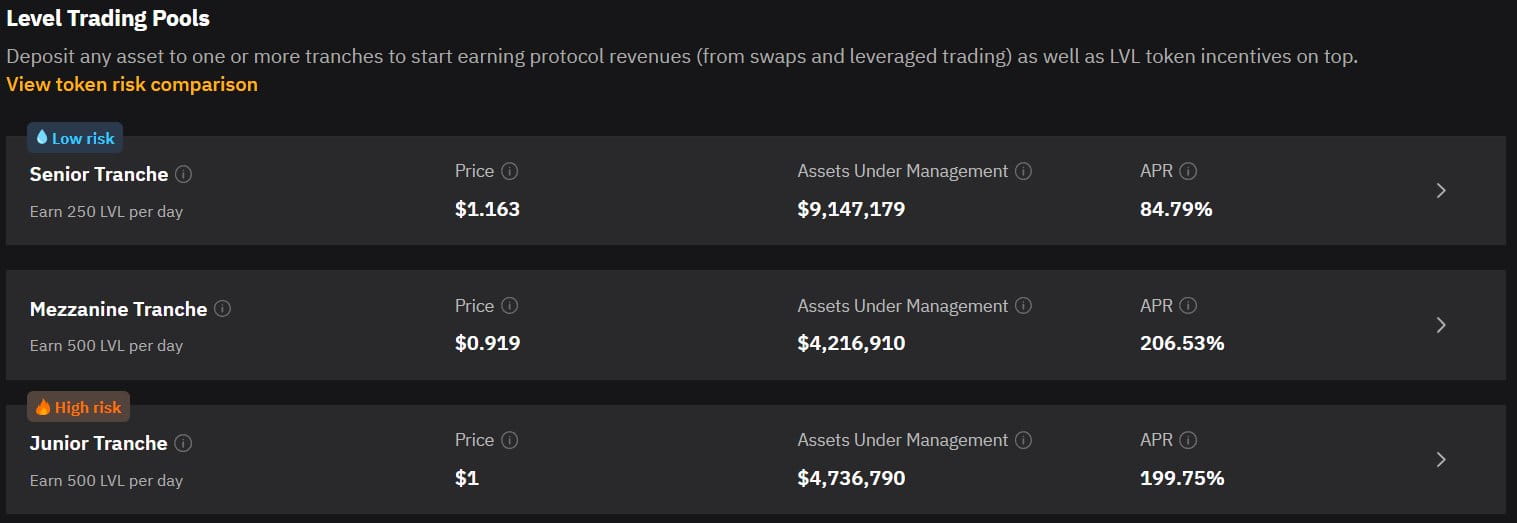
Level was launched in December 2022 and offers spot and leveraged trading (up to 50x) for BTC, ETH, and BNB. The reason Level has gained huge attention is its "loyalty program", which rewards traders with 16,000 LVL per day. A lot of trading volume and fees come from this program, and through a three-tier model, users can earn an annual interest rate of 85% to 206% on their assets. Miners can choose whether to deposit their assets in a lower-risk pool and earn less annual interest, and vice versa.
Token Economics
Total supply: 50 million
Liquidity providers: 36%
Community incentives: 34%
Team: 20%
DAO::10%
 MUX Protocol
MUX Protocol is a perpetual DEX deployed on five chains, providing traders with deep liquidity and up to 100x leverage.
The two main features are:
• Leveraged trading: Users trade with MUXLP, which is the same model used by GMX and GLP pools.
• Aggregator: Select the most appropriate liquidity path to minimize and compare the transaction prices and liquidity depth of each Perp DEX.
Token Economics
The protocol involves four tokens:
MCB: The main token of the protocol
MUX: non-transferable tokens, obtained by staking veMUX or MUXLP
veMUX: Governance Token
MUXLP “Liquidity Provider Token
Now that we’ve discussed the six major protocols and their key features, let’s explore the current landscape of the derivatives industry.
Comparison of Fee Structures

Trading fees (opening/closing positions): dYdX has the lowest trading fees, ranging from 0 to 0.05% (based on trading volume); MUX is second at 0.08%; GMX and Level are both 0.1%.
Funding rate: dYdX is 0.01% every 8 hours; GMX and Level have a maximum of 0.01% per hour; GNS, Kwenta, and MUX are all dynamic.
Indicator comparison
Currently, dYdX offers the best trading platform with the highest liquidity and lowest trading fees, and currently holds 64.4% of the market share among the top 6 DEXs. However, dYdX's model does not allow them to list synthetic products like other protocols, so its competitors can use this to take market share.
As mentioned earlier, dYdX is working towards launching a fully decentralized platform with a revenue sharing mechanism, so more users are expected to support it in the coming months.
On the other hand, GMX currently charges the highest fees, but they are working on that. However, it is interesting to note that GMX has about one fifth of the volume of dYdX, but generates about 2x the fees.
A similar situation also occurs on Level and GNS. The transaction volume of Level and GNS is the same, but the fees generated by Level are about twice that of GNS.
 Growth Potential
According to the indicators, Level Finance is the most undervalued platform. In addition, Level Finance has the best token economics, and the LVL + LGO dynamics are indeed very strong.
GMX can also be considered undervalued as it is the third-ranked protocol in all of DeFi (not considering public chains) by generation fees (YTD) and only ranked 79th by market cap.
MUX has the best TVL/Volume ratio, which indicates high capital efficiency.
GNS and Kwenta are excellent choices for the next bull run as they generate high income and have low to mid-market market capitalizations.
Finally, dYdX is the safest choice because it is the leader in the field, backed by top capital, and its upcoming new version should incentivize users to hold the DYDX token.
The most promising derivatives DEX
Listed below are the top DEXs that are expected to enter the market in the coming months and are likely to capture a larger market share in the future.
Lexer Markets
El Dorado Exchange
Tribe3
nftperp.xyz
NEX_Protocol