


Investing Wisdom And Life Lessons From Blackstone Billionaire Steve Schwarzman
Original author: Sergei Klebnikov
Original source: Forbes
The 77-year-old founder and CEO of Blackstone Group grew up in the suburbs of Philadelphia. At the age of ten, he helped work at his father's curtain and bedding store, tending the counter. At the age of 14, he opened his own lawn mowing business, focusing on attracting new customers while his twin brother mowed the lawn. He showed his desire for success early on.
In his book What It Takes (Avid Reader Press: 2019), Schwarzman recalls begging his father to expand their fabric store nationwide (“We could be like Sears”), if only in Pennsylvania. But his father refused: “I’m very happy already. We have a nice house, two cars, and enough money for you and your brother to go to college. What else do I need?”
Mr. Schwarzman, who attended Yale University, made up for his father’s lack of ambition by founding Blackstone in 1985 with the late Pete Petersen, and turning it into the world’s largest alternative asset manager, with more than $1 trillion under management.
Schwarzman is worth $39 billion, according to Forbes estimates. And his company has spawned several other billionaires, including current president Jonathan Gray, who is worth $7.6 billion. Blackstone started out as a traditional "buy, borrow, sell" leveraged buyout business, but has now evolved into a company that focuses more on buying and growing companies, including using innovative financing techniques, extending the maturity of funds indefinitely, and making the original "club" private equity industry more suitable for ordinary retail investors to participate. Real estate is a major business of Blackstone. Currently, the group's commercial real estate portfolio is worth $300 billion, including more than 12,000 properties. In addition, Blackstone is the largest owner of warehouses and logistics facilities in Europe.
The following is Forbes’ exclusive interview with Stephen Schwarzman.
Forbes: How did you get started in the investment business?
Stephen Schwarzman:
I started out in private equity, representing companies that were just starting out. There were probably only eight or ten companies in the private equity space at the time. I was running the mergers and acquisitions team at Lehman Brothers, advising on private equity deals. I was there for a total of 13 years, eventually becoming a managing director. The people who were doing this small, nascent field of private equity (Editor’s note: it was called leveraged buyouts at the time) were my peers, so I knew them well. People didn’t want to represent them at the time because they were doing very small deals and the whole concept was new. So it was a natural thing for me to do because I knew these people. Later, because I was advising them, I saw how such deals were structured—that’s how I got started. Then in 1982, I wanted to get Lehman Brothers involved in this business because I thought that as one of the largest investment firms in the world, Lehman could raise more money by doing this. However, the executive committee of Lehman Brothers refused to enter this business, which I think was a costly decision for them.
Forbes: How has your investing strategy changed over the course of your career?
Stephen Schwarzman:
You know, the world has changed dramatically since the firm was founded in 1985. Private equity is now not only very common, but also segmented into different sub-asset classes. Firms like ours were pioneers in private equity's move into other alternative asset classes such as real estate, hedge funds and credit.
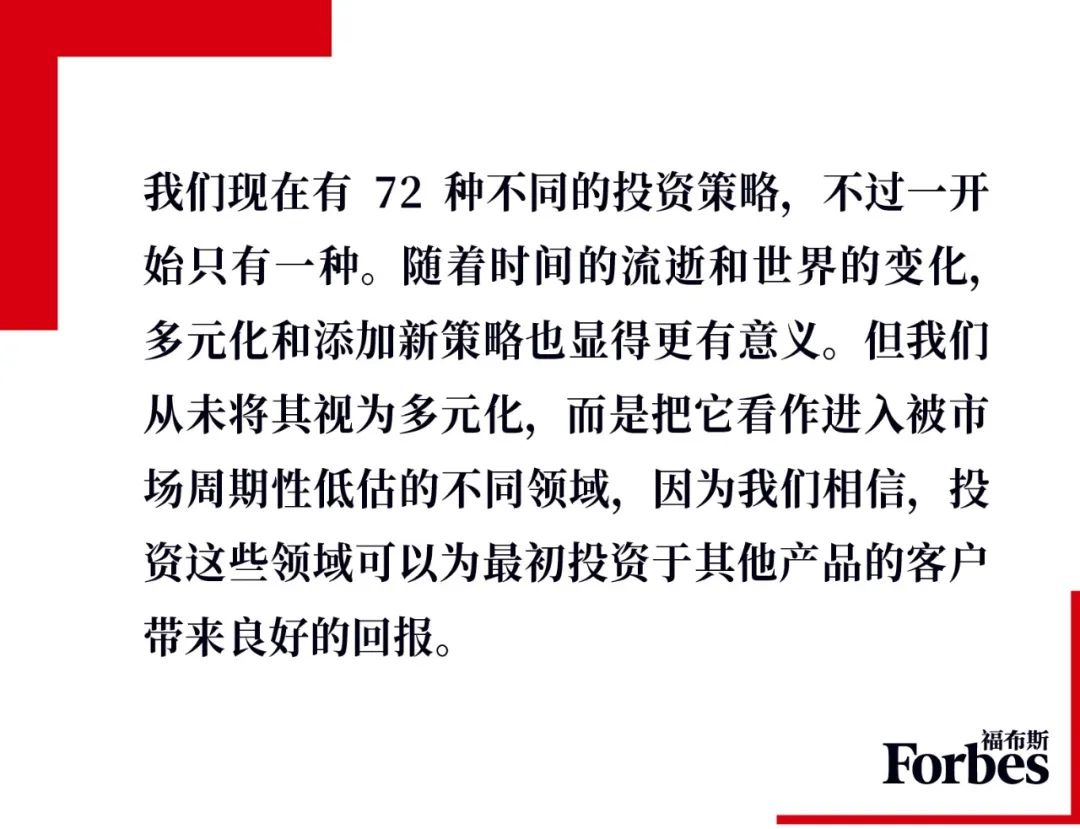
We now have 72 different investment strategies, but we started with just one. As time went on and the world changed, it made more sense to diversify and add new strategies. But we never viewed it as diversification, but rather as getting into different areas that were cyclically undervalued by the market because we believed that investing in those areas could generate good returns for clients who initially invested in other products. So to someone who is not familiar with what we are doing and why we are doing it, our strategy might appear to be very diversified. But we are doing something absolutely amazing, which is one of the reasons why we end up being successful in almost everything we do, and why some people who try to emulate our strategy often enter those businesses when prices are high or are unable to attract talent with real expertise in that area.
Forbes: Which investment do you think is Blackstone’s biggest success over the years?
Stephen Schwarzman:
One investment that's been a really good investment is our investment in Hilton, which we made in early July 2007, right at the peak of the stock market. We know we're paying a significant price for this, but we believe there are at least two significant opportunities to increase Hilton's bottom line.
First, Hilton hadn’t expanded internationally in at least 20 years. And, while it was No. 1 internationally at the time, its hotels were aging and it had no new hotels. We thought that if we took a management company approach and aggressively opened new hotels and had others provide the capital, that activity alone could add about $500 million in earnings per year.
The second opportunity was that Hilton had three headquarters and three full teams of employees—but that wasn't necessary for a company. One headquarters was enough. So we thought the opportunity in terms of efficiency was about $500 million. When we invested in the company, even though it seemed like a high price, we thought it was a pretty good price, right? Because we knew we could achieve our goals relatively easily, and it turned out to be.
During this period, we also encountered the global financial crisis, which reduced business earnings by about $500 million. Interestingly, the previous numbers seemed to be the same. So we put more money into the deal to be safe, but the natural rebound of the economy, plus an additional $1 billion in profits, and continued growth throughout the period and better management of existing assets gave us a total return of $14 billion, which is a great result.
Forbes: On the other hand, can you give an example of an investment that was disappointing to you and share the lessons you learned from it?
Stephen Schwarzman:
And of course, that was our third investment in 1989, in Edgcomb Steel, a steel distribution company. And that investment was not just a disappointment, it was a disaster, it was a complete mistake, and our analysis of it was wrong from the beginning.
One partner thought we could easily make money from inventory margins. In other words, no matter how much we invested, as long as steel prices kept going up, we would make money. But when steel prices fell, we would lose money. Later, steel prices did fall, and the company had trouble paying its debts. We chose to invest more money to save the company, but it continued to perform poorly. That’s when I realized we had to sell the company, so we sold it to a large French steel company in 1990. When we sold Edgcomb Steel, we lost all of our initial investment, but we were lucky enough to save the second investment. This experience was very frustrating. I was the one who made the final decision to do the deal, so the mistake was mine, and I realized we couldn’t make it again.
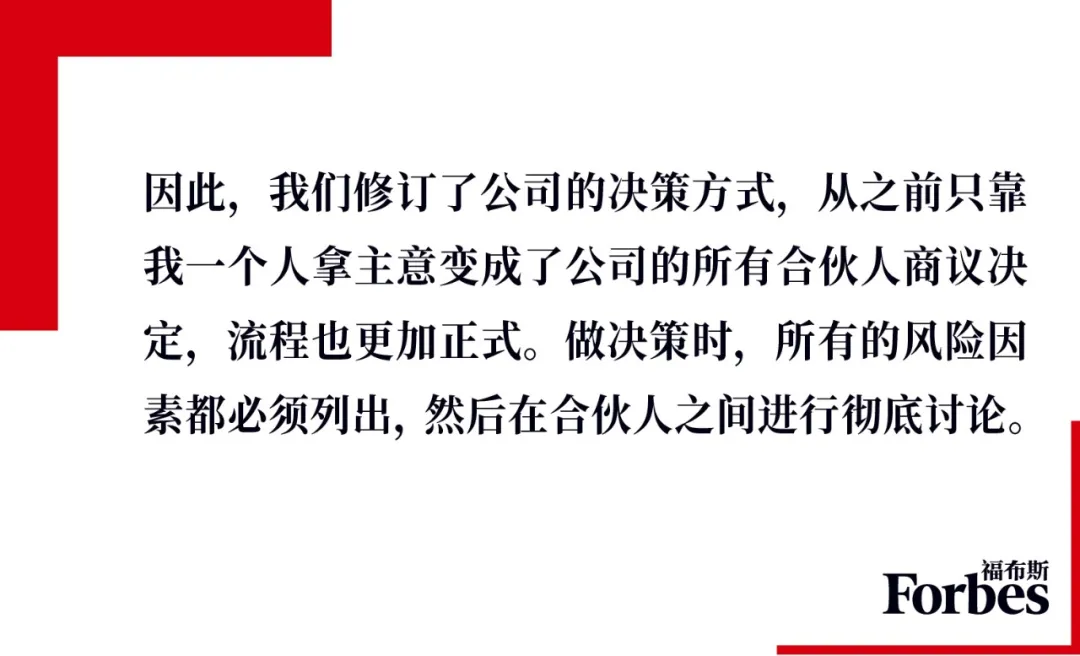
So we revised the way the company made decisions, from just me making the decisions to all the partners in the company making the decisions, and the process became more formal. When making a decision, all the risk factors must be listed and then thoroughly discussed among the partners. There is a simple rule that everyone in the meeting needs to express their views on the potential disadvantages of the transaction and the possible loss scenarios. This process was introduced for basically all decisions in the company, and its purpose was to depersonalize the decision-making process. Everyone in the company needs to keep an eye on what can go wrong, not just what can go well. In this sense, although the investment in Edgcomb Steel was a painful experience, it was also one of the most important investments for our company because it taught us a good lesson.
Forbes: As an investor, what do you think are the most important investment indicators, and what macro or micro factors do you pay close attention to?
Stephen Schwarzman:
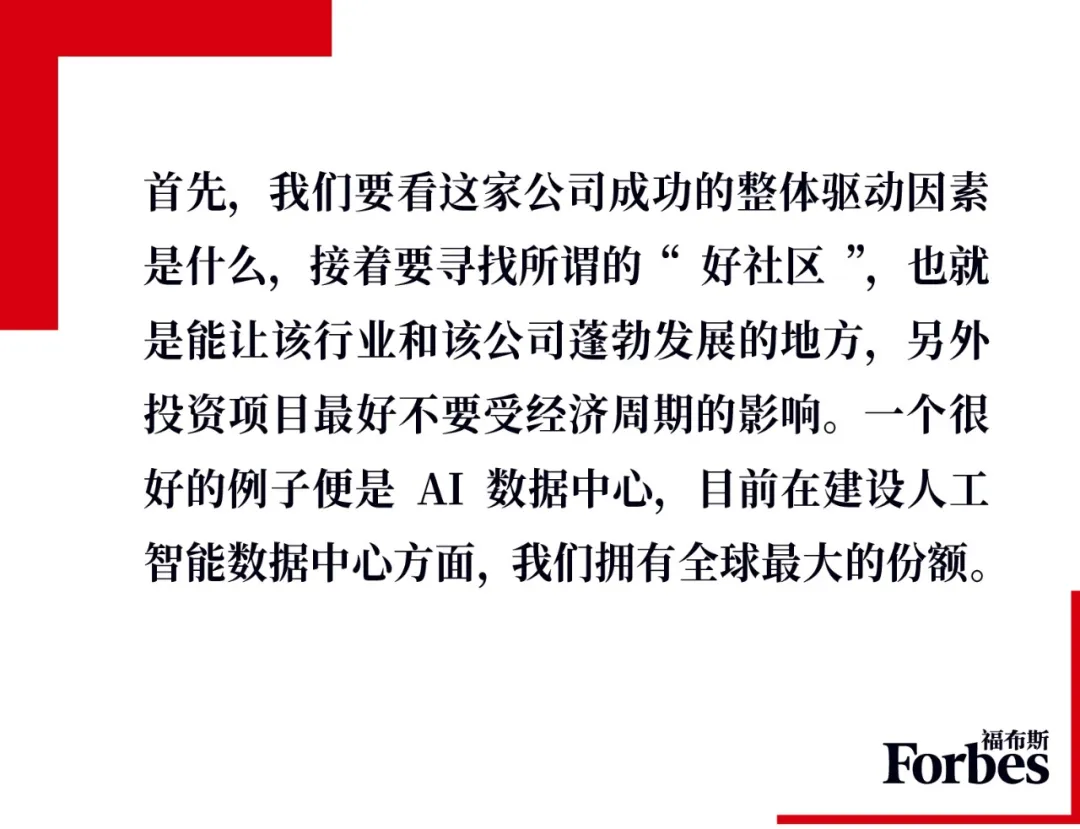
You have to understand the macro environment in which the investment is located - this helps control pricing and also helps control your expectations of how the investment will perform at the micro level. First, we look at what are the overall drivers of success of the company, and then we look for what we call "good communities", that is, places where the industry and the company can thrive, and the investment project is preferably not affected by economic cycles. A good example is AI data centers. We currently have the largest share of the world in building AI data centers. This is because we saw this trend three years ago, and the company we acquired at that time, QTS, has grown six times in market value today (three years ago, Blackstone Group acquired QTS, a company that operates and leases data centers, for about $10 billion. This transaction was the largest data center transaction in history at the time). Another important factor we look at is whether the company can expand geographically. For example, data centers are expanding as we speak. So it is important to pay attention to the growth path of the company and the industry and whether it can expand geographically.
Forbes: If you could give your 20-year-old self some advice about investing, what would you say?
Stephen Schwarzman:
Get to know more smart people and build a system that can generate a lot of proprietary data. Be patient when investing, don't be impatient, and only invest when you are very confident in a project. I know how I think. I am a person who needs to know a lot of information to catch trends and understand things. The more information I have, the easier it is to make decisions. Some people just need to sit in a room and read corporate annual reports or think hard, but I always need to grasp a lot of cutting-edge information that allows me to think, and then I can usually see the pattern from this data. If there is no data, it is difficult to see the pattern.
Forbes: Do you have any investment ideas or themes to recommend to today’s investors?
Stephen Schwarzman:
There must be two or three. Credit remains an excellent area to play from a risk or reward perspective. Real estate is beginning to move with the economic cycle, as construction work in almost all categories has decreased significantly. The private equity space will get busier when interest rates start to come down later this year - I'm guessing in Q3 or Q4, but maybe a little earlier.
Forbes: From a broad strategic perspective or in the current environment, what are the biggest risks facing investors today?
Stephen Schwarzman:
The biggest risk is the current geopolitical environment. The second is regulation, and the third is political uncertainty. Since this US administration took office, there has been an exponential increase in regulation in almost all areas. Over time, this approach will have a negative impact on economic growth.
Forbes: Is there a book that you recommend all investors to read?
Stephen Schwarzman:
They can read my book What It Takes, which seems to have become a bestseller! People from all over the world often talk to me about it, and I am amazed at how much of an impact it seems to have on so many people. I don’t read business books very often, as I have spent so much time in this field myself. A good book I read recently and enjoyed was Shoe Dog, Phil Knight’s memoir about Nike, and it was interesting to learn about his struggles in starting the company. I always have several books in my head at the same time.
Forbes: Thank you for accepting this interview.