
Along with BTC, Ripple and the XRP token are one of the most recognizable brands in the cryptocurrency market. At the same time, there are very real people behind this project, whose experience and skills helped to implement those innovations that we today perceive as an organic part of everyday life and the cryptocurrency landscape, and one of them is Chris Larsen.
In this article, we’ll tell you more about the founder and former head of Ripple and look at how he came to create a peer-to-peer payment system on the blockchain.
Chris Larsen Biography
There should be a long film about the childhood and youth of this genius, who from an early age demonstrated entrepreneurial abilities and graduated from kindergarten as an external student. But the problem is that before the launch of the first projects, almost nothing is known about the life of Chris Larsen. Just a couple of facts:
Born in San Francisco in 1960.
His father worked as a mechanic at the San Francisco airport, his mother was a freelance illustrator
Chris graduated from a local high school and attended San Francisco State University, where he received a bachelor's degree in accounting and international business in 1984.
Note: In 2004, San Francisco State University named Chris Larsen Alumnus of the Year due to the success of the E-Loan project (more below).
In 1991, he graduated from Stanford Graduate School of Business with an MBA degree.
And that's basically all. Either journalists were not too interested in Chris’s early childhood, or he deliberately does not let this information into the public information space. However, the era of Henry Ford and John Morgan with detailed memoirs and stories about their school years is long gone.
Chris Larsen's career
We know Chris Larsen primarily as the founder of Ripple Labs and one of the most profitable XRP holders, but Ripple is only the top of his career ladder. The philosophy of Larsen and all his startups can be described as “money without borders.” Ripple Labs, and, to one degree or another, Chris’s other projects were launched under this motto.
E-Loan
The E-Loan company was Larsen's first independent project. In 1992, he left his job as an auditor at Chevron and founded a mortgage lending company with his colleague Janina Pawlowski. Until 1996, this enterprise transformed into a website for searching mortgage loans, which allowed users to:
search for mortgage loans on your own;
lend without brokerage and agent commissions.
In essence, E-loan has become an open gateway to a limited capital market, which previously could only be used through intermediary brokers. Later, the site began providing lending services using equity capital.
Note: Another feature of E-loan was that the company provided users with their FICO credit score data for free. Before E-loan, this data was closed and provided in limited quantities, which complicated the interaction of consumers with different credit institutions.
In 1998, E-loan brought in annual income of $6.8 million, in 1999 the company went public and in the same year E-loan accounted for 25% of all online mortgage loans, which made the site the absolute leader in its niche. In 2000, E-loan was valued at $1 billion, although just 2 years earlier Intuit Corp offered $130 million to purchase the company.
As a result, Larsen remained CEO of E-loan until 2004 and served as chairman until the company was sold to Banco Popular for $300 million in 2005. Now E-loan operates as a separate division of Banco Popular.
Prosper
After leaving E-loan, Larsen founded the peer-to-peer lending platform Prosper, which launched in 2006. Prosper is something like a centralized analogue of Aave and allows borrowers to receive loans directly from investors without resorting to Banks. In this case, the platform undertakes servicing of loans, assessing credit risk and making payments to creditors, for which it charges a commission.
The original model involved negotiating a loan rate through an auction system, but in 2008 Prosper faced charges from the SEC for violating securities laws and a lawsuit from investors dissatisfied with the delays.
After this, in 2009, Prosper relaunched as a registered marketplace and introduced a fixed-rate lending model. In 2012, Chris Larsen left the position of CEO of Prosper to found Ripple Labs, while Prosper is still in operation today, although the company's effectiveness is assessed with mixed results.
In E-loan and Prosper, a trend is already visible, crystallized later in the idea of Ripple - simplifying access to financial instruments. However, Chris also fought for the protection of consumer data, becoming one of the lobbyists for the financial privacy law in California, which set the standard for this niche in the United States. Initially, Ripple also aimed to provide confidential payments for its users.
Chris Larsen and Ripple Labs
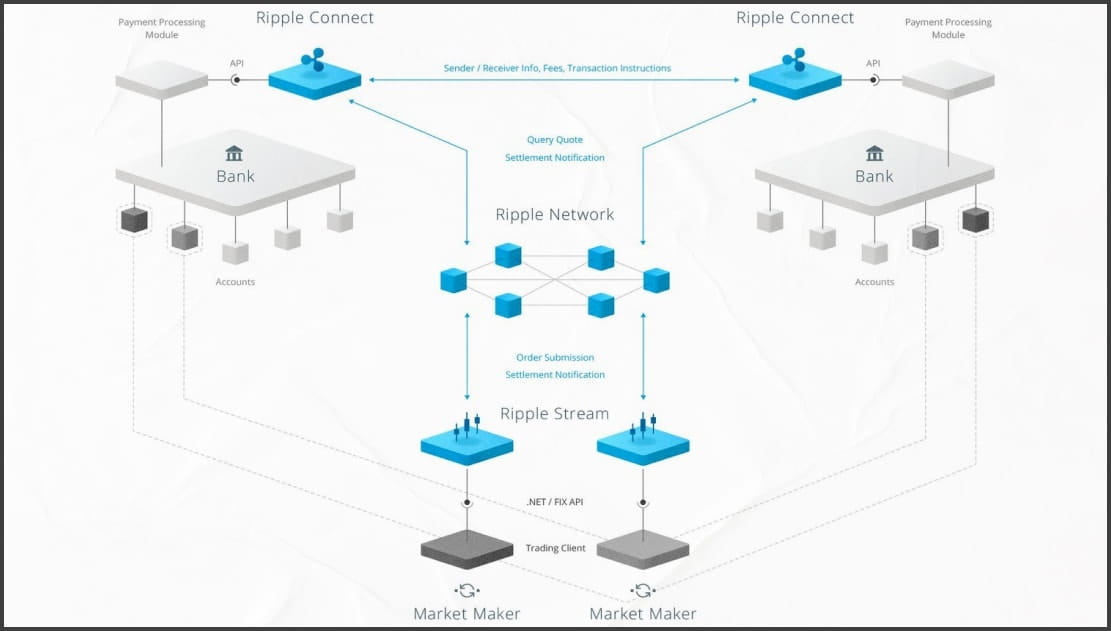
In September 2012, shortly after leaving Prosper, Chris Larsen, along with Jed McCaleb and Arthur Britto, founded OpenCoin, which began developing the Ripple peer-to-peer payment solution. The main network of this network was the XRP Ledger protocol, working on the basis of the token of the same name and the Ripple Protocol Consensus Algorithm (RPCA). The XRP token itself was also launched in 2012.
In May 2013, the company raised a second round of funding from Andreessen Horowitz, Google Ventures and IDG Capital Partners, and in September it rebranded as Ripple Labs with Chris Larsen as CEO. At that time, XRP was the second cryptocurrency by capitalization, second only to Bitcoin, however, Ripple was technically and conceptually different from Bitcoin. In an interview with Nielsen, Larsen described the difference this way:
“The world doesn't need a new currency, the world needs a more efficient way to move existing currencies. Market makers will only want to use a digital asset or cryptocurrency in their trading if it is easily convertible into other valuable assets. Bitcoin doesn't allow this. This is why we created Ripple, we mainly trade dollars, euros, yen, etc. We see Ripple (XRP) becoming a universal bridge for all assets, and market makers will use it to create markets.”
Based on this concept, Larsen began to actively develop a banking partner network, primarily in Africa and Southeast Asia - regions with poorly developed banking infrastructure, where people need accessible and cheap payments. Ripple later launched a CBDC and stablecoin launch platform aimed at governments and large organizations. However, we will talk more about the company itself in a separate article.
Important: one of the most important pages in the company’s history is the SEC vs. Ripple, which was preceded by a class action lawsuit by investors. The main accusation is the sale of unregistered securities (XRP tokens) by both Ripple itself and Larsen. The decision in this case could be key for the US crypto industry and help systematize the criteria for classifying cryptocurrencies.
There was also a dark side to Larsen’s participation in Ripple: three co-founders of the company, including Larsen, received 20 billion XRP after the launch of the token (20% of the total supply). A significant amount was also allocated to the current CEO of the company, Brad Garlinghouse. From the recently disclosed SEC vs. Ripple documents show that sales of these tokens brought in:
Garlinghouse $164.26 million from 2017 to 2020.
Larsenu $453.69 million for the same period.
In 2016, Chris Larsen left the post of CEO and transferred it to Garlinghouse, but still remains the executive chairman of Ripple Labs. His role and real influence on the company's affairs are not entirely clear, as is the amount of XRP and Ripple shares held, so many consider Larsen to be the actual owner of the company.
There is a strong opinion in the crypto community that it is the opaque primary distribution and subsequent sales of co-founders and Garlinghouse that put price pressure on XRP and provoke dumps. However, the decision in the SEC lawsuit will help clarify many of these suspicions.
Chris Larsen Net Worth
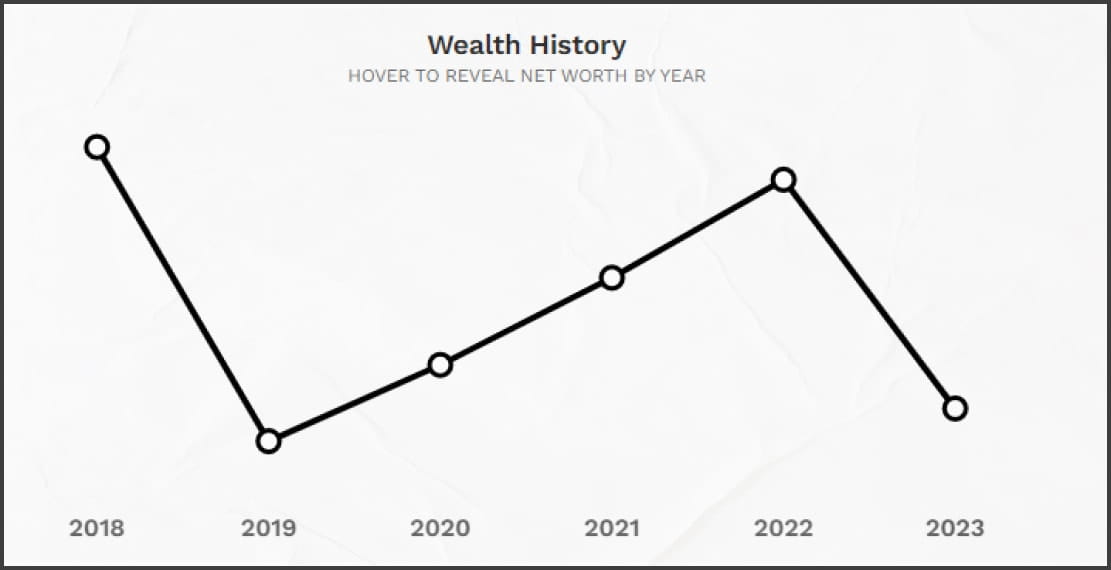
According to Forbes, Chris Larsen's net worth in 2023 is estimated at $2.3 billion, which is half the peak value in 2018 ($4.6 billion) and 2022 ($4.3 billion):
With his fortune, Chris ranks 380th on the Forbes 400 and 1368th on the overall Forbes billionaire ranking.
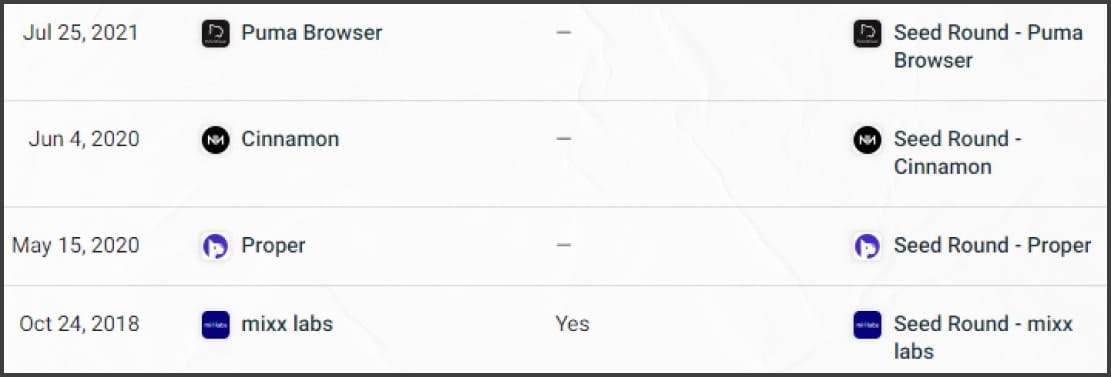
According to Crunchbase, from 2018 to 2021, Chris Larsen invested in several early-stage startups. True, the amount of investment remains unknown:
Conclusion
Chris Larsen is an entrepreneur who used the technology of his time to make financial tools and opportunities more accessible. His philosophy of “money without borders” began to take shape during the founding of E-loan and Prosper and reached its peak during his work on Ripple, which allowed the use of blockchain for cheap and fast bank payments.
Chris remains an important figure in the world of cryptocurrencies precisely because of Ripple. As a co-founder of Ripple Labs and the company's former CEO, Larsen played a key role in developing and promoting Ripple's technology and bringing attention to the use of blockchain to democratize financial instruments. However, at the moment his real role in Ripple remains vague, as does the income from the sale of XRP.