

Preface
When we open the door to Web 3.0, all we see is desolation.
DID itself cannot exist independently. It must promote and grow with each other in Web 3.0 content. DID is like a door. There can be enough to ensure decentralization and prevent some gatekeepers from being tempted to collect tolls after becoming a dominant player. However, after pushing through the door, there must be content to see, otherwise users will never be retained. DID will also become a river without a source and a tree without roots. Our discussion of DID is based on our belief that Web 3.0 is the future trend.
DID, as the front-end facility of the entrance, is the first step in building a complete decentralized user experience. However, after that, it needs the support of DApps such as SocialFi, GameFi, DeFi, etc., so the public chain is also needed as the operating network, and IPFS, AR, etc. Decentralized storage, oracles, decentralized network nodes and other middleware are used to maintain the decentralization of incoming and outgoing information. Finally, verification of information on the chain is required to ensure that the data is actually on the chain and has not been deceived.
In this link, the functions of SBT and DID are highly similar. It is difficult to say that one product is DID or SBT. Even BAB or GAL is more like a PASS token, which guarantees that information is uploaded to the chain after centralized verification. This is fundamentally centralized, just like USDT cannot be called an algorithmic stablecoin.
Uniswap is a type of DeFi, but it cannot be said that DeFi is only Uniswap. Even the DEX under it can continue to be divided into spot, derivatives protocols, as well as AMM mechanisms and order books.
DID and SBT are functional descriptions used to verify personal identity. On-chain addresses, non-custodial wallets, decentralized mailboxes, and Web3 social protocols are all carriers of DID or SBT. Currently, the products that use them as selling points are just A kind of selling point promotion in the early stage of the market.
Only under the protection of DID will users have the willingness and motivation to generate effective data on a large scale. On-chain data analysis will then enter the 2.0 era, rather than the current DeFi and NFT market analysis model. Direct analysis of user behavior is a more economically promising development direction, which will in turn reconstruct the Web 3.0 application iteration method and break away from Ponzi schemes and imitations.
Starting from DID, the accumulated native data will inevitably become more abundant, not just simple transfers, whale address tracking and other usage scenarios. The rich data value not only supports personal privacy, but also is the future of Web 3.0. The monetization source of the economic model has become the value foundation of the entire Web 3.0 application, rather than the advertising model that major manufacturers currently rely on.
In a word, what we need is complete decentralization. The lack of any link or the compromise of centralization will cause fragmentation and fracture, and the advantages of Web 3.0 cannot be truly brought into play.
ID falls into the data web: DID and the history of personal data statistics
The medium is the message, the soul is the identity.
Decentralization brings the return of personal value, and DID is a supporting measure for DeSoc from a broader perspective. As Vitalik said in "Searching for the Soul of Web3", the broader world in the future will be a decentralized DeSoc society. In this society, DID will become a personal unique identifier, which will not only be used in the Web 3.0 network world, but also There is a wider space for use.
If everything must be decentralized, then it is necessary for identity to be decentralized. If a decentralized society continues to use Twitter and Facebook, it will obviously not be a long-term solution, and when Web 3.0 becomes the new foundation After the facilities are installed, it is also possible to feed back the real world. For example, Debank has achieved certain results by displaying on-chain activities around on-chain addresses as a personal display page.
DeGenScore goes even further, focusing on scoring individual on-chain activities, and credit records have shown their power in the real world. From official credit records to Alipay Zhima Credit, the informatization of credit records has shown that it is better than traditional A more effective side of risk control.
Of course, this kind of discussion is divorced from the idea of DID as the entrance to Web 3.0 to a certain extent. It can be regarded as a kind of divergence of thinking, and DID is regarded as an entity expression of the "soul" of a broader decentralized society. From this perspective, DID is no longer an entry tool, but has become a node for on-chain and off-chain interaction, interaction between Web 3.0 and Web 2.0, and interaction between people. This is better than the entry concept. Wider.
But at the same time, we should pay attention to one thing. Only by implementing DID as the entrance function of Web 3.0 can the so-called link be realized within a larger time scale.
Below R3PO conducts a retrospective review of our use of the Internet.
The Origin of All Things: The Emergence of Information Network
Web 1.0: World Wide Web WWW and Browsers
After network communication technology came out of DARPA laboratories and universities, the concept of the so-called civilian Internet came into being. At this time, the entrance was the browser and the World Wide Web, which constituted the entire concept of the network. At this time, the ID was mainly an email address, a personal domain name, and Forum ID, while RSS and BBS are the main scenarios where data is accumulated later.
In other words, in the very beginning, IDs came before applications, just like with Web 3.0.
The root of all evil: the growth and misuse of personal data
Web 2.0 and UGC, blogs, iPhone, 5G, XR
From forums and blogs to Twitter and Tik Tok, starting from the personal right to share, the history of Internet development has experienced a continuous stage of decentralization of expression rights, from the initial elite personality to the whole people being the media, from the middle-aged elite to the teenagers accessing the Internet, to the proposal of the concept of Web 3.0, the Internet has become a priori existence of Generation Z, just like water, electricity and coal, becoming an infrastructure as ubiquitous as air, and its status is unquestionable.
The revelation of Facebook reselling personal data during the 2016 US election was later confirmed to have used this data to "influence" the US election to some extent. There are two prerequisites for all this to be possible: first, people will leave a large amount of digital traces of their privacy on the Internet; second, people will concentrate on leaving their personal data on certain applications, such as Facebook and Twitter.
We need to be clear that what comes first is the concept of personal data, followed by the debate about privacy rights. At this time, IDs are gradually migrating to social tools. This does not mean the death of email, but the change of people's usage habits. More appropriately, Facebook has also become an optional login tool besides email. The implicit premise here is By default, everyone uses Facebook.
But the disadvantages of this situation are becoming increasingly obvious today. Our personal data is stored in applications such as Google and Facebook. It seems that we are discussing our own privacy, but in fact we are talking about our relationship with these applications.
If the separation of personal privacy and data did not exist in the Web 1.0 era, then the social giants and search engines in the Web 2 era all appropriated the fruits of users' labor, all in the name of free.
In this context, user IDs, game props, and social media data are at least not completely owned by users, but at most they only have the right to use them. The introduction of GDPR protects user data sovereignty to a certain extent, but this protection still cannot generate user data. The economic benefits are returned to individuals, and the problem continues to worsen.
DID under Web 3: Reunification of individuals and data
What belongs to the user belongs to the user, what belongs to the agreement belongs to the agreement
In Satoshi Nakamoto's vision, it is best for people to use a new address for every transaction, which can protect privacy to the greatest extent. But in fact, except for hackers and people who forget their mnemonic words, no one will do this, because this It goes against human nature to prefer convenience.
Web 3.0 is the intersection of concepts. Since the concept was proposed in 2004, it has experienced the transformation of the traditional Internet and gradually connected with the blockchain. This connection is not achieved in one step. At least it has experienced the (public chain) Bitcoin Ethereum. In the EOS and EOS eras, as well as the ongoing multi-chain and Layer 2 era, trying to replace the WWW with a public chain is still a work in progress under the current technical conditions. The public chain TPS itself cannot match the concurrency of the existing network. capabilities, and cannot demonstrate the high-efficiency advantages of replacing traditional centralized databases.
But at least, we firmly believe that the next generation of human beings will grow together in the process of using Web 3.0. Then we will now firmly believe in the importance of DID. There will always be an entrance, and it will not be just one entrance, but between interactivity and In decentralized coordination, the number will definitely be limited. This is similar to social tools. Real infrastructure unions form strong user stickiness. Human nature is always lazy. People may change their nicknames and avatars at any time, but no one WeChat ID and mobile phone number will be changed daily.
In other words, Web 3.0 will focus on customers, absorbing concepts such as blockchain, DeFi, and NFT to jointly form the next generation of Internet of Flowers, and DID will become the most direct interactive entrance. We are not yet sure whether it is hardware such as VR equipment, nor can we directly I think wallet software is the best choice, but there will always be some.
The return of personal data control is the criterion for success. This kind of data ownership is not a platform's promise to users, but a real hash value on the chain, which cannot be forged and lasts forever.
During FTX’s epic collapse, we could easily track the changes in the amount of each address and witness every step of the elephant’s fall. But the problem is that CEX still controls our data, and individual users cannot control their own addresses. Lose your own value.
On the contrary, the integration of data and value can inspire the great value of decentralized links - ensuring that personal value is in the hands of individuals. Without on-chain information, no DID or SBT can truly claim to have achieved this. Decentralization.
DID X on-chain data: overview of mainstream project progress
The following is a compilation of mainstream projects involving DID functions and on-chain data. Because DID involves a wide range of areas, projects that can generate a large amount of on-chain data, including SBT, social networking, login tools, etc., are included to understand DID and on-chain data. Combining the above data to achieve a deeper understanding.
Social protocols and on-chain data
The data type of social protocols mainly lies in the personal data generated by users. At the current stage, the amount of data generated by users will be directly related to direct economic benefits such as airdrops. In terms of its operating model, it can be divided into native social protocols. There are two types of protocols and plug-in protocols.
Web 3.0 native social protocol represented by lens protocol;
Lens Protocol is a highly anticipated Web 3.0 social application created by the Aave team. It was launched in February 2022. From the perspective of its architecture, it is closer to the category of meta-protocol. It is hoped that other social applications can build their own social Dapps based on Lens Protocol, such as the official demonstration application - LensFrens, which can basically be regarded as a decentralized Twitter, where users can follow users similar to themselves.

Image description: lens protocol
Image source: lens protocol
Currently, outstanding applications in the Lens ecosystem include decentralized social media application Lenster, LensFrens that can recommend profiles based on users' Web3 footprints, Share-to-Earn social application Phaver, link trend ranking list Refract, decentralized "YouTube" Lenstube, etc. , there are also relatively innovative projects such as Soclly, a time auction network for creators or veterans, Clipto that provides celebrity video customization services, and LensAI, an NFT image generator created with AI technology.
In addition, there are the following projects in the official Lens ecosystem that have been featured extensively:
Decentralized streaming service LensTube
AI creation NFT tool LensAI
Decentralized social protocol service Lenster
Decentralized social media application ORB
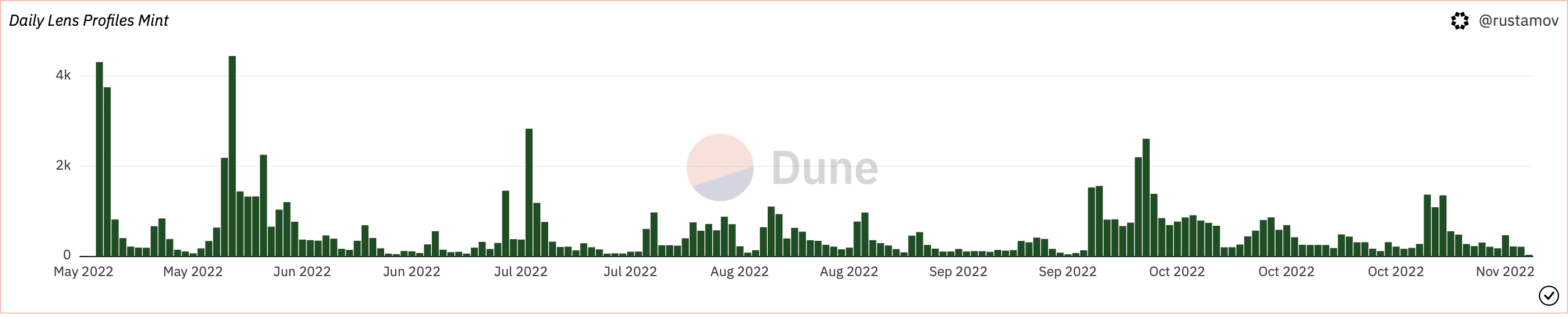
Picture description: Daily casting amount
Image source: dune.xyz
However, most applications have yet to achieve significant network effects. Currently, the number of Profile Mints is in the order of 100,000+, but their daily active users are around 600, and only 44% of registered users have published content.
In Lenster, only about 10% of users have posted more than 20 articles, and 36% of users have published at least one post. The trend of centralization of creators has already appeared before the network became active.
Its detailed operating data can be found at https://dune.com/iamyakuza/lensprotocol
Plug-in protocol represented by Mask Network
Essentially, the user identification work of this model is completed by Twitter and Instagram, and the user data is in the hands of the user, which is a compromise against centralization.
However, as Meta social products become more and more friendly to NFTs, Twitter is increasingly moving towards the concept of decentralized social protocols after falling into Musk's hands. Plug-in protocols such as Mask are also showing some improvement. Web 2.0 and Web 3.0 are rushing towards the connection point in both directions.
Benefited from Musk's acquisition of Twitter, its currency price $MASK doubled in a short period of time, and in terms of long-term construction, it reached a cooperation with Next.ID in July 2022, and Mask Network became its decentralized Your first choice for Identity as a Service (DIaaS).
Next.ID is a decentralized identity aggregator that is building the foundational layer of identity. It takes a unique approach to decentralized identity that seamlessly integrates Web 2.0 and Web 3.0 accounts, creating a highly interoperable layer where both coexist.
In short, whether it is linking to content on platforms such as Twitter or linking to plug-in DID services such as Next.ID, Mask's user data will become more decentralized.
Digitization of personal domain names
Personal domain names are the real remnants of the Web 1.0 era. Driven by ENS, they have become the ticket to the Web 3.0 era and set off the craze of the era.
ENS, the on-chain version of personal identifiers
ENS, the full name of which is Ethereum Name Service, is a domain name service running on the Ethereum network. The primary domain name can serve as the user's cross-platform Web 3.0 username and Profile, and also allows direct access to decentralized websites.
Vitalik once praised ENS as the most successful non-financial Ethereum application to date, which can be compared to a decentralized address book.
On May 4, 2017, Alex Van de Sande and Nick Johnson of the Ethereum Foundation launched the ENS project with the aim of building a human-friendly domain name service, analogous to the relationship between traditional IP addresses and DNS (Domain Name System) domain names. ENS and The relationship between Ethereum addresses is as follows:
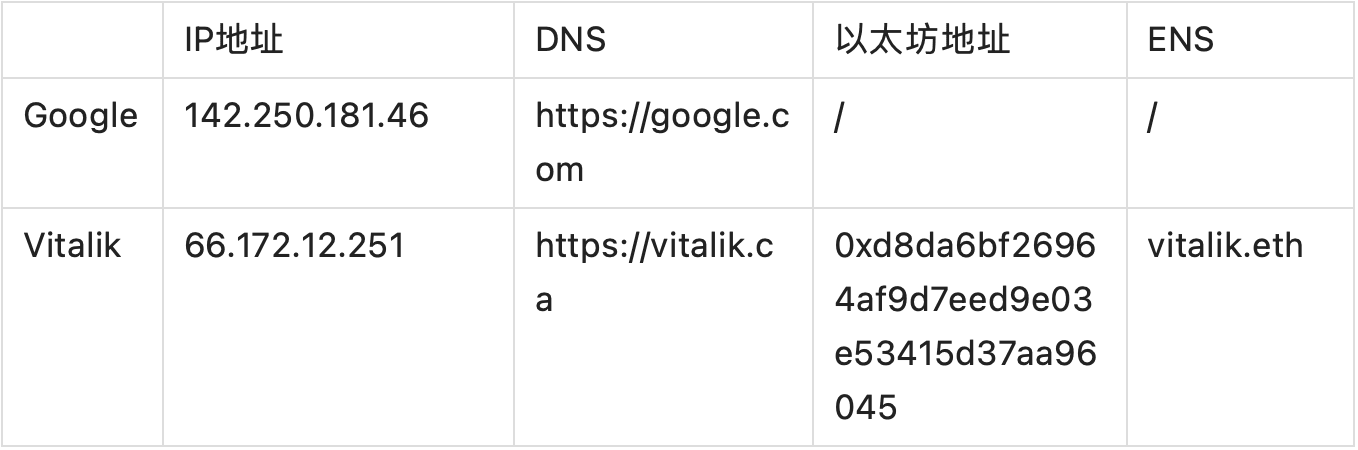
At the same time, each ENS domain name is also an NFT, which runs completely on the chain. The current protocol used is ERC-721. It can not only be minted, but also supports resale on NFT markets such as OpenSea. Currently, it has the highest sales price on OpenSea. The price is the domain name of the investment institution paradigm.eth, which is sold for up to 420 ETH.
ENS has many functions. Currently, the typical use cases include user domain name, web3 business card and DID.
User domain name
First of all, ENS can not only be displayed as an NFT, but it is also an Ethereum network domain name that can actually be run. By enabling the IPFS service, a completely decentralized user experience process can be built, allowing individuals to fully control the website domain name and data. Does not rely on centralized service providers.
This is also the main reason why it has evolved from the initial Ethereum address resolution service to a personal business card in the Web3 world in more than 5 years since its launch.
For example, Vitalik uses vitalik.eth as his personal domain name. When we enter this domain name in a browser that supports IPFS services, we will automatically jump to:
https://dweb.link/ipfs/bafybeic3y6oc2dai3uypyyuaggp4xx3krocpgzbwst2z4ha73jdh7y6nea
Finally, the following interface is presented:
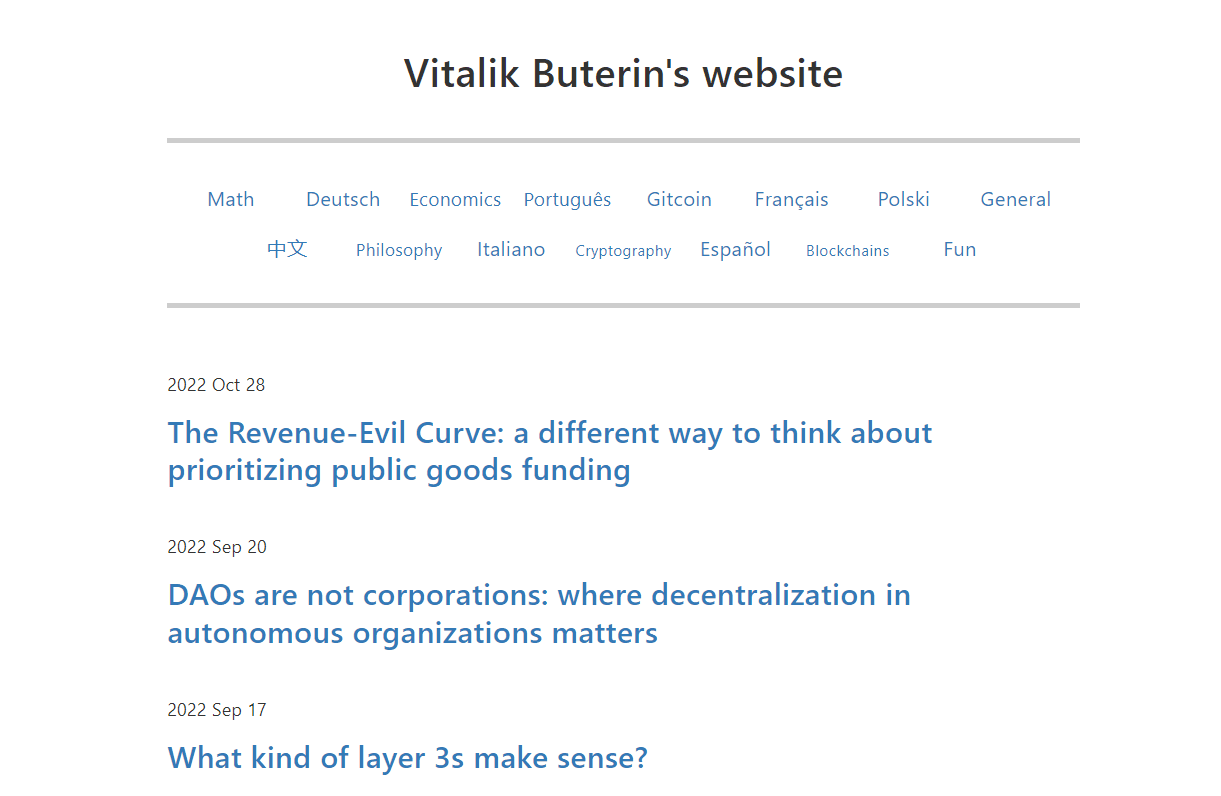
Image description: Vitalik’s personal website
Image source: vitalik.eth
Not only IPFS, the ENS domain name resolution service operator ETH.LIMO ENS domain name gateway now supports a variety of content, and users can now use every ENS compatible storage layer, including IPFS, IPNS, Swarm, Skynet and Arweave, etc.
In addition, although ENS exists on the Ethereum network, it is essentially a cross-chain domain name system. For example, ENS domain names can also be used on the Polkadot network for address binding.
As the on-chain domain name system becomes more popular, ENS will continue to support other blockchain networks and build a unified on-chain user-defined domain name system.
web3 business card
Secondly, ENS domain names can also be displayed as personal business cards. After individuals and organizations purchase personal-related domain names, they can put them on social platforms such as Twitter to show their unique image.
The main attributes of personal information on the chain include specific indicators such as time, amount, currency, NFT holdings, etc. However, there is a lack of a unified identity system. In other words, we need something that can show ourselves.
The ENS domain name is a readable combination of numbers, letters, and symbols, and is also related to the personal on-chain address. Displaying one's own image is a rigid need, just like business cards in the paper era and domain names in the Internet era. Individuals have the right to display and build their own image.
For example, the recently popular digital ENS address represents people's wishes for better numbers. Nick Tomaino, the founding partner of the venture capital institution 1confirmation, purchased "1492.eth" and said "Columbus began his first voyage in 1492." At the same time, he called ENS a perfect NFT series, "Some people don't think ENS is an NFT, but the fact is that it is the most widely held NFT."
Not only can individuals use it, but companies can also use ENS domain names to build their own images. The famous sports brand PUMA changed its official Twitter name to "PUMA.eth" in February. According to ENS website information, the URL bound to this domain name and Twitter have been set as PUMA official information.
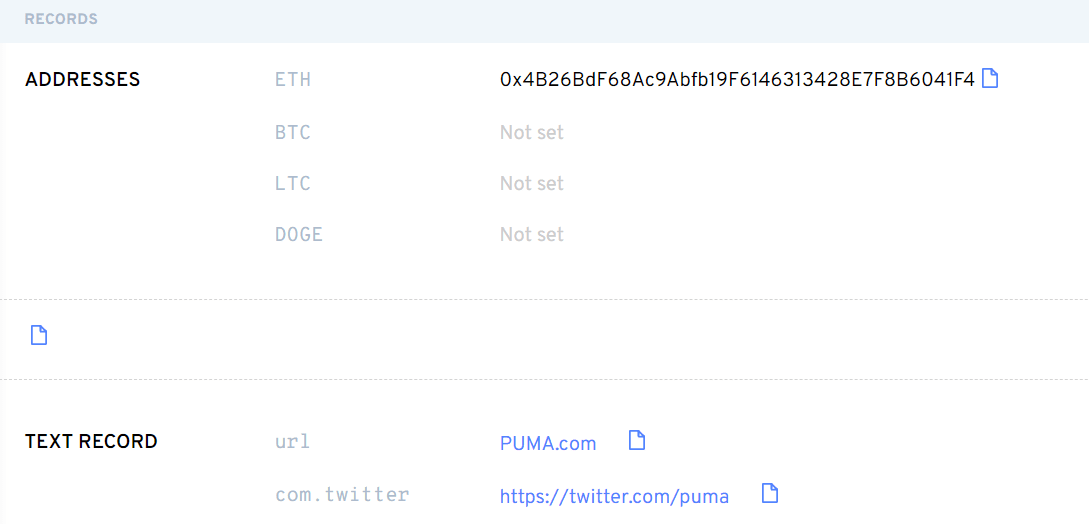
Image Caption: PUMA.eth
Source: ens
DID
As a personal account nickname, the ENS domain name has the function of identifying an individual's unique identity. Especially when ENS is bound to an individual's Web 3-Web 2 social media, we can uniquely determine someone's identity without knowing their specific address on the chain.
In RSS3, the social platform in the Web 3 era, we can directly use ens to retrieve address information and confirm its related results. The experience is highly close to Google search, but behind it is a completely decentralized user experience.
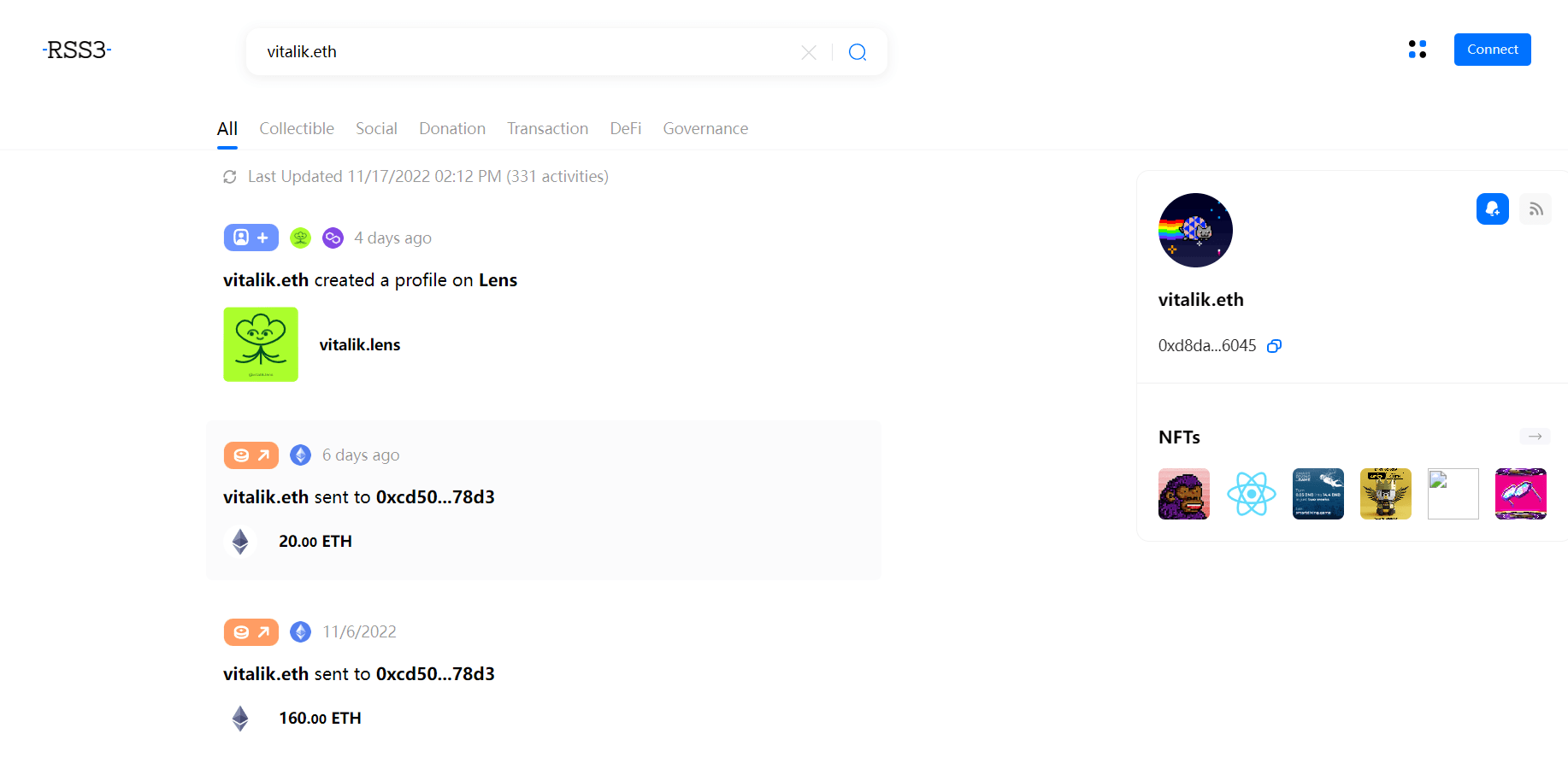
Picture description: RSS3 search interface
Image source: RSS3
If the address on the chain is connected to the display links of all platforms such as NFT avatars, ENS domain names, Twitter account information, etc., a unified user identity system will be built on and off the chain. Even the NFT market OpenSea has supported users to press ENS format ".eth "Directly search for relevant accounts and NFT projects.
The total number of ENS domain name registrations has exceeded 2.55 million, and the number of users is 570,000. The number of new ENS domain name registrations in September 2022 was nearly 400,000, exceeding the 378,800 in July, setting a record high in monthly registrations.
The hot ENS market is the result of the revival of the traditional Internet domain name business. The hype logic is as follows:
Buy the domain names of top real-world companies and organizations and wait for them to acquire them at a high price;
Register a Geely number, such as 666.eth, 888.eth and other numbers that meet specific audiences, and wait for sale;
Buy in bulk, "sweep" at a low price based on the logic of investing in PFP NFT, and wait for the ENS domain name market to become hot before selling it on the secondary market.
Currently in the ENS market, the most popular is the 4-digit domain name of 10k club, with a 24-hour sales of 1445 ETH. For example, 7000.eth was sold at a price of 170 ETH, followed by the three-digit domain name provided by Arabic 999 club, which is also The shortest domain name supported by ENS has a 24-hour sales price of 95 ETH. For example, ٠١٠.eth is sold at a price of 30 ETH.
In addition, there are five-digit domain names for 100K club, emoticon domain names for Triple Ethmoji, and 999 Club ENS Chinese domain names that support Chinese numerals.
The current total market value of ENS is US$93 million, but its liquidity is only 0.78%, and the number of sellers may even be stronger than the number of buyers. Its performance in the secondary market cannot be said to be outstanding, and it is still dominated by speculation and speculation.
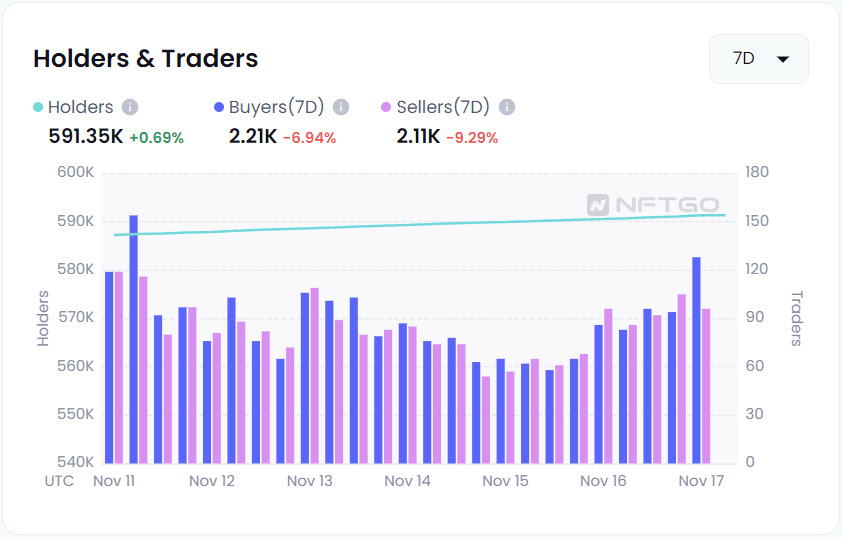
Picture description: ens holds data
Image source: NFTgo.io
This is because ENS domain names are different from general DeFi tokens and NFTs. They have a very strong binding relationship with individual users, similar to personal mobile phone numbers. Most people will use them for a long time and stably, and it is difficult to sell and trade them frequently.
TwitterScan, a miner of user data
TwitterScan was developed by MetaScan. Its purpose is to mine relevant currency prices, NFT and new project developments around Twitter, the most active public information distribution center on Web 3.
Different from pure on-chain data used with DID, TwitterScan's data is completely based on Twitter, and its identity identifier is consistent with Twitter. Its most important innovation is to introduce the idea of on-chain data analysis into traditional Web 2 services.
At present, it can track more than 17,000 Tokens, the dynamics of 150,000 KOLs and more than 300 topics.
This idea of feeding back to Web 2.0 refers to in-depth research and learning. More traditional Web 2.0 platforms can be regarded as part of the available data source, which can be uploaded to the chain, identified and analyzed.
Login device: on-chain data precipitated by identity recognition
In terms of a relatively single login function, the login has its own unique use. In the Web 2.0 era, the most typical use is M2F tools, such as Microsoft Authenticator and Google Authenticator. Time-based secondary verification tools are often used in CEX security verification. .
In Web 3.0, tools surrounding login and authentication can be collectively referred to as logins.
Unipass, unified login
Based on Nervos CKB, it builds a decentralized digital identity (DID, Decentralized Identity) identity recognition protocol for Web 3.0 users.
Its operating logic is that enough users can accumulate enough user data to develop business models around traffic, such as fee models or institutional services, and both the C/B side can be expanded.
Bright ID, 15+ application collection DID services liked by Buterin
In the seventh round of donations on Gitcoin, an open source software funding platform, BrightID was singled out by Vitalik Buterin for its impressive support. Instead, it is creating a for-profit consulting business for applications that integrate BrightID, which can use part of its profits for BrightID, that is, the value of BrightID depends on the applications it integrates.
BrightID will sell each person a "sponsorship" for $1. This will pay a lifetime fee of $1 per user to the app that originally brought the user to BrightID, with the app purchasing the sponsorship to solidify itself as the user's "first stop."
CyberConnect, a DID revamp of WalletConnect
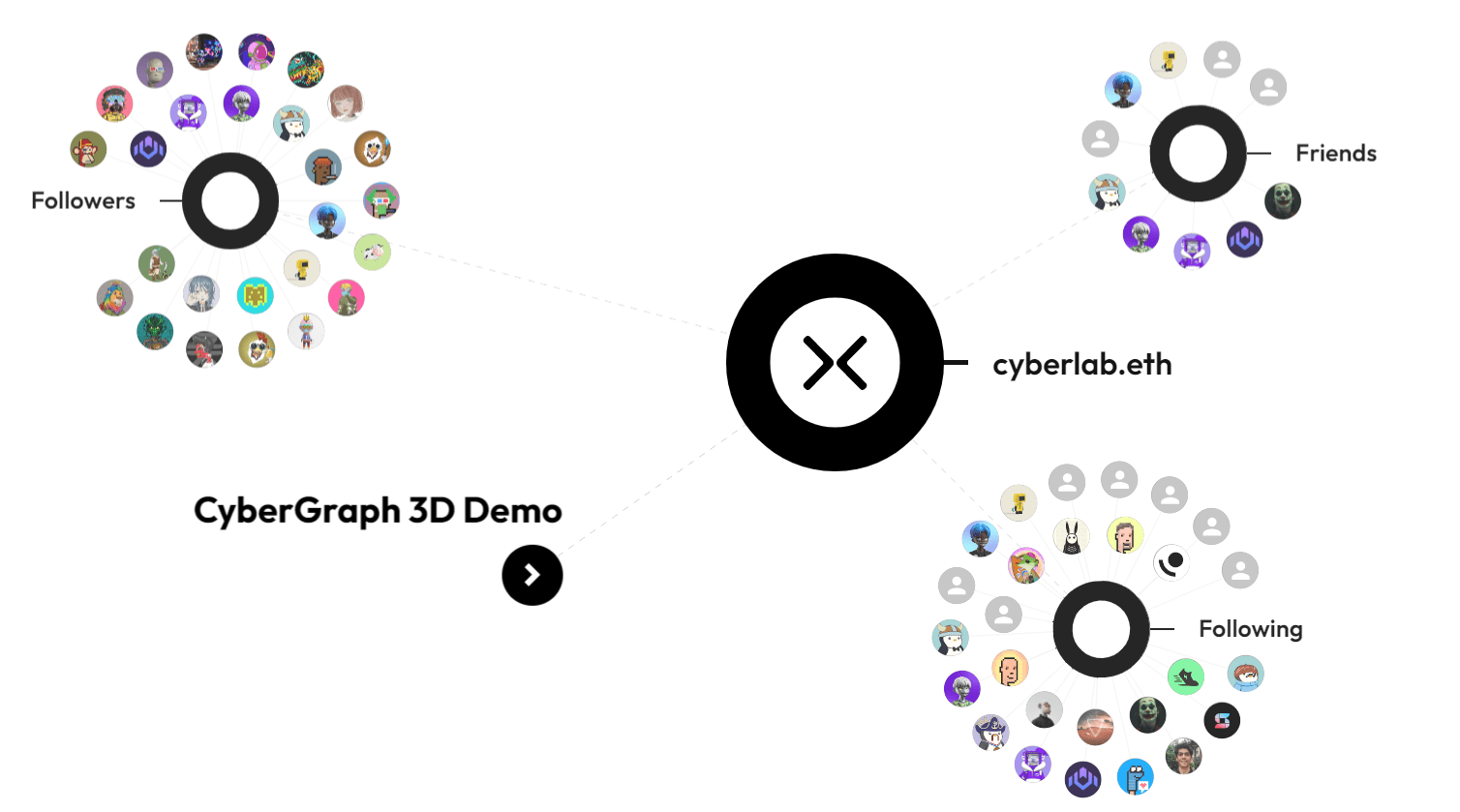
Picture description: cyberconnect operating mode
Image source: cyberconnect
To be precise, CyberConnect is a "meta" DID. Similar to wallet integration services provided by walletconnect, CyberConnect has a similar idea. It continuously integrates new DID partners and public chains to build the most complete login experience. .
CyberConnect's goal is to return ownership of social graph data to users and integrate the identity system throughout the entire application experience.
Currently, its user base is experiencing a surge. In January this year, its user base was around 400,000, but as of October, its user base has exceeded 1.5 million, with 24 companies including Binance and Protocol Labs deeply involved. , and also includes 35 ecological applications such as SpaceID, NFTGo, helloword, and ZKlink.
Reputation Systems: The most relevant use cases for on-chain data and DID
We arrange this part to the end of the article as an example of the back-end experience of DID and on-chain data. Previous applications put DID first, and then user behavior data can be generated. However, the logic of the reputation system is the opposite and must be in Only after sufficient data has been accumulated can a credit "rating" be conducted for a user. This credit rating can be used as the unique identifier of SBT, as an identification code for social recovery, and as the holy grail of lending in DeFi—— "Sesame Credit Score" for unsecured lending.
POAP, the true beginning of reputation systems
POAP is a new way to keep reliable records of on-chain experiences. Every time they participate in an event, POAP collectors will receive a unique badge that is supported by on-chain information. POAP badges are non-fungible tokens (NFT) that record the information footprint of every step on the chain.
Organizers can create their own events on the POAP platform to customize the design and products they will offer to attendees, and users can keep an eye out for QR codes at POAP-sponsored events in order to collect badges and attend different events once your community With POAP, this association will remain permanent between both parties.
If social interaction is a two-way, point-to-point, high-frequency model, then POAP is the proof of the connection between people and things. Once you participate, it will be valid for life.
Major brands and events such as the U.S. Open Golf Open, Lollapalooza, adidas, and Budweiser have partnered with POAP, and as of May 2022, more than 4.5 million POAP copies have been issued to more than 500,000 POAP collectors.
In essence, this is similar to Lens Protocol. It is a component that can be called by other POAP services. Any POAP project or project party can use POAP to build its own reputation system. When this system accumulates enough data, the personal chain The information on the website will be rich enough, and each active POAP can implement the function of DID.
Galxe (Previously Project Galaxy), a “pseudo” decentralized information rating system
Galxe is an ID service that uses KYC services to identify individuals and then upload them to the blockchain for identification.
Among the existing solutions, one is to continuously verify the on-chain behavior to determine the ownership of the on-chain address, such as nansen’s smart money tracking function; the other is to ensure the authenticity of the on-chain information through direct front-end KYC , thus using it as the source of identity for on-chain behavior.
Its product matrix includes services for Binance's SBT project BAB, as well as all-in-one services such as Web3 Passport, but none of them can avoid the embarrassment of where its identity system comes from.
At present, it supports more than 7 mainstream public chains, with 1223 cooperation projects and 8 million registered ID users. It can be said to be the richest DID data provider in the entire Web3.
Including mainstream DeFi applications such as Yearn, public chains such as BNB and ETH, and cyberconnect, etc., can all be connected to the Galxe network.
But just as KYC is not a decentralized operation method, the actual principle of Galxe ID operation is not the decentralized method it claims. This is also the most criticized aspect of its product.
Conclusion
From the perspective of user experience, DID is the real starting point of Web 3.0, rather than underlying network protocols such as oracles and public chains. DID indicates the identity of the entrant;
DID must be a function or module, and is not suitable as a product form alone. Wallets, emails, social media, logins, and authenticators can all have built-in DID functions.
DID, as an identity identifier, connects all Web 3.0 scenarios. DEX replaces CEX, ENS replaces domain names, etc., which will liberate the ownership of personal data and personal value can be transferred;
On-chain data is the posteriori of the scenario, and the data generated by SocialFi and Web 3.0 social protocols can be verified on-chain, as CEX’s Merkel tree proves, no platform will do evil anymore;
By deducing DID from the data on the chain, the unified decentralization of front-end and middleware can stack up a truly complete Web 3.0 application and complete the replacement and reconstruction of the existing Internet.
Copyright Statement: If you need to reprint, please add our assistant on WeChat for communication. We reserve the right to pursue legal liability for any unauthorized reprint or plagiarism.
Disclaimer: The market is risky, so investment needs to be cautious. Readers are requested to strictly abide by local laws and regulations when considering any opinions, views or conclusions in this article. The above content does not constitute any investment advice.