

"With over 23 million accounts and thousands of projects on the NEAR platform, NEAR’s transformation into a blockchain operating system (BOS) will bring millions of accounts and enable billions of users to access Web3. This is because NEAR is building a Web3 stack that will integrate experiences from the open web and simplify discovery and access for users and developers." - CoinDesk
What is an Operating System?
An operating system (OS) is an important system software that acts as a middleman between computer hardware and software applications. It is the core software that manages computer resources, facilitates communication between hardware and software, and provides various services to software applications. Without an operating system, most computers would be difficult to manage and it would be almost impossible for ordinary users to use computers effectively.
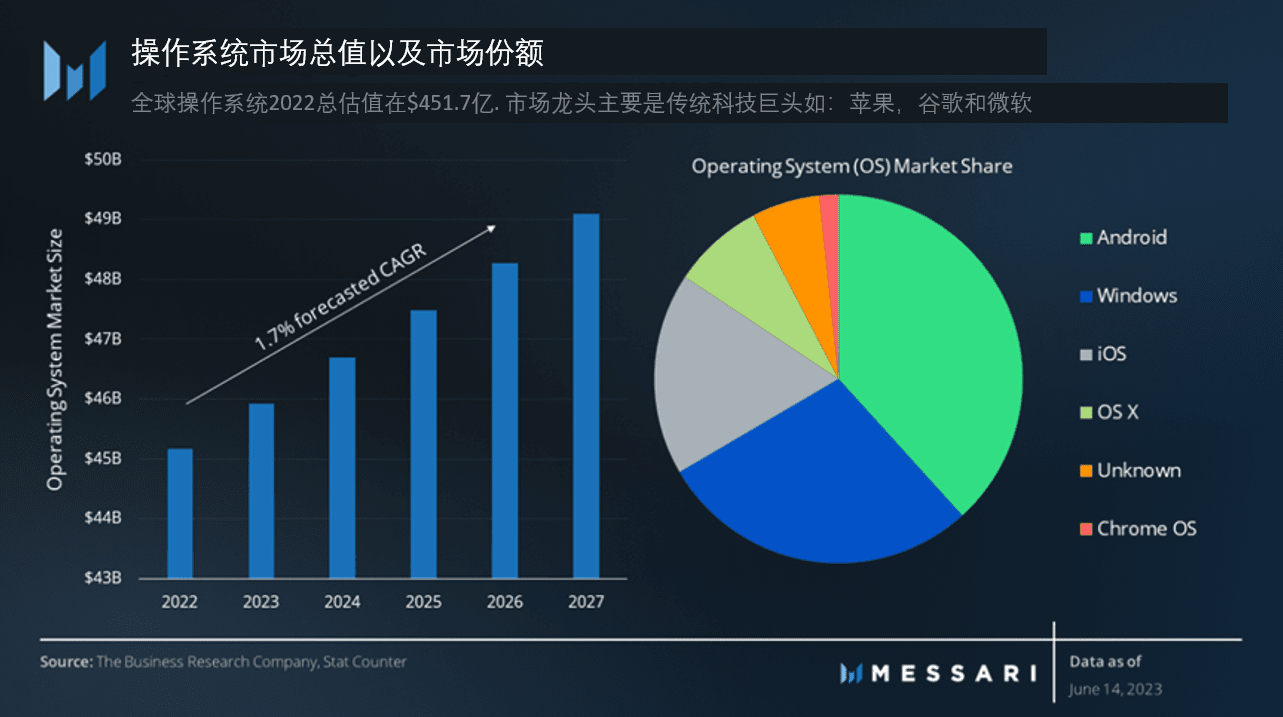
The global operating system market is expected to grow from US$45.17 billion in 2022 to US$49.10 billion in 2027, with a compound annual growth rate of 1.7%, covering multiple major players. Among the leading companies, traditional technology giants Microsoft, Apple and Google occupy important positions. Microsoft occupies an important position in the desktop, tablet and game console operating system markets with its widely used Windows operating system. Apple has significant influence in the mobile and desktop fields with its iOS and macOS operating systems respectively. Google, on the other hand, is the creator of the Android operating system, which is the most widely used mobile operating system in the world, and also develops Chrome OS, mainly for laptops and desktop computers.
The need for an operating system in the cryptocurrency space
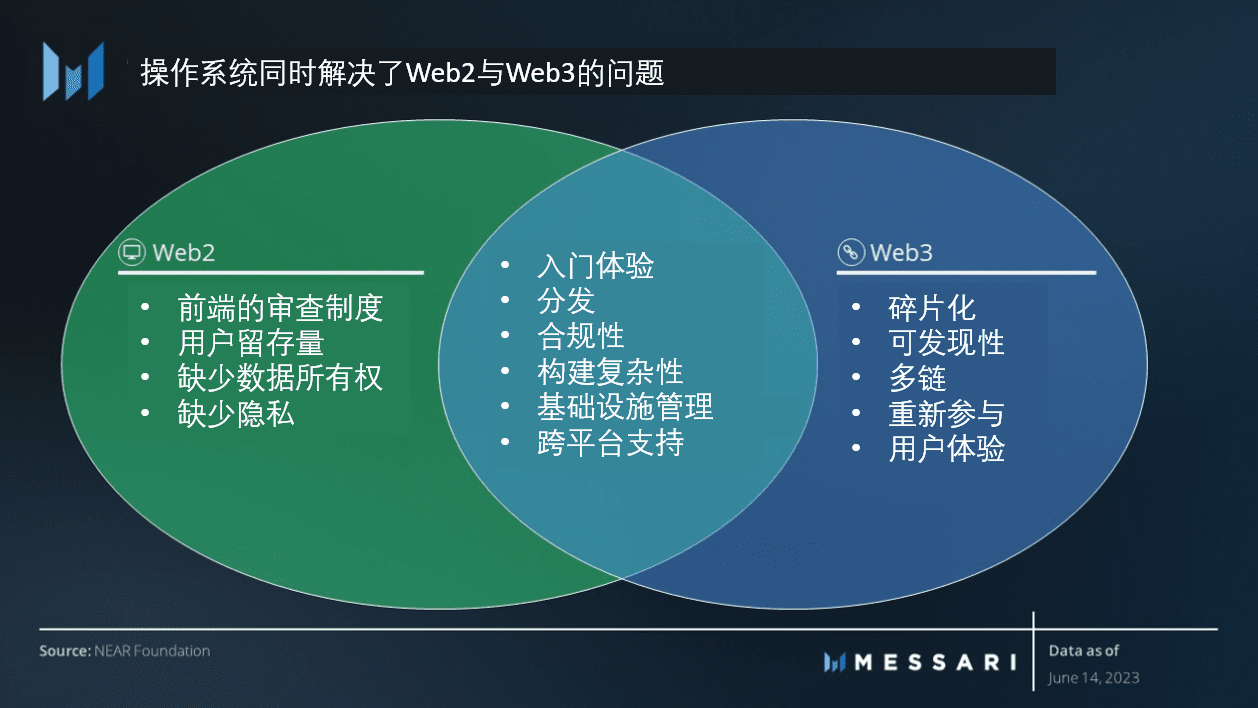
Although decentralization is one of the main attractions of cryptocurrency, ironically, it is also a barrier that hinders the development of blockchain. The complexity faced in Web3 development, complex programming languages, tying projects to specific blockchains without the guarantee of finding and resolving problems, security vulnerabilities, composability issues and poor user experience have created a considerable barrier to entry for developers.
These issues have slowed down the growth of cryptocurrencies and prevented more developers and users from getting involved. As a result, most people still don’t use cryptocurrencies because there aren’t enough practical applications for blockchain overall.
Introduction to blockchain operating system
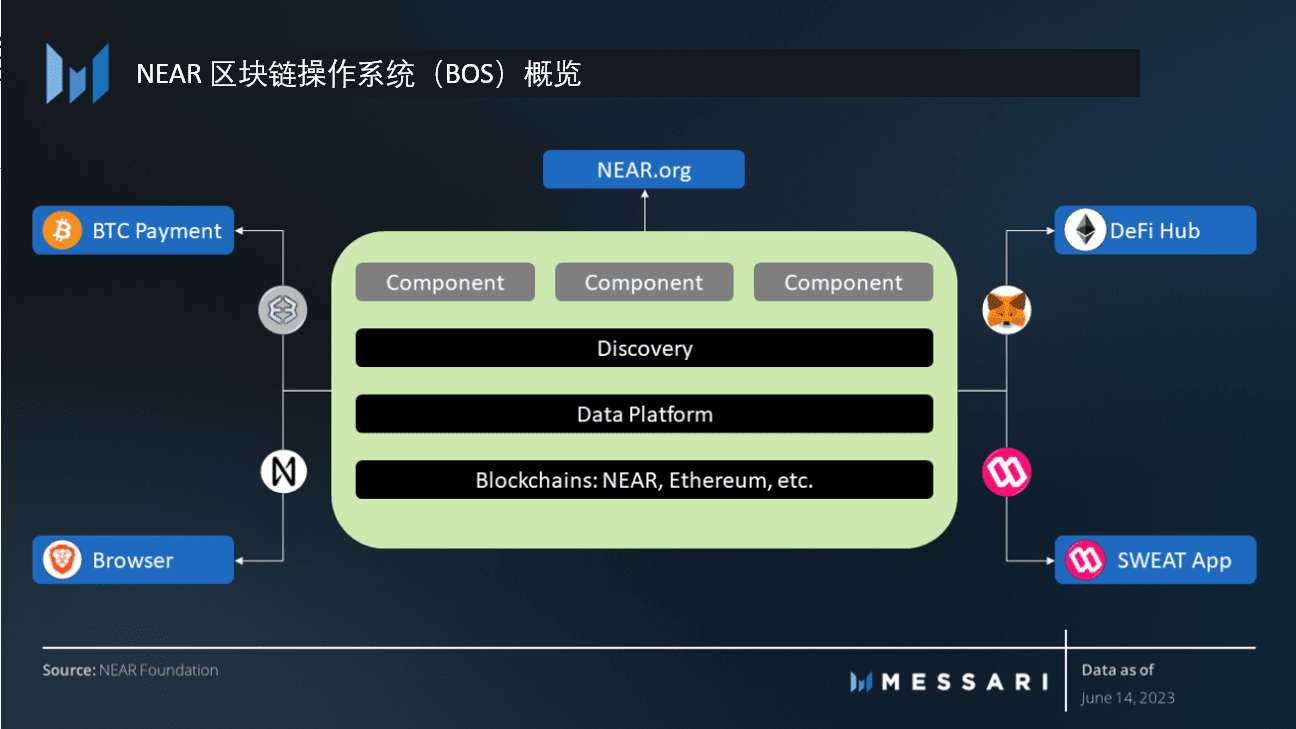
In response to the challenges faced by developers and users, NEAR launched the Blockchain Operating System (BOS) on March 2, 2023. BOS is an open source platform that developers can use familiar programming languages and most components on, enabling it to be built on any blockchain. At the same time, it provides users with the opportunity to connect with various communities and applications while ensuring data privacy without having to own cryptocurrency at the beginning, greatly improving the onboarding process.
By providing a unified, interoperable platform, BOS solves the complexity of Web3 and the limitations of Web2 due to centralization. The platform enables seamless interaction between various blockchains, eliminating the complexity associated with token swaps, exchanges, and multiple identity management. Its design emphasizes user accessibility, providing a simple and clear access process and improved application discovery capabilities.
Components of a blockchain operating system
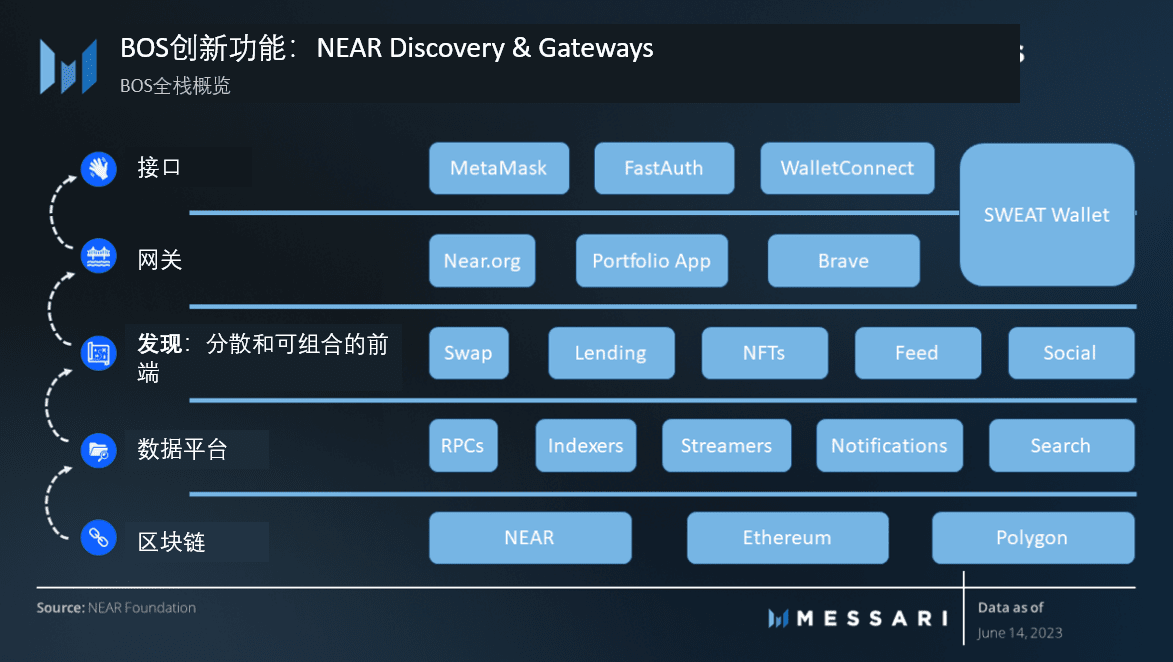
BOS represents a comprehensive blockchain technology stack that serves as a comprehensive framework for developers and users. The core concept of its design is decentralized, composable front-ends, which were previously missing layers in the cryptocurrency ecosystem. These front-ends are stored on the blockchain instead of centralized data servers, making applications highly composable and censorship-resistant. Developers can fork these front-ends in whole or in part to create their own applications, similar to Google's Material Design for React, but with wider connectivity and functionality.
A key advantage of BOS is its potential to break down the factionalism that currently exists in the cryptocurrency space. By building a consistent experience across multiple blockchains using components that are easily combined and forked, BOS opens the door to future open web developers. Developers can freely access the latest Web3 components from around the world, enabling them to create new projects, start DAOs for community-based projects, and explore countless other possibilities related to NEAR. Essentially, what smart contracts do for services, the frontend in BOS is doing for implementation.
BOS also provides a way to access BOS functionality from anywhere through its gateway functionality definition. While NEAR.org currently serves as the primary gateway, there are many other gateways being developed and integrated with BOS. In essence, BOS acts as a two-sided platform that meets the needs of developers and users, leveraging the advantages of decentralization through its innovative combination approach while mitigating potential disadvantages.
Main features of BOS
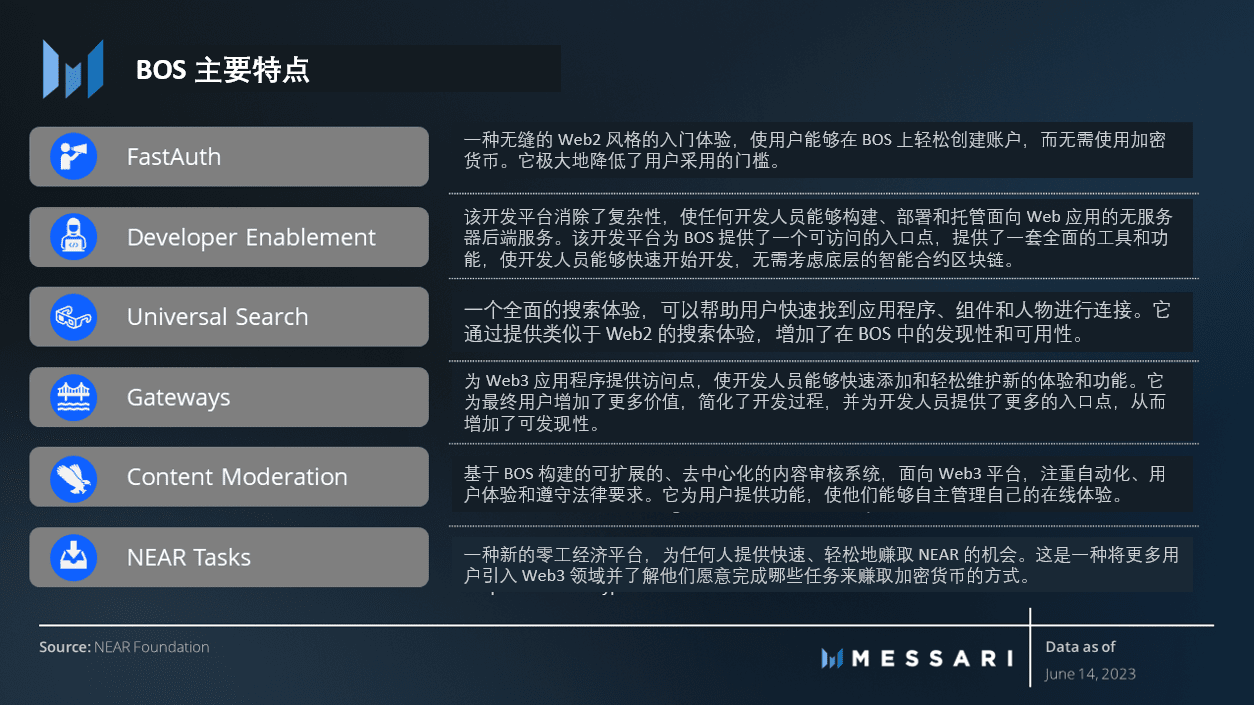
NEAR’s BOS introduces innovative and powerful elements. It aims to improve the accessibility, discoverability, and functionality of cryptocurrency applications while maintaining a user-friendly experience.
FastAuth: Simplifies the process of onboarding users to Web3 applications by providing a familiar Web2-style experience. Users can quickly create a free account using biometrics and email, without the need for a password or cryptocurrency. It leverages NEAR’s meta transactions and zero-balance accounts to enable initial interactions for free user sign-up and sponsorship. Future improvements include extending relayers and FastAuth to other gateways, further decentralization, multi-chain compatibility, and two-factor authentication.
Developer Support: BOS provides a set of tools and capabilities that simplify the development process, enabling developers to quickly create and deploy applications. This not only enables rapid prototyping and deployment, but also promotes a more inclusive environment for developers outside of the traditional Web3 space. Developers can code in JavaScript, so there is no need to learn a new programming language to develop in Web3.
Universal Search: BOS integrates comprehensive search capabilities that enable users to quickly find applications, components, and connections within the ecosystem. This feature improves discoverability and usability in BOS, effectively improving the overall user experience.
Gateway: Gateways serve as entry points to access Web3 applications, fetching front-end code directly from the NEAR blockchain. Gateways facilitate the addition of new features to applications, making BOS a more diverse and user-friendly platform. By creating more application entry points, gateways enhance the discoverability and usability of applications.
Trusted and secure content moderation: A scalable, open-source content moderation system. It provides users with a self-governed platform for content moderation, thereby promoting a healthier online environment. This decentralization of control ensures compliance with legal requirements and upholds the ethics of Web3 platforms.
NEAR Tasks: A part-time economy platform that allows users to earn NEAR by completing tasks. This feature adds another layer of user engagement, promoting understanding and adoption of cryptocurrency.
Target customers and impact on them
Blockchain operating systems are designed to serve three main types of users:
Developers: BOS provides developers with a secure, highly distributed Web3 portal. It simplifies the process of building decentralized applications by providing pre-existing components and familiar coding environments (traditional languages such as JavaScript). This lowers the barrier to entry, enables rapid application development and deployment on multiple chains, and facilitates easy access and discovery for users.
Enterprise: For enterprises, BOS opens the door to innovative technical capabilities and business models. It allows the creation and launch of products and experiences that enhance user engagement, potentially leading to new revenue streams.
End-Users: End-users are able to easily enter an improved digital world. BOS provides an easy onboarding experience without the need for cryptocurrency, with a strong application ecosystem and growing community. It maintains the experience users expect while providing privacy protection, control over personal data, and direct connections with other individuals and communities.
Development and adoption metrics
NEAR Social is a decentralized social network built on the NEAR blockchain that serves as the social layer for BOS. It provides a peer-to-peer network for social interaction, content creation, and distribution. Users own their data, developers can access public data to create applications, and customizable widgets promote innovation. Today, NEAR Social is a central hub of activity on BOS, so we will take a deep dive into its development and adoption metrics.
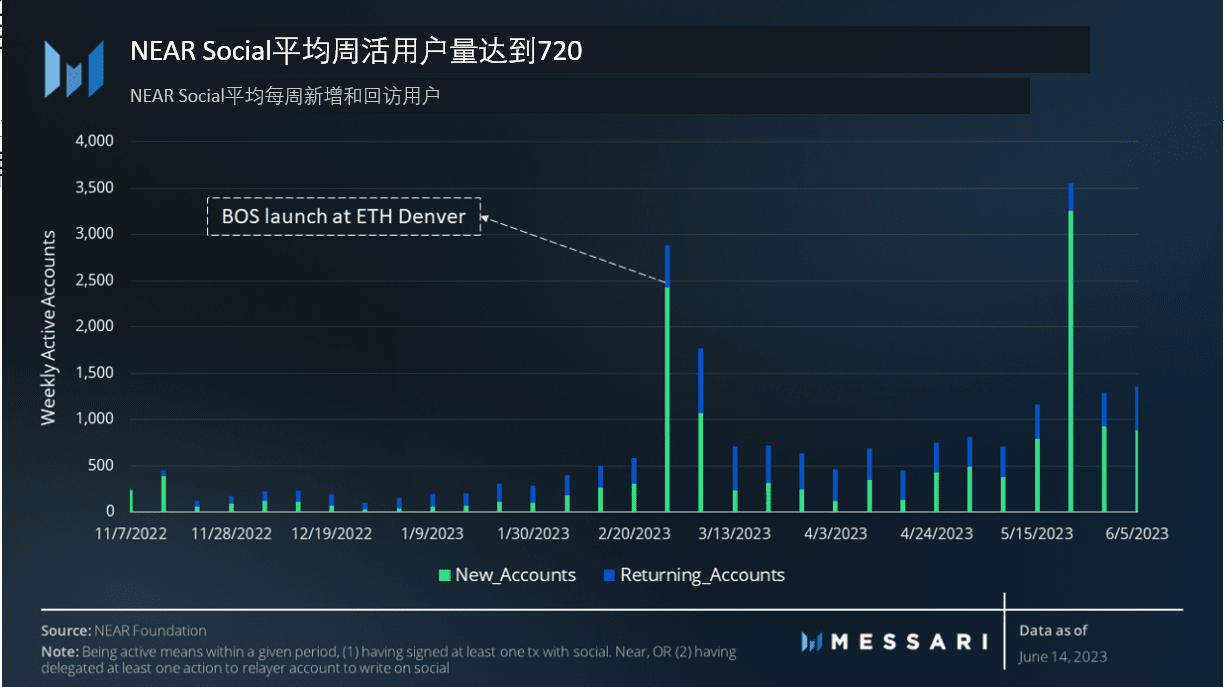
Since launching at ETHDenver on March 2, 2023 via NEAR.org, NEAR Social has shown a positive trajectory in terms of user adoption and activity. The platform has an average of 720 active accounts per week, reaching a cumulative total of 15,000 accounts. An account is classified as "active" if it has either signed at least one transaction with social.near or delegated at least one action to a relay account during a certain period.
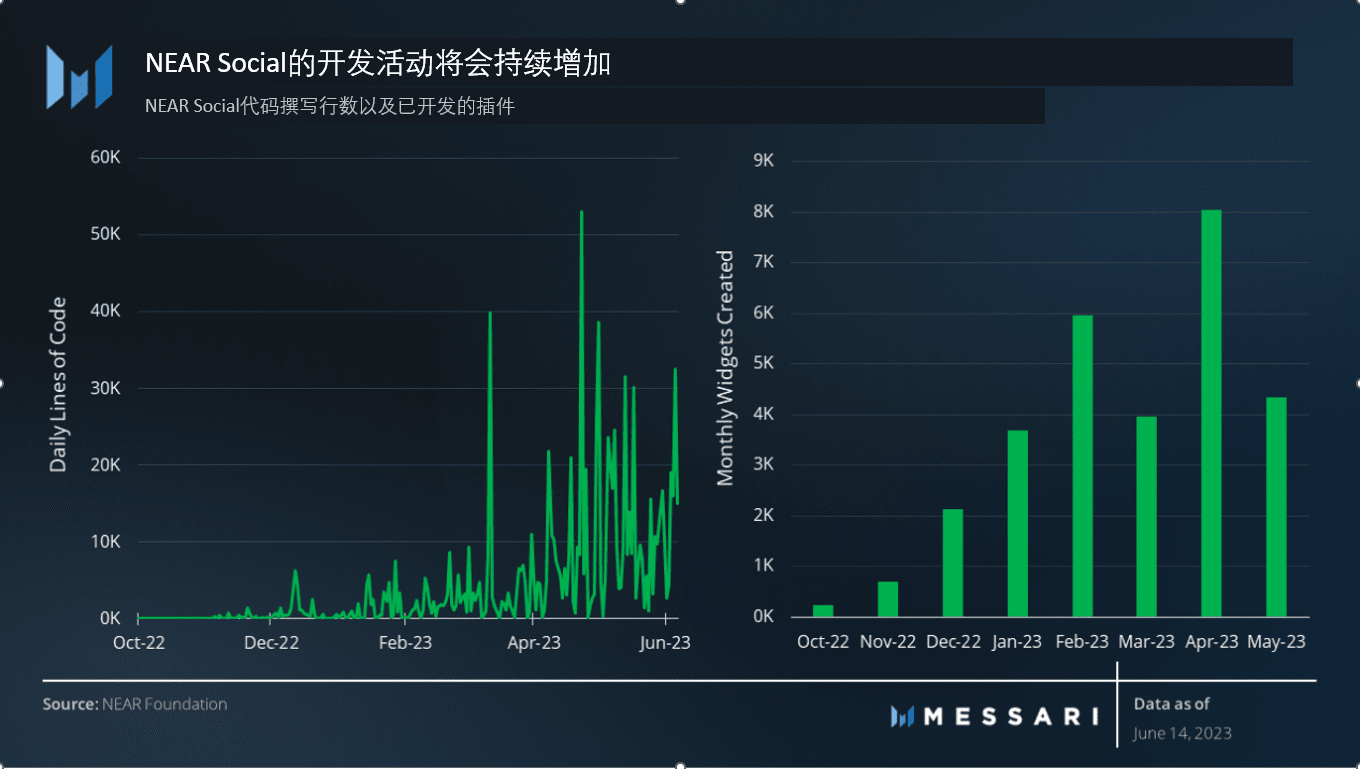
NEAR showed their emphasis on creating a developer-friendly ecosystem in their quarterly report. To incentivize developers, NEAR tokens will be automatically distributed to developers, with 30% of the total transaction fees from the transaction being allocated to the contract that initiated the transaction. In addition, NEAR launched a JavaScript SDK, enabling developers to build in JavaScript in addition to Rust, AssemblyScript, and Solidity. Since the beginning of March, NEAR Social's developer base has grown in all areas.
In addition to the growing developer base, NEAR's metrics also show a healthy growth in the amount of code written and widgets created. Widgets are the building blocks of the Near Social framework. They are reusable open source components that can be used to build applications on top of the SocialDB contract. A widget can be a small component, like a button, or a large component, like a profile page, or even a complete application, like a social network.
Future development and ecosystem components
BOS will continue to be supported by significant attention and development resources. The NEAR Foundation, Pagoda, and other key developers are all committed to its continued growth. However, BOS does not operate in isolation, it is part of a broader ecosystem where several NEAR components are already operational and others are under active development. These elements further enhance the functionality of BOS:
Nightshade: Nightshade is an important part of the NEAR ecosystem, achieving horizontal scalability through sharding design. Phase 0 kicked off this process by introducing four data shards. With the recent launch of Phase 1, the network’s validator capacity has been enhanced by introducing chunk-only producers. The upcoming phase aims to introduce full data and processing sharding as well as dynamic resharding.
Decentralized Funding: The NEAR Foundation is moving towards a more decentralized capital allocation model, delegating decision-making power to community DAOs. Each DAO has specific goals and tasks:
- Marketing DAO: Streamlines the allocation of funds for marketing-oriented initiatives, with a focus on content creation and social media, and welcomes related proposals.
- Developer Governance DAO: Aims to decentralize the NEAR developer ecosystem and promote broad innovation. Currently ramping up activity and considering proposals from technical ecosystem projects.
- Creative DAO: Provides artists and creators with a platform for collaboration and the resources they need to earn money and engage with their audience. It is actively soliciting funding proposals.
NEAR Digital Collective: The NEAR Digital Collective is a governance entity in development that aims to democratize decision-making within the network. The NEAR Digital Collective consists of five main components: a voting body that includes every active NEAR account, a House of Excellence that represents the community in voting and decision-making, an Advisory Board that guides the House of Excellence, a Transparency Council that enforces checks and balances, and a Community Treasury that supports grassroots initiatives on the NEAR blockchain.
NEAR Horizon: NEAR Horizon is a Web3 startup accelerator that provides founders with connections to resources and support to drive the expansion of their projects. The accelerator includes a large network of mentors, service providers, and supporters, establishing a streamlined path for startup growth and development.
Summarize
In summary, NEAR's blockchain operating system (BOS) has the potential to change Web3 by simplifying decentralized development and user adoption. BOS provides a familiar coding environment and a wide range of components, making it easier for developers to build applications. It improves user accessibility, discoverability, and privacy, improving the onboarding experience.
Although BOS is still in its early stages, it has already achieved certain success among developers, users, and projects. NEAR focuses on improving the capabilities of developers, attracting more and more developers and increasing the amount of code. NEAR's decentralized social network NEAR Social shows positive indicators in terms of user adoption and user engagement. Future plans include improved scalability, decentralized fund allocation through community DAO, multi-chain functions, and more. NEAR is BOS.
Original link: https://messari.io/report/near-is-the-bos?referrer=all-research
Translation: YYT | Hu Zi Guan Coin