

The main point
The Binance imposter scam involves criminals posing as Binance employees or representatives to offer fake services designed to steal people's money.
Fraudsters contact potential victims via unofficial emails or social media accounts that are similar to official Binance accounts.
If you fall victim to the Binance imposter scam, immediately report the incident to the relevant local authorities and the Binance Support team.
Protect your account security from Binance impersonators. Learn how scammers build trust along with tips for identifying and reporting fake Binance profiles in this week's edition of Know Your Scam.
Currently, anyone with internet access can create a fake social media profile using the Binance name and logo.
You may find fake Binance profiles in Twitter threads, in the comments section of Instagram posts, or directly contacted via messaging apps like Telegram.
The reality is that we have no control over the moderation of these platforms. Binance imposters can create new accounts in seconds, even after we flag them to the relevant platform moderation team.
If there's one thing you should know about our employees: We will never — under any circumstances — proactively contact users through unofficial channels to offer investment advice, entries for free giveaways, or “back doors” to unlock Binance accounts You.
To help you protect your Binance account, we've outlined the four-step process that Binance imposter scammers typically use and shared some screenshots of Binance scammers we've encountered.
Four Step Process on How Binance Imposters Lure Victims
1. Building a fake identity
First step: crafting the perfect lie. Imposter scams, which we covered in last week's article, typically involve impostors posing as authority figures such as police officers.
However, in this case, the fraudster created a fake identity along with a complicated script to become a Binance employee. They will create fake accounts, complete with the Binance logo or a photo of someone wearing a Binance t-shirt as their profile photo.
Their usernames often include titles like Binance Customer Service, Binance staff-xxx, or Binance Promo, while their email addresses are very similar to official ones.
2. Targeting victims in social groups
Fraudsters will scour the black market for sensitive personal data, including phone numbers, emails, identity credentials, and even previous purchase and travel records. These incorrectly obtained details are then carefully filtered to identify potential victims who are most likely to be manipulated.
Some scammers prefer to lure new victims by creating “official Binance” groups — said to be led by real Binance employees — that offer investment advice and profitable opportunities to make money.
3. Gain trust and persuade
Fraudsters now begin to build trust through carefully designed scripts for their newly acquired targets. The goal is to build a rapport with the victim, create a false sense of familiarity and, ultimately, lure them into the fraud scheme.
Advanced con artists show an impressive ability to adapt to situations, persist in their efforts, and quickly improvise their responses, even when the target victim appears unresponsive or uncooperative at first.
4. Closing
The victim believes the fraudster's fake identity. They will follow the fraudster's request to send funds or, worse, provide their Binance login credentials. With access to a victim's Binance account, fraudsters could potentially empty the account's entire crypto balance into their wallet before the victim regains access.
To illustrate how this four-step process works in practice, we have provided some real-life cases below.
Action Example
Example 1: Insider trading information — Binance WhatsApp group
The user, let's call him Mark, is still new to the crypto world. He was contacted by a “Binance analyst” named Morris.
Via an Instagram message, Morris told Mark about a WhatsApp group that shared crypto investment advice and insider trading information, with guaranteed returns of up to 20%. Morris invited Mark into a group that included several “Binance employees” who regularly posted guides on how to make money, along with group members who shared their big wins.
Mark also noticed that “Binance employees” answered every question professionally. Convinced that this was a legitimate group, Mark followed a tutorial that instructed him to withdraw tokens to the scammer's wallet address.
Of course, none of this is genuine and Mark finds himself the victim of an imposter scam.
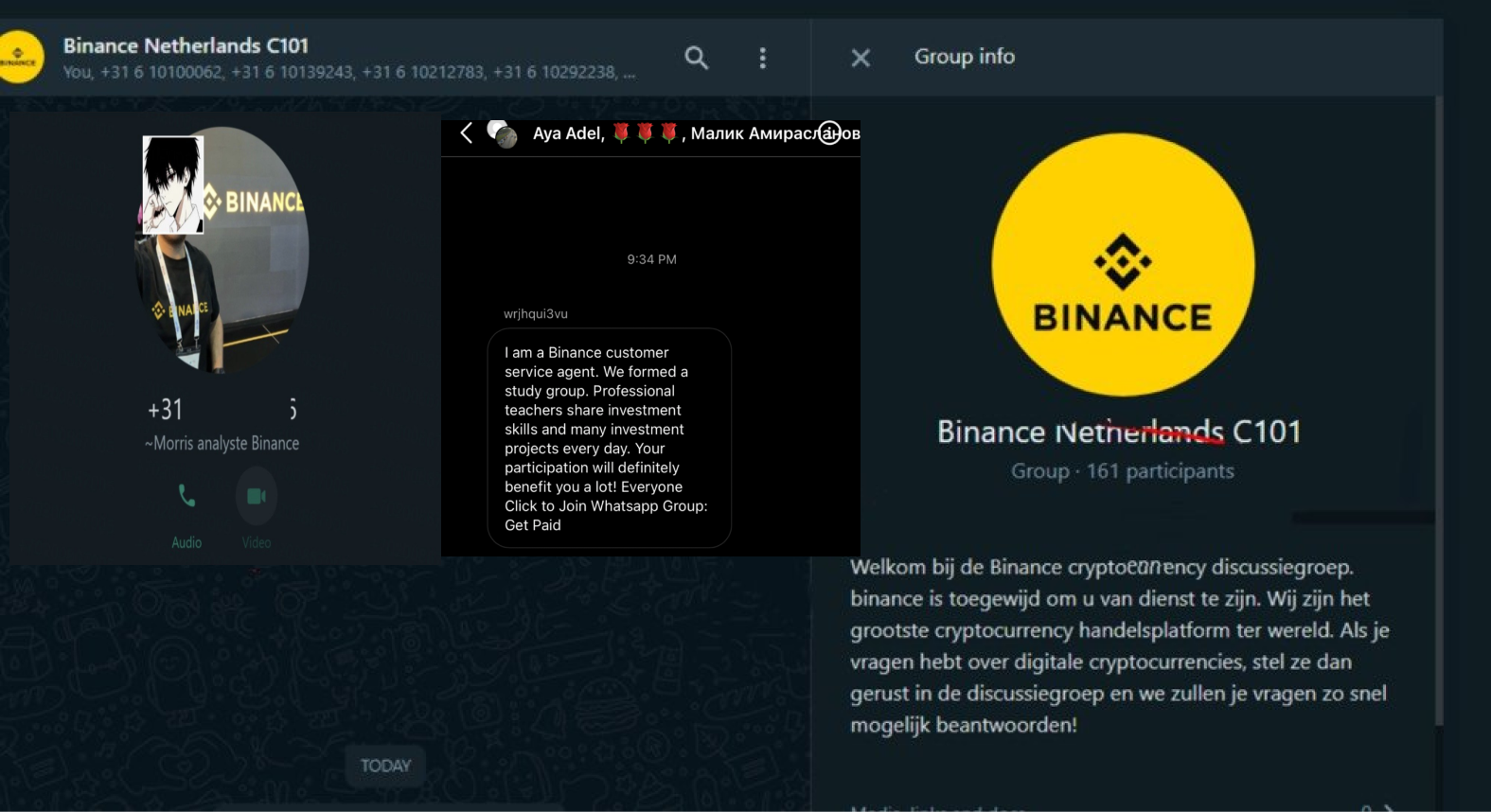
“Welcome to the Binance cryptocurrency discussion group. Binance is dedicated to serving you. We are the world's largest crypto trading platform. If you have any questions about crypto, please ask in the group and we will answer them as soon as possible.” - Indonesian translation of the scam WhatsApp group description.
Example 2: “Binance trading expert”
Social media platforms like Instagram are full of fake profiles claiming they are affiliated with or employed by Binance. For example, in a recent case, fraudsters deliberately put the account name @binance in their bio. Note that their bio also includes various keywords such as “Expert Trader” and “Investment Specialist”.
Unfortunately, criminals often try to leverage our influence and reputation in the crypto sector — trusted by millions of users globally — to prey on unsuspecting victims. Binance employees are strictly prohibited from trading or offering investment advice. Don't trust any “Binance employee” who claims to be a trading or investing guru. Regarding affiliates and KOLs, although we rigorously vet them all to ensure their content is good, their views and opinions do not necessarily reflect ours.
An easy way to identify a fake Instagram profile is to check the number of followers it has compared to the number of likes or comments it receives. If there is a significant mismatch, for example, 25,000 followers but only 100 likes and two comments per post — this may be a fake profile.

Another example
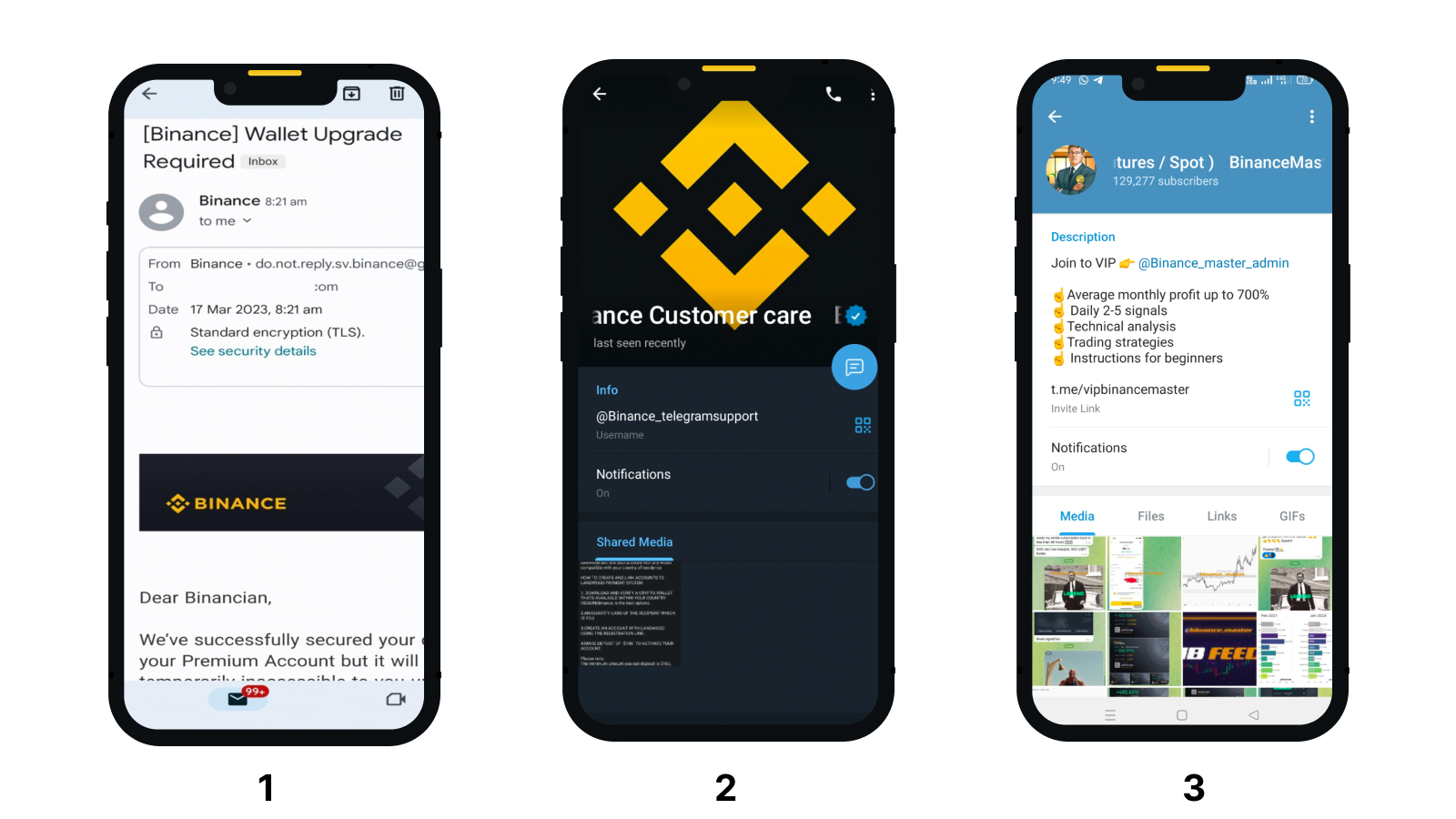
Wallet upgrade. Users receive a fake Binance email from 'do.not.reply.sv.binance@gmail.com' asking them to "update their app". You will see the email address says gmail.com instead of our official domain, which is binance.com.
Binance Customer Service. These scammers try to defraud users by posing as Binance Support employees under the pseudonym “Binance Customer Service.”
Binance VIP. These scammers provide fake crypto investment advice by posing as Binance employees who help run Binance VIP, our benefits program for institutional and high-volume professional traders.
Tips to Protect Yourself from Binance Imposter Scams
Be wary of people claiming to be Binance staff
Don't immediately trust “Binance employees” who contact you via telephone or social media such as Telegram, WhatsApp, Instagram, etc. Our employees will never proactively message users through unauthorized channels to provide investment advice, giveaway entries, or account unlocking services.
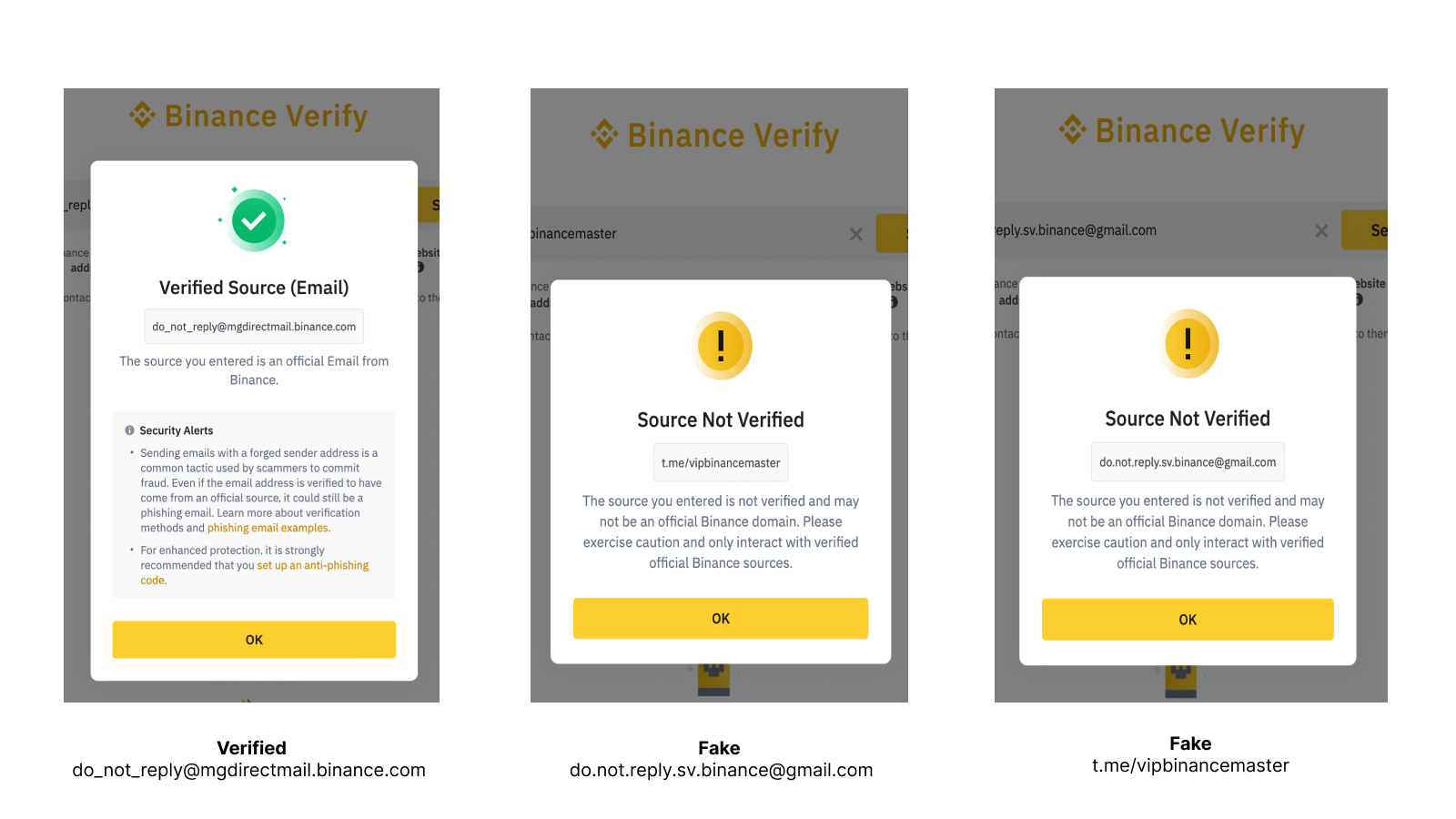
Pay attention to the username or email address, especially the domain name at the end. You can verify the authenticity of email addresses and website links on Binance Verify. Users should remain cautious if links appear as “Verified” and avoid links that appear as “Unverified Sources”.
Protect your personal information
To protect yourself from potential fraud, you must keep your personal information secure, including your travel and shopping history and contact details.
As mentioned earlier in this article, fraudsters will often use the dark web to obtain carelessly managed personal data to find their next target.
If You Have Been a Victim of Fraud
If you have been scammed, beware of further attempts by the same scammer and do not perform any withdrawal or transfer process performed by a stranger.
You are advised to seek assistance from local government authorities if you fall victim to the Binance imposter scam. If your Binance account has been compromised, file a report immediately by following the steps outlined in this guide: How to Report Fraud at Binance Support.
We also encourage all users, both new and old, to read our anti-fraud series to better equip themselves to fight prevalent crypto scams.
Further Reading
(Blog) Know Your Scam: The Ultimate Guide to the Most Common Crypto Scams
(Blog) Know Your Scam: Fake Crypto Investments to Watch Out for
(Blog) Know Your Scam: Red Flags to Spot an Imposter Scam
(Blog) Know Your Scam: Job Vacancies Scams to Watch Out for
Disclaimer and Risk Warning: This content is presented to you on an “as is” basis for general information and educational purposes only without representation or warranty of any kind. This content should not be considered financial advice nor is it intended to suggest the purchase of any particular product or service. Digital asset prices can be volatile. The value of your investment may fall or rise. You may not get back the amount invested. You are fully responsible for your investment decisions. Binance is not responsible for any losses you may experience. Not financial advice. For more information, read our Terms of Use and Risk Warning.