
Lido Protocol's data soared in May
With solid fundamentals, a strong ecosystem and a trusted community, Lido Finance, the largest liquidity staking protocol, has become the LSD staking platform with the highest market share, and can be said to be a successful example of the DeFi ecosystem.
The income of Lido Protocol comes from charging users 10% of the staking rewards as fees, which are distributed to Lido DAO, node operators and insurance funds. After the launch of Lido V2, due to the flexibility of users to exchange stETH back to ETH, its staking data continued to rise, and its revenue in May surged by 22%, making it the fastest growing DeFi protocol in terms of revenue.
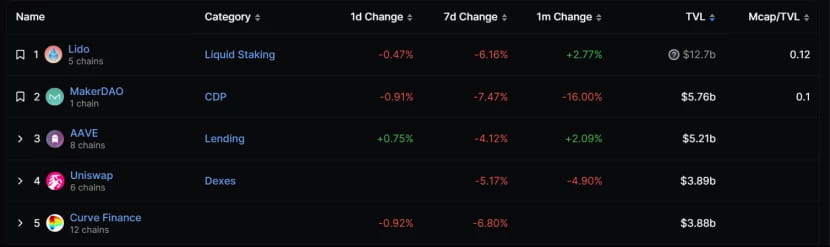
Judging from the TVL data, Lido has become the largest DeFi protocol with an asset value of US$12.7 billion, and its TVL is more than twice that of the second-ranked Makerdao.
Lido’s TVL has been rising since the beginning of this year and has benefited from the implementation of Ethereum’s Shanghai upgrade. Since the launch of Lido V2, its TVL has risen by 15%.
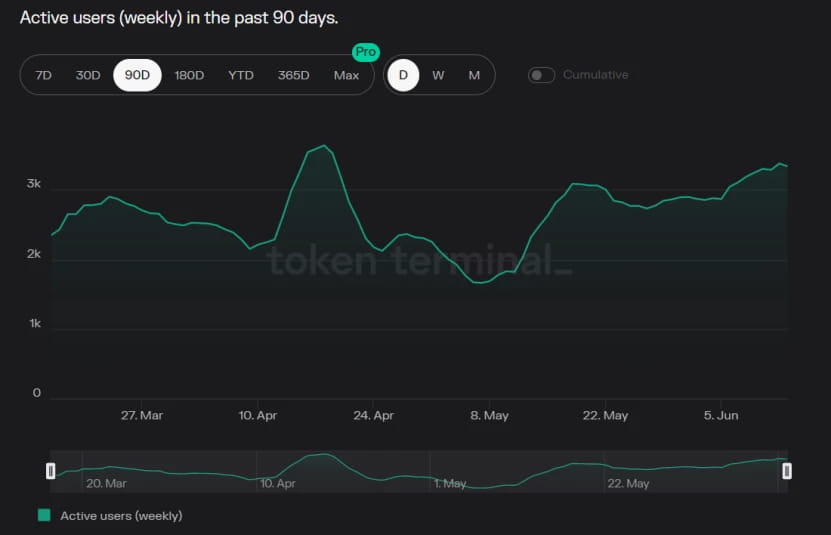
Since most of the liquidity on Lido is made up of ETH, the increase in TVL shows that stakers are returning to the protocol to lock up more tokens. This is also evidenced by the steady increase in active users of the Lido protocol over the last month, as shown in the above figure.
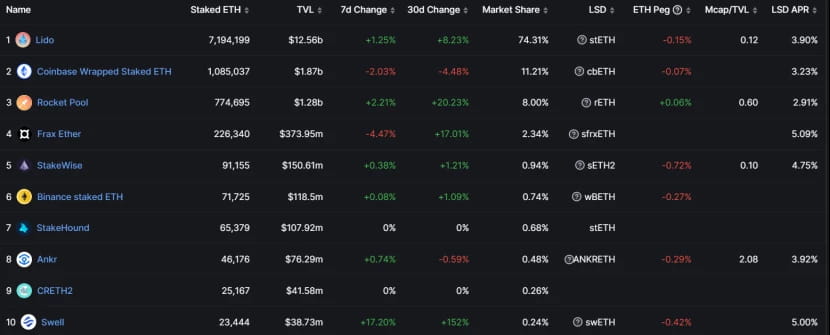
Judging from the ratio of LSD APR and the market value/TVL of the protocol's native token, Lido's data is basically not inferior to other competitors. It is a type with high security and stable returns, which is also an important reason for its stable position.
Lido's main competitive advantages
Lido mainly gains continuous advantages from: 1) natural advantages of LSD; 2) long-term stable operation.
First of all, stETH has a natural advantage, and its holders benefit from the deep liquidity of the token, making it one of the liquid collateral options favored by hardcore users. The extensive collateral integration in DeFi increases the use cases of the token. stETH can be used throughout the Defi ecosystem, either to provide liquidity for exchange pools on Lido or other platforms, or to lend it out on certain platforms. For mature capital seeking the best combination of investment properties, it is obviously more attractive than ordinary LSD, which further enhances the competitive advantage of Lido's collateralized derivatives.
Lido has been operating smoothly for many years since its launch. The gap between Lido and its closest competitors (Rocker Pool, Frax) will become larger and larger as time goes by. At the same time, it will extract profits and squeeze the market space of other competitors, making it more and more popular. More and more stakers are choosing Lido.
Lido's Decentralization Persistence
First, Lido is actively operating using a DAO governance structure. Lido supporters can use LDO tokens to vote on proposed updates to the platform and participate in decisions about the overall direction of the organization.
Secondly, the launch of Lido V2 also marks a further step on the road to decentralization. In V2’s staking route, anyone can develop an entrance for new node operators, from independent validators to DAO organizations to distributed validator technology (DVT) clusters, thereby creating a more diverse validator ecosystem together. .
Moreover, Lido’s Ethereum staking protocol upgrade supports the buffer pool, allowing stETH holders to quickly withdraw their stakes from Lido, achieving a key milestone in the Ethereum staking ecosystem that truly “allows staking” + “withdraws from staking”.
In addition, Lido is recruiting more Lido node operators to increase the diversity of its underlying layer. At the same time, Lido's execution layer client diversity has also improved in the past two quarters. Lido has been adhering to the diversification of operators and validators to reduce the risk of disconnection or censorship while maintaining network performance and neutrality.
Lido's Dual Governance Mechanism Proposal
While adhering to decentralization, Lido is also looking for ways to reduce the risks of its own system. The dual governance proposal of LDO+stETH is an attempt at self-improvement. The Lido ecosystem is currently governed by its protocol token LDO, which gives users the power to vote on activities, upgrades and changes on the platform. The price of stETH maintains a 1:1 redemption ratio with ETH, and the coin represents the ETH holdings staked by users.
Considering the huge amount of staked ETH controlled by the protocol, Lido’s core developers believe that they must change the governance model of Lido DAO and propose a dual governance proposal of “LDO+stETH” to resist moral hazard (Lido’s staked ETH has now reached 7.19 million ETH, 1 million more than when the proposal was made). The proposal aims to solve the principal-agent problem that arises in the current state of governance, where LDO holders (agents) may act in their own interests and ignore the interests of stETH holders (principals).
In fact, pledgers are more concerned about the interests of the Ethereum network, and the interests of LDO holders are not completely consistent with it. In the worst-case scenario, LDO holders could theoretically do evil and steal the ETH staked in the smart contract and abuse their control over the liquidity staking code. This is because Lido DAO has the ability to upgrade the stETH contract to enable it to destroy stETH from any address and mint it to other addresses. This means that although the DAO does not directly control the ETH backing stETH, it can, by modifying the code, steal funds from users, destroy their stETH and mint it elsewhere.
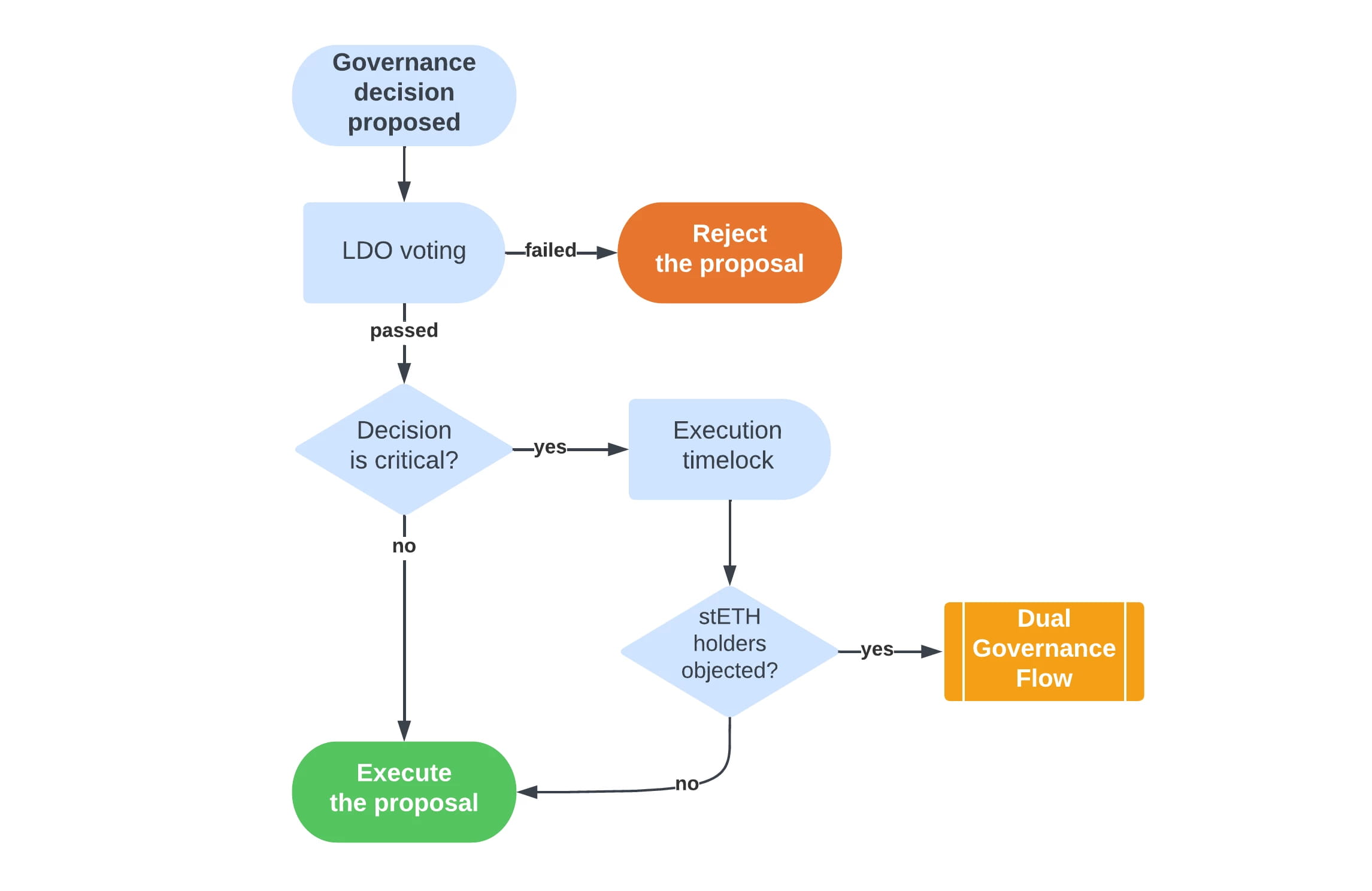
The goal of proposing a dual governance solution is to better align the incentives of both parties and prevent such incidents from happening. Under this solution, LDO holders can still propose changes to the protocol, but stETH holders also gain veto power and have the right to reject proposals that are considered "critical governance decisions." This is critical to protecting the interests of stakers and preventing governance from being controlled or the protocol from being unbalanced.
Although this proposal has not yet been implemented, as the number of stETH continues to rise, the dual governance proposal will be put on the table for discussion again.
Lido benefits from SEC regulation of CEX staking
Last week, the SEC sued Binance and Coinbase. The scope of the charges against the two exchanges varies, but there is a common theme - the SEC is going after the staking services that the two CEXs provide to their US users. While the SEC's complaint does not target Ethereum staking solutions, the agency has hinted at their willingness to go after Ethereum staking.
In February of this year, as part of a settlement agreement with the SEC, Kraken was forced to terminate its Ethereum staking service for US users, with SEC Chairman Gensler claiming that “everyone in this market should be aware of this.” The SEC’s investigation into staking on centralized exchanges will further help Lido gain a larger share of the ETH staking market.
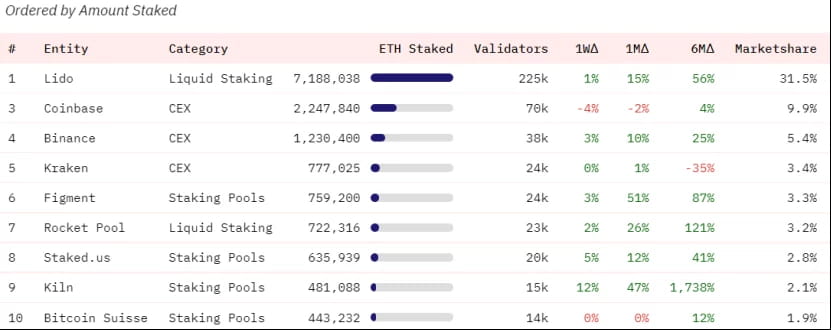
Despite the opening of withdrawals following the Shanghai upgrade, Lido has maintained its dominance over Ethereum staking, with deposits increasing by over 900,000 ETH (15%) this month. Lido’s market share increased from 31.4% to 31.5% – proving that the protocol has turned past success into a continuation of future dominance.
Risks of excessive growth in Lido staking
After voting overwhelmingly against self-limiting deposits in June 2022, the Lido Governance Organization continues to ignore the threat posed by its rising stake percentage. On the surface, self-limiting deposits is against the best interests of LDO token holders and hurts Lido’s profitability, but the risks to the entire staking system of not self-limiting are also very real.
Recently, a growing number of Ethereum holders have begun to oppose Lido, with some arguing that if Lido refuses to self-limit, the community should forcibly correct its behavior. While this argument is worrying, it is unlikely that we will see such controls implemented at the base layer, as it would involve a hard fork that could potentially undermine Ethereum's fragile social consensus layer.
Ethereum developers such as Danny Ryan have warned of the dangers of staking “cartelization,” noting that Lido can extract high profits compared to non-staking pool capital. Ethereum supporter Bankless’ report states that the Lido community should be concerned about the prospect of excessive growth in its stake share (staking centralization), thereby suppressing future demand for Ethereum block space.
Currently, the platform’s stake is approaching the first threshold, which is approximately 33.3% of ETH staked. In theory, if this threshold is reached, Ethereum will be more easily manipulated by attackers. This will lead to the degradation of the core attributes of Ethereum’s value proposition, thereby providing potential attackers with greater power over the chain. If Lido continues to grow at an uncontrolled rate, it will inevitably exceed these thresholds and pose a systemic risk to the ecosystem. Therefore, the continued rise in the staked share is a double-edged sword for Lido, and Lido itself still has a long way to go in terms of decentralization and the improvement of systemic risks.