
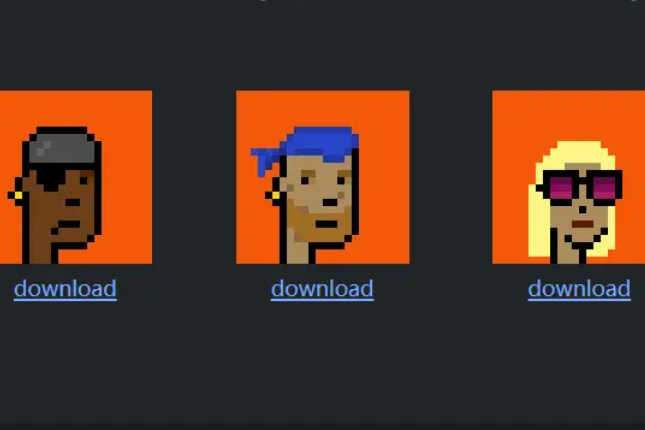

As one of the most classic NFT characters on Ethereum, the crypto-punk image represents a spirit. Owning it is a symbol of identity and has become an ever-attractive narrative. It seems that with the rise of each new chain, the crypto-punk image becomes the first object to be transplanted, and thus we see various on-chain punks, and numerous punk derivatives and synthetic characters.
With the rise of NFT narratives in the Bitcoin ecosystem, various crypto-punks have begun to appear in the BTC network and have been popular among crypto collectors. As the first 10K collection of Bitcoin Punks minted for free using Ordinals, it was sold out in less than a day, and its floor price once exceeded 4 BTC.
After Ordinals, the NFT infrastructure of the BTC ecosystem continued to grow, among which the recursive inscriptions are worth mentioning.
As a new thing in the BTC ecosystem, Recursive Inscriptions ushered in the launch of the first Recursive Punks after its launch. With the community's enthusiasm, 10,000 Recursive Punks were quickly burned and then quickly launched on the MagicEden market. The total daily transaction volume on the platform reached 8.15 bitcoins, becoming the number one series in terms of total transaction volume on the platform. Its highest price once rose to 0.002 bitcoins, an increase of up to 30 times relative to the burning cost. In addition, several punks with rare attributes were traded at a price of 0.05 bitcoins, and the number of their holders increased by more than 2,000 overnight.
The dramatic thing is that users found that the Recursive Punk they burned was blank. After checking the code, they found that this was because the official developer of Recursive Punk used the wrong recursive inscription syntax, and mistakenly wrote "/content/" as "/-/content/:", which caused the inscriptions of users who burned with the official SVG file to be blank. So the community launched a correct repair version, which replaced the "/-/content/:" in the original SVG file with "/content/", which triggered the dispute over the true and false Recursive Punk.
The battle between real and fake punk
On June 13, Recursive Punks on Bitcoin was officially launched and was welcomed by the community. A total of 10K Recursive Punks were burned in a short time. However, after the burning was completed, some users claimed that their Recursive Punks were blank. After verification, it was found that this was because the official Recursive Punks used the deprecated old version syntax "/-/content/:". According to the code update released by developer Casey Rodarmor, the correct writing should be "/-/content/:", which resulted in the inscription generated by the user based on the official SVG file burning without the image.
Syntax update released by Recursive Inscriptions developers
Subsequently, the community launched the v2 version of Recursive Punks, which corrected the syntax errors of the previous official version, that is, replacing the "/-/content/:" in the original SVG file with the correct "/content/". The corrected version was burned relatively slowly, and the images of Recursive Punks can be displayed correctly and clearly. This version was also burned after 24 hours. The community believes that the data source of the official release version is hosted on github, which is not in line with the spirit of decentralization and will mislead the community, so the real Recursive Punks, that is, the v2 version of Recursive Punks, was created.
As a result, Recursive Punks has two versions, the official version v1 and the community-initiated version v2. The v2 version has also been officially recognized by Recursive Punks. In an official tweet, Recursive Punks expressed the hope that protocol developers and the community can recognize both the version without pictures and the version with pictures.
However, Recursive Punks deleted the tweet shortly afterwards and then launched a collection of the picture-free version on MagicEden.
The official tweet has now been deleted
Surprisingly, Recursive Punks, which originally could not display images, can display high-definition large images on MagicEden. After studying the code, it was found that Recursive Punks officially used front-end rendering instead of recursive inscriptions.
However, as the first project on the new protocol Recursive Inscriptions, the official version still has a stronger and wider consensus, and the following data speaks for itself.
MagicEden data shows that the Recursive Punks series without pictures, which is based on incorrect syntax burning, had a total transaction volume of 8.15 bitcoins on the first day of its launch, becoming the series with the highest transaction volume on the platform. Its highest price rose to 0.002 bitcoins, which was up to 30 times the burning cost. In addition, several punks with rare properties were traded at a price of 0.05 bitcoins. The number of its holders also increased by more than 2,000 overnight.
In contrast, after the community-initiated illustrated version was launched on the NFT platform Ordyssey, although the number of holding addresses continued to grow, the total transaction volume was 1.3 bitcoins, ranking third in daily transaction volume.
Although it was denounced by some members of the community as fake recursive punk, stored on github, and even strictly speaking this collection does not belong to recursive inscriptions, it was officially released on the protocol earlier and listed on the MagicEden market earlier. In the early stages of the Bitcoin ecosystem when the NFT infrastructure is not yet mature and complete, whether it can be listed in the secondary market and whether it can be indexed will determine the development speed of the series and even become a key factor in its survival.
This leads us to further ask, what is the standard for judging true punk? Is it v 1 of first is first or v2 that uses the correct recursive inscription code?
Pure on-chain recursive punk is stored on Github?
Interestingly, Recursive Punk, which claims to be the first project on "Recursive Inscription", has nothing to do with "Recursive Inscription".
So, what is "recursive inscription"?
In fact, "recursive inscriptions" are created based on the Ordinals protocol of the Bitcoin ecosystem. The Ordinals protocol was initiated by software engineer Casey Rodarmor in January 2023. It supports engraving data on Bitcoin in the smallest unit of satoshis (or sats) in a unique way to generate Ordinals inscriptions similar to NFTs.
The rise of Ordinals has brought new possibilities to the Bitcoin network. Compared with Ethereum, images in the Bitcoin network are completely stored on the chain and are permanent. The narrative of "permanent storage on the chain" is not only full of romance, but also makes the Bitcoin ecosystem full of infinite imagination.
Recursive Inscriptions, also initiated by the founder of Ordinals, is a further development based on Ordinals.
Due to objective conditions, the inscriptions on Ordinals have an upper limit - they can only hold a maximum of 4 MB of capacity, while recursive inscriptions can achieve higher storage efficiency and interoperability, allowing the size of inscriptions to break through the previous 4 MB capacity limit of Bitcoin blocks, which means that a large number of files, such as video games, movies, or complex software, can be hosted directly on the Bitcoin blockchain. All of this can be achieved directly on the Bitcoin chain without relying on off-chain parsing. This innovation has brought unlimited creativity to the Ordinals ecosystem and stimulated people's imagination.
However, as the first recursive project launched on Recursive Inscriptions, "Recursive Punks" accidentally adopted the wrong syntax format, resulting in the Recursive Punks burned by users being displayed as blank. This means that this version of Punks is not a true recursive inscription project, and naturally has nothing to do with the permanent on-chain storage of Bitcoin represented by recursive inscriptions.
After Magic Eden was launched, the front-end code was modified to display images normally. The code was not stored on the Bitcoin network, not even on ipfs, but on the centralized hosting warehouse github. This is ironic for a project that focuses on the narrative of "permanent on-chain storage of Bitcoin".
Even so, as the first recursive project on Recursive Inscriptions, "Recursive Punks v1" was quite successful when it was launched. Not only was it minted in a short period of time, but its popularity even caused the website to crash. After it was launched on Magic Eden, the total daily transaction volume reached 8.15 bitcoins, becoming the number one series in terms of total transaction volume on the platform. Its highest price once rose to 0.002 bitcoins, an increase of up to 30 times relative to the burning cost. In addition, several punks with rare attributes were traded at a price of 0.05 bitcoins, and the number of their holders increased by more than 2,000 overnight. As of today, the transaction volume is 13 bitcoins. The transaction volume of V2, which was also launched on Magic Eden, is much less.
New things bring potential opportunities, but also huge risks, especially in the early stages when the infrastructure is not perfect. For the Bitcoin ecosystem, although the NFT narrative has injected new vitality into its ecosystem, its immature infrastructure and disputes that have not yet reached a consensus may cause the crypto assets minted on it to be instantly cleared.
Especially for new projects launched on this nascent protocol, regardless of the fact that the legitimacy of the project itself is still controversial (its value depends on the community's standards for judging true and false punks and the promotion and development of future community consensus), not to mention the underlying protocol "Recursive Inscription" protocol layer on which it relies, and the equally controversial Ordinals, both of which have been resisted by Bitcoin core developers, who believe that the new use cases supported by these protocols will take up the block space of the Bitcoin network, thereby excluding more people from the Bitcoin network, which is not conducive to promoting encryption adoption, and deviates from Satoshi Nakamoto's vision of Bitcoin as a peer-to-peer cash system.
The reliance on the underlying basic protocol may cause developers to modify the original protocol, which may affect the functionality of the software and cause incorrect file storage hashes. Cryptocurrency is a very high-risk investment target, especially when all the underlying infrastructure is not yet perfect and no community consensus has been reached. Investing in such assets carries huge risks. BlockRhythm reminds everyone to think independently before investing, DYOR (do your own research).
Source: https://www.panewslab.com/zh/articledetails/v 05 mnz 61.html