

With the development of the Web3 industry, the number of users and project parties is growing rapidly, and the competition is becoming more and more fierce. How to win in the competition, choosing the right tools is the key. As the saying goes, if you want to do your work well, you must first sharpen your tools. A wise man should use the power of others. Whether users or project parties learn to make good use of Web3 task-based platform tools, they will get twice the result with half the effort.
1. Introduction to web3 task platform
The main business of web3 task platforms is to provide tasks such as following the social accounts of project parties, answering questions, on-chain operations, and task bounties. Users can get points, NFTs, and token rewards after completing them. Web3 task platforms play a role in Web3 introductory education and linking users with project parties. Web3 task platforms started in 2020 when Web 2's social media marketing service provider Gleam.io began to provide services to the web3 industry. Subsequently, web3 task platforms also emerged in large numbers. After two or three years of development, Web3 task tools have emerged in hundreds of projects and are becoming a new traffic center in the crypto world.
2. How users use the web3 task platform
The web3 task platform generally has a relatively good user experience. Some platforms are quite interesting and relatively simple to operate. Therefore, it can be used as an introduction to on-chain operations for newcomers to web3, where they can learn the basics of the web3 industry and understand learning projects or communities.
For experienced web3 practitioners, through the Web3 task management platform, they can access and learn about multiple types of projects and communities on the same platform. Some platforms also have project or community classification and filtering functions. Users can save a lot of time and energy to find high-quality projects that interest them.
For users who want to earn income from airdrops, they can get corresponding rewards by completing tasks on the web3 task platform, such as NFT, POAP, airdrop qualifications, token rewards, etc. The investment cost and risk are relatively low. It is an advanced airdrop aggregation website.
In addition, users can accumulate their own on-chain and off-chain activity proofs by completing tasks on the web3 task platform, which is conducive to building their personal Web3 identity and creating their personal web3 reputation.
3. How do project parties use the web3 task platform?
Project owners can attract users to participate on the platform by issuing tasks and offering rewards to achieve publicity purposes. For new projects in the early stages of development and with a small number of fans, they can achieve relatively better marketing results with the help of the traffic effect of the Web3 task management platform. For mature projects, they can do more activation and retention activities, as well as new user acquisition activities.
It is relatively simple, timely and effective for projects to publish tasks on the web3 platform. Project parties can quickly complete a significant Web3 operation activity and increase the number of users and usage of their projects and products.
Many Web3 task platforms have on-chain and off-chain data analysis functions for users. Project parties can screen out real users based on the data of the task platform and issue rewards, thereby preventing airdrops to invalid users and preventing witch attacks, and achieving precise delivery and precision marketing.
By utilizing the Web3 Task Platform, project owners can initiate multi-project joint marketing activities with other projects or communities on the platform.
Web3 Task Platform has beautiful, multi-dimensional, and refined data dashboard display panels, through which project owners can understand the effectiveness of their activities (conversion rate), whether the user profiles reached are accurate (activity), whether the activity task settings are reasonable (completion rate of each task), etc. Operational strategies can be adjusted dynamically.
4. Six major web3 task platforms
Currently, Web3 task platform tools are flourishing. In common, they are all task-based marketing tools and web3 user growth tools. However, the entry points and focuses of each platform are still different. According to the entry point of the platform, it can be divided into three categories: traffic, education, and vertical segmentation. According to the focus of the business model, the platform can be divided into three types: to C, to B, and to C+to B. VeDAO selected 6 representative projects from the track to give you a brief introduction.
4.1、Galxe

Galxe, formerly known as Project Galaxy, is currently the largest Web3 task platform. As of June 24, 2023, it has cooperated with more than 2,700 project parties/communities, launched more than 10,000 tasks, and has more than 11 million Galxe ID users. Galxe allows project parties to issue NFTs on the platform. Users who meet the conditions can obtain Mint qualifications, and project parties can also provide customized services through the platform's data vouchers. Users can see the tasks released by various projects on the platform, and can find potential airdrops, participate in community activities, and discover new projects.
Galxe has built its own digital identity credential Galxe ID, as well as OAT tokens on the chain. Through the analysis of on-chain data, it labels different users with various tags. For each Quest, a Credential set will also be generated, which will be exported as a whitelist to third parties for application (such as Token distribution).
Most of the tasks launched by Galxe are specific project tasks, mainly following the project party's Twitter, retweeting, joining Discord, on-chain interaction, etc. The rewards for users to complete the tasks are mainly OAT (on-chain achievement NFT) and other NFTs, some of which can be sold. The tasks are many and cumbersome, not suitable for Web3 introductory education, but suitable for airdrop hunters and advanced players to accumulate on-chain interaction records. The platform's business model tends to be to B, and it belongs to a traffic platform.
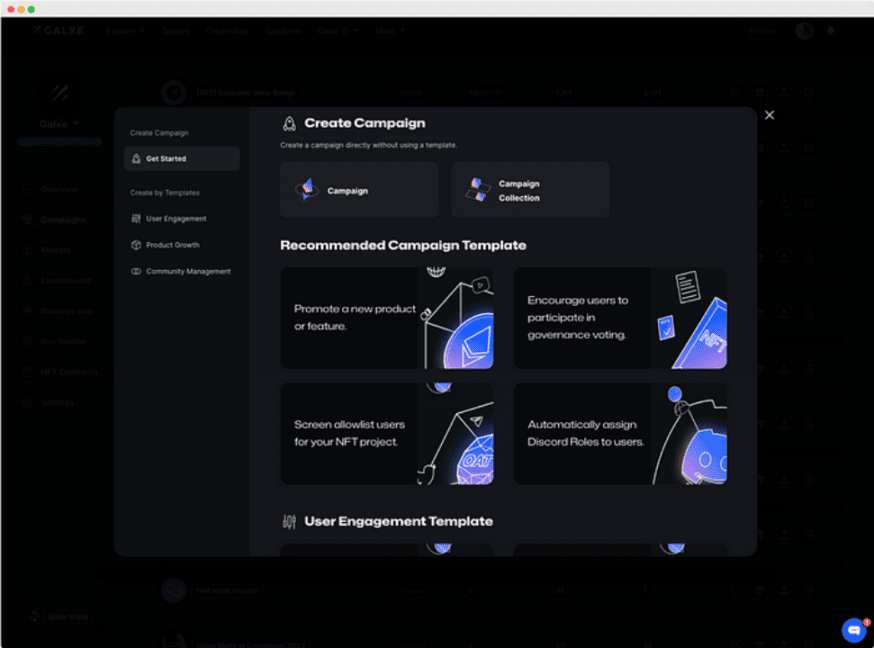
Galxe also has a real-person authentication module: Galxe Passport. After providing KYC information, users can mint an SBT, which is also Galxe's measure to prevent witches. Galxe Credentials are user interaction credentials, which are automatically granted to users by reading the user's on-chain and off-chain interaction records.
4.2. Zealy (formerly Crew3)
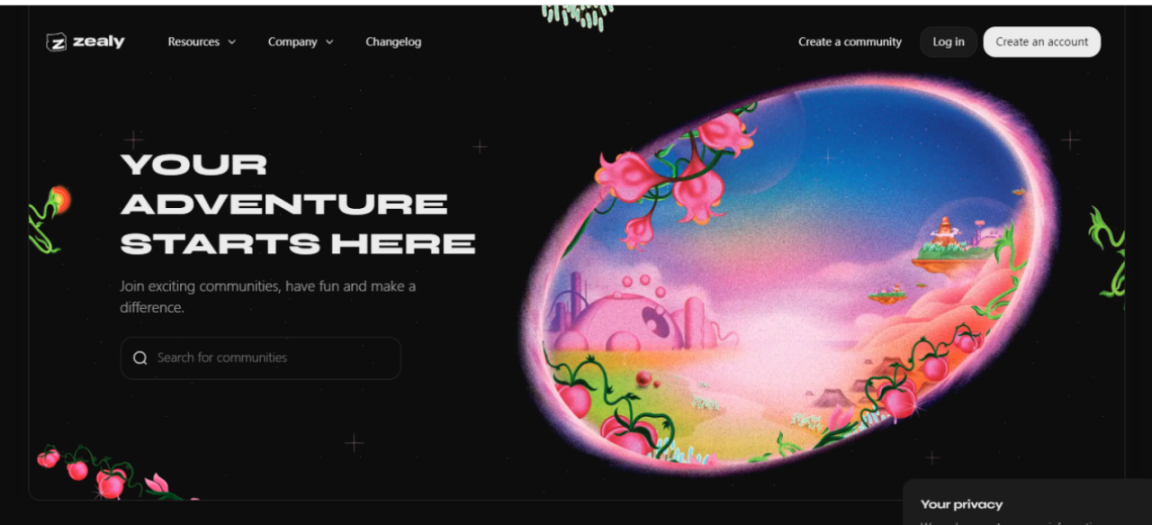
Zealy is a platform that focuses on promoting the community, and its main goal is to help the web3 community grow. Zealy is positioned as a Web3 Discord and has high social attributes. There are many activity templates in the community, including daily check-ins, content creation, invitation tasks and other operational tasks. Compared with other platforms, Zealy is more focused and clearly classified. The platform also has a points ranking system. In Zealy, some project tasks require writing, screenshot proof, invitation and other methods to complete, in order to filter out many automated wool parties and ensure the authenticity of users.
The tasks provided by the platform are basically specific project tasks. Users can complete the tasks by following the project party’s Twitter, retweeting, joining Discord, registering a project account, answering project knowledge questions, etc. Most of the tasks are designed for the project party to market and acquire customers, so the project’s business model is also biased towards B, and it also belongs to a traffic platform.
4.3、QuestN
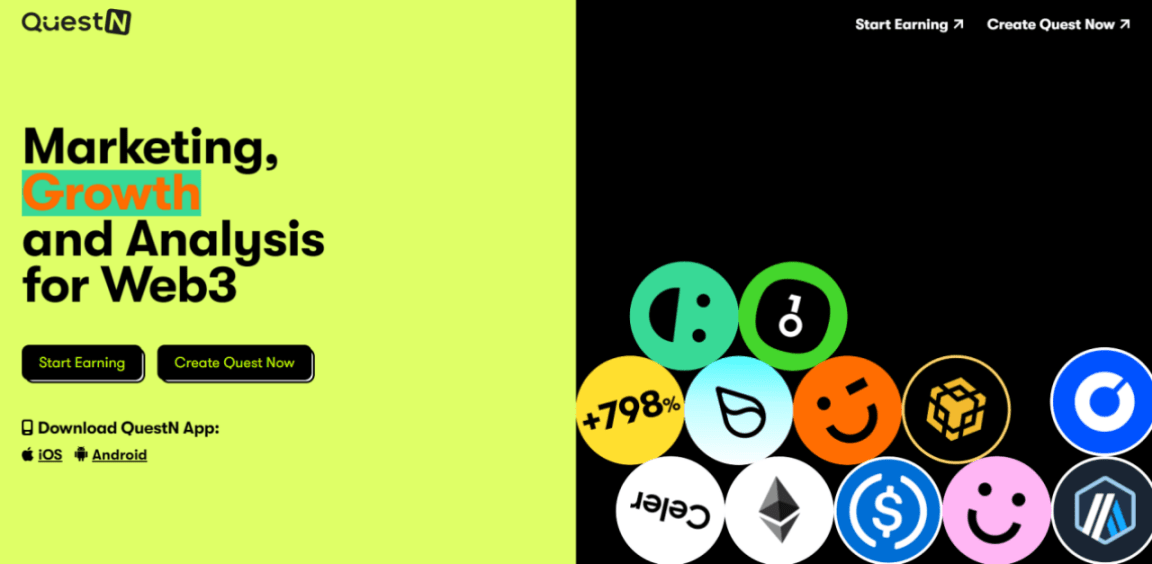
QuestN (formerly Quest3) is a Web3 task activity platform incubated by Hogwarts Labs and is one of the GRT14 donation projects. The platform is a Web3 task voucher platform that serves long-tail B-end users. On most mainstream task voucher platforms, such as RabbitHole and Galxe, only B-end customers with a certain scale can pass the screening of the platform to publish tasks, while QuestN does not set a threshold. Small B-end customers such as KOL, communities, DAOs, etc. can publish tasks. However, in order to ensure the quality of B-end customers, the platform also requires binding to the official website, social accounts, etc. For tasks that provide token rewards, B-end customers are also required to deposit the reward tokens into the vault in advance to play the role of capital verification.
The tasks provided on QuestN are basically specific project tasks. Users can complete tasks such as following the project party’s Twitter, retweeting, joining Discord, registering a project account, etc. The rewards provided include tokens, NFTs, whitelists, etc. Most of the tasks are for the project party to design marketing and customer acquisition business models, which are also biased towards the B model, and are also traffic platforms.
4.4、Layer3
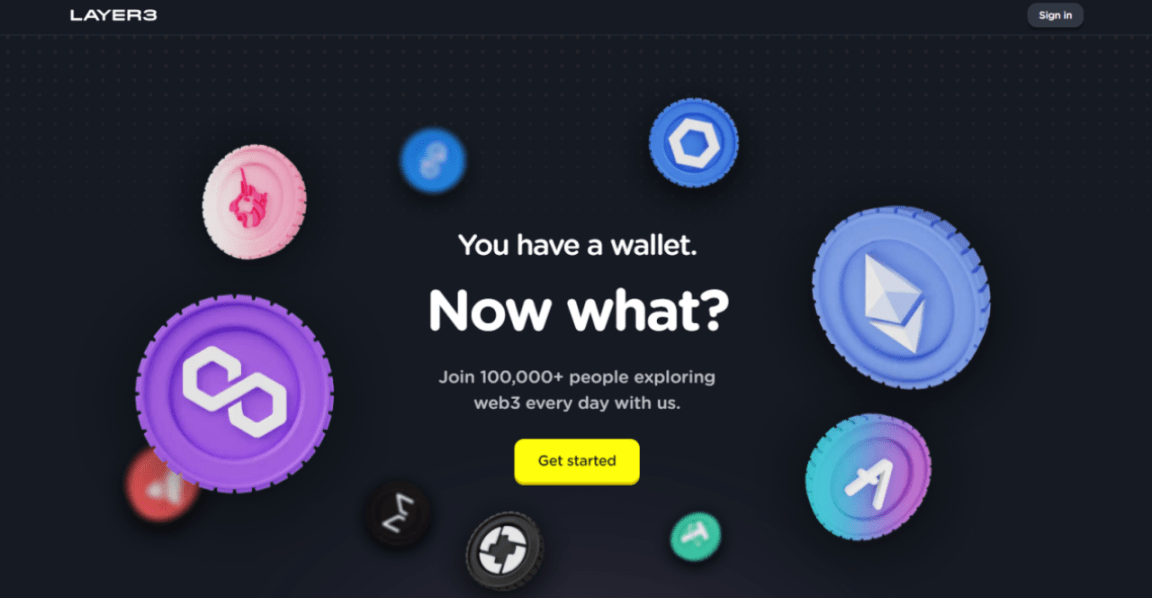
Layer3 has designed a set of "New to Web3" series of tasks, which guide users from the shallow to the deep to complete on-chain interactions in Layer2, DAO, DeFi, NFT and other fields. After completion, NFT and experience value rewards can be obtained. NFTs obtained by completing tasks can also be sold, but the price is generally not high. At the same time, specific project tasks are also provided, and the main operations are on-chain transactions, staking, adding liquidity, etc., but unlike Galxe, these tasks are less difficult, and most of them do not have a minimum transaction amount requirement. Interactions worth 1U can also complete the tasks, and task guidance is also provided. Therefore, it is more friendly to Web3 beginners who do not want to spend too much money. The project party mainly aims to obtain customers and will also cooperate with various interactive platforms. The project party needs to pay a certain fee to the platform party and provide certain incentives to users, which may be airdrops or other incentives, so the platform's business model is a combination of to B+to C. It can be classified as an educational project.
4.5、RabbitHole
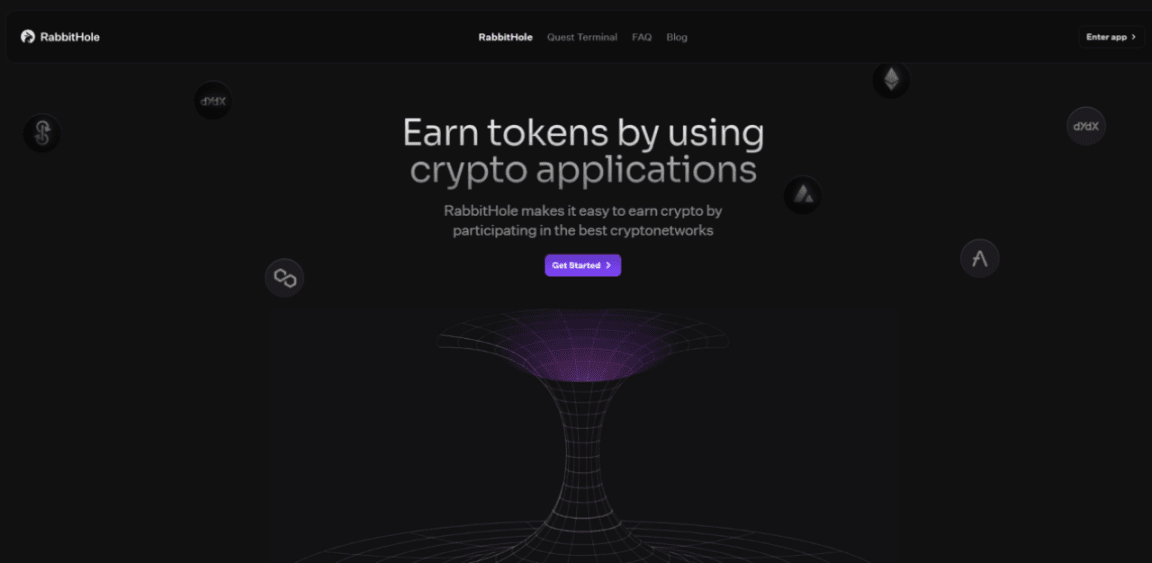
RabbitHole is a long-established decentralized on-chain incentive interaction platform. The current products are divided into two categories: Skill, a web3 new user education platform, and Quest, an advertising delivery platform. One category is Skills, of which there are currently four types: Layer2, DAO, DeFi, and NFT. The tasks that need to be completed are mostly basic Web3 on-chain operations. Detailed tutorials are provided in the Details of each task. After completing these tasks, users will receive a non-transferable "Intro to L2" NFT.
Another type of task is Quests, which are mostly interactive tasks issued by a single project party. In addition to rewarding NFTs, some Quests will also reward project tokens, but tasks that reward project tokens usually require BrightID real-person authentication to prevent witch attacks (a witch attack is when a user disguises himself as multiple identities to operate).
In general, RabbitHole provides a relatively detailed introductory education on Web3 on-chain operations, which is suitable for novice users, and its cooperative projects are relatively weak. RabbitHole announced in February 2022 that it had completed a $18 million Series A financing round, led by Greylock and TCG Crypto. The business model is biased towards C, and can be classified as an educational project.
4.6、TaskOn
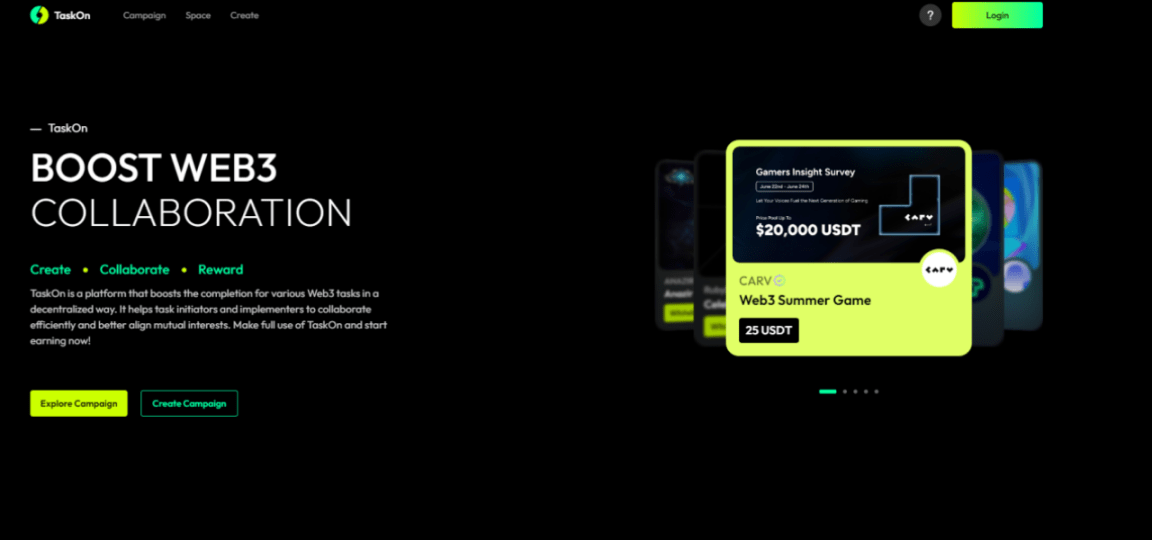
TaskOn is a Web3 task collaboration platform dedicated to the marketing and operational growth of Web3 projects. TaskOn is part of the Moonbeam series of applications. The platform can provide some automation functions to reduce the operation process. For example, API-Verified can help automatically verify whether participants perform product-specific operations. The platform also has an automatic award function, which can immediately issue awards on behalf of the event organizer after the event ends. All the operations of the event organizer are to create an event and charge enough rewards (Tokens or NFTs) into their TaskOn account; TaskOn can also create events for the event organizer, further reducing the organizer's operations. Among the current Web3 task platforms, TaskOn is one of the platforms with simple functions and rapid development. The platform has a series of anti-bot measures and is currently one of the platforms with the highest real user rate (up to 92.9%). The platform's business model is biased towards B, and it belongs to a traffic platform.