


Case Overview
The U.S. Commodity Futures Trading Commission (CFTC) has made its first foray into the romance scam arena in a recent case. The CFTC reportedly sued Justby International Auctions and its CEO Cunwen Zhu on Friday, alleging that the company misappropriated $1.3 million in customer funds that were supposed to be used for digital asset trading.
The CFTC’s lawsuit was filed in the U.S. District Court for the Central District of California. According to the CFTC’s allegations, Cunwen Zhu defrauded at least 29 customers and defrauded more than $1.3 million between April 2021 and March 2022 through his company Justby International Auctions.
Originally, these customer funds were supposed to be used for digital asset commodities and foreign exchange transactions, and Justby was supposed to manage the funds and generate income, but Cunwen Zhu used the funds for personal consumption and transferred most of the funds to bank accounts, digital wallets and digital asset trading platforms controlled by his employees involved in the scheme.
What are the specific methods of “pig killing”?
According to the CFTC, the scammers used social media to contact clients and "pretend to be friends or have a relationship with them" in order to induce them to open accounts. The CFTC's complaint describes three types of actors as being involved: (1) "recruiters" who contacted scheme clients through social media and pretended to be friends or have a relationship with them in order to induce them to open and fund trading accounts; (2) "trading firms" who purported to establish trading accounts on behalf of scheme clients; and (3) "shell companies," such as defendant Justby, whose bank accounts were used by defendants and scheme entities to receive and misappropriate funds from scheme clients.
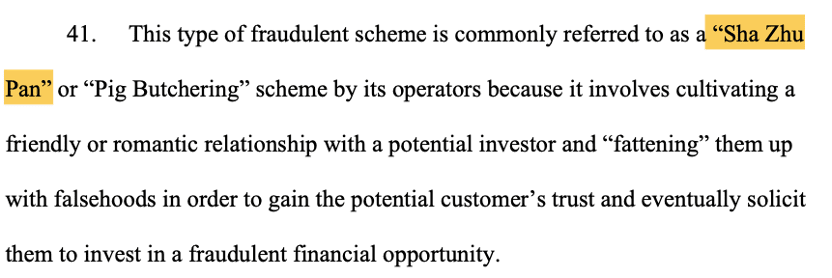
Interestingly, the CFTC mentioned the pinyin of “杀猪盘” in the lawsuit document.
The CFTC mentioned the methods of the pig-killing dish in great detail in the lawsuit. The document mentioned that the "recruiter" spent more than a year on a customer to establish a romantic relationship, and then persuaded the customer to open an investment trading account in his company and invest money. To achieve this goal, the "recruiter" often shares photos of expensive-looking life, records of driving luxury cars, and screenshots of fake accounts with super high returns. These recruiters usually claim to be very successful traders and often attribute their success to an "uncle" or "insider" who provides inside information.
Once deceived, they will then introduce customers to trading companies, open trading accounts and make deposits. These trading companies themselves are legitimate, but the trading software that customers are instigated to download is not real trading software and provides various false information. Usually, if customers follow the investment advice of the "recruiters" and trade on the software, the trading software will show considerable profits. The CFTC's lawsuit documents show that one of the deceived customers' accounts showed false profits of more than two million US dollars.
Response and recommendations from the CFTC
The U.S. Commodity Futures Trading Commission (CFTC) has issued several customer protection fraud alerts and articles, including “Avoid Forex, Precious Metals, and Digital Asset Romance Scams,” warning users to be wary of a recent increase in scams on online dating and social media platforms that trick victims into sending money to fraudulent websites claiming to trade forex, precious metals, or digital assets.
In its ongoing litigation against Zhu and Justby, the CFTC seeks compensation for defrauded customers, disgorgement of ill-gotten gains, civil penalties, trading bans, and permanent injunctions against further violations of the Commodity Exchange Act (CEA) and CFTC regulations. This incident shows that regulators are increasingly paying attention to and taking action to combat scams in the cryptocurrency space. It is foreseeable that financial cases related to digital currencies will see greater regulatory scrutiny as it is more difficult to track the whereabouts of money.
“As people sought to escape isolation during the pandemic and connect with others online, scammers saw a new opportunity to exploit the public and commit fraud,” CFTC Enforcement Director Ian McKinley said in a statement. “Today’s action is the CFTC’s first of its kind and demonstrates that the CFTC will hold accountable unscrupulous individuals who defraud customers and protect the public from Internet scams.”