

Author: Blocmates. Translated by: Cointime.com QDD
History has witnessed the importance of exchanges, from their initial peer-to-peer exchanges to becoming the cornerstone of the global financial ecosystem. However, their disadvantage lies in centralization, which concentrates power in the hands of a few. The more complex the exchange, the greater the need for centralization.
But now, a transformative paradigm is emerging, introducing a truly decentralized perpetual exchange. This is the rise of a dark horse.
A decentralized blockchain platform with its own L1? I thought honest and tenacious builders were going extinct in this space.

Superfluid is a decentralized perpetual exchange that runs on its own L1. This makes the exchange high-performance, providing the same functionality as traditional centralized exchanges. Trade settlement times are short and liquidity is deep.
Not only that, the exchange has many other advantages.
It stands out in many ways. It was probably the first decentralized perpetual exchange that caught my attention and I spent a few hours getting to know it. It’s amazing. In this post, I want to share how it achieves this magic.
(Trust me, you don’t want to miss this opportunity).
Benefits of running on Superfluid L1

One of the biggest benefits of running on its own L1 is that the exchange has high throughput and performance while providing an extremely smooth user experience. Instead of relying on off-chain order books, the exchange provides a consistent flow of transactions through Byzantine Fault Tolerance consensus. Byzantine Fault Tolerance is a consensus algorithm that enables a network of nodes to reach a consensus in the presence of one or more malicious or faulty nodes, that is, 75% of the network reaches consensus.
Since SuperLiquidity currently uses a tuned version of Tendermint, it is optimized for end-to-end latency, which means that it provides almost instantaneous trade settlement speeds, comparable to the speed and efficiency provided by some major centralized exchanges. This improves the overall user experience and provides a much better trading experience than most other decentralized exchanges. SuperLiquidity L1 currently supports 20,000 operations per second (including order placement, cancellation, and liquidation). The SuperLiquidity team will continue to research and eventually provide users with almost instant trade settlement capabilities (bringing it to the same level as centralized exchanges).
Another benefit is that Hyperfluid L1 has full-stack optimization capabilities, which means it is highly customizable for applications without relying on other frameworks such as the Cosmos SDK.
Core Features
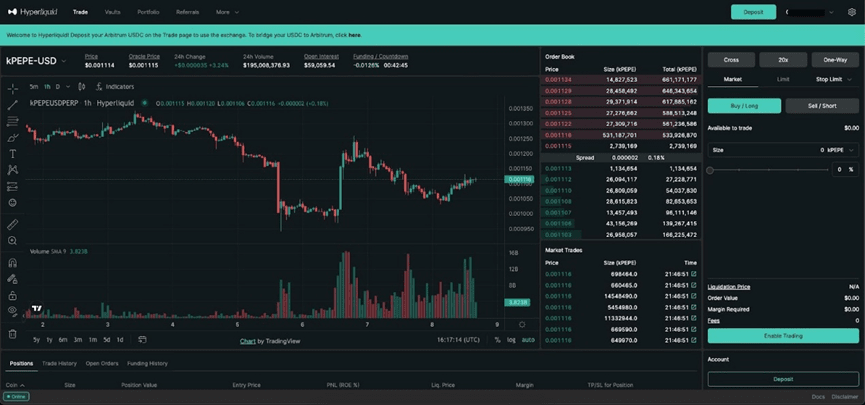 Super fluid user interface
The Ultra Liquid Exchange provides the same order book style trading experience as a centralized exchange, where orders are matched by price and time priority. All margin checks are performed when new orders are opened, as well as when orders are matched. This allows the margin system to always be consistent and unaffected by Oracle price fluctuations.
Matching the experience of centralized exchanges, you don’t need to sign every transaction when trading. The ultra-liquid exchange provides a true one-click trading experience, and this feature has been available since their closed beta release three months ago!
Supported Tokens
The ultra-liquid exchange supports many tokens including AVAX, BNB, BTC, CRV, ETH, FTM, MATIC, SUI, etc. The full list can be found here. The team plans to launch a decentralized listing process where users can list their project tokens by staking native tokens and voting on new markets.
cost
There are no fees during the first three months of closed beta on the mainnet. The updated fee model includes a fixed 2.5bps taker fee, competitive with fees on high-volume centralized exchanges, and a 0.2bps maker rebate. Unlike other fee structures where only the highest-volume traders enjoy low fees, all traders on SuperLiquidity enjoy the same low taker fees. Referrers can even earn 10% of their referral fees. Most of the fees go directly to HLP (more on this later).
Order Type
The ultra-liquid exchange supports execution of a wide variety of order types and options, including:
Market order: Executed at the market price.
Limit Order: Executed at the set limit price or better.
Stop Market Order: A market order is executed when the price reaches the set stop price.
Stop Limit Order: A limit order is executed when the price reaches the set stop price.
Pending Order Only: Added to the order book, but executed as a pending order.
Reduce Only: Execute to reduce the current position instead of opening a new position in the opposite direction.
Take Profit: Executed when the take profit price is reached.
Stop Loss: Executed when the stop loss price is reached.
Margin

The protocol sets the default margin as cross-margin so that collateral can be leveraged across multiple cross-margin positions. Users can also open isolated margin positions, which do not affect each other.
The same margin maintenance logic defines liquidations. However, in case of cross margin, positions are liquidated when the account value falls below the maintenance margin multiplied by the total open notional position.
Users can leverage up to 50x. They must ensure that they maintain a sufficient minimum threshold to keep the margin position open. For isolated positions, users can increase and decrease margin at any time after opening a position.
Funding Rate
The Hyperliquidity Protocol emulates the most popular centralized and decentralized exchanges (which offer perpetual swaps) to determine funding rates. This helps the protocol avoid large discrepancies between perpetual swaps and the underlying assets.
The protocol pays a funding rate every hour. For more details on the funding rate, visit the protocol's page.
Vault
The protocol provides vaults with different strategies where users can deposit assets and receive returns. Native protocol vaults include liquidation and market making. Protocol vaults do not charge any fees. For example, community members can deposit funds into a liquidation vault and receive a portion of the profits generated by the vault.
Additionally, users can become “Vault Leaders” by creating their own vaults and receiving a 10% share of the profits. These vaults can use strategies that the leader uses themselves, but they want to share with the community. Vaults can be created with a minimum of $100 in funds.
For "Vault Depositors", they receive the vault profits and/or losses based on the depositor's share of the vault. For example, a depositor who deposits $100 into a $1,000 vault has a 10% share.
The vault can be accessed here.
Recommended by
The ultra-liquid referral system is familiar to both DEX and CEX users. Traders receive 10% of the fees paid by their referrals.
HLP - Starlight

HLP stands for Hyperliquidity Provider. It is a vault for market making on hyperliquid exchanges. Any user can deposit funds into HLP and share its earnings. Market making is usually the exclusive domain of large funds or market makers. However, the Hyperliquid protocol makes it possible for all users who deposit into the HLP vault to participate. Currently, market making strategies are run off-chain, but LP positions, orders, trading history, deposits, and withdrawals are visible on-chain. The protocol plans to work with other market makers in the future. As the protocol starts charging fees, most of the taker fees will also flow into HLP. Learn more details here.
To get started, users can deposit USDC in the HLP vault. The vault offers an annualized yield ranging from 0% to 15%!
How to Access Superfluidity
The protocol has launched a closed mainnet alpha version, which can be accessed through a referral system here. To gain access to the application, you can use another user's referral code (which can be found on the protocol's Discord or on the user's Twitter).
When you enter the app you can also use the code ALPHA to gain access to their closed mainnet.
Now this is all well and good, but how do we move our funds into super-liquidity?
The answer is simple, superfluid bridges.
Bridging to Superfluidity
Superfluid’s Ethereum Virtual Machine (EVM) bridge enables interoperability between other chains and Superfluid L1. Currently, users can bridge their assets from Arbitrum. Validators securing Superfluid L1 also help ensure the security of the bridge. The bridge’s contracts have been audited by Cyfrin. The protocol is working on implementing a new bridge to support native Arbitrum USDC!
To bridge to the Hyperfluid protocol, simply head to their app.
1. Connect your browser wallet and switch to the “Arbitrum” network.
2. Go to the referral page here. Paste your referral code.
Or, use code ALPHA.
3. Once completed, click "Enable Trading".
At this stage, you can only bridge from the Arbitrum network to Superfluid. Therefore, during step 3, please remember to transfer the funds you wish to use for trading to Arbitrum first. During the closed alpha testing phase of Superfluid, there are no additional gas fees for trading.
Visit the Superfluidity Testnet
If you want to test the protocol for free before trading with real funds, you can use the testnet.
1. Go to the faucet and get 100 simulated USDC.
2. Go to the deal page. Use the code TESTNET to join.
3. Start trading.
The architects behind superfluidity
Chameleon Group and Chameleon Trading are the driving forces behind the development of ultra-liquidity. Their team is led by Jeff and Iliensinc, who were classmates at Harvard University. Other members of the team come from Caltech, MIT, and the University of Waterloo. All members of the team have core expertise in finance and technology and have worked for companies in various fields.
The team started in the space in 2020 (initially as a market maker) but were quickly (and not surprisingly) shocked by the lack of user-friendly applicability in the market. This made them realize that in order for decentralized markets to thrive, a high-performance exchange was needed that would address the inefficiencies associated with decentralized exchanges and provide a superior and intuitive user experience. Since the team is completely self-funded, they have no pressure from external funding on the direction of their product development.
Super-mobile community
A key indicator of a protocol's success is its community. I'm not just talking about the number of members asking the million dollar question "wen token", but a community that truly values the project and shows passion. A core part of the community are developers who are interested in understanding the protocol and finding ways to build further. Another core part of the community are those who ask difficult questions about the architecture.
Superfluidity has won over communities of both types of enthusiasts. When you go into their Discord, you’ll see people asking those technical questions that are often asked when fully utilizing/testing the protocol. This gives the project an unyielding bona fides.
Summary
Typically, a decentralized exchange has a few centralized entities that provide the initial liquidity and reap all the profits. But this doesn’t apply to Superliquidity; they are fully transparent to all users in the community. This is an incredible differentiator for this protocol.
The second and most important thing is that it is completely self-funded. This allows the founders of the protocol to have a very high degree of freedom in building the protocol.
The UI has never been so intuitive for decentralized perpetual contracts. The team has incredible experience. You can bridge assets from Arbitrum One to the ultra-liquid L1 and start trading. You can make markets with ease!
I’m very bullish on the protocol and that may sound a bit biased, but the team has built a very well-designed product and kudos to them for that.