

Even a platform that seems too big to fail may not be able to escape the curse of “explosion”.
Written/Compiled by Karen, Foresight News
When the FTX empire collapsed, a series of leading platforms suffered heavy losses, starting a "domino" collapse. Many market makers, lending platforms, exchanges, venture capital and crypto project parties were more or less negatively affected, ranging from mild to severe. Some funds are stranded in FTX or there is a small amount of risk exposure to FTX. In serious cases, most of the assets are trapped in FTX. In some cases, there are serious solvency problems, and cash withdrawal and other services are suspended, and the future is uncertain.
Platforms that seem to be "too big to fail" may not be able to escape the "explosion" curse. No one knows who will be the next target of the explosion. At present, the "hardest hit areas" are mainly concentrated in the market makers and lending fields. For example, Genesis Trading has about US$175 million in locked funds in the FTX trading account. Even if its parent company DCG injects US$140 million in shares into it, the lending department has suspended redemption services due to multiple factors. BlockFi has significant risk exposure to FTX and related entities and is preparing for possible bankruptcy protection, not to mention that Alameda, which was previously managed by SBF, has already filed for bankruptcy protection.
Market Makers and Lending
Genesis Trading’s solvency issues highlighted
Genesis Trading, a market maker and lending company under Digital Currency Group (DCG), previously stated on November 11 that its derivatives business had approximately $175 million in locked funds in FTX trading accounts. Although Genesis Trading stated at the time that this would not affect its market making activities, its operating capital and net position in FTX did not have a significant impact on its business, and it did not have an ongoing lending relationship with FTX or Alameda.
Although parent company DCG subsequently injected $140 million worth of shares into Genesis Trading to strengthen its balance sheet, Genesis Trading's repayment problem remains difficult to resolve.
On November 16, Genesis Global Capital, the cryptocurrency lending arm of Genesis, suspended redemptions and new loan issuance. Genesis is looking for solutions for the lending arm, including finding new sources of liquidity.
For a time, rumors that DCG's Grayscale might dissolve GBTC ignited market sentiment. However, Grayscale clarified that its subsidiary Genesis is not a counterparty or service provider for Grayscale's products. The assets of products such as GBTC are stored in Coinbase cold wallets and are still safe. Grayscale products continue to operate as usual, and recent events have no impact on product operations.
At the same time, "savior" Zhao Changpeng once again stated that he was considering acquiring Genesis' loan assets and had begun to learn more about the status of Genesis' balance sheet.
BlockFi has significant exposure to FTX and related entities and is preparing for possible bankruptcy protection
It was revealed that BlockFi had previously provided 3AC with a loan of about $1 billion, with the collateral being two-thirds Bitcoin and one-third GBTC, with a collateral ratio of 130%. BlockFi has been liquidated. In June this year, sources said that BlockFi's valuation was less than $500 million.
BlockFi’s line of credit from FTX and acquisition talks with FTX pushed it further into the abyss.
BlockFi suspended withdrawal services on November 11, after which the California Department of Financial Protection and Innovation suspended BlockFi’s lending license in the state for at least 30 days due to unclear status of FTX.
On Tuesday, BlockFi confirmed that it had significant exposure to FTX and related corporate entities, including debts owed by Alameda, assets held at FTX, and undrawn amounts from its credit line at FTX US. BlockFi said that while the team will continue to work to recover all outstanding debts, it expects that the recovery of outstanding debts will be delayed as FTX enters bankruptcy proceedings. In addition, BlockFi stated that withdrawals continue to be suspended, and customers are asked not to submit any deposits to BlockFi wallets or interest accounts. Previously, Autism Capital quoted BlockFi employees as saying, "The only condition for FTX to rescue BlockFi is to put our user funds on their platform for their shell game, and they have exerted tremendous pressure to transfer BlockFi funds to FTX custody."
After FTX and several of its related entities filed for bankruptcy, the Wall Street Journal reported, citing people familiar with the matter, that BlockFi is preparing for a possible Chapter 11 bankruptcy protection application and is also planning layoffs.
Crypto lending platform Salt suspends deposits and withdrawals citing FTX bankruptcy
This week, crypto lending platform Salt also suspended deposits and withdrawals, saying that "the collapse of FTX has impacted our business," but did not disclose the specific amount of exposure to FTX. The California Department of Financial Protection and Innovation will suspend Salt's license for 30 days pending the department's investigation into Salt's recent announcement to restrict its platform activities, including suspending customer withdrawals.
As a result, the online investment platform Bnk To The Future announced the termination of its acquisition plan for the crypto lending platform Salt due to Salt’s risk exposure to FTX and Bnk To The Future’s inadequate due diligence.
Exchanges
Liquid Global stops deposit services
Crypto exchange Liquid Global (Quoine Pte. Ltd) suspended fiat and cryptocurrency withdrawals on November 15 and stopped deposit services on November 16.
Quoine Pte. Ltd is one of the 134 FTX-affiliated companies that filed for bankruptcy. On August 19, 2021, Liquid said its hot wallet was attacked and lost about $71 million, and subsequently obtained $120 million in debt financing from FTX.
Huobi Technology has $18.1 million in crypto on FTX
This week, Xinhuo Technology (formerly Huobi Technology) issued an announcement on the Hong Kong Stock Exchange, "stating that its subsidiary Hbit Limited has approximately USD 18.1 million worth of cryptocurrencies deposited in the cryptocurrency exchange FTX. Since FTX's group entities (including FTX) filed for bankruptcy protection in the United States on November 11, 2022, it may not be possible to withdraw the above-mentioned cryptocurrency assets from FTX. The Group reached an agreement with Mr. Li Lin, the controlling shareholder and non-executive director of the Company, on November 13, pursuant to which Mr. Li agreed to provide the Group with additional unsecured financing of up to USD 14 million. The Company will use shareholder financing to pay for customer assets and liabilities arising from the incident when necessary."
Coinbase has $15 million in deposits on FTX
Coinbase announced this week that it has $15 million on deposit with FTX and that it has no contact with Alameda Research or loans to FTX.
Gemini Earn product was greatly affected by the suspension of redemptions by Genesis Lending Division
The Gemini Earn product under the crypto exchange Gemini was also affected by the inability to redeem Genesis Global Capital, the lending arm of Genesis. Gemini said that it is currently working with the Genesis team to help customers redeem funds from the Earn program as soon as possible.
According to CryptoQuant data, the number of ETH withdrawals on the crypto exchange Gemini reached 12,150 per day, a record high. The Data Nerd data also showed that within 24 hours, excluding altcoins, $850 million of funds had flowed out of the crypto exchange Gemini, including $230 million in stablecoins, 22,000 Bitcoins ($370 million), and 200,000 ETH ($250 million). Currently, its stablecoin reserves have dropped to $150 million.
Digital Surge suspends deposits and withdrawals due to FTX Australia
Australian crypto trading platform Digital Surge said it was unable to operate its business normally due to the impact of FTX Australia's management and suspended all deposits and withdrawals. Digital Surge said in an email to customers that it "has limited exposure to FTX and is working to understand the situation related to our users."
Prior to this, the Australian Securities and Investments Commission (ASIC) had suspended FTX Australia’s financial services license until May 15, 2023.
Crypto.com says exposure to FTX is less than $10 million
Crypto.com CEO Kris previously responded that he had transferred about $1 billion to FTX, saying "our exposure to FTX is minimal (less than $10 million), and we only use it as a trading venue to hedge customer transactions. We have never used funds for the earnings of FTX or any third party." He also said that Crypto.com deposited USDC in FTX in order to use it to buy other tokens and then transfer it back to Crypto.com's wallet.
Venture Capital / Fund
Temasek to write down $275 million investment in FTX and FTX US
Singapore state investment fund Temasek said it invested $210 million in two rounds of financing from October 2021 to January 2022 for a minority stake of about 1% in FTX International and invested $65 million in about 1.5% of FTX US. As of March 31, 2022, its investment in FTX cost 0.09% of its net portfolio value of S$403 billion and "currently has no direct exposure to cryptocurrencies."
Temasek emphasized that "it took approximately eight months from February to October 2021 to conduct an extensive due diligence process on FTX, during which time it reviewed FTX's audited financial statements, which showed that it was profitable." Given FTX's financial situation, Temasek decided to write down its entire investment in FTX, "regardless of the outcome of FTX's bankruptcy protection application."
Paradigm's $290 million investment in FTX has been written down to zero
On November 13, The Block quoted sources as saying that Paradigm had informed its limited partners that its investment in FTX was reduced to zero after the liquidity collapse. Paradigm said it invested $290 million in FTX affiliates, but it was not a customer of FTX and had no exposure to FTX's crypto assets.
Multicoin Capital's asset size fell by about 55% in two weeks
After FTX suspended withdrawals, according to The Block, Multicoin Capital managing partners Kyle Samani and Tushar Jain wrote to LPs, saying that about 10% of the fund's assets under management (AUM) were still waiting for withdrawals on FTX. "Unfortunately, we are unable to withdraw all of the fund's assets on FTX. Assets including BTC, ETH, and USD are waiting for withdrawals, accounting for about 15.6% of the fund's assets and about 9.7% of the fund's AUM." In addition, after Binance announced the acquisition of FTX, Multicoin immediately took action and sold all FTT positions at an average price of $17.79.
According to a letter obtained by The Block, Multicoin Capital’s third venture fund has $25 million in venture capital exposure to FTX.US, accounting for 5.8% of the fund’s total raised. In addition, the venture fund also holds about $2 million in FTX International.
Today, Blockworks cited sources as reporting that Multicoin Capital's asset size fell by about 55% in about two weeks due to the FTX bankruptcy. In addition to 9.7% of the assets being held by FTX, the losses were also due to its long-term bullish view on Solana and Solana ecosystem assets, such as Mango, holdings in FTX.US and unfinished derivatives contracts. In addition, Multicoin has no plans to shut down its flagship product or switch to proprietary trading, and is also introducing operational and infrastructure improvements, including efforts to reduce counterparty risk.
Galois Capital admits half of its funds are stuck on FTX exchange
The Financial Times reported on November 12 that Kevin Zhou, co-founder of hedge fund Galois Capital, said in a letter to investors that nearly half of the company's assets were trapped on the FTX platform and could not be withdrawn. Galois Capital manages more than $200 million in assets.
Sino Global Capital’s direct exposure to FTX is limited to a few million dollars
Sino Global Capital, a cryptocurrency venture capital firm, said in a statement on Tuesday that its “direct exposure to FTX is limited to mid-seven figures in custody, but no LP capital has been invested in FTX. In addition, Sino Global Capital is currently operating normally and will continue to invest as a fund.”
Most of Ikigai’s assets are trapped in FTX
Travis Kling, founder of crypto asset management company Ikigai Asset Management, said that the vast majority of Ikigai hedge fund's total assets are on FTX. When withdrawing funds on Monday, only a small part of them was obtained, and most of the funds were trapped in FTX.
Stablecoins
Circle and FTX are each other's minority shareholders, and the investment in FTX is $10.6 million
Circle CEO Jeremy Allaire said on November 9 that he had never lent money to FTX or Alameda and that he and FTX were each other's minority shareholders. According to Decrypt, Jeremy Allaire's statement last week that he and FTX were each other's minority shareholders referred to the company's $10.6 million investment in FTX Group.
In addition, Circle said that the collapse of FTX and the automatic conversion of USDC to BUSD on Binance will cause Circle's performance to be significantly lower than its February forecast, estimating that the circulation of USDC decreased by $8.3 billion from June 30, 2022 to September 30, 2022, of which $3 billion was driven by Binance's automatic conversion.
It is worth mentioning that Genesis also acts as Circle’s counterparty in Circle’s regular yield product Circle Yield. As of November 16, 2022, the total outstanding loans of Circle Yield customers were $2.6 million and were protected by collateral agreements.
USDD Anchorage Continues
USDD is also one of the stablecoins that was negatively affected by the FTX incident. Alameda Research is one of the nine whitelisted institutions that TRON DAO Reserve can mint and redeem USDD.
CoinGecko data shows that USDD began to slightly anchor on October 9, and fell to $0.9765 on October 11. It has now slightly rebounded to $0.9873. In the Curve USDD/3CRV pool, USDD currently accounts for more than 80%, which fully demonstrates the downward pressure on USDD. Sun Yuchen also pointed out earlier that Alameda may have sold its USDD holdings.
According to the USDD transparency website, as of the time of writing, the total supply of USDD is over 725 million, of which USDC reserves are 442 million. Previously, according to Lookonchain monitoring, USDD still had 990 million USDC reserves on November 10, which was later reduced by 548 million USDC, of which Justin Sun used 350 million USDC to repay the loan in JustLend.
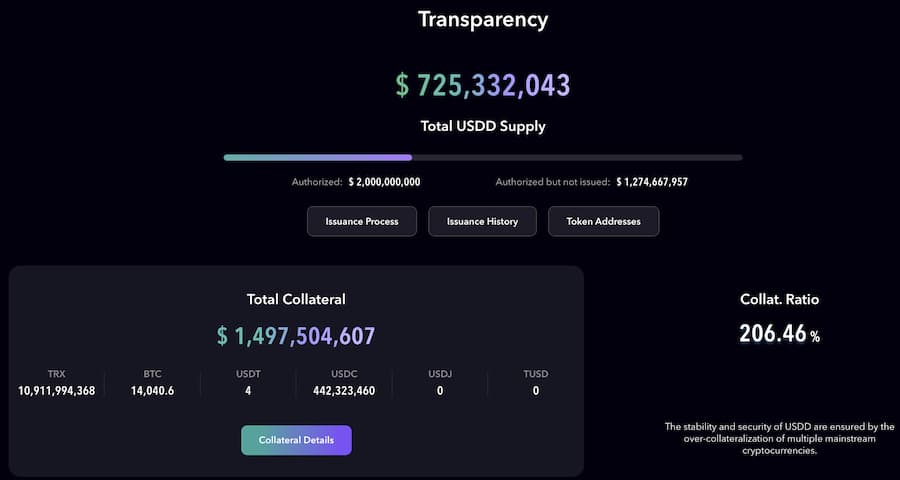
Although the official disclosure is that the current collateral ratio of USDD exceeds 200%, it is worth noting that in the reserve details of TRON DAO Reserve, in addition to 442 million USDC, there are 14,040 BTC (currently about US$233 million) and more than 1.9 billion TRX (in two addresses, more than US$96 million). The remaining nearly 9 billion TRX are stored in the TRX destruction contract managed by TRON DAO Reserve (theoretical destruction).
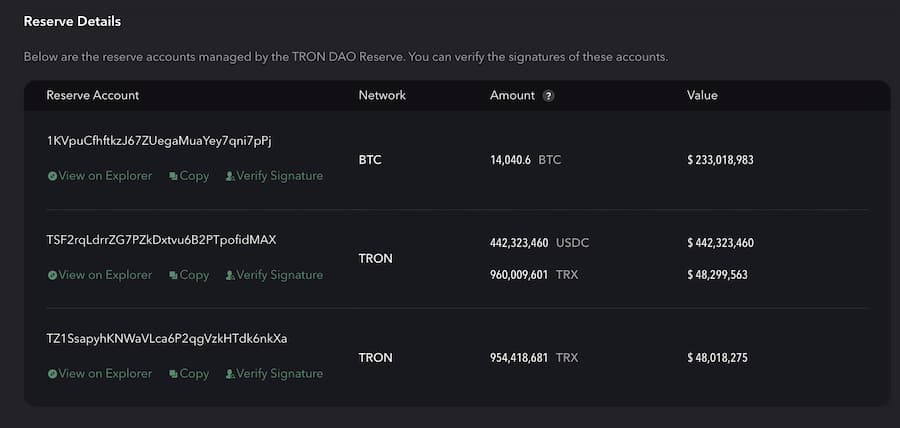
Among them, in a reserve address holding more than 950 million TRX, more than 99% of the TRX is locked in the TRX governance contract; in a reserve address holding more than 960 million TRX, more than 99% of the TRX is also locked in the TRX governance contract, and almost all USDC reserves are also used to earn income in JustLend lending products.
Encrypted public chain or project
Solana Foundation has approximately $1 million in cash exposure to FTX
The Solana Foundation issued a statement saying that as of November 6, 2022, when FTX stopped processing withdrawals, the Solana Foundation balance sheet held approximately $1 million in cash or cash equivalents on FTX.com, which was less than 1% of the total cash or cash equivalents, so the impact on the operations of the Solana Foundation was negligible. In addition, the Solana Foundation did not host SOL on FTX.com.
As of November 14, 2022, the Solana Foundation holds 3.24 million FTX common shares, 3.43 million FTT tokens, and 134 million SRM tokens in the FTX.com account.
Klaytn: Alameda address has over 4.78 million unstaked KLAY and over 5 million KLAY staked in consensus nodes
South Korean public chain Klaytn announced last night that the bankruptcy of FTX and Alameda had no direct impact on the Klaytn ecosystem, and that it had worked with the governance committee to remove Alameda from the governance committee as soon as possible after its bankruptcy. Currently, Alameda still has 5,000,100 KLAYs pledged in the consensus node and holds 4,785,401 KLAYs in the wallet address starting with 0x3786. In addition, in the first quarter of 2022, the Klaytn Foundation conducted a block transaction of 20 million KLAY tokens with Alameda, and has now received the full payment of USDT according to the agreement.
The Klaytn team stated that Klaytn has never contacted FTT. The Klaytn team has tried to contact Alameda but failed to get a response. In the future, it will continue to monitor Alameda’s wallet and will fully cooperate with FTX’s bankruptcy proceedings as needed.
Mojito Markets funds are deposited in FTX and have previously signed a market maker agreement with Alameda
Mojito Markets is a decentralized trading and prediction market on the Aptos ecosystem. It has already sold the funds raised by IDO. Mojito Markets announced yesterday that after IDO, the APT raised will be exchanged for USDC on FTX to reduce the volatility of the treasury price. At the same time, it has signed a market maker agreement with Alameda Research, which has resulted in the project being unable to withdraw funds from FTX and having no tokens for market making. Currently, Mojito Markets has removed the APT/MOJO liquidity on LiquidSwap and plans to issue airdrops in December.
Mojito Markets’ post-IDO performance was also criticized by users. On the evening of October 23, its token MOJO had almost no liquidity after it was launched on the Liquidswap trading protocol, and the token price was far lower than the IDO price.
Star Atlas has significant cash exposure to FTX, with operating funds cut in half
Star Atlas is a game metaverse based on Solana. Its CEO Star Atlas said that Star Atlas development studio ATMTA has significant cash risk exposure to FTX, saying that the current operating funds have been reduced by about half, but the company still maintains a strong balance sheet.
Nestcoin suffered losses due to depositing investment funds in FTX
As TechCrunch reported this week, Nestcoin, an African Web3 startup that had received investment from Alameda Research, suffered losses due to depositing investment funds in FTX. People familiar with the matter said that Nestcoin will lay off at least 30 employees and reduce the salaries of remaining employees by 40%. Nestcoin said that its products are essentially DeFi protocols and non-custodial products, so customer funds were not affected.
other
Signature Bank is a cryptocurrency-friendly bank in the United States. It recently stated that it only has a deposit relationship with FTX, and its deposit relationship with FTX and its related companies is less than 0.1% of the bank's total deposits as of November 14, 2022. The deposit balance in the digital asset field remains stable.
Silvergate Capital, a provider of financial infrastructure solutions for digital assets, previously issued a statement saying that customer deposits in FTX account for less than 10% of total deposits and that it has not invested in FTX.