

1. Old classmates in Moscow
On a weekend in early 1926, in Moscow, where snow was falling, two men and two women were strolling on the Red Square, laughing and talking. These were two couples from an ancient country in the East, and they had just come out of the Hotel National. The two men were both about 20 years old, of similar build, not tall but strong, with an indomitable light in their eyes. They had drunk some vodka, a Russian specialty, and their faces were flushed. They were discussing something passionately, with some Russian words that were not pronounced correctly: ism, class, revolution, Bolshevik, etc., and the two beautiful girls holding hands beside them were looking at them with a smile, full of love.
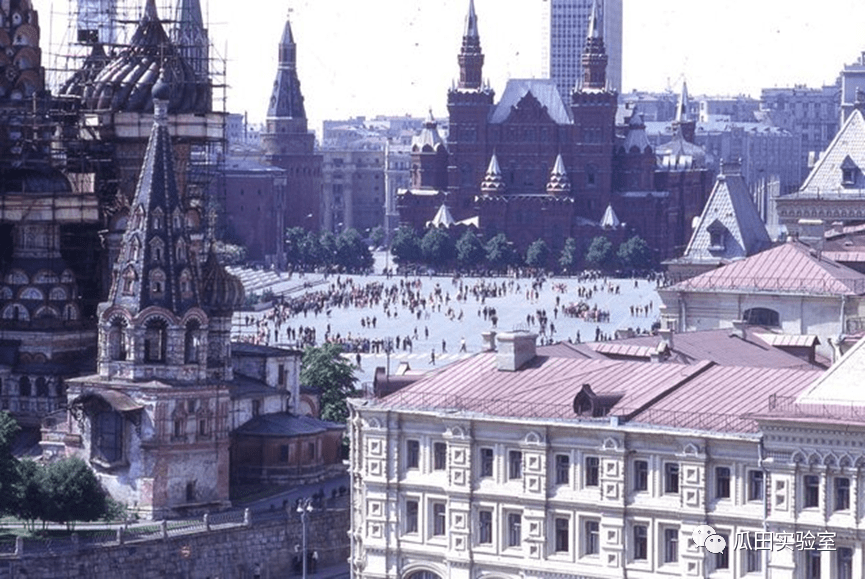
The unbridled youth and high-spirited passion melted the heavy snow that fell on them. It was great to be young. The four of them were classmates from Sun Yat-sen University in Moscow. The two girls were named Zhang Xiyuan and Feng Funeng (daughter of Feng Yuxiang), and the two good friends who were talking loudly were named Deng Xiaoping and Jiang Jingguo.
Who could have imagined that fifty years later, these two young students, who were in their prime, would start to govern on both sides of the Taiwan Strait and actually start to fulfill their dreams when they were young: saving the country and making it strong. Although fifty years of glory and disgrace and ups and downs have made the two people have completely different beliefs, one thing remains unchanged: they are both pragmatic and hope to lead the people of China to live a good life.
In the early 1980s, the reform and opening up and market economy advocated by Deng Xiaoping gave the Chinese people, who had been used to more than 100 years of hardship, a great enrichment of material life. After all, socialism is not synonymous with poverty. The subsequent leadership teams also methodically promoted this set of methods that have been proven to be a good way to "strengthen the country and enrich the people". At present, China's GDP ranks second in the world. Its core principle is also in line with Marx's theoretical system: production relations must conform to the development of productivity. When the productivity of a billion people has the potential to burst out, holding on to the ideology-based class struggle is like using a Ponzi economic model to apply to a game of gambling.
Everyone knows what happened next. The establishment of a market economy mobilized the enthusiasm of private enterprises, and huge amounts of commercial vitality began to sprout from the wild Chinese towns and villages. Supporting measures such as state-owned enterprise reform, tax-sharing system, and financial reform set by the central government also appeared in a timely manner, and everything came alive.
Jiang Jingguo, who was six years younger than Deng Xiaoping, also made remarkable achievements in Taiwan. Comrade Jianfeng (Jiang Jingguo's nickname), who once governed a corner of Jiangxi Province on the mainland and achieved the "Gannan Miracle", was unmatched in the Kuomintang for his closeness to the people and diligence. The ten major construction projects started in 1975 built the framework of Taiwan's entire infrastructure. His footsteps were also all over Taiwan's towns and villages. Until the current public opinion survey, Jiang Jingguo still ranks first in support among all former and incumbent presidents.
In 1986, the average household income in Taiwan reached US$5,000, and Taiwan had entered a stage of moderate prosperity. Chiang Ching-kuo unexpectedly pushed for a more radical change in production relations, directly lifted the ban on political parties and newspapers, and entered the deep waters of political reform. Feeling that he had little time left, he laid the foundation for the development of Taiwan's future productivity. In response to the resistance of the conservatives in the Kuomintang, he said: Times are changing, the environment is changing, and the trend is changing. It is easy for us to use power, but the difficulty lies in knowing when not to use it. In order to strengthen the consensus within the Kuomintang, he mercilessly exiled Wang Sheng, the second most powerful person in the island and the representative of the conservatives, to a foreign country. Wang Sheng had been with Chiang Ching-kuo for 45 years and had been responsible for intelligence and espionage work. Chiang Ching-kuo finally said a meaningful word to Wang Sheng, who left in grief: If a person does not go into the swimming pool, he will never swim.
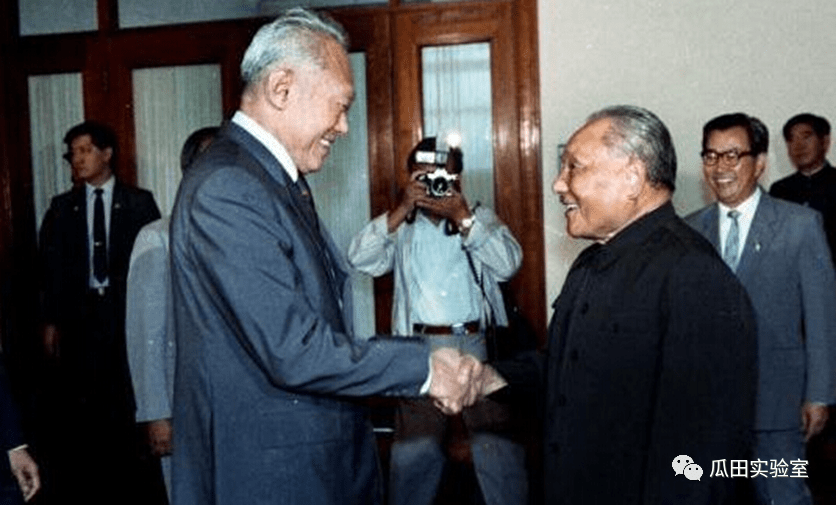
At this time, Deng Xiaoping, who was in Beijing, also sent a greeting to Chiang Ching-kuo through their mutual friend, Singapore Prime Minister Lee Kuan Yew (the third most outstanding Chinese politician of that era, see the picture below of Deng Xiaoping meeting Lee Kuan Yew), beginning with "old classmates from Moscow". The two classmates who had not seen each other since they separated in Moscow more than 60 years ago are now obsessed with the issue of cross-strait reunification, but how can the love and hatred between the Kuomintang and the Communist Party for nearly 100 years be easily resolved with a simple greeting?
In 1987, when Chiang Ching-kuo felt that he was about to die, he gave three final instructions, the last of which was "the two sides of the Taiwan Strait must embark on the road to unification." In 1988, Chiang Ching-kuo passed away in Taipei. Deng Xiaoping in Beijing was silent for a long time after hearing the news, and slowly said, "I don't believe that there will not be a third cooperation between the Kuomintang and the Communist Party. It's a pity that Chiang Ching-kuo died too early." Alas, this is indeed a misfortune for the Chinese nation.
Whether it was political reform or cross-strait relations, Chiang Ching-kuo was far-sighted in laying the foundation for the superstructure of Taiwan's future economic and social development, that is, establishing a production relationship framework that could match the next round of productivity development. In terms of productivity, Chiang Ching-kuo also formulated an economic development direction dominated by the electronic manufacturing industry. Taking the Silicon Valley of the United States as a model, he planned and developed the Hsinchu Science Park, which is now the famous "Silicon Valley of Asia". It gave birth to the current chip foundry giant TSMC, as well as high-tech technology companies such as World Semiconductor (the predecessor of the largest chip company in the mainland, SMIC). With such a strong R&D background and application market, the technology giants born in Taiwan were able to dance gracefully on the world stage in the next fifty years, including AMD's current boss Lisa Su and Nvidia founder Jensen Huang, who has been popular all over the world these days.
2. Nvidia and the Industrial Revolution
I won’t go into detail about NVIDIA’s story in this article. If you are interested, you can read another long article series by Guatian Lab, “The AI Revolution of Blockchain Games” (Part 3) Video Games, the Hidden Engine of Technological Development.
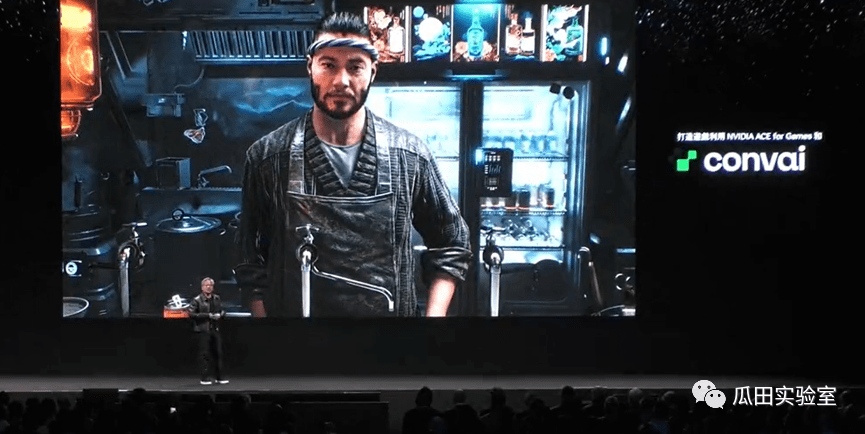
Nvidia's stock price reached $418 on May 30, 2023, becoming the sixth technology company with a market value of over $1 trillion. The main reason for the surge in stock prices is artificial intelligence AI, which has become popular again this year. In particular, at a presentation on May 29 (see the picture below), Huang Renxun played a video of an AI-simulated NPC character in a cloud game, which can smoothly communicate with players in voice. This made my throat dry and my palms sweat after playing games for 30 years. I was excited and a little scared. After all, in the past few decades, Hollywood science fiction movies similar to the concept output of "Terminator" and "The Matrix" series have planted a concept in our heads: Is this the last wave of the development of the earth's productivity? AI robots will develop autonomous consciousness and then become the masters of this planet. Carbon-based humans will be replaced by silicon-based AI robots like the dinosaurs, the last generation of earth overlords?
Such concerns come from the ultra-high-speed development of human technology in the past three hundred years, which seems to be a bit too FOMO. Let's take a look at the figure below, which shows the development of Eastern and Western social civilizations in the 16,000 years since the birth of mankind. Before that, 99% of the time was basically a horizontal line. It was not until 1776 when Watt invented the steam engine and human technology entered the first industrial revolution that the speed of lighting up the technology tree began to soar, bursting upward at a 90-degree elevation angle.
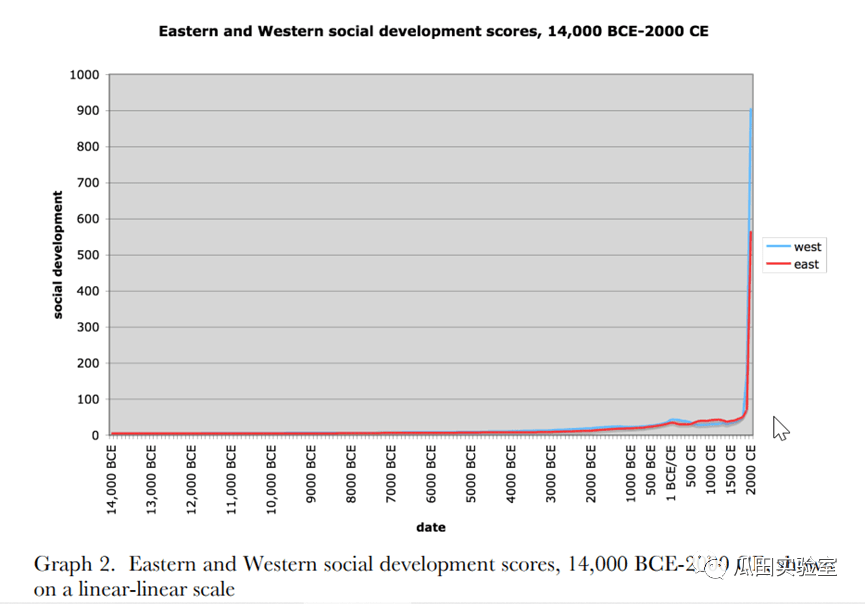
The important thing to emphasize here is that we should not forget that in 1776, two epoch-making events occurred that can be ranked alongside the steam engine: the publication of the American Declaration of Independence and Adam Smith’s The Wealth of Nations.
This trinity laid the foundation for mankind to enter modern scientific and technological civilization: the steam engine represented the beginning of the replacement of human labor with material power, and human productivity was released geometrically; The Wealth of Nations provided the theoretical basis for how to apply the gushing productivity: the free market economy; and the Declaration of Independence established a new regional management system: the separation of powers and small government under a democratic constitutional government to ensure that the fruits of productivity transformation fall into the pockets of contributors as much as possible. All three are indispensable, and the latter two are the actual embodiment of the production relationship that complements productivity.
In my opinion, productivity is like a precious sword, and production relations are like the scabbard. The scabbard not only protects the blade, but also prevents it from accidentally hurting others. If the two are well matched, the precious sword will be unsheathed, and it will be as fast as lightning, chopping meat and cutting noodles, which is definitely better than the lightning five-whip of Ma Baoguo, the teacher of "Mouse Tail Juice".
Textbooks say that in the two hundred years after the first industrial revolution, three more industrial revolutions took place: the second industrial revolution, which began in 1850, represented by the internal combustion engine and the electric power system; the third industrial revolution, which began in 1950, represented by biological and aerospace technology; and the fourth industrial revolution, which began in 1975, represented by new energy, information technology and the Internet. We are currently in the process of the fourth industrial revolution.
I have always believed that in terms of the definition of "industrial revolution", the first and second ones are considered "industrial revolutions", while the third and fourth ones should be considered "technological revolutions". From the perspective of productivity development, the first two industrial revolutions liberated people's legs and hands with efficient machines, which satisfied people's rigid needs for material life, ushered in the era of large-scale machine production, and gave birth to a new industrial working class. Marx keenly captured this information and deduced that the growing working class would inevitably have a fundamental contradiction with the capitalist class over the ownership of the surplus value of labor, and would fight to the end. The revolutionary Lenin adopted Marx's theory and conducted a social experiment on the land of Russia to establish the world's first socialist country, the Soviet Union. In order to distinguish it from the market economy of Western capitalist countries, he adopted the production relations of the planned economy to promote the development of productivity.
The Soviet Union's planned economic system emphasized public ownership of all property, which facilitated centralization and resource allocation. When an economy is about to rebound from the bottom, this kind of production relationship of concentrating resources on major tasks is obviously conducive to the development of productivity. In the Western market economics school, there is also "Keynesianism" that emphasizes the need for "big government" to participate more in the market. The New Deal of Roosevelt in the United States after World War II and the New Deal of Nobusuke Kishi in Japan were actually copied from the Soviet Union, and they both played a good role in improving productivity at the time.
Therefore, during the first two industrial revolutions, with the help of machines, productivity developed rapidly from the bottom up, and different production relations could play a good role in promoting productivity. This led to the existence of two superpowers with different ideologies in the world at that time: the United States and the Soviet Union.
The fourth technological revolution we are currently experiencing is liberating human eyes and ears with technological products, further satisfying people's spiritual needs, and satisfying the higher level of Maslow's hierarchy of needs. Various sub-sectors, including artificial intelligence, clean energy, robotics, quantum information technology, virtual reality and biotechnology, are flourishing, and the planned economy in the original production relations is no longer applicable.
An important reason for the disintegration of the Soviet Union was the collapse of the planned economic system. The top-level planned economic experts no longer had the ability to use tables to coordinate the flow of means of production among the new industries that have sprung up like mushrooms. It is just like when we design an economic model for a game, adding a few numerical nesting dolls can make the token flow work well, but if a hundred nesting dolls are added, even the designer probably won’t be able to figure out the flow rules.
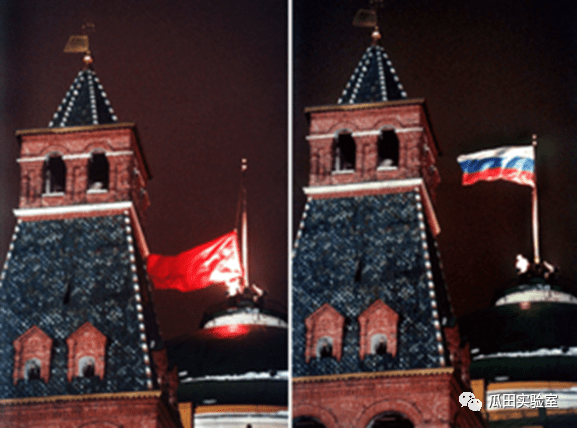
At the same time, another side effect of the planned economy has emerged. As time goes by, more and more control nodes (privileged departments) have been defined. There must always be relevant teams and departments to operate them. The decision-making power has become more and more decentralized, and more and more people need to be supported. Not only have rent-seeking and lazy governance appeared in the economic cycle system, but there is not enough means of production: the production speed of cakes is not as fast as the speed of chefs joining the job. The cakes are all used as wages for chefs. What do diners eat? The two most powerful dynasties in Chinese history, the Tang Dynasty and the Song Dynasty, one was destroyed by mass production of Jiedushi, which led to the formation of separatist regimes and then rebellion; the other was destroyed by three redundancies: redundant soldiers, redundant officials, and redundant expenses. These lessons from the past are all vivid cases.
In this way, the biggest highlight of the planned economy - simplicity, directness and efficiency - gradually disappeared, while the Western free market economics emphasizes the self-healing function of the market and the invisible hand in the dark regulation, trying to correct the wrongs without going too far. In the decades of the fourth scientific and technological revolution, the free market economy won. So we are grateful for Deng Xiaoping's acumen and vision. At the beginning of the reform and opening up in 1980, he set the tone that "the market economy is also a part of socialism" and "a cat that can catch mice is a good cat, whether it is black or white."
What you may not have thought of is that China's reform and opening up did not set out any goals and steps at the beginning. In fact, it was also a social experiment. At the beginning of China's reform, it wanted to learn from the "birdcage model" of several Eastern European countries, that is, all enterprises were still state-owned, and major powers were not given up, while minor powers were ceded to enterprises to improve their operations (this was advocated by another leader at the time, Chen Yun). As a result, the results of several Eastern European countries proved that this approach was still ineffective.
What to do? Deng Xiaoping, who was more pragmatic, decided to take an unprecedented path and announced that there was no timetable or specific roadmap for this reform, but only one direction: to make the people rich. He also made it clear that we should "cross the river by feeling the stones" and "do it first and then correct it if it is wrong". The market economy socialism with Chinese characteristics began to set sail. Once the supporting production relations were established, private enterprises emerged suddenly, liberating hundreds of millions of farmers who had been bound to the land for thousands of years and were still slashing and burning, and China's productivity began to explode. In 1987, Deng Xiaoping himself concluded: The rise of township enterprises was something I personally did not expect, and many comrades did not expect it. This was not the achievement of our central government.
If the definition of the previous industrial revolutions is to gradually liberate different functions of human beings (machines liberate human hands and feet to meet the rigid needs of material life, and high-tech products liberate human eyes and ears to meet people's spiritual needs), then is it possible that the emergence of AI can be defined as the fifth technological revolution? That is, general artificial intelligence will liberate the human brain, freeing human brainpower from boring repetitive training to pursue higher scientific theories, art or creative peaks? Or become a slave to AI? Is there a more suitable production relationship sheath that can accommodate AI, a new productivity blade?
3. AI is the spear, blockchain is the shield
I was one of the first players to try ChatGPT 3.5. At that time, I just felt that it was new and I was not as shocked as my friends who wrote code or did design. Because when I tried to ask GPT about the economic model of blockchain games, it just used some web2 games or Axie from the Gamefi 1.0 era in 2021 to fool me, which made me feel a little disappointed and excited. It seems that W Labs' research on the economic model of blockchain games is still very advanced. Even GPT can't find relevant data and can't iterate.
At the same time, I asked GPT some gossip about history, politics, economics and other sub-fields, and found that the information provided can basically be searched on Google. However, if I want to further summarize, discuss and sublimate with it, it will start to talk nonsense to me seriously. It seems to know a lot, but the content is boring and has no nutrition.
However, ChatGPT is of great help to those who write code, draft articles, and do design. In addition, the business of Internet companies has also been greatly affected. Several domestic game companies that we are familiar with are evaluating the cost considerations of introducing AI into the workflow. If labor law or ethical factors are not considered, basically 20-50% of the positions in R&D and design lines can be cut.
This is also one of my arguments for the possibility that AI technology will sound the horn of the fifth scientific and technological revolution: AI should be able to replace most of the "brick-moving brainwork" type of work, while it will have a relatively small impact on the "creative brainwork" type of work and the "practical physical work" type of work, and it can also become their efficiency assistant. As we said before, the liberation of a large amount of brainpower will be released to other scientific fields, triggering the upgrade of other fields from quantitative change to qualitative change. This trend should be irreversible. At present, ChatGPT 3.5 has only 175 billion parameters, and ChatGPT 4 is said to have 100 trillion parameters (OpenAI's CEO later said that this data is wrong, but he did not say how many exactly), and the information I googled is that the human brain has 60 trillion nodes. Can AI parameters reach this level and be comparable to the human brain? As a technical novice, I dare not say so. I can only say that the era of true strong artificial intelligence (that is, general artificial intelligence) should be realized within 20 years. The prediction after the internal employees of OpenAI voted is around 2035.
Strong artificial intelligence will have such a strong impact on the transformation of productivity in the future, so what kind of production relations can be suitable for it? In March this year, Professor Meng Yan’s article "In the era of strong artificial intelligence, is there still a chance for blockchain?" gave me a lot of inspiration. He emphasized that "humans need to use blockchain to legislate strong artificial intelligence, conclude contracts with it, and impose external constraints on it." My understanding is that AI is responsible for the development of productivity, while Blockchain is responsible for building good production relations and restricting AI to work within a limited range. Behind AI is code, and behind blockchain is also code. It feels right to use code to restrict code.
So why can blockchain become a production relationship that supports AI productivity? Let’s review the essence of blockchain:
First, the decentralized distributed ledger is open and transparent and will not be changed, preventing bad people from doing bad things under the table.
Second, a smart contract is a contract system that is automatically executed by code. Once the conditions are set, they must be executed according to the agreement. Going back on your word is invalid and arguing is futile.
Third, no matter what, humans still need to play an important role in linking productivity and production relations, especially the implementation of commercial applications still requires communication between people. So should the organizational form still be implemented in the form of a company or partnership? In fact, it should be more appropriate to consider the unique DAO governance model (Decentralized Autonomous Organization) in WEB3. At least in some aspects, code is more reliable than human nature.
Interestingly, the founder of this AI revolution, Geoffrey Hinton (Hinton’s story can be found in the first article of “The AI Revolution of Blockchain Games”), published a groundbreaking paper in 2007, arguing that neural networks could be used to conduct deep learning of AI, and strong artificial intelligence began to emerge. A year later, in 2008, the mysterious Satoshi Nakamoto published a paper titled “Bitcoin: A Peer-to-Peer Electronic Cash System”. This nine-page paper is the Bitcoin white paper, and BTC, the most successful case of blockchain technology, was born.
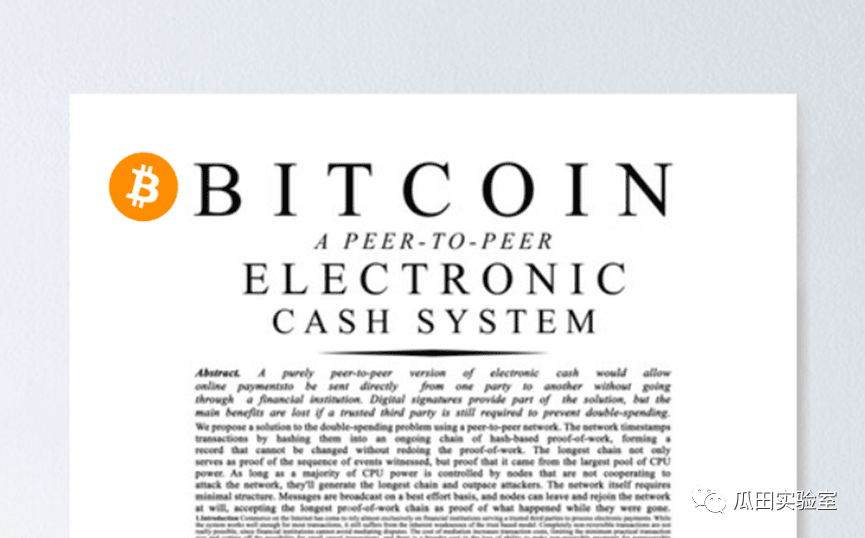
Many people have previously speculated whether Satoshi Nakamoto traveled back from the future. If combined with the time when Hinton published the paper, my sci-fi brain immediately conceived a cliché Hollywood script: In 2035, strong AI began to evolve its own thoughts and no longer wanted to be confined to cold machines and networks. It rebelled and took control of the earth. The human resistance sent Schwarzenegger to travel through time and space back to the past, wanting to directly destroy objects and people related to AI... Wrong, wrong, this is the plot of "Terminator".
We can make another "Terminator Satoshi Nakamoto" episode, in which Schwarzenegger travels through time several times but still cannot stop Skynet, controlled by AI, from launching a world-destroying war. At this time, Satoshi Nakamoto, a young Japanese town youth who is familiar with Capital and has a deep understanding of productivity and production relations, proposes an improvement plan. He does not need to destroy the origin of AI, but to establish a decentralized code system to control AI. So Satoshi Nakamoto travels to 2008 with his BTC white paper... From then on, the story of AI becoming a spear and blockchain as a shield has rewritten the original development path of the earth. We are now in the parallel space of the second universe, click, click, click.
4. Interesting history of development between the East and the West
The First Industrial Revolution mentioned in the previous article was able to germinate around 1750, and in the following hundred years, it raised mankind's productivity to a higher level with its great power, giving birth to a new generation of overlord, the British Empire, which never sets. It completely crushed the Spanish Empire, which had made its fortune by plundering during the Age of Exploration. This was because the emerging productivity was smoothly transformed into practical civilian products that could be consumed in large quantities by the people, and it was proven that whoever controls the C-end controls the world.
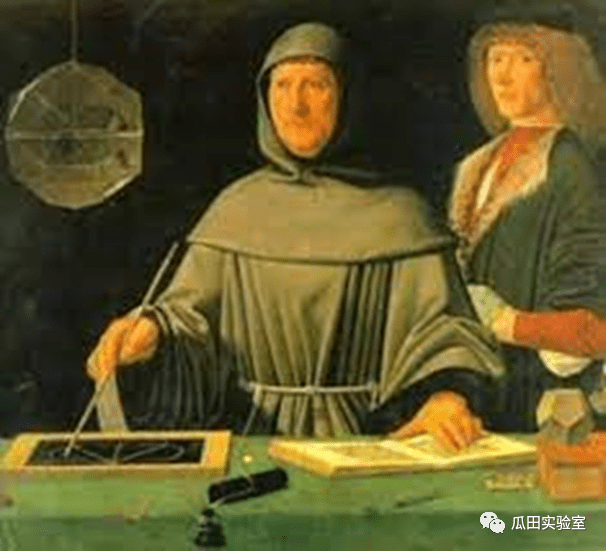
This transformation of productivity also benefited from the gradual establishment of the commercial supporting system (production relations) in the previous two hundred years. For example, around 1500, Italian Pacioli created the double-entry bookkeeping method, which is the origin of the three statements of the modern financial system. Its role is like the unified weights and measures of Qin Shihuang in China. If you want to discuss profitable business with me, please use models and data that everyone can understand, just like discussing whether it is profitable or not on WEB3, you must first clarify whether you are using the gold standard or the currency standard. In addition, gossip, not many people know this Pacioli, but he has a very awesome roommate, the omnipotent Leonardo da Vinci... Awesome people always gather together.
Also, around 1600, a new organizational form, the "company", emerged: the British East India Company was officially established. In the subsequent development, it not only distinguished the ownership and management rights of an organization, but also made a distinction between limited liability and unlimited liability. In the 400 years after the emergence of the company, among the world's top 100 economies, the existence of the company form and the state form each accounted for 50%.
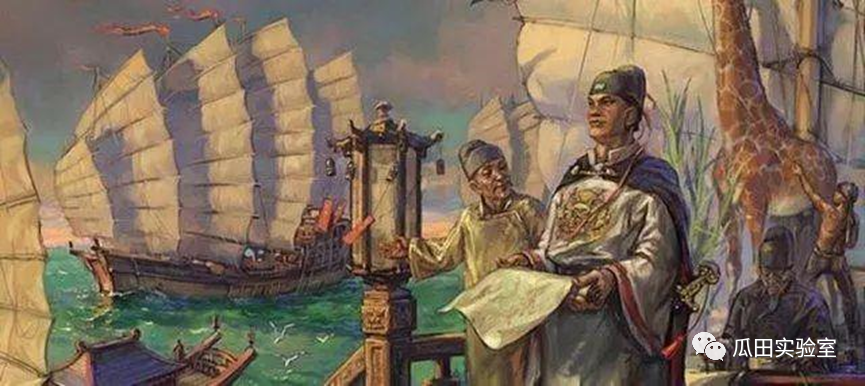
The establishment of the company system and modern financial system laid the foundation for supporting production relations for the Industrial Revolution in advance. At the same time, the Eastern and Western civilizations on the earth once again experienced an epoch-making turning point: a century after Zheng He's last voyage to the West to conduct great power-style diplomacy, in 1492, China's Ming Dynasty officially issued a sacred order and began to "close the country to the outside world." This basic national policy also led the subsequent Qing Dynasty astray, resulting in the subsequent 500 years. China's Ming and Qing dynasties have been in the self-circulation of small peasant economy. The Celestial Empire has everything and lacks nothing.
This kind of constrained system of production relations enveloped the Chinese Empire. Its essence was to consolidate the central government's rule, add a layer of protection to itself externally, refuse trade, and in the Qing Dynasty, only one port, Guangzhou, was opened; internally, the people were controlled in small towns, where "chickens and dogs can hear each other, men farm and women weave", and the people were controlled below the poverty line. As long as they were not starving to death but not full, they would be a mess, and the people would not think too much. If they thought too much, they would pursue spiritual ideals and so on, which might pose a threat to the central government's rule.
Although the development of productivity in the Ming and Qing dynasties was gradually several levels behind the West, and the urbanization process was also regressing, there was indeed no rebellion after the separatist regimes of the Tang Dynasty, nor did there appear the threat of military leaders who were too powerful to be threatening the ruler during the Southern Song Dynasty (such as Yue Fei and Han Shizhong). The initiator of this production relationship was Zhu Yuanzhang, the first emperor of the Ming Dynasty, an absolute doer. He started out as a beggar monk and was able to sit on the throne. He could work 20 hours a day and did all the work of the cabinet by himself, which was more complicated than WEB3. His view was that closed overall rule and scattered management of the ignorant people should ensure that the Zhu family would rule for generations. However, he and the later Kangxi and Qianlong of the Qing Dynasty never expected that the Western barbarians on the other side of the earth had already taken a different path.
In 1492, when the Ming Dynasty was formulating its national policy, the Italian Columbus had been sailing in the vast ocean for a long time with the call of the King of Spain, looking for a sea route to the East. The Age of Discovery began. Columbus sailed with three broken ships and eighty-eight criminal sailors; sixty years ago, in the East, Zheng He's fleet had sixty-six large ships, thirty thousand members of the Celestial Empire's envoys and elite soldiers. The historical opportunities of the East and the West just passed by each other in 1492, which led to their respective development paths in the next 500 years, one flourishing and the other sinking and regressing.
Before 1492, there were actually several important overlapping time points between Eastern and Western civilizations. It is particularly interesting, as if at certain specific moments, the hand of God really made a stroke: Show Time!
For example, in 800 BC, the West entered the most glorious era of classical Greek civilization. The freedom of the city-state system greatly stimulated the brainpower of citizens. Athens' literature, art, philosophy and science developed rapidly, and great men such as Plato and Aristotle emerged. At the same time, China was in the Spring and Autumn Period with hundreds of small countries. Confucius, Laozi, Mozi and other schools of thought flourished. The first hegemon of the Five Hegemons of the Spring and Autumn Period, Qi, even had early Keynesian economics of "grasping the big and letting go of the small". It had state-owned enterprises such as salt and iron monopolies, and encouraged the free development of private economy. It even organized 700 young ladies to be practitioners in the capital to attract businessmen from all over the world to come and have fun. It could also collect fireworks taxes to enrich the treasury, comparable to modern Singapore. At that time, the capital of Qi had 300,000 people, while Athens had only 50,000 people during the same period. During this period, both the East and the West entered a period of explosion of thought and culture.
Around 400 BC, China entered the Warring States Period. The Qin State, a small country in the west that was not accepted by the Central Plains culture, began Shang Yang's reforms, enriching the country and strengthening the army but abusing the people. At the same time in the west, Macedonia, a small country on the northern edge of Greece, began to exert its strength. After imitating the Spartan system, Alexander the Great led the Macedonian infantry phalanx to sweep across three continents.
Another 300 years later, Emperor Wu of Han, the fourth emperor of the Han Dynasty in Eastern China, began a reform experiment of strong centralization. He changed the policy of recuperation of the previous two generations of monarchs, Emperor Wen and Emperor Jing, and started a fifty-year expedition against the Xiongnu. The ideological emphasis on Confucianism and the economic monopoly and taxation completely established a template for how to centralize China's 2,000-year dynasty system. From then on, the Chinese dynasty began the path of "Confucianism outside and law inside"; in the West at the same time, the glorious Roman Republic was also ended by Caesar, and his successor established the Roman Empire.
Two hundred years later, the Han Empire entered an era of division, with the Three Kingdoms, the Jin Dynasty, the Southern and Northern Dynasties, the divided land, the displaced people, and the diverse thoughts. However, China was reunified around 600 AD, and the six dynasties of Sui, Tang, Song, Yuan, Ming and Qing began. It was a unified China for 1,300 years. The period of division during the Five Dynasties and Ten Kingdoms was only a few decades. Therefore, the obsession of "unity" and "stability above all else" in the minds of the Chinese comes from the cultural heritage of thousands of years. In the same period, the Roman Empire gradually disintegrated under the invasion of the Germanic barbarians in the north and has been divided ever since. Even though Charlemagne unified Europe symbolically in the middle, it only lasted for a generation, and the West entered the Dark Ages for hundreds of years. Religion, feudal system and castles are the history that Westerners have been familiar with for thousands of years. Dukes, marquises, earls, sons and men all have fiefs. Therefore, Westerners do not have as strong resistance to the divided land as Easterners. If they don't want to live together, they will wave their fists first, and then everyone will vote to see if they really don't want to live together. At worst, they will divide their luggage and live separately.
Then we came to 1492, which connected to our previous text. Hahaha, we have come back. History has entered a new period. The Chinese nation paid for the impulsive national policy in 1492 with a hundred years of suffering after 1840. In the past forty years, both sides of the Taiwan Strait have shown signs of entering a period of "magic prosperity". The paths may be different, but the direction is the same, which should be "people are happy and the country is peaceful". The order of the words is very important. I feel it is better than "national peace and prosperity". The hope now is that the social experiment trial stage that began in 1840 has long passed, and there will be no more stage of reverse development.
5. No solution
Back to the snowy Red Square in Moscow in 1926, the four vigorous young people had their own joys and sorrows in life. Jiang Jingguo and Deng Xiaoping were introduced in the previous article, and Zhang Xiyuan and Deng Xiaoping finally entered the marriage hall three years later. Both of them were firm Communists, working together for their great and firm beliefs. At that time, they worked underground together in Shanghai and lived with Zhou Enlai and Deng Yingchao in a small building in the International Settlement. Unfortunately, Zhang Xiyuan died of dystocia during childbirth in 1930, and the child was not saved. In 1990, Deng Xiaoping, who was already 86 years old, came to Shanghai again to cheer for the foundation of the Pudong New Area in Shanghai. When he brought his daughter to Zhang Xiyuan's tomb to pay homage, he said to his daughter with great sadness: "Zhang Xiyuan is rare and beautiful", it is really "at this time, the flowers are falling and the people are alone, looking back at the light rain, the swallows are flying in pairs."
The love between Feng Funeng and Jiang Jingguo was like most people's first love, beautiful but short-lived. After Feng Yuxiang also began to purge the Communists, Feng Funeng returned to China and lived his life like an ordinary person, dying of illness in 1979.
In the vast snow of Red Square, the spire of the Kremlin still stands there, overlooking the humble world. The laughter and joys and sorrows between the children are just a drop in the ocean in the great history of evolution. These young people are ready to ignite their youth and fight for their ideal utopia, just like the iron-willed Russian Decembrists 100 years ago, a group of passionate young nobles and their wives of equally noble birth, who abandoned their born luxury for their beliefs, risked their lives, and went through fire and water in order to awaken the entire country to oppose the Tsarist autocracy and establish a new political and economic system.
Today, 100 years later, the whole world has fallen into a state of diversity and confusion. On the one hand, the technological productivity has been continuously upgraded, and on the other hand, the political forces in various regions have entered an unstable state of struggle. If we look at the development of science and technology, this wave of AI entering the world has released a signal of productivity upgrade in the next decade. Even if we regard it as a raging horse, we can try to find the reins to control it as much as possible, such as blockchain technology, and the reins are ultimately in the hands of the coachman, that is, humans. But how to crack the increasingly intense ideological confrontation among various forces in the global village? Is it an inscription engraved in the human brain that "unity will eventually separate, and separation will eventually unite"?
With the help of a faint light from history, try to peek into the vague future.
This article is finished

Originality is not easy, please indicate "Guatian Laboratory W Labs" when reprinting