

Investors and precious metals traders can’t agree on the reasons behind the recent rally in gold prices. But for some, the surge in prices simply means now is a good time to cash in.
Last week, gold prices broke through $2,400 per ounce, setting a new record high. The crazy rise is impressive. However, a large number of gold sellers have emerged in gold jewelry stores and pawn shops in the United States.
At a pawn shop called King Gold & Pawn in Brooklyn, there is a constant stream of customers coming to sell gold. They don't care how high the price of gold will rise, they just want to raise more money to pay bills and rent.
“People are using gold as the ATM it’s never been before,” said Gene Furman, owner of King Gold & Pawn and Empire Gold Buyers. Since gold prices began to rise in late February, Furman’s Fifth Avenue store has seen more than three times the normal number of people coming in to sell and pawn gold jewelry.
One of them, Branden Sabino, a 30-year-old IT specialist, sold a gold necklace and a gold ring last week. "Prices are high and I need cash," he said, adding that he has no savings due to rising rent, groceries and car insurance costs.
There is no doubt that the speed and magnitude of the rise in gold prices has been breathtaking, with prices up 17% since hitting their 2024 low in mid-February.
Investors often seek to hold gold as a safe haven asset due to concerns about political, economic and financial crises. Heightened tensions in the Middle East, the conflict between Russia and Ukraine, and the upcoming U.S. election have once again highlighted gold's traditional status as a safe haven asset. At the same time, some investors have been betting that inflation may remain high for a long time, which has supported gold's gains. While experts debate the reasons for the rise in gold prices, the answer is much simpler: "Gold prices are high."
Most of the world's gold is held by countries, with the United States alone owning more than 8,000 tons, but privately held gold reserves are not uncommon.
For many people, their idea of a gold reserve is the 400-ounce bars seen in movies like Goldfinger and the British heist comedy The Italian Job. But in reality, dealers sell in units as small as 1 gram (about 0.032 ounces), and private individuals buy gold as jewelry or coins as gifts, store them in families for years, and pass them down from generation to generation.
However, changing fashions and economic demands mean there are fewer reasons to pass on old items to relatives - and gold prices are attractive at the moment.
“Young people are not wearing their grandmother’s jewelry anymore,” said Tobina Kahn, president of House of Kahn Estate Jewelers. “Most young people want an Apple Watch, not a pocket watch.”
Gold watchers say most of the demand is currently coming from Asia and emerging markets. Since 2022, central banks, led by the People's Bank of China, have been buying gold on an unprecedented scale to break away from their dependence on the U.S. dollar.
Ordinary consumers in Asian countries are also buying gold, snapping up coins, bars, jewelry (even beans), and exchange-traded funds (ETFs) that track gold and gold mining stocks.
This is a stark reversal from the historical pattern that has dominated global gold trade for decades, with Asian buyers often selling when prices are high.
Adrian Ash, head of research at online gold investment service BullionVault, said that given the relative strength of Western economies, particularly the United States, “there is no rush to buy gold.” While there are hot wars going on in Gaza and Ukraine, Western investors are not feeling the severity of these disasters at the moment.
In recent weeks, the volume of selling on the BullionVault trading platform has more than doubled compared to the same period last year. "People are very happy to accept the current price level," Ash said.
Western investors’ lack of urgency to hold gold was also reflected in weak sales at the U.S. Mint, which posted its worst March sales of American Eagle gold coins since 2019.
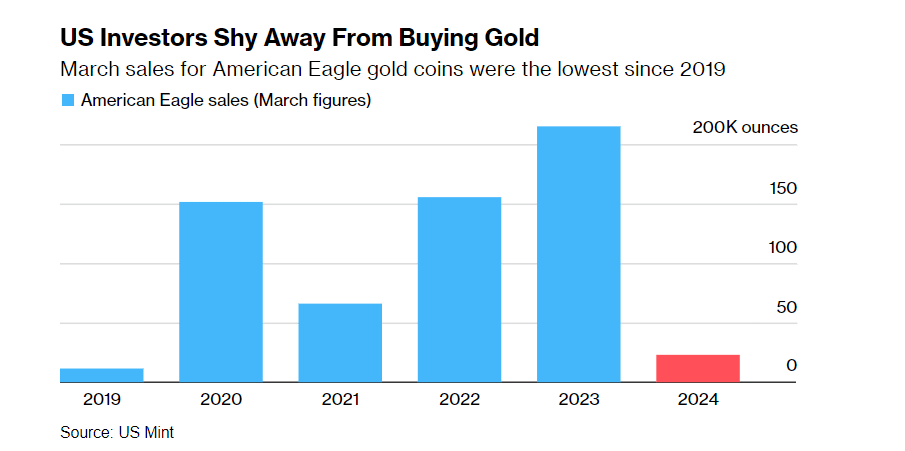 American Eagle gold coin sales in March are lowest since 2019
Of course, longer-term issues such as rising U.S. debt levels and the health of the banking system, as well as concerns about inflation, mean there are still some investors who want to hold gold, whatever the price.
Jason Collins, director of Gerrards Precious Metals in London's historic Hatton Garden jewelry district, said some of his clients still buy gold because of concerns about the safety of banks. "If something bad suddenly happened in the UK, or the entire banking system collapsed, the gold in your pocket will not collapse at that time," he said.
So, what's next for gold? Tobina Kahn has a warning for holders who are still waiting to sell, hoping that gold will reach $3,000. Her point is don't wait.
“Business is very busy and we are getting more calls than ever from customers who want to sell their jewellery,” she said. “I’m telling customers to come now while prices are at an all-time high.”
The article is forwarded from: Jinshi Data