

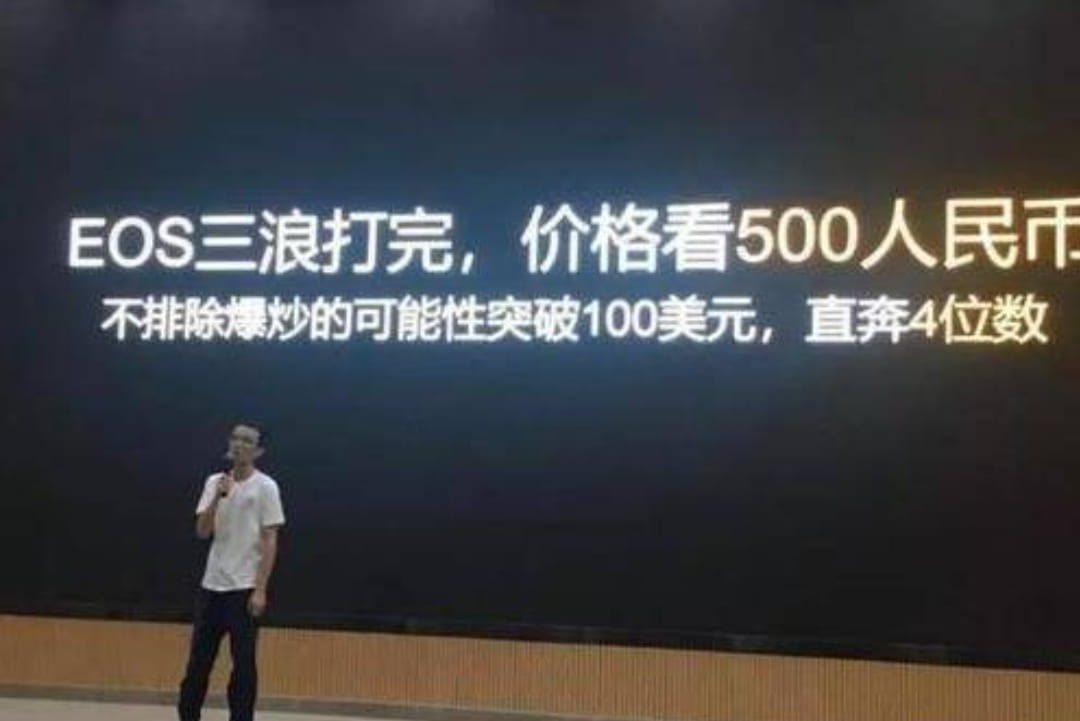
The good news is that you persevered and survived the bear market. The bad news is that you have been steadfast in holding on to EOS.
Pursuing short-term interests is called speculation in the investment field. Almost all courses teach people to have a long-term vision and to invest rather than speculate, because short-term market conditions are highly uncertain due to various factors. Long-term holding of investment is more certain. It sounds like there is nothing wrong with it, but the concept of investment seems to be out of tune with the overall environment of the currency circle. Many people in the currency circle call themselves speculators, who get rich by blindly gambling and return to zero after careful research. From this, it can be seen that investment is definitely not simply extending the holding time. The premise of extending the holding time is to determine that the holding target has long-term value. So how to determine the long-term value of tokens?
The conflict between users and holders
Why do token prices rise? It sounds like a very simple question. Because the total amount of tokens is fixed, as demand increases, the price will naturally increase. The change in supply and demand affects the price, which is the most basic economic principle, but people tend to ignore other factors that affect the price. For the cryptocurrency circle, the most easily overlooked factor is the circulation of tokens.
In order to make it easier to understand the circulation of tokens, a virtual cryptocurrency project YONGGEQI is created here. YONGGEQI is an on-chain ticketing system company. Due to some characteristics of blockchain technology, issuing on-chain tickets can prevent fake tickets and reduce scalpers. It has been widely used soon after its launch. The platform has also issued its own token YGQ, which supports payment methods such as YGQ and US dollars.
Although the platform supports YGQ payment, in fact, YONGGEQI users have no reason to hold YGQ. Due to the drastic price fluctuations of YGQ, holding YGQ during the ticket purchase process is actually a burden. The platform's users and token holders are separated. In order to connect the user holders, the general platform will adopt profit sharing for repurchase and destruction, pledge locking to provide privileges, governance voting, gamification and other methods.
Individual projects are easier to solve, but how does a public chain connect users and holders? In fact, no public chain project has given a satisfactory answer yet, which is the main reason why investment is out of place in the cryptocurrency circle. The separation of users and holders means that even if the number of users on the public chain gradually increases, it will not bring more benefits to the public chain. The price performance is that the token price cannot break through the previous high, so long-term holding and value investment become a joke.
Storage and capture of value
Long-term value lies in two aspects: value storage and value capture. If a public chain wants to become a long-term investment target, it can only have long-term value if it can store or capture value.
Currently, Bitcoin performs best in value storage. It is difficult for an emerging public chain to become a value storage, because this is not achieved by designing a function or implementing a new technology. What is needed more is market acceptance. Only when people are willing to believe that a certain token can become a value storage will they be willing to hold a large number of tokens. Even though Bitcoin has the title of "digital gold", its price still fluctuates violently, and it still has a long way to go in terms of value storage.
The path of value storage is not easy, so is the path of value capture? It is also extremely difficult.
The capture of value cannot avoid the reality of the conflict between users and holders. Because the fundamental interests of users and holders are inconsistent, it is impossible to find a suitable balance when capturing value. Capturing too much harms the interests of users, and capturing too little harms the interests of holders. Users only want a smooth experience and a lower cost, while holders only want the appreciation of tokens. If a project only serves holders + users, then it will never get out of that small circle. Not only will it fail to expand, but it will easily form an involution.