

Tako means octopus in Japanese, and octopuses are considered great problem solvers. Researchers have discovered that octopuses have the ability to solve puzzles, use tools, and adapt to their environment with ease.
background
The background of Tako Protocol is to solve the centralization problem of Web2 platform. In traditional social networks, content creation, storage, distribution and recommendation are usually controlled by centralized platforms, resulting in limited user control, algorithmic bias, scarce innovation and inconsistent data formats. The multi-layer architecture of Web3 provides a creative structure that enables collective wisdom to contribute to content creation, storage, distribution and recommendation. Tako Protocol aims to serve as the content distribution layer in Web3 social networks, providing a more decentralized, collaborative and transparent content discovery method.
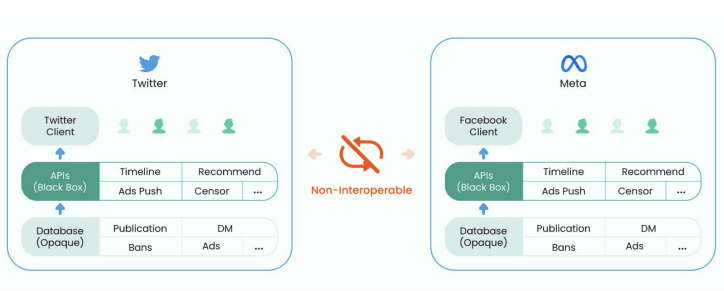
Traditional social networks in Web2 follow the process of content creation, storage, distribution, and recommendation. For example, on Twitter, posts created using Twitter are stored in Twitter's database and processed and ranked by Twitter's algorithm based on the user's interactions and interests. The content is then displayed in the user's timeline based on its ranking.
It is easy to understand the importance of a content distribution or recommendation layer for a platform that strives to capture users’ time and attention among competitors to maximize advertising revenue. As a result, almost all of these platforms have developed their own recommendation algorithms, using exclusive, opaque, and non-interoperable user-generated data.
On one hand, the paradigm of “platform as content curator” has evolved from Google’s “search-based” approach to a “discovery-based” approach seen on platforms like Twitter, Instagram, and TikTok.
On the other hand, this competition between platforms also leads to:
Users don’t have enough control over their data and experiences.
Selling user data for commercial purposes without the user's knowledge or compensation.
Algorithmic bias and limited exposure to diverse content.
Innovation is scarce, and third-party accessibility and involvement is low.
Web3 introduces a completely reformed network structure divided into multiple layers. This allows collective intelligence to contribute to different parts of the network, including content creation, storage, distribution, and recommendation, thereby maximizing Internet innovation.
However, although the architecture and design of Web3 social networks bring new possibilities for content distribution and recommendation, these possibilities have not been realized due to the lack of an effective content distribution and recommendation layer.
For example, many decentralized applications (dApps) still rely on traditional follow-based information flows, which requires users to spend a lot of time and effort to find the content they are interested in. In addition, traditional follow-based information flows also annoy users by recommending irrelevant or "low-quality" content.
As a result, more dApps will face challenges in content distribution and recommendation, stemming from the exponential growth of content, differences in content quality, inconsistent data formats, and a growing lack of interoperability between protocols, all of which hinder the user experience. These are some of the existing and upcoming challenges that Tako seeks to solve.
 introduce
Tako Protocol is a decentralized recommendation engine that redefines content discovery in Web3 Social using a permissionless network. The protocol aims to solve the centralization problem in Web2 platforms, which has led to limited user control, algorithmic bias, lack of innovation, and inconsistent data formats. Web3 architecture is divided into multiple layers, providing a creative structure for collective intelligence to contribute in content creation, storage, distribution, and recommendation. Tako Protocol aims to serve as the content distribution layer in Web3, providing a more decentralized, collaborative, and transparent way of content discovery. It consists of two main components, Tako Aggregator and Tako Network, responsible for building a decentralized and sustainable content distribution network. The Tako Network consists of Feed Relayers and Subscribers, who work together to enhance content discovery in a decentralized manner while maintaining content quality. The protocol enables users to control their content consumption experience, promotes innovation and creativity, and ensures self-regulation and profitability to encourage community participation. The Tako Protocol aims to promote a more inclusive and seamless Web3 social network while maximizing Internet innovation.
Tako Protocol is a decentralized recommendation engine in Web3 social networks. Fundamentally, we are built permissionlessly by users and relayers, eliminating centralized parties. Its goal is to solve the centralization problem in traditional social networks and serve as a content distribution layer in Web3, help open social protocols develop, and promote the mass adoption of innovative and diverse Web3 social networks.
core value
The user-centric approach gives users full control over their content consumption experience, aligning it with their interests and freeing them from the constraints of certain platforms or protocols.
Open curation enables every user to participate in building the recommendation engine, transforming us from "platform as content curator" to "user as content curator." Users and creators can effectively promote content to reach target audiences through interest-based and value-driven recommendations.
Architecture
Tako Protocol consists of multiple parts and procedures, as shown in the figure below, to maximize the decentralized aspect and efficiency of content distribution.
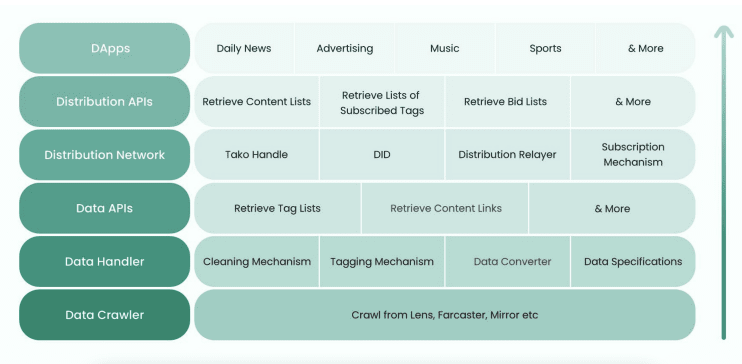
To perform these procedures, two main components were developed: Tako Aggregator and Tako Network.
Tako Aggregator is a database that integrates content aggregation and processing capabilities. Through aggregation, content tagging, and standardization of content data, it ensures seamless development of recommendation systems and extensive content discovery from multiple social protocols.
The detailed steps to build this database are as follows:
1. Content Acquisition (CA): Use specified APIs to acquire content data from various open ecosystems in real time and sort them for subsequent processing and aggregation.
2. Content Tagging (CT): Use AI API to analyze content and generate tags for each content based on its topic.
3. Data Standardization (DS): Clean and standardize data from various sources into a common and more machine-readable format, ensuring their compatibility and interoperability in subsequent integration and development.
4. Distributed Storage Management (DSM): The processed data is stored on a distributed storage network like IPFS by periodically uploading files for each batch of data. This approach, in addition to centralized storage servers, ensures the security, immutability, and accessibility of the data to any third party.
5. On-chain Data Synchronization (ODS): Updates the index information of data files on the blockchain through smart contracts to achieve transparency and verifiability.
6. Open Data APIs (ODAs): Provide developers with real-time data with tagged and standardized content for easier integration and higher throughput.
By building this database, Tako Aggregator solves the chaos in content data, coordinates and liberates user data that is chained in data silos, and assists developers to build recommendations in a decentralized and interoperable way using standardized tag matching. One database, one database for everyone.
Tako Network introduces an innovative, permissionless decentralized content distribution network (dCDN) paradigm responsible for distributing recommended content across multiple protocols and ecosystems. It follows a publish-subscribe architecture and uses a value-based consensus mechanism to ensure decentralized, efficient, and personalized content discovery.
The network consists of various roles and modules. Each role and module contributes to the functionality and robustness of the entire system, while also benefiting from these contributions throughout the process.
mechanism
To illustrate the working process of a dApp built on Tako Network, let’s consider a simple example:
1. Alice wants to share information about hiking and decides to become a FR by minting a TNS called "hiking.tag". As a FR, she curates content about hiking equipment, skills, and knowledge by selecting relevant content from Tako Aggregator's database.
2. Bob, who is interested in hiking, subscribes to the "hiking.tag" TNS after discovering it through search or through related content. Bob then receives a more accurate and personalized stream of information about hiking. He also has the option to provide feedback by liking or disliking specific content.
3. Through effective curation, the "hiking.tag" TNS attracts a large number of subscribers. This increased exposure benefits Tom, a content creator with a hiking theme whose posts have been curated by Alice. Tom's engagement and profitability increase due to the targeted audience provided by TNS subscribers.
4. To further improve performance, Tom or fans who wish to support him can initiate a bid to add his content to other TNS related to the hike. FRs of these TNS then evaluate the bids based on factors such as relevance, content quality, and bid price. It is critical for FRs to maintain the trust and value of their TNS by accepting bids that align with subscriber preferences, as irrelevant or low-quality content may reduce the trust and overall value of their TNS.
Tako Network benefits users with its low participation threshold, allowing anyone to have a significant impact on the recommendation system. Users, even without technical expertise, can become Feed Relayers to curate and recommend content, incubate potential creators, enhance their social influence, and profit from their efforts.
This value-based mechanism also combats the vulnerability of vulnerability, where low-quality TNS can be easily replaced by other trustworthy FRs. A single point of failure or manipulation can hardly destroy the entire network and ruin the user's experience, as it once did on traditional platforms.
In this inclusive and dynamic network, thousands of FRs host information flows based on established consensus. Even in niche areas or subcultures, each user can discover content that resonates with their interests and passions, enjoy diversity and avoid algorithmic bias.
Governance
In the Tako Protocol system, the Distributed Autonomous Organization (DAO) plays a key role in stabilizing and improving the system in a decentralized manner. In the Tako DAO, suggestions and decisions made by creators, forwarders, developers, or other community members are of great value. DAO members will have the power to propose protocol upgrades, propose parameter adjustments, approve budgets or funding, and recommend whitelisting or blacklisting of specific roles. The Tako DAO also serves as a communication channel to facilitate connections between different roles within the ecosystem and facilitate communication between users and the Tako team.
Economic Model
Tako Protocol's economic model ensures sustainability and active participation of community members, users, Relayers, and developers. In addition to the Tako Network's native revenue distribution module that incentivizes the screening and recommendation of high-quality content, early adopters and regular users who provide feedback will also be rewarded for their contribution to the growth of the protocol and the recommended experience. In order to further enrich the ecosystem, grants will also be proposed and allocated to developers who develop the ecosystem to achieve innovative dApps and protocols. The goal of the Tako Protocol is to build a sustainable content distribution network that benefits all participants and roles and promotes community consensus.
Roadmap
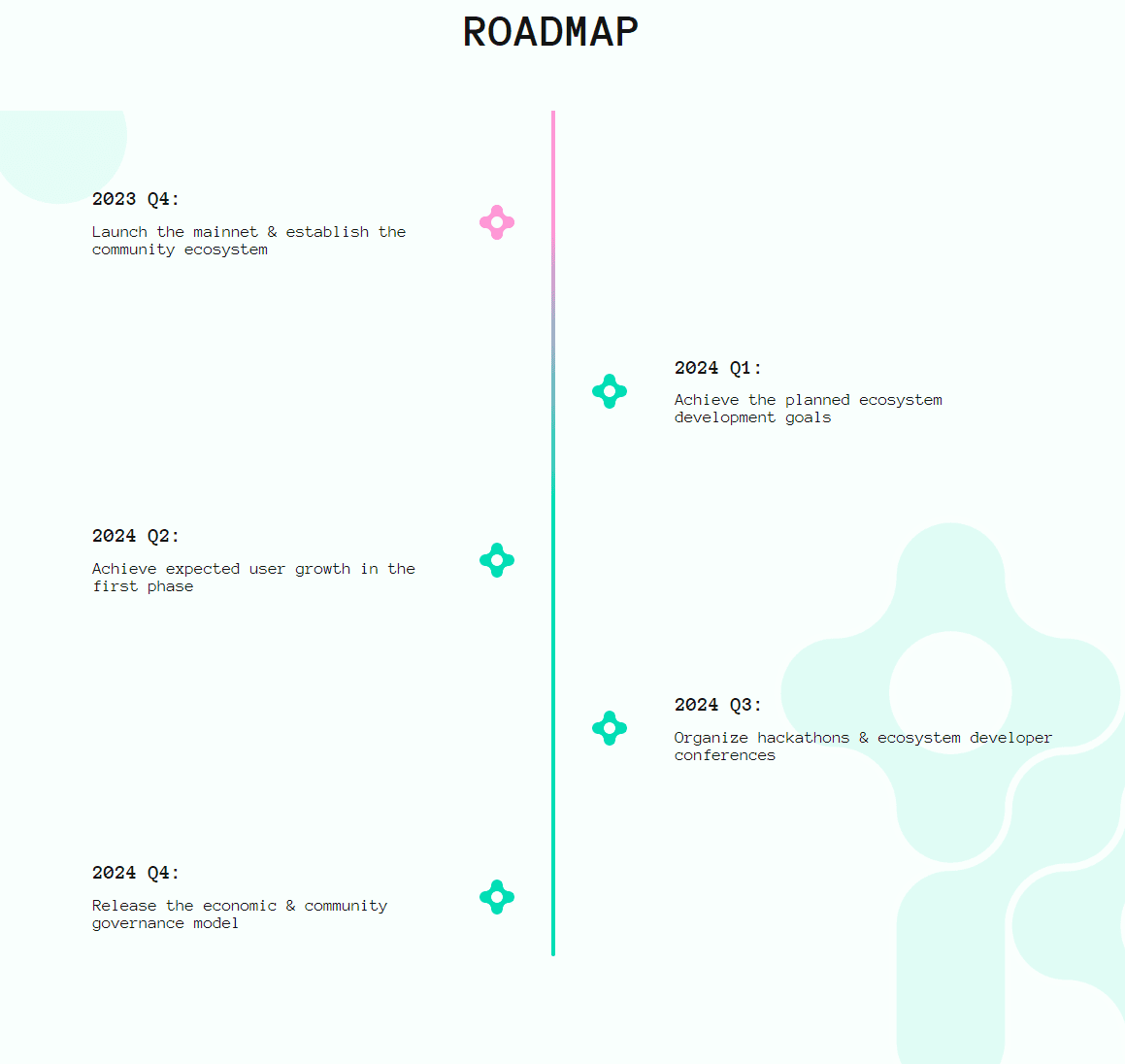
The main tasks are to complete the white paper and architecture design in Q2 2023, launch the mainnet and establish a community ecosystem in Q4 2023, and achieve the expected user growth in the first phase in Q2 2024.
Conclusion
Tako Protocol aims to solve the centralization problem in traditional social networks and serve as a content distribution layer in Web3, helping open social protocols to develop and promoting the mass adoption of innovative and diverse Web3 social networks. By building this permissionless, dynamic and sustainable content distribution layer, Tako Protocol strives to ensure that every role in the ecosystem is equally important and appropriately rewarded. In this inclusive and dynamic network, every user can discover content that resonates with their interests and passions, enjoy diversity and avoid algorithmic bias. This marks the beginning of a new, more open and user-centric era of digital social interaction.