


Key points to remember
In this new blog series, we concisely summarize our research team's findings to expand on the conclusions of the original reports.
This article provides you with an overview of Binance Research's latest report on the BRC-20 standard, an experimental token standard to introduce fungible tokens on the Bitcoin blockchain.
The emergence of the BRC-20 standard has met with mixed reactions. We are still in the early stages and have not yet determined whether this system is viable in the long term.
Binance Research lets you access cutting-edge insights into the processes shaping Web3. By sharing this information, we aim to bring the latest findings from crypto researchers to our community. Want to dig deeper? The full reports are available on the Binance Research website.

In 2023, the Bitcoin ecosystem saw a surge in innovation with the development of something called Ordinals. The Ordinals protocol was implemented earlier this year, allowing new entities like “listings,” often referred to as “Bitcoin NFTs,” to begin gaining prominence within the crypto community.
BRC-20 tokens are the latest innovation in this Ordinal-based movement and have been the subject of much heated discussion over the past few months. Many people are excited about the new energy this innovation brings, while others see it as a deviation from Bitcoin’s original goals and are less satisfied with its effects.
Today we’ll take a look at the rise of the BRC-20 standard by exploring its background and the community’s response. We’ll also discuss the risks and challenges that BRC-20 tokens currently pose, providing insight into what could be improved in the future.
Historical
The BRC-20 standard is an experimental token standard that was first conceptualized in March 2023. It allows for fungible tokens to be deployed, issued, and transferred on the Bitcoin blockchain. This latest innovation driven by Ordinals means that both fungible and non-fungible tokens (NFTs) are now part of the Bitcoin ecosystem.
It should be noted that BRC-20 tokens are extremely risky and are at a very early stage of development. The creators themselves have been explicit about the risks associated with their experimental nature. This aspect should be kept in mind when reading, and this article is not intended to give an endorsement or advice, but only to inform.
Ordinals and inscriptions
The Ordinals protocol involves tracking individual satoshis (sats) according to what founder Casey Rodarmor calls “Ordinal Theory.” Sats are the smallest unit of bitcoin, and 1 BTC is equal to 100,000,000 sats. Ordinal Theory assigns a unique identifier to each sat on the Bitcoin network.
Additionally, these sats can be “inscribed” with content such as text, images, videos, etc. to create an “inscription.” This process actually describes the creation of an NFT on the Bitcoin blockchain. To learn more about ordinals, inscriptions, and Bitcoin NFTs, check out Binance Academy’s article: What are Ordinals? Bitcoin NFTs Overview.
What is the place of BRC-20 tokens?
With inscriptions enabling the activation of NFTs on Bitcoin, development naturally evolved towards fungible tokens. This is where the BRC-20 standard comes into play. If inscriptions are the non-fungible application of Ordinals’ innovation, BRC-20 tokens are their fungible counterpart.
On March 9, a crypto Twitter user with the handle @domo posted a thread theorizing about a method called BRC-20 that could create a standard for fungible tokens on top of the Ordinals protocol.
The method essentially consisted of writing text on sats to create fungible tokens. The initial design only allowed for three different operations: deployment, issuance and transfer.
The humble beginnings of BRC-20 tokens (@domo's first thread on the topic)

The three possible initial operations for BRC-20 tokens

The first token contract to be deployed was for the $ORDI token, with a limit of 1,000 tokens per issuance and a maximum supply of 21 million (referring to Bitcoin’s maximum supply). In less than a day, all 21 million $ORDI tokens were issued, and more tokens quickly followed. The total capitalization of BRC-20 tokens peaked at over $1 billion, but has since declined and is now around $300 million.
Community Response
The initial innovations around ordinals and inscriptions have already sparked heated debates within the Bitcoin community. Discussions often center around transaction fees, which have increased with the rise of these ordinal-related innovations. The BRC-20 standard has taken this debate to a new level.
On the one hand, there are the “pro-fee” supporters, who welcome the increase in transaction fees and see it as essential to the longevity of Bitcoin. On the other hand, there are the “low-fee” supporters, who are more critical of the increase in transaction fees and see it as going against the philosophy and initial intentions of the system.
The “pro-fees” argument
The viability of Bitcoin's security model is a major concern for many in the community. Bitcoin's block rewards are halved after every 210,000 blocks are issued, which occurs approximately every four years.
Bitcoin Block Reward per Successful Block
Source : Bitcoin Visuals, Binance Research
Miners need to be compensated because they keep the system secure. Given this fact, Bitcoin transaction fees are bound to be higher in the future. Thus, many community members, especially miners, have been pleasantly surprised by the attention that ordinals and BRC-20 tokens have received. They are optimistic about their impact on the relatively quiet Bitcoin fee market.
While the price of Bitcoin has increased significantly since the days of 50 BTC block rewards, this issue illustrates the vulnerabilities in the BTC miner economic model. With the possibility of a brighter future in terms of demand for block space, this situation seems more favorable to miners and could incentivize more to join the network.
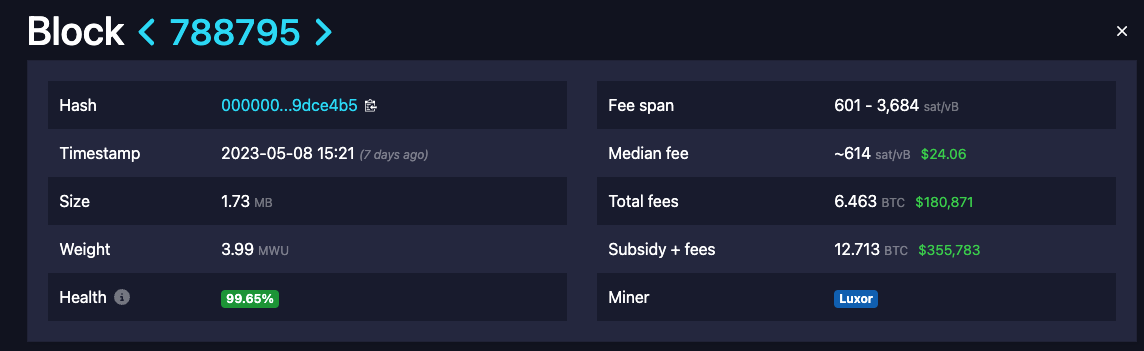
Early May even saw Bitcoin blocks with transaction fees exceeding the 6.25 BTC block reward. This is quite significant, considering that transaction fees averaged just 1-2% of miners’ revenue for most of 2022 and were not much higher in previous years. It indicates the growing demand for block space that ordinals and BRC-20 tokens have helped to create.
The total fee for block 788795 was 6.46 BTC, compared to a block reward of 6.25 BTC.
The argument of the "low fees" supporters
While many are pleased with the increased activity and buzz around the Bitcoin ecosystem and are motivated by the fee increase from a sustainability perspective, others are more critical.
These “low fee” advocates believe that Bitcoin’s true purpose is to serve as a non-fiat hard currency and that the blockchain should only be used for peer-to-peer transactions. They believe that ordinal transactions, which require a lot of data, primarily serve to congest the Bitcoin network and increase fees, ultimately discouraging peer-to-peer transactions.
Some argue that the fee increase excludes users from countries where Bitcoin is seen as an alternative to the local fiat currency system. Others are more extreme and even consider ordinals and BRC-20 tokens as an attack on the Bitcoin blockchain.
Risks and challenges
As previously stated, ordinals, inscriptions, and BRC-20 tokens are extremely new and very risky innovations at this early stage. They are at the cutting edge of what is happening in the cryptocurrency space today. So there are a few key risks that any reader should be aware of.
1. Limited or non-existent infrastructure
Let’s be honest, BRC-20 tokens are just an idea that grew out of an experimental token standard created by a pseudonymous user on Twitter. While the innovation and potential of the idea are undeniable, it’s important to understand that we’re still at the beginning of the story and the infrastructure is still underdeveloped.
The token standard has been around for a few months and has only seen significant activity in the last few weeks. While designers are working quickly, there isn’t much in place at this point. We’ve seen the beginnings of marketplaces and a DEX, but much of the trading is still done over-the-counter (OTC) through Discord servers. Without proper infrastructure, it’s difficult to track tokens and their owners.
Another challenge is the lack of methodological consensus. These instruments are not unique to the Bitcoin blockchain, but come from ordinal theory, which essentially “associates” sats with certain characteristics. In the absence of social consensus on this method, some parties might not recognize certain ordinals and therefore not recognize certain BRC-20 tokens.
There is still a long way to go if we want the market to have more than a few thousand owners. While there is optimism about what BRC-20 tokens have unlocked and what they could potentially offer, the infrastructure still has a long way to go.
2. No real utility
The majority of BRC-20 tokens currently trading are meme tokens. Almost by definition, these tokens have no utility and are largely driven by social media and community sentiment. While this may attract some attention and buzz, the lack of utility and, therefore, a serious owner base means that these tokens could collapse suddenly and without warning.
Every reader should keep this risk in mind and if you see a new token offering some form of utility, you should dig deeper and ask yourself if it is true or just a PR stunt.
3. High risk of scam
Let’s not forget that the novelty of this experience comes with a high risk of scams. For example, over-the-counter (OTC) trading of tokens on Discord servers is naturally a very high-risk activity and has led to many people getting scammed.
Plans to build infrastructure for ordinals or BRC-20 tokens could also pose a potential security risk at this early stage. We do not want to scare readers, but as these tokens and this new technology are still in their early stages, the risk of fraud is high and should be taken seriously.
Conclusion
Ordinals, inscriptions, and BRC-20 tokens have demonstrated that there is indeed demand for Bitcoin block space outside of traditional peer-to-peer payments. Users want to do the same things they do on Ethereum and BNB Chain, but with Bitcoin.
The lack of revenue for miners from transaction fees has been a major concern for many Bitcoin proponents, and this recent wave of activity has aptly demonstrated the possibilities that exist. Recent developments have been encouraging and help represent a potential path to Bitcoin’s long-term viability.
Cryptocurrency growth is often exponential. For example, after the first registration on December 14, 2022, it took more than a month to reach 100. However, between February 2 and 15, the number of registrations increased from 1,000 to 100,000. In April, we had reached 1 million and are now at more than 7 million.
While we cannot predict the size of this market, we can expect the number of listings to continue to increase. This is a space to watch closely.
Exponential growth in registrations so far
Source : Dune Analytics (@dgtl_assets), Binance Research (16 mai 2023)
Binance Research
The Binance Research team is committed to producing objective, independent and comprehensive analysis on the crypto world. It publishes informed thoughts on Web3 topics, including the crypto ecosystem, blockchain technologies and the latest market trends.
This article is just a preview of the full report, which contains additional information and detailed analysis of key BRC-20 market charts. It also explores Bitcoin Layer 2 solutions and the future outlook for the industry. The content offered is very rich; don’t miss out on this exclusive information!
Click here to read the full report, Check out more in-depth investigations into recent Web3 developments on the Insights & Analysis page of Binance Research’s website. Grab this chance to educate yourself with the latest findings from crypto researchers!
For more information
Binance Research 2.0
Binance Research: Top Crypto Trends in May 2023
Binance Research: Exploring the Use Cases and Possibilities of AI in the Crypto Universe
General Disclosure: This material has been prepared by Binance Research and should not be considered a forecast or investment advice, and does not constitute a recommendation, offer, or solicitation to buy or sell any security or cryptocurrency, or to adopt any investment strategy. The terminology used and opinions expressed are intended to promote the understanding and responsible development of the industry and should not be construed as final legal views or the views of Binance. The opinions expressed are as of the date indicated above and are those of the author of the material and are subject to change as circumstances evolve. The information and opinions contained in this material are obtained from proprietary and non-proprietary sources deemed reliable by Binance Research, and their completeness and accuracy are not guaranteed. Accordingly, Binance makes no warranty as to its accuracy or reliability and accepts no liability arising from any other errors or omissions (including liability to others due to negligence). This document may contain “forward-looking” information that is not exclusively historical in nature. Such information may include, but is not limited to, projections and forecasts. There can be no assurance that such projections will prove to be correct. Use of the information contained herein is at the sole discretion of the reader. This document is intended for informational purposes only and does not constitute investment advice, an offer or solicitation to buy or sell any security, cryptocurrency or any investment strategy, nor will any security or cryptocurrency be offered or sold to any person in any jurisdiction in which the offer, solicitation, purchase or sale is unlawful under the laws of such jurisdiction.All investments involve risks.
Trade anywhere with the Binance crypto trading mobile app (iOS/Android)
Find us on:
Instagram : https://www.instagram.com/binancefrench
Twitter : https://twitter.com/LeBinanceFR
Facebook : https://www.facebook.com/BinanceFrance
Telegram : https://t.me/BinanceFrench
Risk Warning: Digital asset prices are subject to high market risk and price volatility. The value of your investment may go down as well as up, and you may not get back the amount you invested. You are solely responsible for your investment decisions and Binance is not responsible for any losses you may incur. Past performance is not a reliable indicator of future results. You should only invest in products that you are familiar with and whose risks you understand. You should carefully consider your investment experience, financial situation, investment objectives and risk tolerance and consult an independent financial advisor before making any investment. This is not intended as investment advice or as an inducement or recommendation to trade in any digital asset. For more information, see our Terms of Use and Risk Warning.