

Introduction
Recently, Binance Research released a research report on LSDfi, covering the overall pattern, benefits and possible risks of the LSDfi track. The report shows that although LSDfi is growing rapidly, its scale is less than 3% of LSD itself. As a young track, there is still room for improvement.
In addition, in the BNB chain ecosystem, liquidity pledge and related gameplay are also developing. Data shows that the LSD project on the chain has relatively lower fees, and there are also opportunities to participate.
At the same time, while LSDfi maximizes the income from ETH staking, since the track is still in its early stages, participants still need to pay attention to various risks, find a balance between returns and risks, and lock in deterministic opportunities.
Shenchao has selected and refined the core viewpoints of the report, as follows:
Core conclusions:
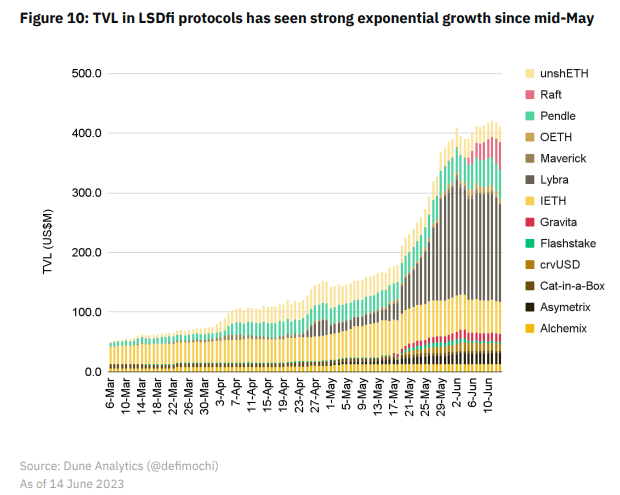
Over the past few months, TVL of LSDfi protocols has grown rapidly, benefiting from the adoption of LSD. The cumulative TVL of the top LSDfi protocols has exceeded $400 million, more than doubling since a month ago. Favorable factors that promote LSDfi growth include the growth of staked ETH and the current low penetration rate of LSDfi.
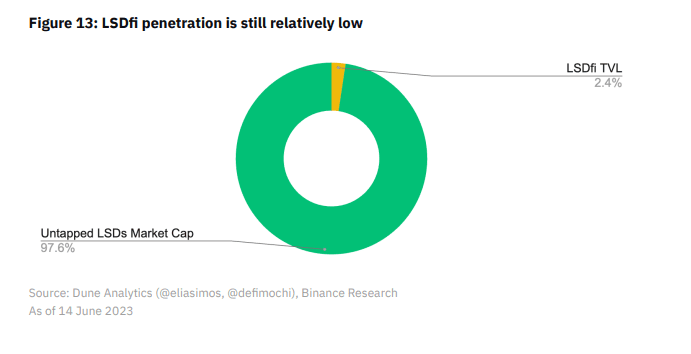
Currently, the TVL of the LSDfi protocol accounts for less than 3% of the total addressable market. Although LSDfi provides attractive opportunities for LSD holders, users should be aware of the associated risks, including but not limited to penalty risk, LSD price risk, smart contract risk, and third-party risk.
Ethereum staking and LSD development
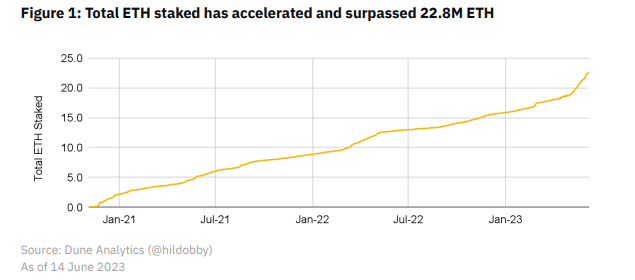
The ETH staking market is developing rapidly. With the successful transition of Ethereum to the PoS consensus mechanism and the withdrawal of staked ETH after the Shapella upgrade, the amount of staked ETH has increased rapidly. Currently, the total staked ETH has exceeded 22.8M ETH.
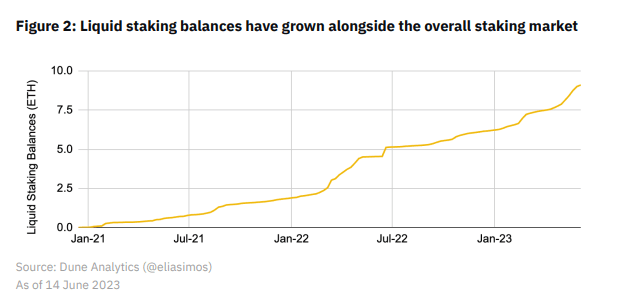
LSD is booming simultaneously. Running an independent node has technical difficulties and high capital requirements, which is not suitable for everyone. Therefore, the liquidity staking protocol lowers the threshold for participation while maintaining the liquidity of the staked assets. The data also shows that the proportion of ETH staked in the LSD gameplay is increasing.
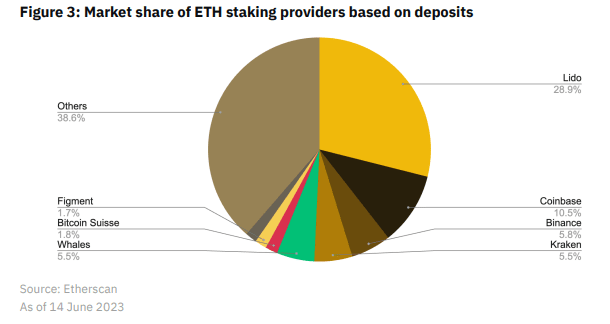
In terms of market structure, a situation of one super and many strong players has initially taken shape: Lido is the largest staking provider, accounting for 28.9% of the market share, followed by centralized exchanges such as Coinbase, Binance and Kraken. There are also some smaller liquidity staking providers, but their staking ETH is relatively small.
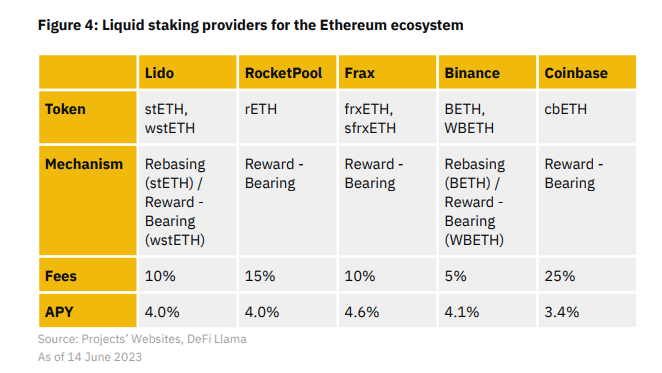
In addition, the rates of each provider vary, but the returns are basically around 4%.
Liquidity staking in the BNB ecosystem is also active, with a total staking value of approximately $150 million. Similar to ETH liquidity staking, BNB stakers receive liquidity staked BNB, which can be used in other areas of DeFi to further generate returns.
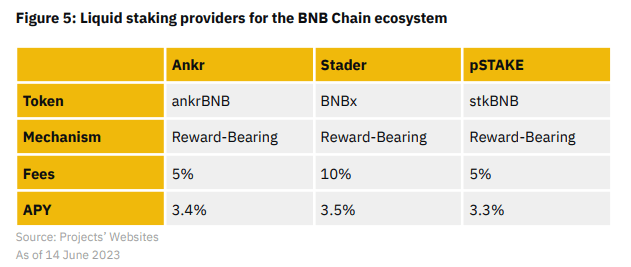
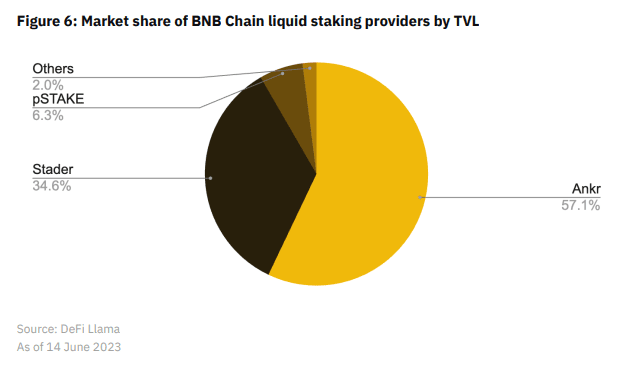
LSD-based financialization gameplay: LSDfi
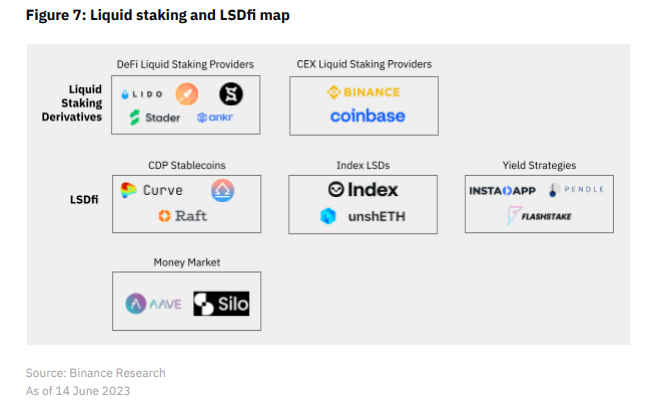
The LSDfi protocol allows LSD holders to maximize their assets and realize additional income. The specific types and classifications of LSDfi are as follows:
1. DeFi Liquid Staking Provider: A DeFi provider that allows users to participate in staking and receive LSD in return.
2. CEX Liquidity Staking Providers: Centralized Exchanges ("CEXs") that provide Liquidity Staking Services.
3. CDP Stablecoin: A collateralized debt position ("CDP") protocol that uses LSD as collateral and allows users to mint stablecoins.
4. Index LSDs: Tokens representing the holdings of a basket of LSDs.
5. Revenue Strategy: A protocol that allows users to obtain additional revenue opportunities.
6. Money Market: Protocols that facilitate lending and borrowing activities through LSDs.
Based on the above classification, we can see the location and related services of different protocols:
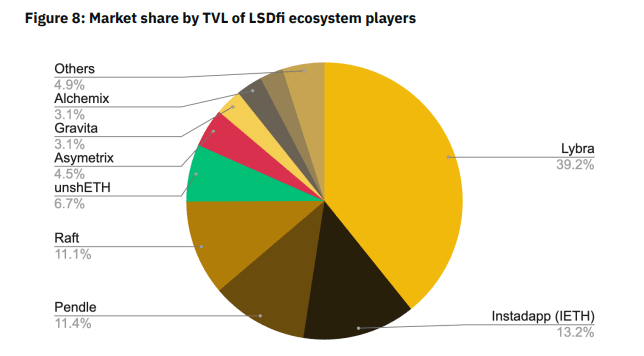
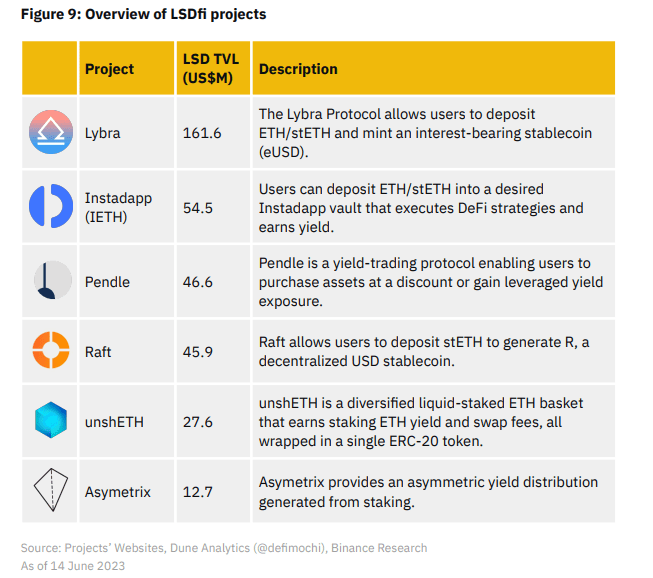
Structurally, the market share of major LSDfi protocols and providers is relatively concentrated, with the top five accounting for more than 81% of TVL. Lybra is the market leader, and the project has risen rapidly after its launch in April, with a TVL of over $160M.
In terms of growth momentum, LSDfi is developing rapidly. In recent months, TVL has increased rapidly, doubling since a month ago to exceed $400 million. This growth trend is driven by LSD holders' desire to maximize their returns.
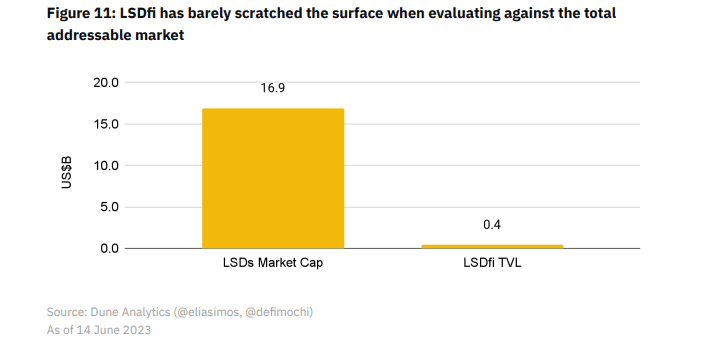
The road ahead is long and arduous. Despite LSDfi’s impressive growth, the MC of the LSD track exceeds $16.9 billion, and the total TVL of the LSDfi protocol is only $412 million, with a current penetration rate of less than 3%.
Finally, LSDfi is a young market with both risks and opportunities. Participants need to consider pledge risks, price volatility risks, smart contract risks, and third-party risks, and act with caution.
Staking penalty risk: Validators who fail to meet certain staking parameters (e.g., being offline) will face penalties, and LSD holders may be exposed to these penalties.
LSD Price Risk: The price of LSD tokens may fluctuate and diverge from the underlying tokens due to market forces. This may expose users to price volatility and potential liquidation risk, especially when used as collateral. Smart Contract Risk: Every interaction a user has with a smart contract presents a new dimension of smart contract vulnerabilities.
Third-party risk: Some projects may use other dApps as part of their normal operations (e.g., a yield-generating strategy). In this case, users are exposed to additional counterparty risk.
Conclusion
The report generally believes that the LSDfi protocol opens up new opportunities for LSD holders seeking returns. By providing additional application scenarios for LSD, LSDfi incentivizes staking participation and has the potential to accelerate the growth of LSD. Considering that the industry is still in its early stages of development, it will be exciting to further observe innovations in this field and the adoption of LSDfi. LSDfi will be a thriving ecosystem, and we have only touched on a small part of it. Based on this, Binance Research may release another report in the coming weeks to explore all aspects of LSD from a data-driven perspective.
The full report is as follows:
https://research.binance.com/static/pdf/lsdfi-when-liquid-staking-meets-defi.pdf