

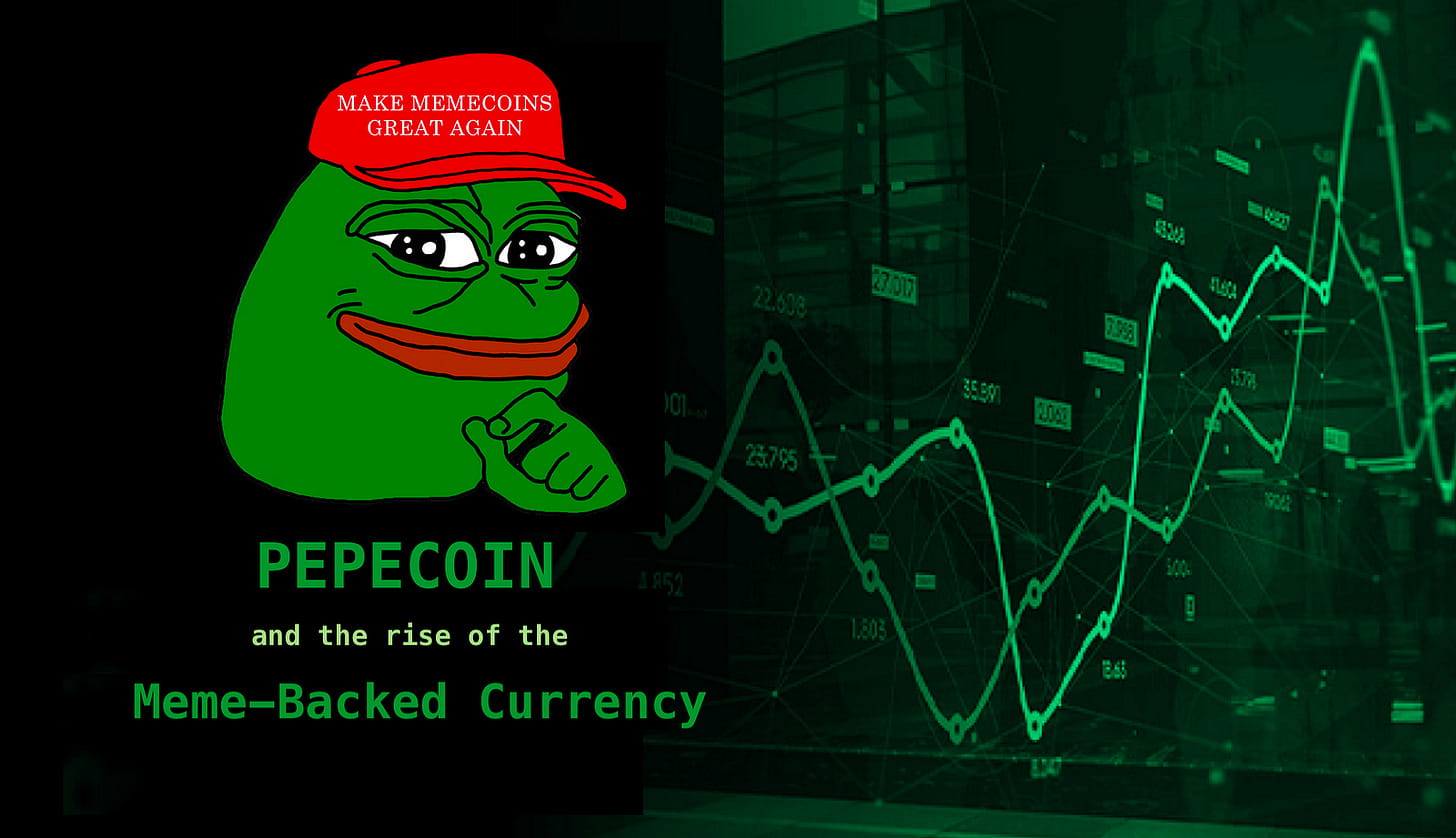
Memes, dreams, and get-rich-quick schemes
Introduction
Over the past two months, it’s been hard to miss the epic saga of Pepecoin, and the resurgence of memecoin fever that has followed it. In fact, on May 5, Pepecoin surpassed a staggering $1 billion market cap, becoming a top 50 cryptocurrency[1]. In many ways, Pepecoin’s rise is reminiscent of the astonishing rises of two of the most famous memecoins, Dogecoin and Shiba Inu. In fact, Pepecoin itself even paid tribute to the long tradition of memecoins it inherited, claiming to “make memecoin great again”[2]. So, what makes a memecoin “great”? Why do they exist (and even thrive) in the cryptocurrency ecosystem despite their apparent lack of utility?
Know your memecoin
Memecoin has always been the novelty and weirdness of a cryptocurrency. Their most striking feature is actually their professed lack of any practicality, which they display with a semi-ironic pride. Although almost anyone can create a memecoin with a few clicks of a button, not all memecoins are created equal. After all, there are far more people holding Dogecoin than holding “HarryPotterObamaSonicInu” (which is a real coin on CoinMarketCap)[3].
In fact, the most successful memecoins never came from humble backgrounds: they were warriors. These were the memes that fought fiercely on the turbulent ocean of Internet meme culture, where any cultural sensation or thing that caught people’s attention, from an Elon Musk quote (Tweelon) to a sex joke (CumRocket) to literal feces (PooCoin) to a GPT quote (PepeGPT), could be turned into a memecoin [4].
In these epic battles, only those memes that prove themselves accessible, relatable, and enduring will survive. For those that succeed, there will be endless glory, fascination from the crowds, respect from the powerful, and a memecoin that can weather even the toughest crypto storms. In the midst of it all, perhaps Pepe does have a chance to survive, thrive, and prosper.
Pepe: The King of Memes
 The original Pepe emoticon "Feels Good Man". Source: https://zh.wikipedia.org/wiki/Pepe_the_Frog
Pepecoin was born with a privileged status, as the Pepe meme (along with Doge) belongs to a kind of royalty in internet meme culture. It was created in 2008 by cartoonist Matt Furie, who drew a picture of a green frog with bulging eyes watching itself pee while saying “feel good” [5]. Since then, Pepe has quickly become popular in various forms, including sad, laughing, and more [6].
Since its inception, the Pepe meme and its corresponding ugly frog image have always had distinct countercultural and subversive connotations, especially in contrast to the more benign Doge meme. Although most uses of Pepe are mild, the ugly frog also has an “ugly side.” On 4chan and other fringe social media platforms, the frog meme is often twisted and modified to become darker, sometimes becoming the embodiment of extreme political symbolism. Over time, variations of the Pepe meme have become emblematic of far-right groups and other more subversive corners of the internet. [7] As a result, there exists a great duality in the Pepe meme: on the one hand, it exists in mainstream society as a countercultural image of an ugly frog with a happy, sad, or grinning expression; on the other hand, this countercultural symbol has been co-opted by extreme political movements whose actions actively contribute to social instability.
This duality is what makes Pepecoin so controversial, and why Coinbase got into trouble when it accused the Pepe meme of being “used as a right-wing extremist hate symbol”, only to be forced to apologize and admit that most mainstream uses of Pepe are not biased[8]. But in the context of memecoins, they rely on controversy and sustained media attention. After all, it is Pepe’s long-standing status as the king of memes and the undisputed symbol of internet meme culture that underpins Pepecoin’s value proposition, and explains its astonishing speed to reach a market cap of $1 billion and $1.87 billion in trading volume at its peak.
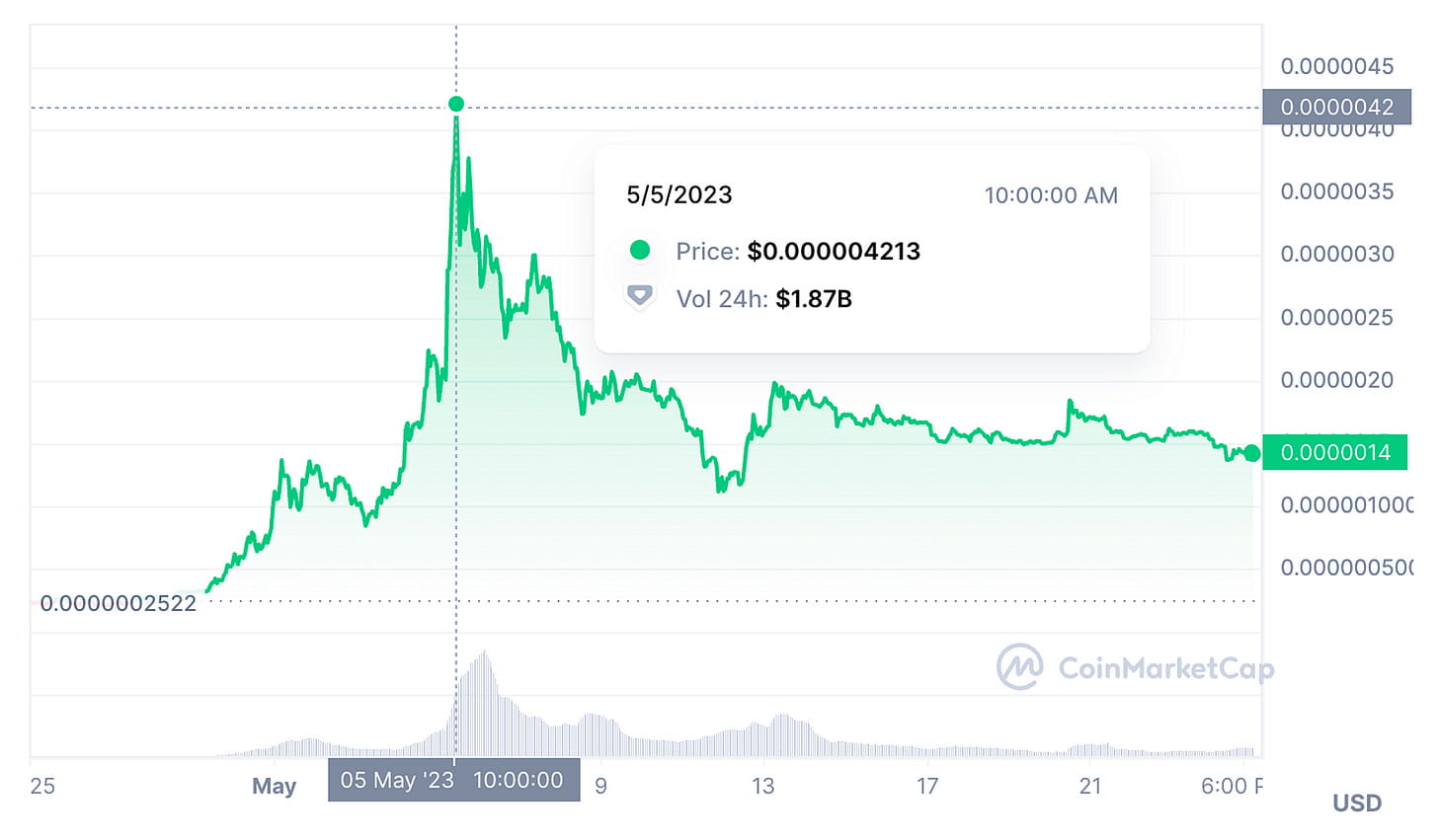 Pepecoin price, CoinMarketCap. Data as of May 24: https://coinmarketcap.com/currencies/pepe/
Pepecoin is similar to Dogecoin in that it uses its power as the undisputed king of the internet meme to support its value as a cryptocurrency. It can be argued that Pepecoin's slogan "Make memecoin great again", as well as its claim to be driven entirely by "pure meme power", has a degree of truth. After all, since Pepe is such an important meme king, Pepecoin has the potential to be around for as long as Dogecoin.[9]
Daily Limit Ups, Daily Limit Downs, and the Power of FOMO
Memecoins like Dogecoin and Pepecoin, combined with their lack of any utility, have naturally become targets for hype and regulation. In many cases, “promoting shitcoins” has become a favorite pastime of the wealthy.
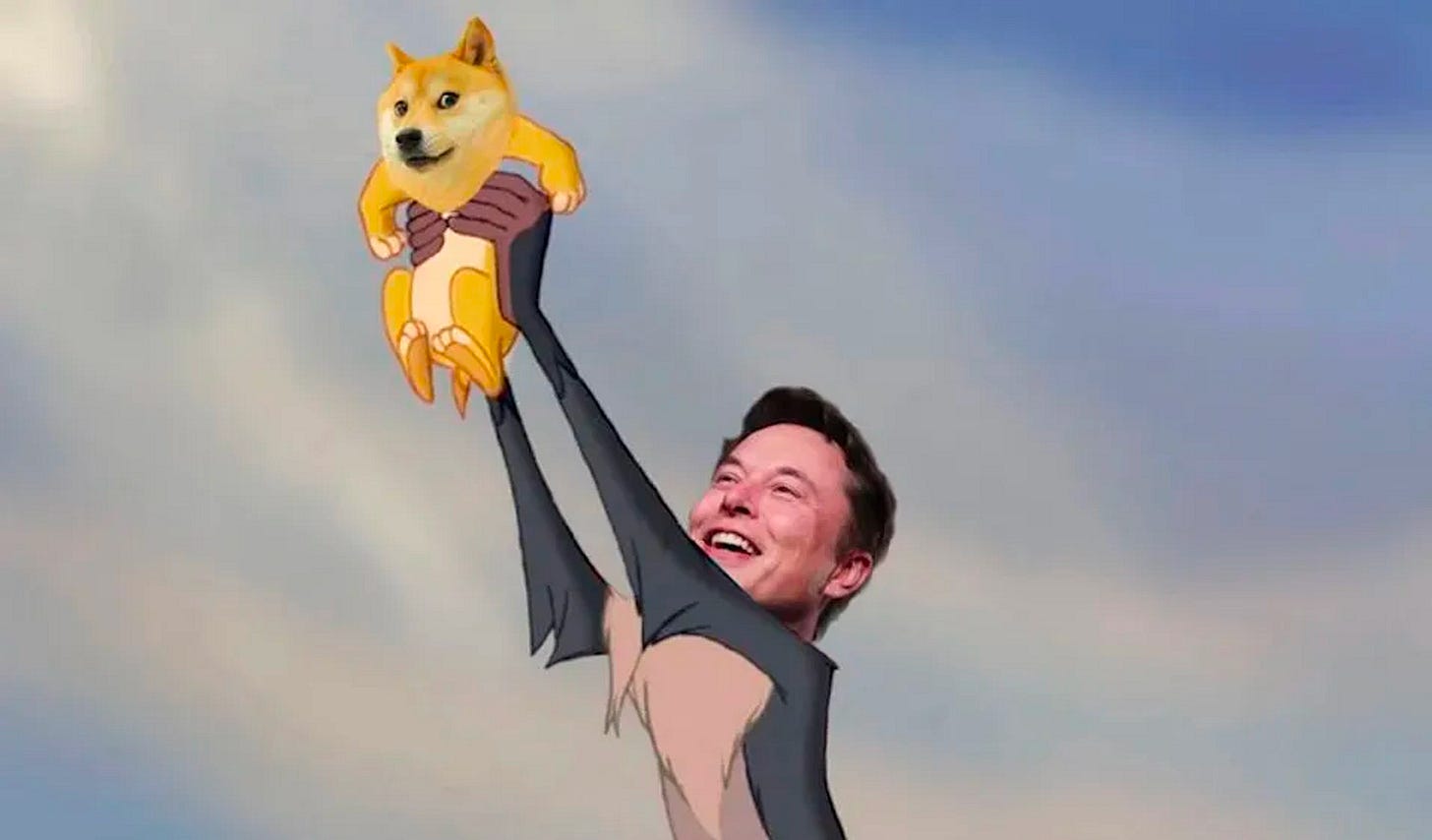
One need not look further to see Elon Musk’s influence on the fate of Dogecoin, demonstrating how key opinion leaders can drive prices to great heights [10]. Simply by tweeting “Doge” and writing “Dogecoin is the people’s cryptocurrency,” Dogecoin prices soared 40%. During the great bull run of 2021, Dogecoin grew an astonishing 147.6 times in just over five months.
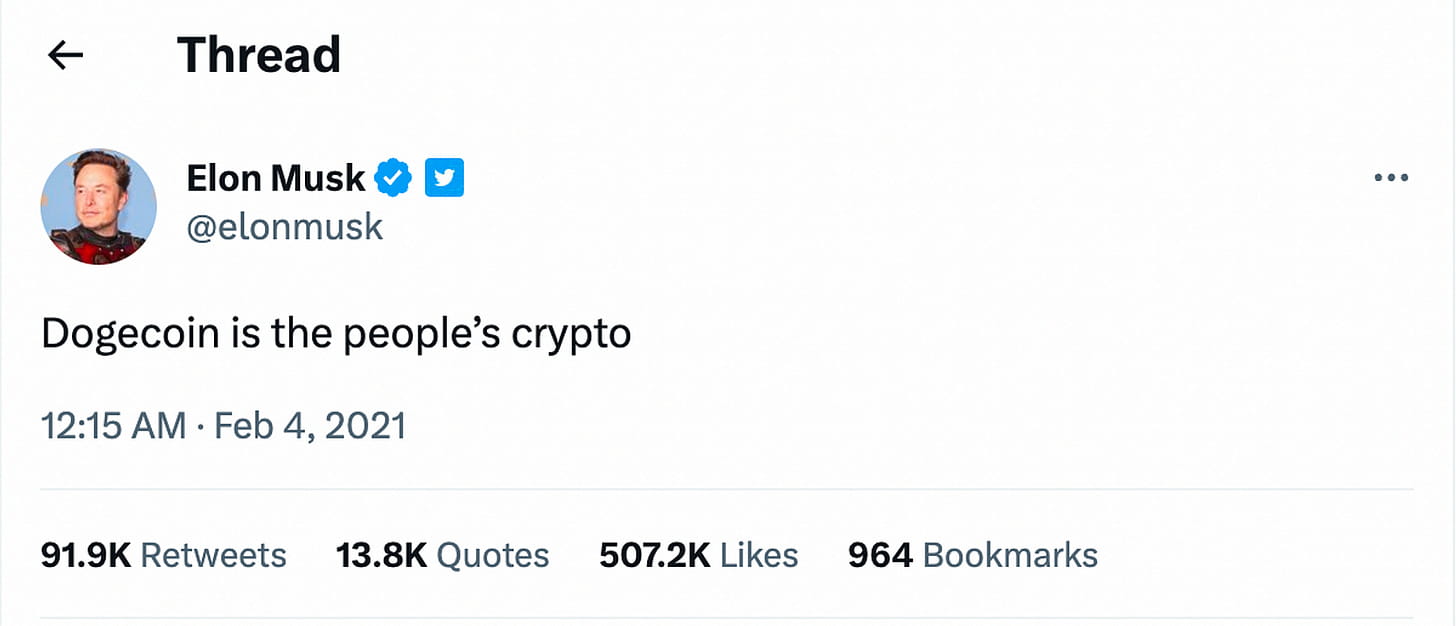 Elon Musk calls Dogecoin "the people's cryptocurrency."
Arguably, this ability to be manipulated at will by key opinion leaders is inherently built into the economic logic of memecoin. As mentioned before, the monetization and appreciation of memecoin is based on the attention and cultural capital that the underlying meme (or cultural phenomenon) can accumulate and sustain. Key opinion leaders like Musk are by definition capable of creating and sustaining cultural phenomena on their own, causing these cultural derivatives (i.e. memecoins) to grow significantly in value, which in turn triggers the fear of missing out (FOMO) psychology of retail investors who want to jump on the get-rich-quick cryptocurrency bandwagon.
The same logic applies to the rapid rise of Pepecoin over the past month or so. While there is no clear celebrity promoting Pepecoin on Twitter (as there was with Elon Musk and Dogecoin), judging by on-chain data, the Pepecoin hype appears to have seen some huge winners. For example, a wallet labeled blackrock3.eth bought $244 worth of Pepecoin on April 21 and sold all of it for $2.63 million at its peak on May 5.[11]
Of course, with every rise comes a fall. Today, a full 20 days after its peak, Pepecoin is down 70% from its all-time high.[12] As attention for this online memecoin fades and the fear of missing out (FOMO) frenzy subsides, its price (a function of attention) will naturally fall. But that’s just the nature of memecoins. For a memecoin, Pepecoin’s -70% can be considered relatively stable and “mild.” At least Pepecoin has not repeated the fate of “Squidward Game Token,” a memecoin that rose to prominence on the wave of the huge success of the 2021 Netflix TV show “Squidward Game.” The “Squidward Game Token” soared from 1 cent to $2,856 in just one week before its creators essentially took their money and ran away in a classic “rug pull.”[13]
But this kind of volatility coming from memecoins that claim their value comes solely from the power of their memes isn’t surprising, given that “useless” is written right on their labels.
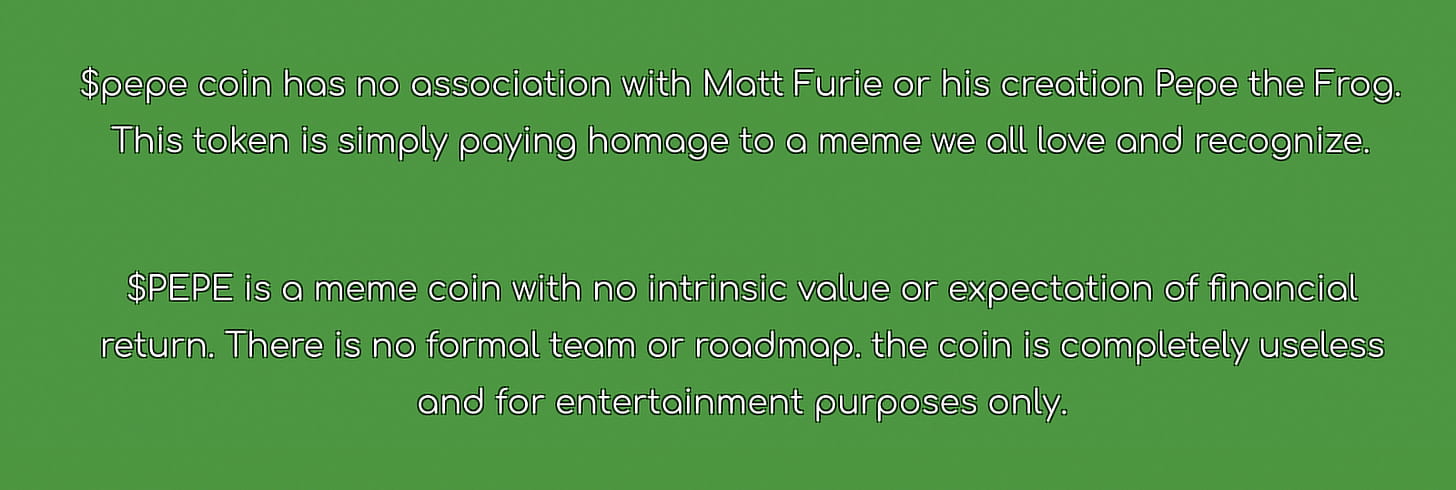 From the Pepecoin website
Meme chains and practicality issues
But what does the future of memecoins look like? Will they always be objects of pure speculative bubbles? In reality, the answer is more complicated than a simple yes or no. Memecoins are designed to be supported by the power of their underlying memes. The problem is that you can never quantitatively measure the economic value of a meme. After all, these are just free JPEG images widely circulated on the Internet, and therefore obviously have no monetary value. After all, why should I pay for a meme that I can view, copy, and create for free?
But just because a meme doesn’t have a price tag doesn’t mean it has no intrinsic value. If the “Pepe” meme has no value, why do people continue to use it as a symbol of resistance, counterculture, and digital identity? This is the paradox at the heart of all art, especially digital memorabilia that can be freely copied and pasted: No one doubts that they have value, but there’s no way to measure that value.
In a way, memecoins may actually be a way to solve this problem. If a meme is an "unquantifiable value", then a memecoin is essentially a "quantifiable non-value". Therefore, the two complement each other, attaching a certain degree of quantifiable representation to the value of the meme behind the memecoin. Therefore, even if the memecoin craze is largely driven by speculation, I don't expect mainstream memecoins like Pepe and Doge to go to zero as long as the memes themselves still exist.
However, there has been a frenzy in the cryptocurrency community to add so-called “utility” to these coins that were initially deemed “useless.” The most notable of these are Dogechain, a PoS chain built with Polygon Edge that executes smart contracts and allows Dogecoins to pay for transaction fees[14], and Shibarium, a L2 scaling solution that recently announced a public beta[15]. Most of these “added utility features” focus on classical strategies for acquiring chains that are only nominally “utility-rich.” However, the cryptocurrency industry is already littered with the corpses of failed chains, and today there are too many L1 and L2 chains that can match and surpass the functionality of proposals like Dogechain and Shibarium. The core question for building chains to inject so-called “utility” into these tokens is: why should I choose to use Shibarium and Dogechain to execute smart contracts instead of Arbitrum, Optimism, or Polygon?
Any satisfactory answers to these questions must go back to the origins of memecoins in the first place - the original meme of the entire memecoin, such as Doge in the case of Dogecoin, or Pepe in the case of Pepecoin. In fact, if any of these memecoin-driven memechains are successful, they will most likely become some kind of meme-focused chain, where the design of the chain leverages and amplifies the iconic power of the meme, which in turn increases the value of the memechain. Through this lens, it can be said that the long-term potential of memechain lies in becoming a special application chain, specifically designed to operate the underlying meme.
In the long run, the successful operation of a memechain will most likely be more similar to the operation of successful NFT communities such as BAYC, Azuki, Nouns, or Doodles than the operation of an actual L1 or L2 chain like Ethereum, Arbitrum, or Polygon. The focus needs to be on the underlying assets that support memecoin in the first place - i.e., memes - rather than the functionality of the chain itself.
This convergence and triangulation of positioning, combining meme, currency, and technology, is arguably the most innovative and inspiring aspect of memecoin. If Pepecoin, Dogechain, and Shibarium can innovate a new governance structure that allows for the permanence of the underlying meme, they will undoubtedly leave an important mark on the cultural heritage of Web3. Then, perhaps we really can “make memes great again.”
 Pepecoin makes memes great again.
About the Author
0xFishylosopher, or Jay, is an undergraduate at Stanford University pursuing a dual degree in Computer Science and Philosophy. He serves as the founding editor-in-chief of Stanford Blockchain Review and is the content director of the Stanford Blockchain Club. Outside of Stanford, he is a student researcher at Rough Draft Ventures, the student arm of General Catalyst, and a researcher at Web3.com Ventures.
references:
[1] https://markets.businessinsider.com/news/currencies/what-is-pepecoin-pepe-memecoins-dogecoin-shiba-inu-crypto-news-2023-5
[2] See Pepecoin’s Website: https://www.pepe.vip/
[3] https://coinmarketcap.com/alexandria/article/9-funniest-memecoin-names
[4] What are Memecoins: https://www.pcmag.com/how-to/what-is-a-meme-coin-how-do-they-work
[5] https://knowyourmeme.com/memes/pepe-the-frog
[6] Derivative memes of Pepe the Frog: https://knowyourmeme.com/memes/pepe-the-frog/children
[7] https://www.thedailybeast.com/how-pepe-the-frog-became-a-nazi-trump-supporter-and-alt-right-symbol
[8] https://www.forbes.com/sites/antoniopequenoiv/2023/05/11/coinbase-apologizes-for-tying-meme-token-pepecoin-to-racist-symbols/?sh=37957e942419
[9] https://www.forbes.com/advisor/investing/cryptocurrency/what-is-dogecoin/
[10] Elon Musk and Dogecoin: https://coincodex.com/article/21927/elon-musk-dogecoin/
[11] See https://coinmarketcap.com/headlines/news/blackrock-labeled-wallet-nets-2-4m-from-pepe/. Note that while some have speculated this wallet may belong to BlackRock fund, there is no concrete evidence suggesting this to be the case.
[12] Data from CoinMarketCap, as of May 25: https://coinmarketcap.com/currencies/pepe/
[13] About the Squid Game Token Collapse: https://www.bbc.com/news/business-59129466
[14] About Dogechain: https://coinmarketcap.com/alexandria/article/what-is-dogechain-the-smart-contract-platform-for-doge
[15] About Shibarium: https://blog.shibaswap.com/introduction-to-shibarium/
[16] See the importance of community building in NFT circles such as NounsDAO: https://review.stanfordblockchain.xyz/p/nouns-dao-and-the-philosophy-of-governance