



Written by: Teahouse Waiter
1 Introduction
Jupiter is a decentralized exchange (DEX) aggregator on the Solana blockchain that aims to revolutionize the accessibility and user experience of DeFi. Launched in 2021, the Jupiter platform helps users discover the best trading prices by aggregating data from multiple decentralized exchanges within the Solana ecosystem. It offers advanced trading features such as limit orders and cost averaging (DCA) to provide a seamless and efficient trading experience.
Key points:
Jupiter is a DEX aggregator on the Solana blockchain. It provides users with a variety of financial trading options by connecting them to multiple decentralized exchanges on the network.
Jupiter offers additional services and features, including a limit order swap feature, which allows users to set preferred conditions for their trades, and dollar-cost averaging (DCA), which enables users to set up recurring purchases over a period of time.
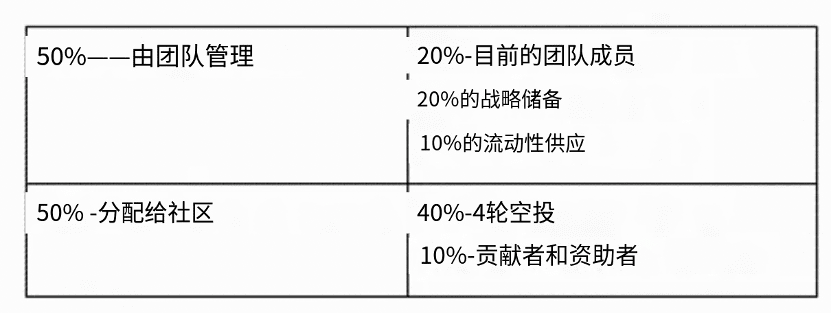
Jupiter’s native token is JUP, which debuted on January 31 of this year. The token is evenly distributed between the team and the community.
Of course, Jupiter’s usage is not limited to direct asset swaps through multiple exchanges. The platform has some other advanced utilities to improve the user experience.
2. Main features and functions
Let’s take a look at some of these advanced utilities and what they offer Jupiter users.
Liquidity Aggregator
Jupiter's liquidity aggregator technology is one of its core competitive advantages. In the traditional DEX model, the liquidity pool of each exchange exists in isolation. When users exchange assets, they often need to find the best trading pool to obtain the best transaction price. This is not only time-consuming and laborious, but also difficult to ensure the optimality of the transaction due to the dispersion of liquidity. Jupiter's liquidity aggregator technology can span many liquidity pools within the Solana ecosystem, automatically find and aggregate the best liquidity resources through algorithms, and provide users with a one-stop optimal trading path.
Before trading, users can choose to modify parameters such as transaction fees, slippage size, and whether to use direct paths. This means that users can obtain the best transaction price and the lowest slippage in the entire ecosystem on one interface, improving the efficiency and economy of asset exchange. Jupiter transaction aggregation is implemented based on its back-end intelligent routing technology.
On the backend, Jupiter uses complex algorithms to monitor and analyze the entire market's transaction data in real time, including price, depth, slippage and other dimensions. Based on this data, the intelligent routing algorithm can dynamically select the best transaction route for each transaction, ensuring the success rate and cost efficiency of user transactions even in the case of volatile markets. Specifically, once Jupiter obtains market data, its multi-path search algorithm will begin to look for the best transaction path.
This process involves complex calculations because it not only considers the direct trading pair, but also analyzes whether a better trading price can be obtained through a series of intermediate token conversions. For example, if a user wants to exchange from token A to token C, the smart router will not only consider the direct A→C transaction path, but also possible intermediate paths such as A→B→C or A→B→D→C to find the lowest cost transaction solution.
Although the technology behind smart routing is very complex, Jupiter is committed to providing users with a simple and easy-to-use trading experience. The operation of smart routing is completely transparent to users. Users only need to enter the tokens and quantities they want to exchange, and the rest of the work is done automatically by smart routing. This design minimizes the difficulty of user operation, allowing users to easily trade even without a deep technical background.
Limit Orders
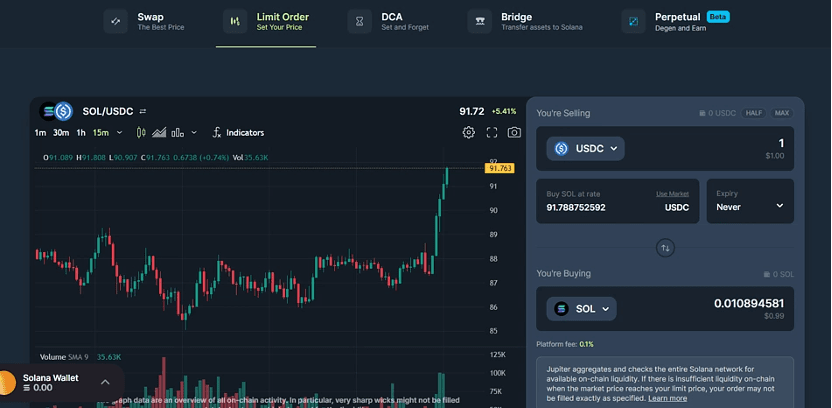
It is well known that centralized exchanges offer limit orders. Limit orders enable traders to establish trades that are only executed when the specified conditions are met. This is easier for such platforms because they operate an order book system that uses a record of buy and sell requests for asset pairs. For decentralized exchanges, this is a bit more complicated due to the nature of AMMs and liquidity pools.
However, Jupiter offers limit orders. On Jupiter, when a user places a limit order, the protocol retains the order, including details of the parameters (sell/buy price and quantity) set in the limit order protocol. The protocol then fetches prices from supported decentralized exchanges and monitors changes in those prices. When the market price reaches the point set by the trader, it executes the trade. If the on-chain liquidity is not sufficient to meet the order size, the trade is executed in smaller parts until the order is filled.
Jupiter claims that its decentralized limit order function has the same efficiency as centralized limit order. The only difference is that there is no market maker, order book, and centralized control system.
Dollar Cost Averaging
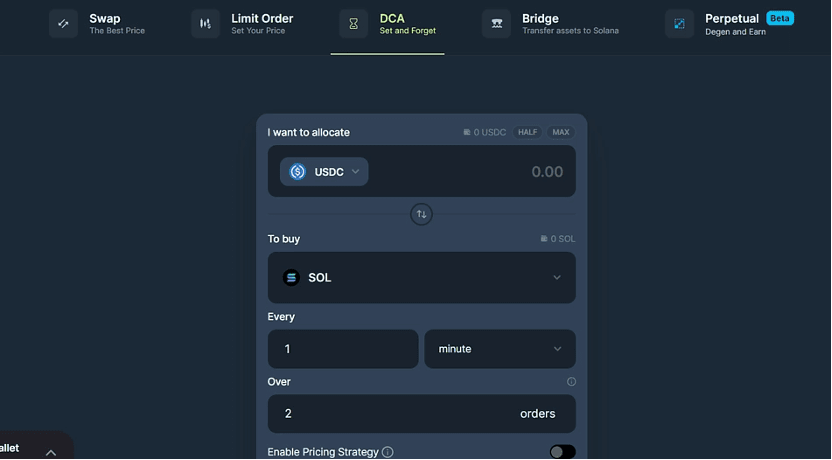
Dollar Cost Averaging (DCA) is a popular method for spot buying assets. Here, traders split their trades to sell or buy an asset over different periods. The idea is to increase the trader's chances of capturing different peaks (for selling) and lows (for buying) rather than all at once and at a single price point.
Using Jupiter’s DCA feature, traders commit capital to a trade and specify the different price points (or ranges) they wish to buy, the amount at each price point, and the time interval for that trade.
For example, a trader may decide to buy $1,000 worth of Solana (SOL) over ten days (note that the interval is flexible and can be set to hours and minutes) and wants to invest $100 every day at a specific price level. The protocol transfers the $1,000 to the DCA program, which is held in the trader's vault. When each trade is executed, the assets are transferred to the trader's wallet. For assets other than SOL, traders must create an Associated Token Account (ATA) to be able to automatically transfer purchased tokens to their wallet.
Bridge Aggregator
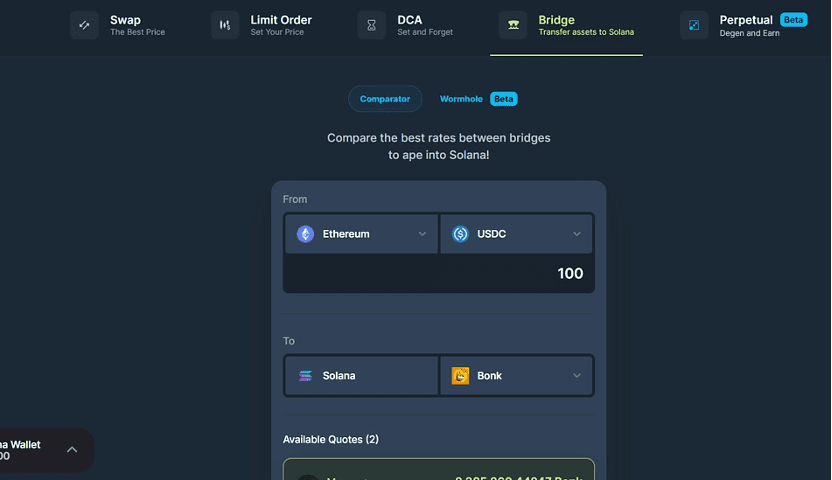
Jupiter is also a bridge aggregator. In a similar manner to DEX aggregators, it collates data from supported bridges and provides users with available routes for bridge transactions, details of those routes, and suggested routes based on the prevailing conditions. After selecting a route, users are redirected to their preferred bridge to complete the transaction. Bridge facilities supported by Jupiter include Mayan Finance and Debridge.
Jupiter also supports Wormhole for asset bridging. Wormhole is an inter-network messaging protocol that enables advanced communication between blockchain networks. At the time of writing, the Jupiter bridge powered by Wormhole supports asset bridging between the Ethereum and Solana blockchains.
Sustainability
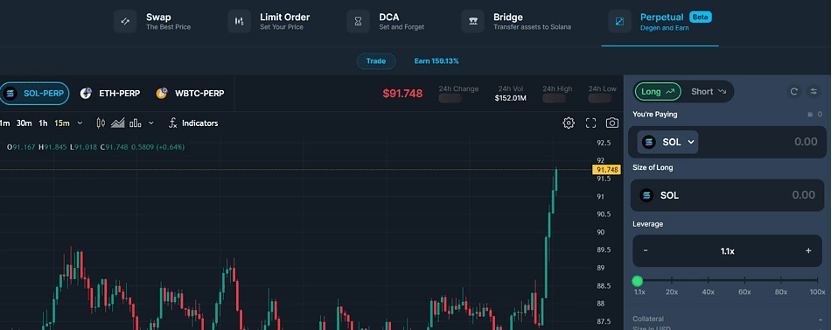
Perpetual traders bet on the future price of an asset. Jupiter has a decentralized perpetual contract trading platform where users can take long or short positions with up to 100x leverage. Users can participate as a trader or a liquidity provider. Liquidity providers on the derivatives trading platform lock their assets in the perpetual vault and earn yield when traders use these funds to trade. The perpetual vault currently supports five assets; WBTC, USDT, USDC, SOL, and ETH.
Traders commit collateral and take funds from the vault based on their collateral and the selected multiplier. For example, if a trader uses 5x leverage on $20 worth of collateral, the trading capital becomes $100 (20 * 5). Perpetual trading platforms operate like other centralized derivatives trading platforms. However, leveraged funds are provided by liquidity providers. According to Jupiter, the perpetual contract trading facility ensures zero price impact, zero slippage, and deep liquidity by leveraging LP pool liquidity and oracles. It uses the Pyth network's oracles for price feeds.
3. GIVE
JUP is Jupiter's native governance token and plays a key role in the platform ecosystem. Token holders vote on key ecosystem decisions, covering topics such as launching projects, dispute lists, and grants. It enables the community to participate in key decisions that affect the platform, including liquidity regulations, emission schedules, and ecosystem initiatives.
JUP was first launched on January 31 this year, with an initial supply set at 10 billion, and a distribution strategy that emphasizes community participation and decentralized governance. A large portion of these tokens are designated for airdrops to active users of the platform, designed to reward early and ongoing users of the platform. This community-centric approach aims to ensure that governance power is widely and fairly distributed among users. The Jupiter team promises that token distribution will strictly adhere to the roadmap, and any transfer of tokens from cold wallets will require six months of advance notice.
The initial circulation supply of JUP is adjusted to 1.35 billion. In the future, the circulation will be managed through the community multi-signature wallet to ensure the healthy development of the Jupiter ecosystem.
As of now, the price of JUP is $1.64. The market cap is about $2.216 billion, up 3.76% and growing in value. The 24-hour trading volume is about $533.984 million, but it is down 20.81%, indicating a recent decline in trading activity. The volume-to-market cap ratio is high at 24.12%, indicating ample liquidity and active trading relative to the market size. There are 1.35 billion JUP in circulation, which is 13.50% of the total JUP supply and the maximum supply of 10 billion. If all tokens are in circulation, the fully diluted market cap is about $16.421 billion.
Investment Potential:
The current price point and market trends suggest possible bullish sentiment, which could draw interest from investors seeking growth.
A high volume-to-market cap ratio demonstrates the liquidity of the token and may attract investors who prioritize the ability to execute fast trades.
Despite the decline in volume, the recent increase in market capitalization suggests that a consolidation phase may occur before further price movement.
But the fact that the vast majority of JUP supply is not yet in circulation could have a significant impact on price. If more tokens were released, it could lead to increased selling pressure, which would generally cause prices to fall. The issuance schedule of the remaining tokens and any associated vesting periods are critical to understanding future supply impacts.
In the long term, the value of JUP will depend heavily on the success and adoption of the Jupiter platform. As a governance token, its utility and demand are tied to the platform's relevance in the DeFi space and its ability to attract and retain users. The potential for additional utility and incentives for holding JUP, such as staking rewards or fee reductions on the Jupiter platform, could enhance its long-term value proposition. Jupiter's positioning within the Solana ecosystem, known for fast transactions and low fees, may also contribute to its long-term appeal.
4. Team / Financing
The team behind Jupiter consists of two key members: Meow and Ben Chow. Leveraging their extensive backgrounds in technology and entrepreneurship, they co-founded the platform in May 2021. Both were part of Meteora, the Solana liquidity platform. Meow’s expertise in building DEX/Meteora on Solana and Ben Chow’s background in interaction design and product development have been instrumental in the development of Jupiter.
Regarding Jupiter’s financial status, no specific financing information has been released. This may mean that Jupiter has been self-funded or operated without external investment so far.
Currently, the platform’s trade aggregation functionality has seen widespread adoption, accounting for over 50% of Solana’s trading volume, demonstrating strong usage and market penetration.
5. Other ecological modules
LFG Launchpad
Jupiter LFG Launchpad is an innovative platform in the Solana ecosystem that provides a transformative solution for Solana projects and investors through the Dynamic Liquidity Management Mechanism (DLMM). This platform not only helps emerging and existing crypto projects raise funds, distribute tokens, and guide liquidity, but also provides a way for investors to discover and invest in high-quality, innovative projects.
How it works: LFG Launchpad uses the DLMM algorithm to dynamically adjust token prices and allocations based on market demand and supply to address the price volatility, robot manipulation, fraud, illiquidity, and limited options that are common in traditional crypto launch platforms. DLMM uses a mathematical formula that takes into account factors such as total funds raised, total tokens sold, total tokens available, current round, current currency, vesting schedule, and lock-up period to ensure that token prices and allocations for each round are both fair, efficient, and stable and consistent.
It is worth noting that the custom price curve modeling provides a custom price curve tool, not for price discovery or balance, but for liquidity guidance and backup and the different needs and scenarios of each project. The tool is designed to help project teams design the price curve they want, which will automatically tell them the amount of money raised at different price points, perform mathematical conversions, etc.
The main objectives of the project are:
LFG Price Discovery: Everyone starts at the same time, no complicated isolated pool mechanism. The open market should be where discovery happens.
Providing instant liquidity to paper gainers while having sufficient buy liquidity to prevent excessive price fluctuations.
Provide enough back-up buyer/regret liquidity before the team is able to withdraw liquidity so that the price stabilizes.
Transparent on-chain market production to eliminate fraud.
In addition, the project aims to facilitate the entire process from application to launch through an open application process. The process provides anyone with the opportunity to submit an application through the Jupiter Research forum, and then the JUP DAO decides which projects are accepted into the LFG Launchpad through on-chain governance and voting using JUP tokens.
The whole process is divided into four steps:
JUPResearch Forum Post: Anyone can apply to post in the LFG Introduction section of the forum, describing their project in the rough outline provided, to start a conversation.
Candidate Phase: Based on community sentiment, feedback, project traction, TGE (Token Generation Event) timing, and quality of introductions, certain candidates will enter the Candidate Phase. During this phase, projects will receive a dedicated Discord forum thread to communicate with the DAO in a more private environment and automatically qualify to participate in the next LFG Launchpad vote, conditional on participating in an AMA (Ask Me Anything) with the working group.
DAO Voting: In the first week of each month, the DAO votes to decide which two candidate projects will be launched in the following month. Voting is conducted on vote.jup.ag and lasts for 3 days (72 hours). After the voting ends, up to two projects will be approved to launch in the following month.
LFG Launch: After voting closes, the working group will coordinate with the approved projects and the Jupiter team to set their launch date. LFG Launchpad is built by the community, for the community and DAOs.
Advantage
For the project:
Provide a platform for Solana project to raise funds and issue tokens in a reasonable and efficient manner
Allows multiple currencies and multiple funding rounds, with flexible and customizable parameters.
Enhance token liquidity and exposure through Jupiter Exchange and other DEXs.
Reduce the risk of price manipulation and volatility through DLMM and liquidity incentives.
For investors:
Providing opportunities to discover and invest in high-quality, innovative projects on Solana.
Ensure fair and transparent token distribution and pricing through DLMM.
Offer attractive rewards and incentives.
Providing ease of access and trading options through Jupiter Exchange and other DEXs.
Advantages to the Solana Ecosystem:
Increased adoption and innovation of Solana.
Strengthens network effects and synergies between the Solana project and users.
Solana’s security and decentralization are enhanced through the JUP token.
In summary, Jupiter's LFG Launchpad is an innovative platform designed to provide the Solana project with a foundation for long-term success while protecting buyers from hype, FOMO, and fraud. Unlike other launchpads, LFG Launchpad does not rely on complex incentive mechanisms or isolated price discovery systems, but relies on the power of the community, open markets, and the ecosystem itself. The platform supports new projects through the support of Jupiter DAO and the community, while providing technical support and user experience optimization to ensure the interests of both projects and participants.
Jupiter Labs
Jupiter Labs is a laboratory that operates independently from Jupiter. It will operate independently in the future and is committed to promoting innovative projects. In the Jupiter ecosystem, users and community members enjoy certain priorities, including priority use rights and token incentives. Currently, Jupiter Labs is focusing on two major project areas: perpetual contracts and LSD stablecoins.
Derivatives Protocol (Jupiter Perpetual): The model is similar to GMX V1 and has entered the actual use stage. It defines roles for liquidity providers and traders. Liquidity providers invest in the pool, and traders use the tokens in the pool for leveraged trading without worrying about transaction slippage. However, liquidity providers also bear the risks of possible profits for traders and depreciation of tokens.
LSD Stablecoin Protocol (Project XYZ): Allows users to mint interest-free stablecoin SUSD by pledging SOL. When the LST yield is higher than the SOL borrowing rate, a leveraged arbitrage strategy is used to maximize returns. The protocol introduces a redemption mechanism to maintain the price stability of SUSD, but this may also affect the borrower's position.
Jupiter Labs' innovations increase returns while also bringing additional risks, such as protocol risk and oracle quote risk. It is necessary to maintain the balance of the system by building a sound economic model, appropriate incentive mechanisms, and dynamic redemption strategies.
Jupiter Start
Jupiter Start is a featured component in the Jupiter ecosystem, which is designed to serve as a project promotion and launch platform. Jupiter Start's Launchpad function and Atlas function are newly launched components in the Jupiter ecosystem, aiming to further broaden Jupiter's business scope and strengthen its influence in the DeFi field.
Launchpad is a project launch platform that allows new blockchain projects to be launched through the Jupiter ecosystem. This platform usually provides a chance for startup projects to showcase and raise funds at an earlier stage. Through Launchpad, Jupiter can assist these new projects in token issuance, while also providing its users and community with access to new projects and tokens. Typically, users participating in Launchpad can purchase project tokens before the project is publicly traded, sometimes at a discounted price.
The specific details of Atlas’ functions are not disclosed at this time. The author speculates that the header can help users explore various projects within the Jupiter ecosystem and may include the status, progress, roadmap and other relevant information needed by investors and users.
6. Future Development
As the growth of the transaction aggregation function approaches its ceiling, Jupiter's future development may rely on its success in being able to expand horizontally in the DeFi field. In addition, the launch of Jupiter Start's Launchpad and Atlas functions will likely become the main way to attract new projects and investments, bringing new growth momentum to the Jupiter ecosystem. Secondly, the new protocols launched by Jupiter Labs will play a key role in the prosperity of the ecosystem, especially if they can operate successfully and gain broad support from the community.
For JUP, as new projects are launched, JUP tokens may gain new functions and usage scenarios, such as community governance, incentive mechanisms, etc., further increasing their practicality and value. Faced with the risks brought by code security and new protocols, Jupiter must ensure strong security and a robust risk management mechanism to protect user assets and trust.
Overall, Jupiter and JUP have positive prospects for the future, especially if they can continue to provide technological innovation, strengthen community engagement, and benefit from the growth of the entire cryptocurrency market. However, as investors and users, you also need to pay attention to any technical or market risks related to the Solana ecosystem, as well as regulatory changes in the cryptocurrency industry, which may affect the future performance of Jupiter and JUP.