

Author: Kadeem Clarke. Translated by Cointime.com QDD.
Do Kwon’s lawyers and South Korean courts reportedly question Luna’s potential crypto security status?
South Korean court rules that LUNA tokens are not securities, court says it is difficult to consider Luna Coin as a financial investment product regulated by capital market regulations. Court dismisses prosecution's appeal to confiscate Terra co-founder's… https://t.co/Tilr0QT0sh
— Web3 Daily (@web3_247) April 23, 2023 According to court documents, Terraform Labs co-founder and CEO Do Kwon has asked the Securities and Exchange Commission to drop the charges against him.
In a motion filed on April 21, Do Kwon argued that the SEC’s allegations are invalid, arguing that tokens such as Mirror Protocol, Terra Classic, and TerraUSD Classic are securities.
Title of Act: Securities and Exchange Commission v. Terraform Labs Pte Ltd., Memorandum of Law in Support of Motion
Do Kwon's Legal Troubles and Arrest
A suspected cryptocurrency fugitive, Do Kwon, was reportedly arrested for possessing false documents while traveling in the Balkan country of Montenegro.
Do Kwon was supposed to be in Singapore, but police failed to find him there. International law enforcement agency Interpol issued a "red notice" asking police around the world to help arrest Kwon.
Although it is difficult to find the whereabouts of the fallen cryptocurrency king Kwon,
1. But during a months-long search, people found that he had left comments on Twitter advocating the restart of his Terra-LUNA token system.
2. He also commented on the world-shaking collapse of FTX, the cryptocurrency exchange led by the much-maligned Sam Bankman-Fried last fall.
3. Kwon insisted that he was not hiding or evading the police, but simply concealed his location for safety reasons.
Montenegro authorities said they were waiting to confirm the identity of a person suspected of being Kwon after arresting him at the airport in the capital, Podgorica. The country borders Serbia, where South Korean intelligence agencies believe Kwon has been since December and which has no extradition treaty with South Korea.
In February of this year, Kwon was charged with civil fraud by the Securities and Exchange Commission for "orchestrating a multi-billion dollar crypto asset securities fraud involving algorithmic stablecoins and other crypto asset securities."
Additionally, Kwon’s lawyers claim that the agency lacks proper jurisdiction over the charges against Kwon and Terraform Labs because Terra’s tokens and projects are “global in nature” and not specifically targeted at U.S. investors.
“The cryptocurrency industry is an important and innovative part of the global and U.S. economies, and there is no evidence that the legal structure of the 1930s contemplated it,” Kwon’s team argued.
Legal Development and Investigation
Recently, a district court in South Korea dismissed securities violation charges against Terraform Labs co-founder Hyun-Seong Shin, ruling that LUNC is not a security under the Korean Capital Markets Act. The ruling applies only to LUNC and supports Kwon's motion.
However, following the indictment of ten individuals in the Terra stablecoin ecosystem by the Seoul Southern District Prosecutors’ Office, prosecutors allegedly identified Sygnum as the Swiss bank through which Kwon transferred more than 10,000 Bitcoins from the Terra platform and the LUNA Foundation to cold wallets and converted them into fiat currency.
Dan Sung-han, head of the joint investigation team for financial and securities crimes at the Seoul Southern District Prosecutors’ Office, said the organization oversees bitcoin owned by LFG and that the amount transferred was about $100 million, which is in line with the SEC’s complaint.
The prosecution clarified that the $100 million was not just in the Sygnum account, but was spread across the country. It was confirmed that part of the funds had been transferred to the account of Kim & Chang Law Firm to pay millions of dollars in legal fees.
The SEC’s action against Kwon and the company he co-founded led to his arrest in Montenegro, where he is currently detained awaiting extradition. South Korean authorities issued an arrest warrant for Kwon last September.
It is uncertain how this will affect other lawsuits filed by U.S. regulators and the future of Terra v2. However, any such legal precedent would be beneficial for Terra and all cryptocurrencies.
What is Terra (LUNA)?
In their most basic form, stablecoins are digital representations of fiat dollars, and they are designed to provide users with the security of cryptocurrencies while eliminating the volatility typically associated with cryptocurrencies.
1. Stablecoins like LUNA or LUNA 2.0 are crucial because they bridge traditional currencies and digital value.
2. Both Terra stablecoins and LUNA are cross-chain tokens on the Terra blockchain and can be used on the Terra blockchain as CW20 tokens, on the Ethereum blockchain as ERC-20 tokens, and on the Binance Smart Chain as BEP-20 tokens.
3. As mentioned above, the Shuttle bridge enables inter-chain transfers. When transferring tokens to a network other than Terra, these tokens will support the network's native token credentials at a 1:1 ratio and follow the standards widely used on the chain.
Terra accepts stablecoins pegged to the US dollar (TerraUSD; UST), the euro (TerraEUR), the Chinese yuan (TerraCNY), the Japanese yen (TerraJPY), the British pound (TerraGBP), the Korean won (TerraKRW; KRT), and the International Monetary Fund’s Special Drawing Rights (TerraSDR). LUNA provides collateral for them.
The crash resulted in a blockchain split, also known as a hard fork, which created a new blockchain and token that now operates independently of the original one.
While LUNA or LUNA 2.0 represents the newly generated LUNA tokens after the hard fork, the original LUNA token is now known as LUNA Classic or LUNC. More than 65% of holders approved the Terra platform’s recovery plan after its introduction.
Terra is a blockchain project created by Terraform Labs and is the basis for many stablecoins and decentralized applications.
1. Terra USD, or Terra $UST, is one of the stablecoins that is algorithmically pegged to the U.S. dollar.
2. Terra UST is an algorithmic stablecoin designed to reduce the volatility that is unique to cryptocurrencies like Bitcoin.
3. In contrast, collateralized stablecoins like Tether are anchored to more traditional currencies, such as the US dollar, through cash and equivalents rather than algorithmic tokens.
4. An early version of the Terra protocol was extended to allow stablecoin developers to create Terra DeFi projects.
5. The two cryptocurrencies used in the project are Terra and LUNA. Terra is a stablecoin standard that is pegged to fiat and other currencies. For example, TerraUSD (UST) is pegged to the US dollar, while TerraKRW (KRT) is pegged to the Korean won.
The network's staking and governance asset is the native token LUNA. Users who stake LUNA can gain governance rights, become validators, and obtain rewards. They can also use LUNA to create Terra's UST tokens or tokens pegged to its local currency.
However, it is important to note that while these stablecoins are pegged to the value of fiat currencies, they are not backed by fiat currencies. The LUNA token, on the other hand, is considered an algorithmic stablecoin.
Algorithmic stablecoins are digital assets whose value is not pegged to a physical asset, but rather derived from a set of rules. This approach allows Terra users to invest in the price of these pegged tokens without holding their physical counterparts.
MANAGER 2.0
Terra 2.0 is the latest version of Terra (LUNA), developed by Do-Hyun Kwak as a rebirth strategy, with the goal of providing a fork and airdrop of the Terra blockchain to cryptocurrency investors affected by the recent market decline. The main goal of the new plan for the Terra ecosystem is to restore trust in this stablecoin.
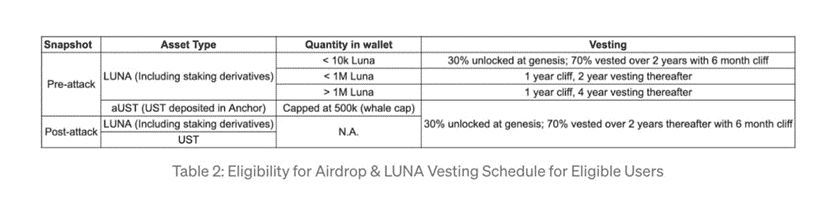
Terra 2.0's policy is to occasionally issue additional LUNA tokens to cryptocurrency investors who purchased 10,000 LUNA or more before the stablecoin suffered a catastrophic collapse. This will help prevent Terra 2.0 from being sold immediately. Over 300% of the LUNA tokens held by cryptocurrency investors will be unlocked immediately, and the remaining 70% will be distributed over two years. After six months, these cryptocurrency investors will receive new Terra 2.0 tokens.
Related History
Terra LUNA was launched on the Cosmos blockchain in April 2019, with an initial launch price of $0.19, and fluctuated between $0.19-0.30 in the first few months. Do Kwon is the founder and CEO of TerraformLabs, and has been working on the ecosystem since January 2018 with co-founder Daniel Shin.
In 2019, Kwon spoke on CNBC about the origins of his blockchain, with the core idea being that digital assets can only increase in value if they innovate and create value for their users.
The decline of LUNA and the advent of LUNA 2.0
The main problem that led to the demise of Terra (UST) and LUNA was that they were not linked to a stable asset like gold or the US dollar, but to the LUNA token which fluctuates like any other cryptocurrency.
After a prolonged bear market in the cryptocurrency market and a global recession in early 2022, most cryptocurrencies, including LUNA, were crushed. Although all seemed calm to the Terra community, which calls itself “lunatic,” this was not the case.
In response to the situation, Terra's founder Do Kwon proposed a network hard fork (blockchain split) to permanently separate LUNA from UST. With the majority vote of the Terra community, LUNA 2.0 came into being.
The new Terra token, LUNA or LUNA 2.0, was launched on May 27, 2022, replacing Terra’s original LUNA token, Terra Classic (LUNC).
1/ Yesterday, we said Terra 2.0 was coming. Tomorrow, it is coming.
The community has been working around the clock to coordinate the launch of the new chain. Subject to change, we expect Terra to go live around 06:00 AM UTC on May 28, 2022.
——Terra May 27, 2022
Because it is a community-governed blockchain, both co-exist today, and some investors and developers continue to build on the Terra Classic network.
How does Terra 2.0 work?
Terra 2.0 is a permanent update to Terra Classic.
Although Terraform Labs and Do-Hyun Kwak will not be part of Terra 2.0, Luna and Terra Inc. have developed a "robust revitalization plan" to effectively save the entire Terra Classic ecosystem by creating a new Terra. This is the first plan, which is named Terra 2.0.
While there are strong signs that Terra 2.0 will not suffer the same fate as its predecessor, cryptocurrency exchanges and tech entrepreneurs are divided over the feasibility of supporting the Terra 2.0 blockchain.
The core idea of Do-Hyun Kwak and Terraform Labs was to verify every invalid block and blockchain network transaction, so that the new LUNA coin and Terra 2.0 can flourish. This plan will be implemented through a hard fork, which means that Terra 2.0 will not be directly linked to LUNA Classic, but will remain on the same blockchain.
Kwak’s proposal has received attention, but more support is needed. Terra 2.0 is not based on the original Terra blockchain, but on a completely new blockchain, New Terra. LUNA Classic replaces the original LUNA token.
What is the consensus mechanism of Terra 2.0 (LUNA 2.0)?
The Terra 2.0 cryptocurrency blockchain uses a standard proof-of-stake consensus algorithm to validate transactions. At any given time, there are 130 validators participating in the network consensus, with voting power determined by the amount of LUNA 2.0 bonded to the node. Returns are generated by gas fees and LUNA 2.0 rewards at a fixed 7% annual inflation rate.
LUNA 2.0 token holders contribute to the consensus mechanism by delegating their tokens to validators, who typically stake their own funds with the delegators. In this system, validators retain a certain commission and then distribute rewards to delegates.
Delegate rewards for the Terra 2.0 cryptocurrency vary depending on the validator; validators with more voting power will naturally generate more rewards, but these must be distributed among a larger pool of delegates.
What is unique about LUNA?
The following factors make LUNA an attractive crypto asset:
1. Fast cross-border payments: The Terra stablecoin allows for seamless cross-border exchanges at the lowest global cost. Terra contains a blockchain with an average block time of six seconds, which makes transactions faster around the world.
2. Low Transaction Fees: Transaction fees on the Terra blockchain are among the lowest among cryptocurrencies.
3. Interoperability: Terra runs on Terra Bridge, a cross-chain system that makes Terra tokens interoperable. Terra tokens can be transferred between Binance Smart Chain and Ethereum, and work is underway to support cross-Solana transactions. Terra also runs CHAI payment software, which allows Terra users to seamlessly complete payments on its blockchain.
4. Automatic liquidity pool: After the user deposits on the Terra protocol, the tokens are automatically pledged in the pool on its protocol, saving the user's time and effort in finding the liquidity pool. You can easily use Terra tokens for many applications on its protocol.
What is the difference between LUNA 2.0 and LUNA Classic?
Despite their similarities, LUNA Classic and LUNA 2.0 are different. Under the new governance plan, the Terra network has been split into two chains. The old chain will become Terra Classic with the Luna Classic token (LUNC), while Terra with the LUNA token will become the new chain called LUNA 2.0.
The old LUNA will not be completely replaced, but will coexist with LUNA 2.0. Any Terra Luna DApps will prioritize LUNA 2.0, and the development community will begin building DApps and providing utility functions for the new token. However, it does not include algorithmic stablecoins.
Terra Classic will retain its community, as many investors and traders are against Do-Hyun Kwak's recovery plan and new chain, Terra Classic still has a sizable fan base. The Classic community has agreed to burn as many LUNC tokens as possible to reduce the coin supply and increase individual token prices.
What happens to the old Terra blockchain?
TerraUSD and LUNA Classic are both native tokens of the first-generation Terra network.
1. The goal of this blockchain platform is to provide a peer-to-peer electronic cash system. UST and LUNA are two of the tokens available on this blockchain.
2. Since UST is a stablecoin, it can be directly pegged to the US dollar, which means that UST is expected to maintain a value close to $1. The LUNA token is essential to ensure that UST maintains its peg.
3. Use a standard contract-based algorithm to maintain the peg. New tokens are issued by destroying LUNA tokens to keep TerraUSD at or close to $1.
4. On the original Terra platform, users must exchange LUNA tokens for UST and UST for LUNA. Even if the market price of one token is different from the other at the time of the transaction, these trades are still conducted at a guaranteed $1 price.
TerraUSD was ultimately unable to maintain its peg to the U.S. dollar, causing its value to plummet.
1. However, the exact reason for the depreciation of this stablecoin has not yet been discovered.
2. When this happens, the algorithm that drives the entire platform attempts to correct the problem by issuing more LUNA tokens than usual.
3. In fact, the total LUNA supply increased from more than 700 million tokens around May 5, 2022, to 7 trillion tokens just eight days later.
4. As a result, the total value of LUNA tokens fell by as much as 99.9%. By introducing trillions of new tokens to the market, the value of a single token was eventually reduced to a fraction of a cent.
The old LUNA token has been rebranded as LUNA Classic and listed under the LUNC ticker with essentially no value. On the other hand, the old Terra blockchain will effectively cease to exist, and the new Terra is an entirely different blockchain. The UST stablecoin is the only aspect of the Terra blockchain that has been completely removed, meaning that even though new LUNA tokens will be issued, the stablecoin will not exist.
airdrop
Terra’s Twitter said they were first airdropped to UST and LUNA holders on May 28.
10/ Q: When will the airdrop take place?
A: The LUNA airdrop will occur on the first block of the new Terra chain, estimated to be around May 28, 2022 at 06:00:00 GMT.
——Terra May 27, 2022
Specific groups will receive new LUNA token airdrops:
1. The community pool receives 30% of the token allocation, of which 10% is designated for developers.
2. LUNA token holders who held prior to the crash or attack will receive 35% of the new LUNA tokens.
3. UST holders who held before the crash are receiving 10% of the new tokens.
4. LUNA holders who hold on after the crash (including staked derivatives) will receive 10% of the new tokens - 30% of the tokens are unlocked at genesis, and the remaining 70% is distributed over a 2-year period with 6-month intervals.
5. Those who hold UST after the crash will receive 15% of the tokens - 30% of the tokens are unlocked at genesis, and the remaining 70% will be distributed over a 2-year period with a 6-month interval.
Terra will airdrop the new tokens to all holders who hold at least 10,000 LUNA tokens or less “to ensure that small LUNA holders have a similar initial mix of liquid assets.”
Terra Ecosystem
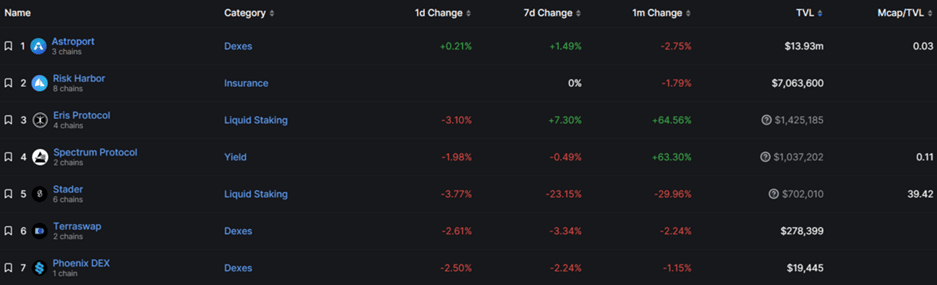
The Terra ecosystem is focused on decentralized financial applications, which gave rise to Terra Finance (TeFi). The sheer number of native projects built on Terra, and the large amount of capital attracted at this early stage, demonstrates the quality of the ecosystem.
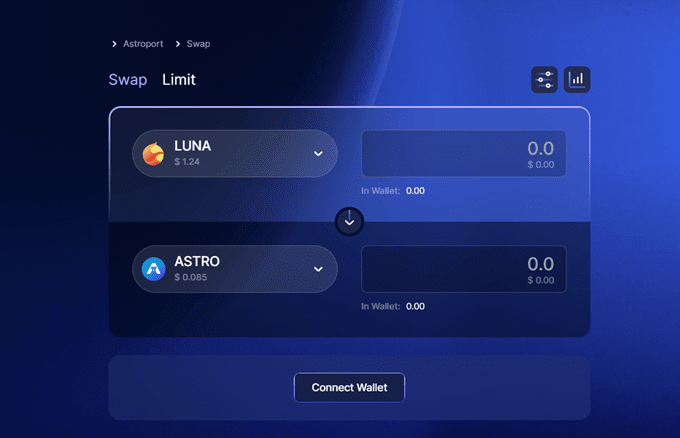
1. Astroport Protocol
Similar to the Uniswap/Curve relationship, the Astroport protocol aims to be the core DEX or automated market maker for the Terra ecosystem, facilitating the exchange of all assets on Terra. Astroport has quickly gained widespread attention, and within seven days of its launch, more than $1.2 billion in assets from 23,379 unique wallet addresses have been deposited into the protocol. Astroport's unique token distribution and economic design, long lock-up period will also protect the protocol from any rapid capital outflow in the short term.
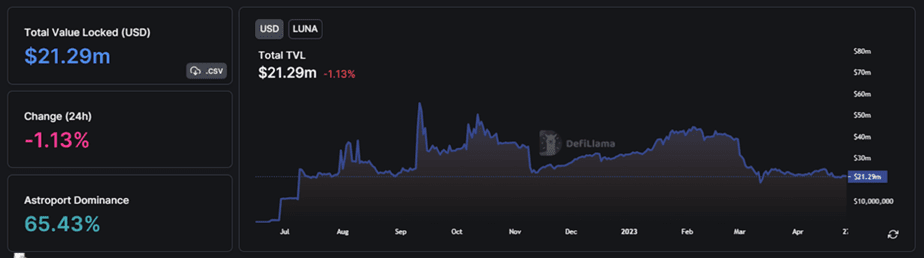
As LUNA's most important dApp, Astroport's current TVL is as high as US$1.393 billion.
2. TerraSwap
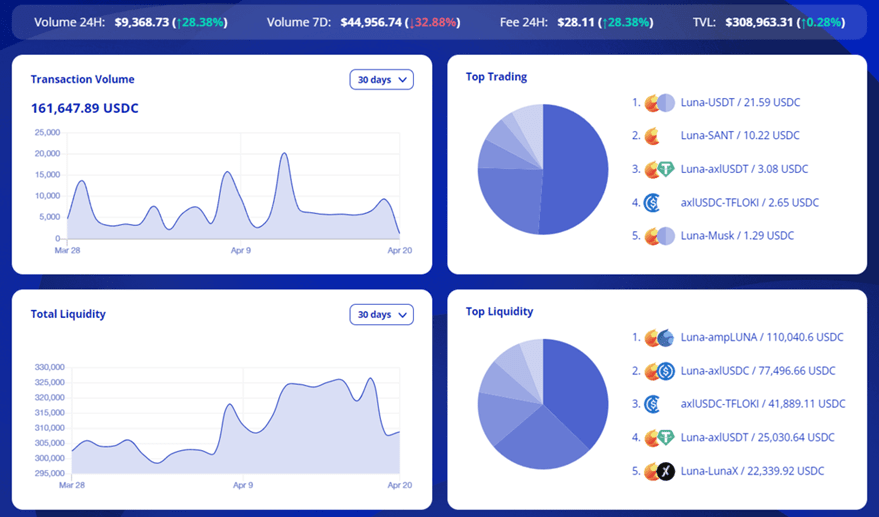
Similar to Uniswap, TerraSwap is the first AMM protocol on Terra. The main difference is that TerraSwap does not allow users to list tokens or create pools freely.
In short, TerraSwap allows users to swap tokens on the Terra blockchain, creating liquidity pool pairs. These pools (called "liquidity pools") give users liquidity to swap blockchain tokens. The pools track the balances of both assets to ensure that there are always tokens ready to trade. Users who provide liquidity are rewarded with LP tokens.
TerraSwap is the original TerraSwap protocol.
3. Prism Protocol
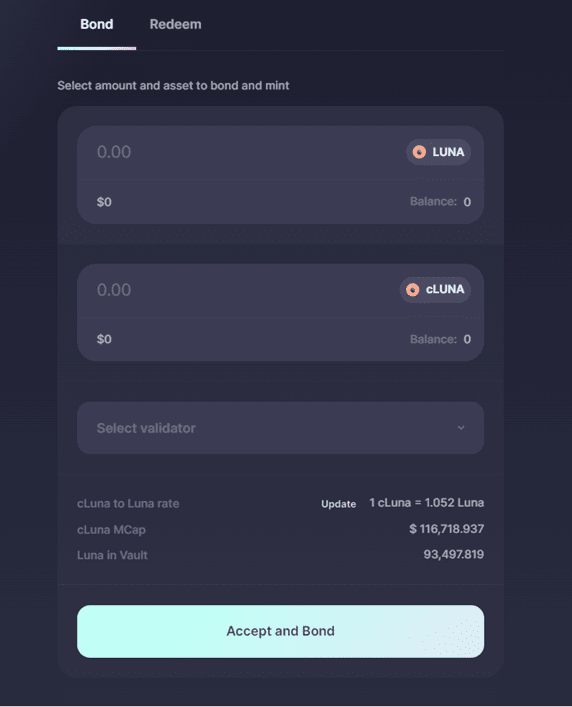
Prism Protocol is one of Terra's most distinctive protocols. It allows users to split income-generating assets into two different parts: the income part and the principal part, thus creating a new asset class. Users can avoid liquidity risk while maximizing price or yield exposure.
Since PRISM tokens are the underlying assets in all liquidity pools, users must hold PRISM and other assets to provide liquidity. Users who want to participate in governance can stake their PRISM tokens to obtain xPRISM and provide part of the protocol fees.
Prism only supports the decomposition of Terra's native token LUNA into pLUNA and yLUNA. PRISM intends to decompose more tokens from Layer 1 into high annualized yield farm tokens in the future and allow the selection of multiple expiration dates to guarantee the income obtained.
Users can also use Telegram to place orders to exchange tokens and receive notifications when their orders are fulfilled.
4. Risk Harbor
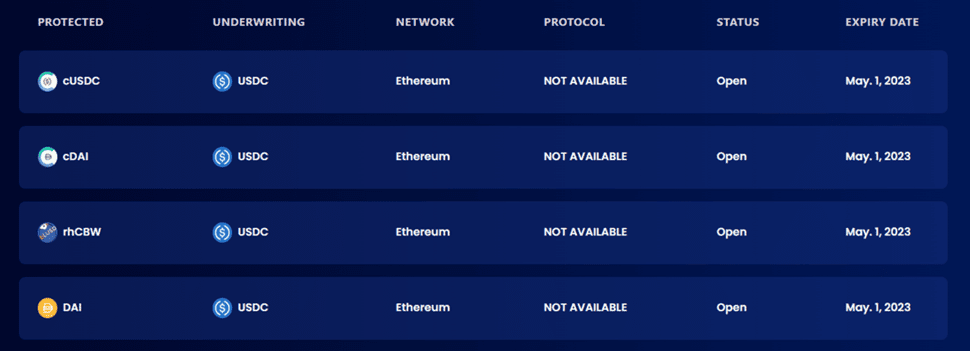
Risk Harbor is a DeFi risk management marketplace that uses an automated, transparent, and unbiased claims process to protect liquidity providers and stakeholders from smart contract hacks.
Risk Harbor’s core belief is that every crypto asset should be protected without the need for trusted intermediaries, enabling a truly permissionless and open financial system that is accessible to everyone.
Unlike other decentralized conservation policies, Risk Harbor takes a parametric conservation education approach. Its algorithmic, transparent, and unbiased solution eliminates the need for oracles and third-party institutions while providing nearly instant payments.
Individual users can purchase the parametric protection they need through Risk Harbor. Insurers create risk management pools using predefined parameters, and buyers select the pools they want to invest in. The total premium is paid in advance and added to the corresponding insurer's pool in proportion.
5. Spectrum Protocol
Spectrum Protocol is an advanced decentralized yield optimization platform that enables users to earn compound interest on their crypto asset farms.
Spectrum Protocol automatically maximizes rewards from various liquidity pools and other yield farm products in the Terra ecosystem by securing and governing their investment strategies through smart contracts.
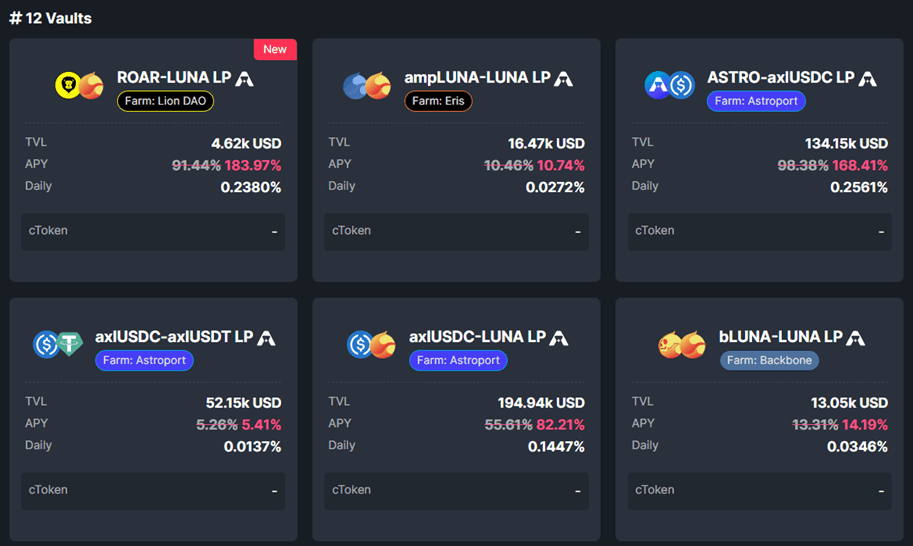
Spectrum Protocol’s main product is Vaults, where you can provide liquidity or collateral for crypto tokens (SPEC, MIR, ANC, mAssets, etc.). Users can choose an auto-stacking investment strategy, where Vaults automatically increase the number of tokens deposited by discounting returns back to the LP originally deposited; or an auto-collateralization strategy, where Vaults automatically collateralize returns to the corresponding governance stake, further increasing returns.
Spectrum is a farming optimizer similar to Nexus Protocol, but with more options in terms of LP tokens and strategies for different platforms.
6. Mars Protocol
The Terra Luna debacle wiped $60 billion from the crypto market. Platforms like Mars Protocol have revived, while others like Pylon Protocol have faded away.
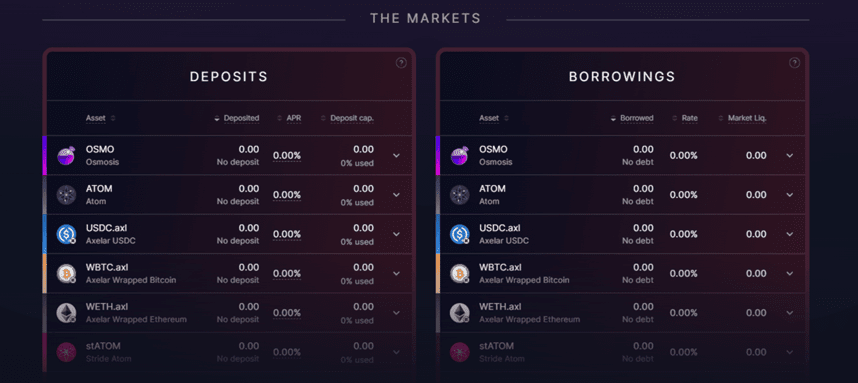
Mars Protocol was once the main lender to Terra Luna.
Mars Protocol’s new plans include launching a separate Cosmos application chain on January 31. Its new features will make it easier for blockchains in other Cosmos ecosystems to lend and borrow.
Partnerships
The project has collaborated with many past and present partners. From the purest research perspective, these partnerships are of strategic value. Allina Health, The McKnight Foundation, AmeriCorps, Omaha Public Schools, and Washington Nationals are just a few examples. The project has over 300,000 Twitter followers and a solid social media presence.
As the overall size of DeFi grows, the utility of DeFi stablecoins is also increasing. LUNA has good overall utilization, which keeps them stable. It may be too early to discuss whether Terra has the strength to challenge Ethereum's dominance in the smart contract field.
Furthermore, Terra focuses on a specific aspect of decentralized finance that will require more user adoption to be meaningfully challenging to the leading enterprise blockchains. Even if Terra closes only a portion of the existing gap, the comparison will begin.
Alliances: Harnessing the power of incentive alignment
The LUNAtic community has successfully integrated the Federation module on the Terra mainnet with an overwhelming yes vote on Proposal 4717, opening up a range of possibilities for growth and cross-chain collaboration.
Federations represent a paradigm shift in scaling the decentralized economy.
It is important to note that chains like Migaloo and Kujira have decided to integrate it.
The ability to achieve large-scale coordination among different actors through economic incentives is an exciting feature emerging from the Internet's transition from Web2 to Web3. Federation is an open-source Cosmos SDK module that enhances and expands its ecosystem by allowing blockchains to align incentives with neighboring chains, developers, and users.
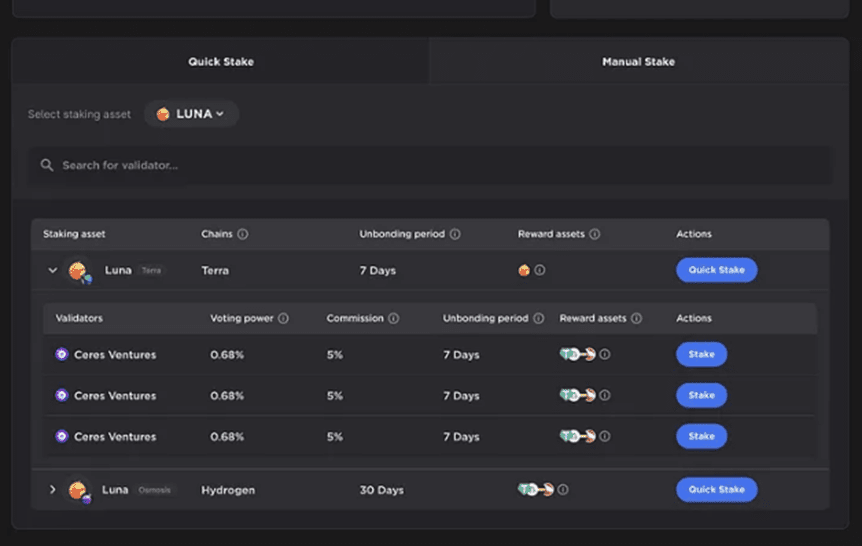
The core purpose of the Federation is to serve as an economic tool to direct the monetary policy of the decentralized economy (i.e. staking rewards) towards the desired goal. The Federation achieves this goal by enabling users to stake multiple tokens on a single chain to receive a portion of the local staking rewards - a feature that was previously unavailable in Web3.
Alliance is a dynamic, adaptive tool that can scale as the needs of the ecosystem change. It can convert any token into Alliance assets and adjust its reward weights and acquisition rates through chain governance. Both users and decentralized economies can use Alliance for the following purposes:
1. Diversify and increase staking returns - By increasing take rates above 0%, newer, less liquid chains can supplement their native staking returns with uncorrelated, less volatile, more liquid federated assets. Larger, more established chains can diversify their native staking returns by including foreign tokens as federated assets and setting take rates above 0%. Users can diversify and increase their returns by staking on one chain, bridging their LSD to another chain, and staking to earn a second yield in the form of that chain's native token.
2. Attract users, liquidity, and developers - Chains of any size can attract new users and liquidity from participants in the consortium chain who bridge and pledge their holdings within their ecosystem by assigning a low Take Rate to the consortium assets. The result of consortium staking is positive reflexivity: higher usage leads to higher liquidity, which leads to more developers creating dApps, which leads to higher usage and higher liquidity, etc.
3. Incentivize application developers - The Alliance can provide L1 deposit benefits to application token subscribers in the ecosystem, allowing users of the most promising applications to be rewarded directly from L1 fees and inflation. The community can also use the Alliance to fund the development of key ecosystem applications (e.g., DEX, currency market, NFT market, etc.) or new DeFi primitives.
4. Deepen liquidity of base token pairs - Chains can increase liquidity of desired token pairs by making LP tokens a federation asset and assigning a reward weight greater than 0%.
More news and updates
Astroport announces the next supported chain: SEI Astroport is already online on the Injective mainnet and Neutron testnet
https://terraweekly.substack.com/p/terra-weekly-40?utm_source=www.m6labs.co&utm_medium=referral&utm_campaign=what-happened-to-luna-2-0
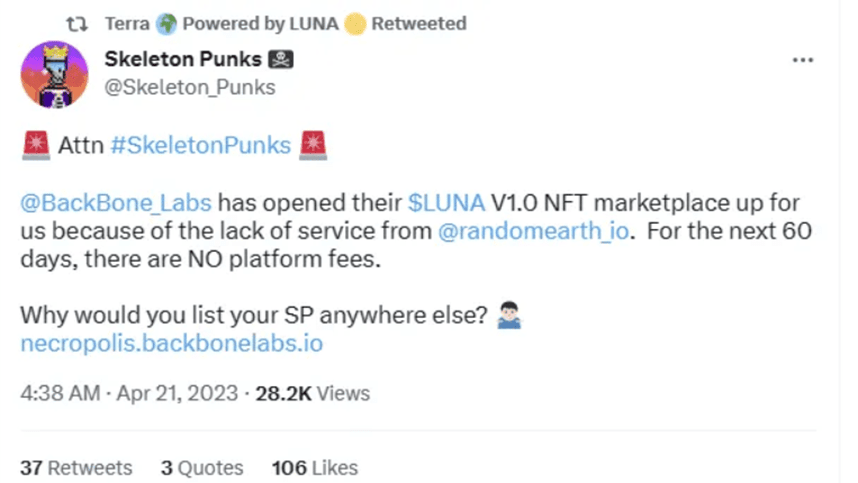
Backbone Labs has launched its own NFT marketplace to fill the void left by the departure of Knowhere and Random Earth: Necropolis.
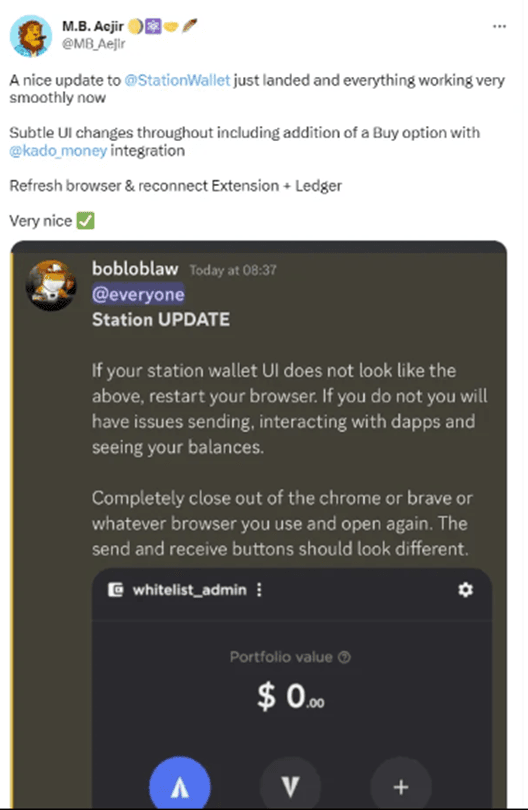
The Station wallet has had a new update, including the integration of Kado’s in/out:
in conclusion
The future of LUNA 2.0 is impossible to fully predict given the collapse of its UST stablecoin. Previously, LUNA was home to some very popular DeFi projects, but is now rarely mentioned.
Terra’s new blockchain has struggled to gain traction due to a mass exodus of investors, developers, and community members, many of whom were badly hit by the collapse of the original Terra ecosystem last May.
Even if the new blockchain does not include an algorithmic stablecoin, it will not destabilize and cause the old ecosystem to collapse as it did.
Trust in the Terra project appears to have been completely destroyed, with many predicting that LUNA will eventually fall to zero.
However, the future cannot be predicted based on past events. The success of Terra LUNA 2.0 depends on the performance of the new blockchain and efforts to restore investor trust.