

Author: Christine Kim, Vice President of Research, Galaxy Digital; Translation: Golden Finance xiaozou
After the Ethereum merger and the Shanghai upgrade, Ethereum has successfully transitioned from a proof-of-work to a proof-of-stake consensus protocol. The next big thing on the Ethereum development roadmap is Ethereum Improvement Proposal (EIP) 4844, called proto-danksharding. The code update aims to improve the scalability of rollups running on Ethereum. Named after Ethereum core developers "Protolambda" and Dankrad Feist, EIP 4844 introduces a new transaction type called blob, increases the data and storage requirements of Ethereum blocks, and creates a new fee market that prices blobs separately from regular transactions.
The Rollup protocol relies on layer 1 blockchains such as Ethereum for data availability (DA) (the ability to widely disseminate and temporarily store batches of transaction data). Generally speaking, smart contract-based rollups that rely on Ethereum for DA also rely on Ethereum for transaction settlement (verification). These rollups are dedicated to reading data from DA layers (such as Ethereum) and executing valid transactions and smart contract code. Rollups built on Ethereum rely on the inclusion of batched transaction data into Ethereum blocks to achieve transaction finality. The Sequencer batches and compresses user transactions in a cost-effective manner for submission to the DA layer.
Normally, it is expensive to publish large amounts of data to Ethereum, in part because the network stores data permanently as part of transaction history in a field called “CALLDATA.” With EIP 4844, an additional 512KB or 768KB of data space per block will be created for rollups. Ethereum core developers are weighing how much additional space should be created for blob transactions. Importantly, data published to this space will be stored for approximately three weeks. Since data verified by blob transactions is stored for a short period of time, and the blob transaction fee market is independent of other types of transactions, in theory, the cost of publishing data to Ethereum for rollups will be greatly reduced. Over time, developers plan to introduce data sampling techniques so that blob data does not need to be downloaded in full for Ethereum full nodes to verify, further reducing the cost of rollups. Proto-danksharding is a pioneering effort and “prototype” to achieve full danksharding, which will enable Ethereum nodes to determine the availability of a full blob by downloading only the blob data block.
This article will dive into how EIP 4844 works, the limitations of proto-danksharding, the plans for EIP 4844 to move toward full danksharding, and the immediate benefits and considerations of the code update for end users and decentralized application (dapp) developers if implemented as planned in the fall of 2023. Given the focus of proto-danksharding on supporting a layer 2 rollup ecosystem and modular scaling of Ethereum, the implementation of the code update in the next Ethereum upgrade will be an important testing ground for the large-scale application of modular blockchain theory to one of the world’s largest public blockchains.
1. Background
EIP 4844 is seen as a scalability upgrade for Ethereum. However, it is worth noting that the code update does not substantially increase or improve the transaction capacity of Ethereum itself. Proto-danksharding reduces the cost of posting large amounts of data to Ethereum, thereby reducing the operating costs of rollups. EIP 4844 is seen as an improvement in Ethereum scalability because it makes layer 2 networks running on top of Ethereum more cost-effective, but the code update does not improve the scalability of Ethereum as a general-purpose blockchain for transactions and smart contract code execution.
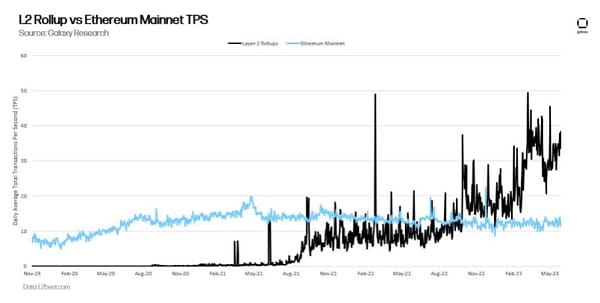
Ethereum rollups like Arbitrum, Optimism, StarkNet, zkSync, and Polygon zkEVM have been growing in activity over the past four years, with L2Beat.com estimating that the combined transactions per second (TPS) achieved across all layer 2 networks is 3.8 times Ethereum’s average daily TPS.
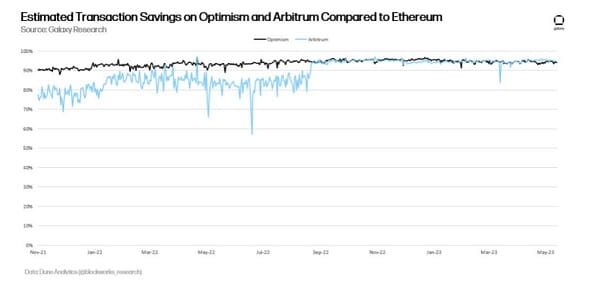
According to data provided by Blockworks Research via Dune Analytics, rollups save end users and dapp developers more than 99% in gas fees compared to the cost of deploying code and transactions directly to Ethereum.
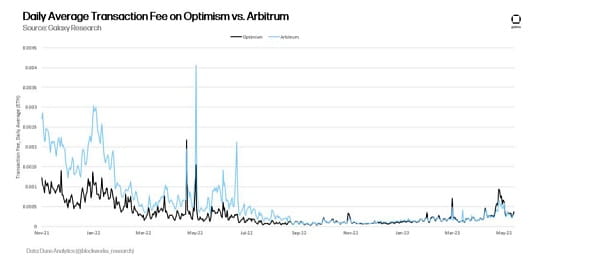
As of June 13, 2023, the cost of sending a transaction on the two most popular Ethereum rollups (Optimism and Arbitrum) is approximately $0.03 to $0.05. However, during periods of high on-chain activity and network congestion, costs can sometimes soar to over $1.
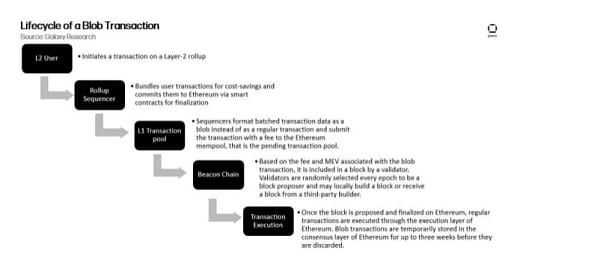
The goal of EIP 4844 is to reduce rollup costs by introducing a new transaction type called a binary large object (blob). The following is a step-by-step description of the blob transaction lifecycle defined by EIP 4844:
EIP 4844 does not affect how regular transactions submitted to the Ethereum mempool are included in blocks, nor does it affect the fee market that determines the pricing of Ethereum block space, but EIP 4844 does increase the storage requirements of Ethereum blocks. The additional data space is used to attach blob transactions to blocks. Blobs are like trucks that can be attached to Ethereum blocks to handle regular transactions without affecting or crowding out existing block space. Blob block space will be auctioned according to its own fee market, mimicking the fee market design of EIP 1559. Initially, blob transactions will cost almost nothing. After that, the cost of blob transactions will increase by 12.5% for each block that is confirmed with more than half of the blob block space (at least 256KB). The cost of blobs per block will decrease by 12.5% if blob block space is underutilized, meaning that the block space is less than 50% filled.
Blob transactions are not stored indefinitely on Ethereum, but rather on Ethereum’s consensus layer (CL) beacon chain and are removed from CL nodes after three weeks. Proto-danksharding will support up to four blobs per block, each of which can contain up to 128KB of additional data. The 512KB maximum blob space limit per block may be adjusted based on ongoing testing of EIP 4844. Developers are actively discussing the possibility of increasing the maximum blob limit from 4 to 6. Each blob is an opportunity for a rollup sorter to confirm a batch of transactions to Ethereum. Ethereum produces approximately 7,094 blocks per day, and after EIP 4484, assuming a limit of up to 4 blobs per block, a maximum of 28,376 blobs can be processed per day. (This is a theoretical maximum that may never be reached in practice due to the dynamics of blob fees. The cost of continuously processing the maximum number of blobs per block is prohibitively expensive for the sorter.)
Over the past six months, the sorter running on Ethereum’s second-largest rollup in terms of transaction activity has submitted approximately 3,126 transaction packages to Ethereum per day.
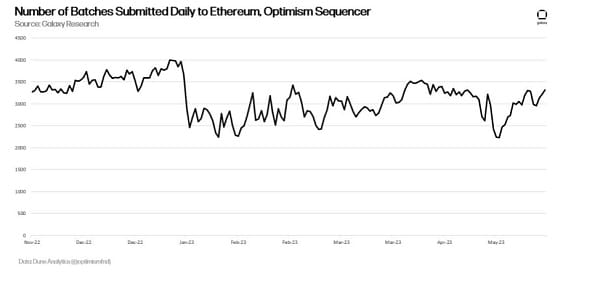
Arbitrum has about twice the transaction load confirmed by Optimism, and like Optimism, it also relies on the sorter to publish data to Ethereum via CALLDATA to complete transactions. Popular rollups on Ethereum include but are not limited to Polygon zkEVM, zkSync, and StarkNet. On Optimism, more than 90% of fees come from Layer 1 CALLDATA fees.
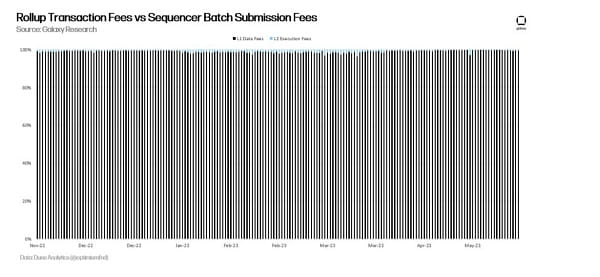
The purpose of introducing dedicated data storage space (no matter how small it is at first) is to reduce the cost of using Ethereum as the DA layer for all Ethereum rollups. Conservatively, rollup developers estimate that rollup fees will decrease by 100% to 900% after the activation of EIP 4844. However, these estimates may change depending on the increase in rollup adoption and activity in the months before and after the launch of proto-danksharding.
While blob transactions may be cheaper than regular transactions at the beginning of EIP 4844 activation, they have the potential to quickly rise in cost if the number of rollups running on Ethereum increases. Additionally, while each blob represents an opportunity for a sorter to publish up to 128KB of data, rollup sorters can coordinate so that a single blob contains data from multiple rollups. Ethereum developers are aware that since there are a limited number of blobs per block and a single transaction package may not fully utilize the full 128KB of data space available for each blob transaction, a secondary market for blob pricing may emerge. While preventing the emergence of an off-chain secondary market is a priority (rather than preventing this possibility by introducing a higher level of protocol complexity), developers are currently taking a "wait-and-see" approach to introducing blobs through EIP 4844, with the intention of further optimizing EIP 4844 in the future.
Proto-danksharding lays the foundation for the introduction of more advanced technologies that can further reduce blob costs without increasing the computational load on nodes. The full vision of blob is "full danksharding", which increases the maximum number of blobs per block from 4 to 64.
(1)完全 Danksharding
4 blobs would increase the Ethereum block size by 512KB. 6 blobs would increase the Ethereum block size by 768KB. As mentioned earlier, the additional block space is strictly dedicated to blob transactions and does not permanently store data like regular block space. The full vision of EIP 4844 is to introduce up to 64 blobs to Ethereum without significantly increasing the computational load of nodes for block verification. In order to achieve full danksharding, Ethereum needs to implement two technologies: data availability sampling (DAS) and erasure encoding.
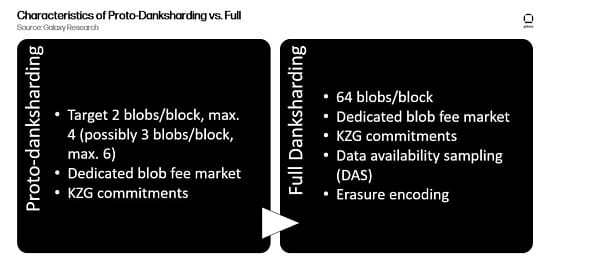
Data Availability Sampling (DAS)
When validating layer 2 rollup transactions, the goal of DAS is to ensure that all data packaged by the sorter has been published on-chain. A full node is randomly selected to download a piece of data from a blob and generate a data availability proof. The more times the full node data is sampled, the greater the probability of obtaining all data from the sorter without retaining important data. For the node, the data sampling process involves less computation than downloading the entire blob data, but in theory guarantees the availability of the data. As with proto-danksharding, blob data sampling under full danksharding will ensure that transactions from the sorter have been verified and published on-chain for any user or network stakeholder to evaluate. Users and stakeholders will then review these transactions over a period of time, confirm that they have been completed on a DA layer such as Ethereum, and build new batches of transactions based on the previous batch of transactions.
With DAS, Ethereum developers believe they will be able to increase the number of blobs and the amount of data posted to Ethereum without increasing the computational load on nodes. In addition, developers intend to further reduce the computational load on nodes by implementing proposals such as history expiry in future upgrades. In the words of Ethereum researcher Dankrad Feist, over time, Ethereum will be used as "a public bulletin board rather than an archival system," handing over the responsibility of retaining a complete copy of transaction history to network stakeholders who regularly use this data, such as layer 2 rollups and blockchain infrastructure companies (such as Infura, Alchemy, and Blockdaemon). The introduction of blobs through EIP 4844 is an early example of how one day all transactions may be stored on Ethereum.
Erasure Encoding
Erasure coding is a technique to improve data sampling. If a malicious sorter withholds a small portion of block data (say, between 1% and 49% of the blob data), then transaction sampling may result in some sample proofs being returned as correct values rather than incorrect values in the first place. Erasure coding ensures that verifying at least half of the blob data is sufficient to reconstruct the rest of the blob. This technique only works if the data can be represented as a polynomial (an expression consisting of more than two algebraic terms). The most common form of erasure coding is based on Reed-Solomon (RS) codes, which are advanced mathematical formulas that can account for missing data given enough known data. Intuitively, sampling alone may not be effective in ensuring the availability of large amounts of data, especially if a block of data is withheld by a malicious sorter. Erasure coding introduces data redundancy to the blob, so a malicious sorter must withhold a significantly large portion of the blob data to successfully retain any amount of data.
DAS combined with erasure coding is the technology behind full danksharding. These technologies are the same as those behind some DA layers such as Polygon Avail and Celestia. In many ways, the vision of supporting modular blockchain computing (which other blockchain projects are testing on a small scale) will be partially tested on Ethereum at a large scale through proto-danksharding and formally tested through full danksharding.
(2) KZG Commitment
Before DAS and erasure coding can be implemented on Ethereum, full danksharding requires the implementation of the KZG commitment scheme. Kate Zaverucha Goldberg (KZG) commitments are a zero-knowledge (ZK) proof system that allows polynomials to be evaluated without revealing the entire polynomial. If large data objects like blobs are first represented as polynomials, they can be efficiently manipulated and proven by computers. EIP 4844 focuses on introducing KZG commitments as part of the blob verification and proof generation process. For layer 2 rollups that rely on ZK proofs, KZG commitments can represent computations on transactions and rollup protocol states. In the context of EIP 4844, KZG commitments can check the properties of a blob without reading the entire blob transaction.
(3)KZG Ceremony
The KZG commitment scheme for verifying blobs relies on a secret value generated once by a trusted setup. Some cryptographic protocols, such as Zcash, Tornado Cash, and Filecoin, rely on a trusted setup to securely generate a secret value for on-chain computation cycles. The trusted setup ceremony for EIP 4844 was launched in January 2023 and has received nearly 100,000 contributions from the Ethereum community. Background: The trusted setup ceremony is a one-time process for generating data for cryptographic protocols from contributions from multiple parties. The goal of combining the entropy contributed by multiple parties in a trusted setup ceremony is to generate a secret value that is almost impossible to regenerate or guess. It is very important that the final value created by the trusted setup ceremony cannot be reproduced.
The KZG ceremony will open contributions in May 2023 and may close a few months before EIP 4844 is activated on the mainnet. Most ceremony contributions are provided through a public website funded by the Ethereum Foundation, where users connect to the website through their Ethereum address and automatically run calculations, whose randomness helps improve the security of secret values. In addition, there are other contributions created through unique events involving music, large groups, animals, and even marble linkage devices.
2. Benefits and Impacts
There are many similarities between the introduction of blobs on Ethereum and the introduction of Segregated Witness (Segwit) on Bitcoin. Both code updates introduced modifications to the way data is stored on-chain, resulting in an increase in the effective block size and support for layer 2 protocols. However, one of the main differences between Segwit and EIP 4844 is the intended long-term impact of these code updates. While Segwit was designed to address immediate vulnerability issues in the protocol code and support the creation of the Lightning Network in the short term, the motivation for EIP 4844 is to lay the foundation for further scaling optimizations (such as DAS) and ultimately become a most optimized DA layer. Proto-danksharding enhances Ethereum's ability to support L2 rollups and serve as rollup sequencers, while encouraging end users to transact on rollups rather than directly on Ethereum.
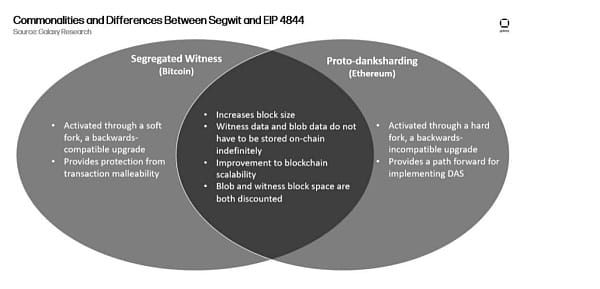
Compared to the data that populates regular Ethereum blockspace, blob blockspace has several key differentiating properties. First, due to its short-lived nature, blob transactions are expected to have lower gas fees than regular transactions. Second, while dapps, developers, and end users can easily retrieve regular transaction data stored in Ethereum blocks through the Ethereum Execution Layer (EL) and interact with these transactions through the Ethereum Virtual Machine (EVM), Ethereum's execution environment, executing smart contracts, blob data will be relatively difficult to retrieve and interact with. Blob data will be stored in Ethereum's CL and can therefore only be used for a limited set of operations, namely transaction confirmation and finalization.
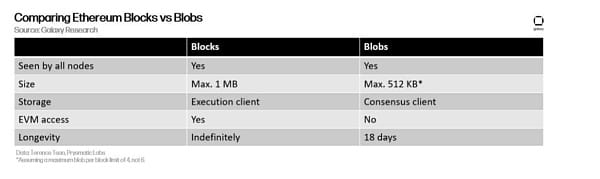
Looking ahead, one of the metrics to watch for the impact of EIP 4844 is the reduction in rollup fees. Bulk transaction data is published to Ethereum using the CALLDATA field in an Ethereum transaction, which consumes 16 gas per byte. On the other hand, the cost of a blob is essentially free at first and then gradually climbs. In addition to the cost of a blob, another metric worth watching regarding the impact of EIP 4844 is the data propagation load on full nodes. The size of a regular Ethereum transaction is less than 1KB, which means that Ethereum nodes can easily propagate this data without using high bandwidth. However, the size of a single blob transaction can reach 128 KB, which means that blobs require more computation by nodes to propagate.
The following table summarizes several metrics relevant to assessing the impact of EIP 484416:
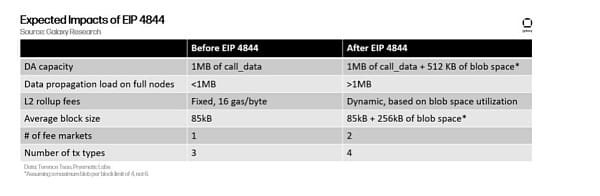
Like Bitcoin’s Taproot upgrade, it’s difficult to predict how blob transactions and blob block space will be used, beyond the expected use case of processing layer 2 rollup transactions. Given that L2 rollup adoption has been volatile over the past few years and susceptible to extreme volatility, it’s difficult to accurately predict how much EIP 4844 will reduce L2 rollup costs. L2 rollups themselves have also undergone significant upgrades and improvements over the past few years. Last August, Arbitrum Nitro completed its Nitro upgrade, claiming that the upgrade increased transaction throughput by more than 7x. Optimism completed its Bedrock upgrade on June 6, 2023, which aims to reduce fees for end users by 10% and introduced several other user experience related improvements.
Because the capacity and functionality of rollups built on Ethereum are constantly evolving, it is difficult to accurately predict the extent to which EIP 4844 will impact fees and activity on layer 2 rollups. In summary, the expected benefits of EIP 4844 for Ethereum are as follows:
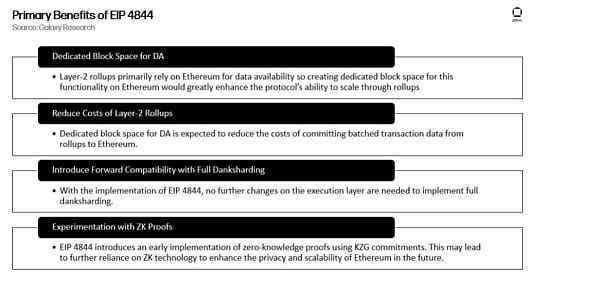
3. Related considerations
The idea for EIP 4844 was proposed at the Ethereum ETHDenver conference in February 2022. The first EIP 4844 test network was launched in August 2022. Since then, the Ethereum client team has iterated on the code and launched four additional test networks. As developers work to launch their sixth dedicated test network, there are obvious concerns and unanswered questions around the implementation of EIP 4844. As of May 2023, ongoing discussions on the implementation of EIP 4844 include:
· De-SSZify EIP 4844 specification: For months, developers have been discussing the best way to serialize the new blob transaction type. Initially, developers were leaning towards introducing an early iteration of the SSZ format to the EL layer via blob transactions. Unlike CL, Ethereum EL has traditionally relied on the RLP serialization format. Eventually, developers planned to upgrade all transaction types from the RLP format to the SSZ format, but given that the upgrade path from RLP to SSZ is still unclear and certainly not ready for implementation in the Cancun upgrade, developers decided to remove SSZ from EIP 4844, at least from the EL side.
KZG Commitment Crypto Libraries: There has been some interest in the situation with KZG commitment crypto libraries. These libraries provide implementations of the KZG functions defined by the polynomial commitment specification of EIP 4844. However, some major aspects of the library are undergoing updates, making it difficult for Ethereum client teams to use and integrate these libraries into their codebases.
Testing via the Geth (EL) client: EIP 4844 is tested on a forked version of the Geth (EL) client. Developers are actively working on migrating EIP 4844 testing to the main Geth codebase.
MEV-Boost testing: MEV builders and relay nodes have not yet started full-scale experimentation with blob transactions. Developers are working to include testing of MEV-Boost related software early in the EIP 4844 development process.
· Blob fee market design: The blob fee market is based on EIP 1559. EIP 1559 increases the gas cost of transactions by 12.5% in both directions based on block space capacity. However, the implementation of EIP 1559 on Ethereum introduces high volatility to block sizes. To avoid the blob block space being used to produce the same results, developers are considering alternative parameters for the blob gas fee.
Decoupling blobs from block propagation: Blobs are the heftier data propagated between Ethereum nodes. Therefore, developers are working on strategies to decouple blob propagation from block propagation so that transaction processing speed is not slowed down by blob activity.
· Blob transaction mempool during chain reorg: During a chain reorg, regular transactions are reinserted into blocks. Since blobs are decoupled from block propagation, there is no direct way to guarantee that all blobs in the mempool will be reconstructed after a reorg. Developers are considering ways to handle blob transactions in the event of a temporary chain split.
· Handling blob transaction churn: Unlike transactions that can be easily canceled by users after being submitted to the mempool, blob transactions are quite difficult and resource-intensive to propagate and should not be so easily canceled or replaced after broadcasting. Developers may implement penalties for invalidating blob transactions after they have been submitted to the mempool.
The next Ethereum upgrade, named after its scope, is called Cancun on EL and Deneb on CL, and is tentatively scheduled to activate EIP 4844 on the Ethereum mainnet sometime in the fall or winter of 2023. Any upgrade to Ethereum requires a lot of testing and coordination. Since the Ethereum merge, the Ethereum protocol has expanded and become more complex. The following is a description of the parts of the Ethereum protocol and related software that must be updated to welcome the Cancun upgrade.
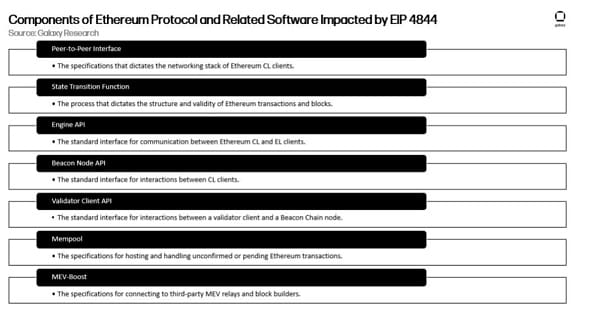
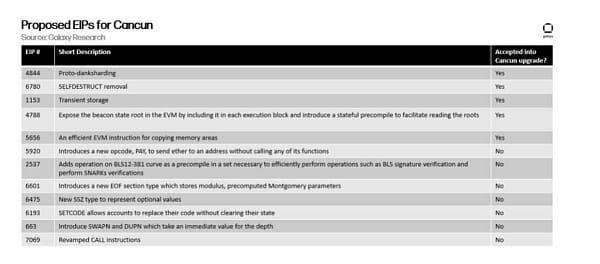
In addition to EIP 4844, the following four EIPs will be launched in the Cancun upgrade:
EIP 6780, SELFDESTRUCT only within the same transaction: This EIP changes the functionality of the SELFDESTRUCT opcode so that the SELFDESTRUCT opcode can be deprecated with minimal impact on existing smart contracts.
EIP 1153, Transient Storage Opcode: This EIP introduces the transient storage opcode, which behaves identically to the storage opcode except that the data is discarded after each transaction, leading to cleaner smart contract design and gas fee savings for end users.
EIP 4788, Beacon Chain Block Root in the EVM: Expose the Beacon Chain block root in the EL header to allow CL state proofs in the EVM. This will improve trust assumptions for staking pools, re-staking structures, smart contract bridges, MEV protocols, etc.
EIP 5656, Memory Copy Instructions: Introduces a new EVM instruction for copying memory regions to provide an efficient means of building data structures and deploying computationally heavy operations on Ethereum.
Similar to the process for the Shanghai upgrade, Ethereum core developers are prioritizing the activation of EIP 4844 as the major code update going into the Cancun upgrade. As a result, due to the complexity of EIP 4844 and the significant time and work required to thoroughly test the code update, the developers have decided to reject all other Cancun upgrade EIP proposals except for the four EIPs mentioned above. The goal is to make the Cancun upgrade as streamlined as possible, including only those EIPs with the least complexity or the highest urgency. The urgency priority of EIP 4844 over other EIPs was canceled long before the merge upgrade, which was a controversial topic that highlighted the need for improvements beyond Ethereum scalability.
The need for EIP 4844
The EIP 4844 upgrade will reduce the cost for end users to send transactions and deploy smart contracts on rollups. While there have been a few spikes in trading activity that have caused transaction fees to increase to over $1, rollup fees, and Ethereum fees, have been relatively low since January 2022. As of June 14, 2023, the cost of transferring ETH on most L2 rollups is often less than $0.20.
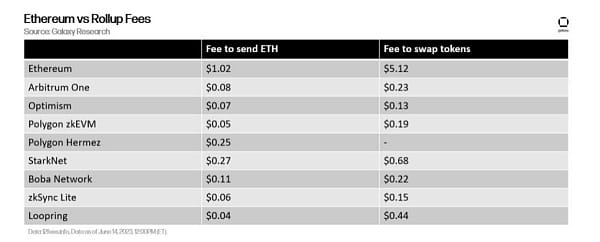
Without high fees or transaction congestion on Ethereum, economic activity has almost lost the financial incentive to turn to rollups. Based on Ethereum's 8-year history of on-chain activity, it is only a matter of time before fees rise, once again emphasizing the need for Ethereum scaling solutions. However, in the short term, without a catalyst event or narrative driving on-chain activity, EIP 4844 is unlikely to further reduce Ethereum fees.
Even if a catalyst does emerge to drive economic activity and growth on Ethereum and Ethereum-based dapps around the activation of EIP 4844 this year, it’s unclear whether the transaction activity flooding Ethereum will shift in meaningful quantities to take advantage of the cost savings. While rollups are cheaper to use than Ethereum (much cheaper even today), rollups are still in the early stages of development and do not yet offer users the same level of security, usability, or decentralization as Ethereum. Most rollups on Ethereum today will likely never reach levels of parity with L1, as innovation in rollup technology and new rollup designs will make current rollups obsolete.
Ethereum is the world’s most secure, decentralized, general-purpose blockchain, supporting thousands of dapps that are also interoperable and composable through standards like ERC-20 and ERC-721. While rollup developers are designing proof systems that support trust-minimized bridges and working to enhance client diversity to eliminate reliance on multi-signature wallets, these efforts will take years to develop and deploy. At their current stage of development, rollups are competing with alternative layer-1 blockchains that also do not offer the same high guarantees for users and transaction activity as Ethereum in terms of network uptime, finality, or interoperability. Today’s rollups are not an attractive alternative to Ethereum.
Rollups are expected to become increasingly attractive over time, but until they can achieve a higher degree of decentralization, usability, and security, code updates like EIP 4844 are unlikely to single-handedly drive rollup adoption or activity. For most Ethereum end users, EIP 4844 will have little to no impact on their experience. For the few end users who already use rollups or switch to rollups because of proto-danksharding, the impact will be cheaper fees with no meaningful improvements to rollup security or interoperability.
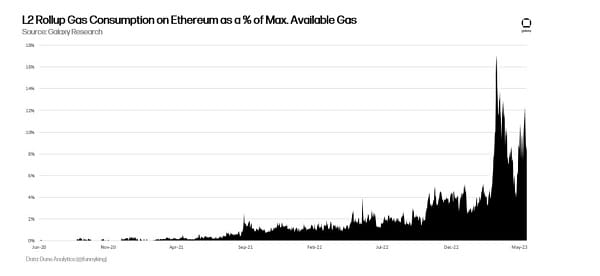
Arguably, migrating the sorter from using CALLDATA to blob data will free up regular block space for Ethereum end users. Over the past 3 years, only an average of 2% of available block space has been used by L2 rollups. Therefore, the impact of rollups migrating from using CALLDATA to blob data on available block space is minimal. Second, increased rollup usage by Ethereum end users could lead to a proportional increase in bridging activity, which could subsequently offset the small reduction in sorter block space usage.
The urgency of EIP 4844
Over the past 12 months, the crypto industry has been rocked by a series of protocol failures, hacks, high-profile bankruptcies, and criminal prosecutions. More broadly, post-COVID-19 macroeconomic conditions—rising inflation and rising interest rates in several countries around the world, most importantly the United States—have also led to a general decline in economic activity in both crypto and traditional financial markets. In addition, the crypto industry has seen increasing regulatory scrutiny from government agencies such as the U.S. Securities and Exchange Commission (SEC), targeting blockchain-based applications and services, the most valuable and popular of which run on Ethereum. Here are the top regulatory headlines related to the crypto industry since the beginning of 2023:
In February, cryptocurrency exchange Kraken was sued by the SEC for selling unregistered securities through its staking service, leading them to shut down their staking service in the United States.
In March, members of the European Parliament (MEPs) voted in favor of an anti-money laundering bill that would require decentralized autonomous organizations, decentralized finance protocols, and NFT marketplaces to perform the same user due diligence as traditional banks and financial institutions.
In the same month, the New York Attorney General (NYAG) filed a lawsuit against cryptocurrency exchange KuCoin and classified ETH as a security in the same lawsuit.
In April, the U.S. Treasury Department released a similar report confirming the need for decentralized finance protocols to comply with U.S. anti-money laundering and sanctions laws.
In June, the U.S. Securities and Exchange Commission sued Binance, the world’s largest cryptocurrency exchange, for violating federal securities laws.
In the same month, the U.S. Commodity Futures Trading Commission (CFTC) won a lawsuit against decentralized autonomous organization (DAO) Ooki DAO for offering unregistered commodities.
During the cryptocurrency bear market and amid growing fears of a global recession, lawmakers and regulators around the world continue to evaluate the extent to which policies and rules can impact Ethereum access and Ethereum activity, and to what extent they should be implemented. In order for Ethereum to achieve its vision of becoming the world computer, it is important that Ethereum core developers work to mitigate centralization trends and strengthen censorship resistance not only at the protocol level, but also at the application level.
Over the past year, the Ethereum Foundation and other high-profile Ethereum stakeholders have become increasingly concerned about the Maximum Extractable Value (MEV) phenomenon, which is affected by the centralization of MEV. In order to mitigate the negative externalities of MEV, Ethereum core developers have worked with Flashbots to develop MEV-Boost, an additional software for validators on Ethereum to run after a merge to earn MEV without being driven to centralization by the power of MEV. However, MEV-Boost is only a stopgap solution to the MEV problem in the short term and has its own centralizing effects, which can be mitigated by implementing an in-protocol version of MEV-Boost, called in-protocol Proposer Builder Separation (PBS).
In a way, the inclusion of EIP 4844 as the main code update for the Cancun upgrade reflects the priority given by Ethereum core developers to scalability through rollups over other long-term plans and goals. The lower priority of other EIPs with similar complexity to proto-danksharding in future upgrades after the Cancun upgrade is another consideration around EIP 4844, which shows that Ethereum core developers are eager to advance the use of Ethereum as a DA layer in preparation for the coming future, when transaction execution is mainly performed on rollups instead of Ethereum.
Given recent trends in politics, regulation, and on-chain activity, PBS and other EIP proposals are intended to enhance Ethereum's censorship resistance, but the priority of proto-danksharding over them is not entirely based on need or urgency, but also on the completeness of the EIP. The large-scale upgrade of Ethereum Virtual Machine (EVM) availability (EVM Object Format "EOF") was not included in the Ethereum merge, Shanghai upgrade, or the recent Cancun upgrade because Ethereum core developers unanimously agreed that the code update was not ready. The EIP 4788 upgrade aims to optimize the EVM's trust-minimized access to the beacon chain to support decentralized staking pools and other dapps built on Ethereum. EIP 4788 has undergone a rigorous Cancun upgrade readiness assessment and was included in the upgrade on June 8, 2023.
Here are the EIPs proposed for inclusion in the Cancun upgrade and their status as of June 2023:
EIP 4844 emphasizes the idea of long-term scalability through modularity, even though rollup technology is still in its infancy. Modular blockchain design may change dramatically in the next few years based on continued research and the emergence of new technologies. As mentioned above, EIP 4844 is the vanguard of full danksharding, which Ethereum needs to achieve in order to compete as a DA layer with highly optimized DA layers such as Celestia. Based on the impact of EIP 4844 on Ethereum, the timing and idea of Ethereum implementing full danksharding may change.
4. Conclusion
EIP 4844 is not a game-changer for Ethereum scalability, as it does not reduce fees for Ethereum end users. Proto-danksharding reduces the cost of rollups and primarily benefits rollup users and operators. EIP 4844 puts Ethereum on a meaningful path to scaling through modularity and offloading transaction execution activity to other protocols. The benefits of Proto-danksharding will be primarily recognized by rollup sequencers who pay for Ethereum block space. The secondary impact of Proto-danksharding will be for end users and dapp developers who will eventually migrate from Ethereum to rollups for transactions over time.
Since 2022, rollup transaction activity has increased and fees have decreased. In addition, there have been several groundbreaking innovations that have increased the confidence of Ethereum core developers and other Ethereum stakeholders in rollups as a future technology for scalable blockchain design. However, rollups are unlikely to realize their full potential or be ready for mass adoption in the near future, and certainly not with the launch of EIP 4844 in Q3 or Q4 2023. Post-EIP 4844, proto-danksharding will not impact or reduce Ethereum fees without meaningful migration of transaction activity to rollups. Ethereum end users will still be subject to the same high fee volatility and network congestion unless they submit transactions through a rollup sorter, which is typically centralized and operated by a single entity.
Proto-danksharding is not a panacea for Ethereum’s scalability issues, but rather should be seen as the first step in transforming Ethereum into a modular blockchain that primarily supports transaction execution via L2 rollup. EIP 4844 lays the foundation for future implementations of full danksharding and the use of polynomial commitments in DAS. In many ways, EIP 4844 is a vote of confidence in the theory of modular blockchains and will encourage further rollup experiments on Ethereum. Modularity as a solution to scaling blockchains fundamentally redefines Ethereum’s primary function from a general-purpose blockchain serving end users and dapp developers to a DA layer serving sequencers.