

Today a study carried out by the Coingecko platform caught my attention, where a comparison is made between the prices of physical works of art and digital works of art represented as NFTs. The prices are surprising in both cases, but there is an abysmal difference.
To start we have the most expensive physical work called Salvator Mundi by Leonardo Davinci, which sold for $475 million dollars. This compared to the most expensive digital art Everydays by Beeple, it is 6.8 times more expensive with a value of $69 million dollars.
If we take the second most expensive physical work as a reference, we have Interchange by Willen de Kooning selling for $328 million dollars. On the other hand we have digital art called Clock with $52 Million dollars.
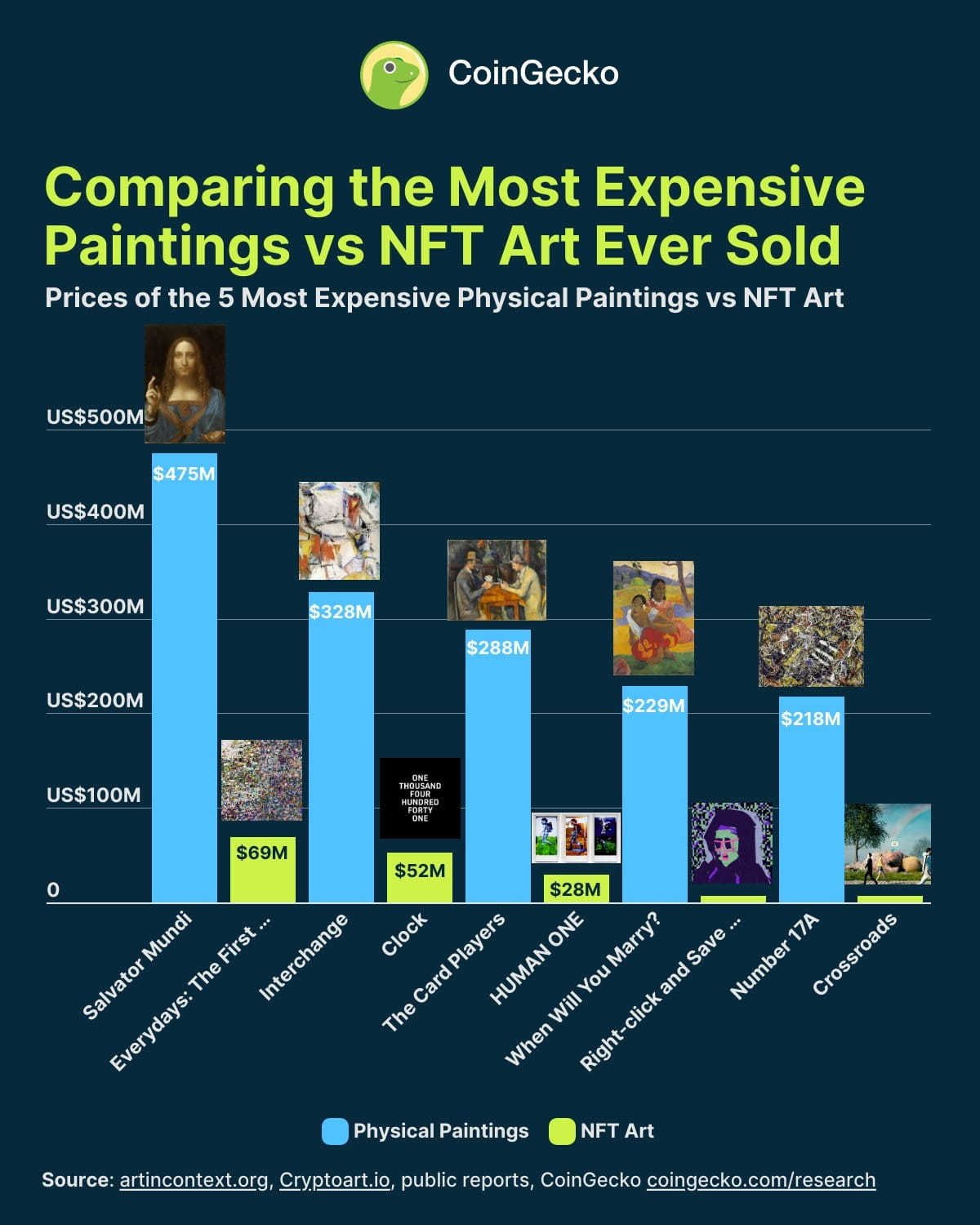
Source: https://www.coingecko.com/research/
At these prices, not even the first digital work of art can surpass the top 5 in the list of most expensive physical works of art in price. It is worth mentioning that in this study only art-type NFts are being considered, and not others that have different types of utility such as Cryptopunks.
This type of digital art is appreciated by some collectors, who are looking for something different from the conventional and unique creative expressions. They are mostly acquired in an exclusive marketplace for art NFTs, where they are acquired through an auction.
The NFTs market, although it has been on the market for years, is still very incipient, where there is still some distrust on the part of some investors and/or collectors. The future is still uncertain for the art NFT market, so it is not known if they can increase the current price or lose their value as such.