

Original author: 0xBeyondLee
1. The Smart Era is here
In fact, many years ago, "Satoshi" as the smallest indivisible unit of Bitcoin already existed, that is, 1 Bitcoin = 10 ^ 9 Satoshi, but it has not entered the vision of mainstream players because it is too microscopic and has no usage scenarios. However, in the past three months, with the explosion of the Bitcoin ecosystem, Satoshi as an inscription carrier has naturally received a lot of attention. In addition, Satoshi, with its intuitiveness and anti-volatility characteristics, has replaced USDT to take the throne of the number one pricing unit in the Bitcoin ecosystem.
In addition to being an inscription carrier and pricing unit, the satoshi itself is also naturally suitable for collection speculation. Of course, to clarify this point of view, we must first understand the properties of the satoshi itself.
Open the ordinals official browser and enter any number or name in the search box to find the corresponding satoshi. A satoshi contains a lot of information. For example, my name beyondlee includes five representation methods, rarity, estimated mining time, etc.
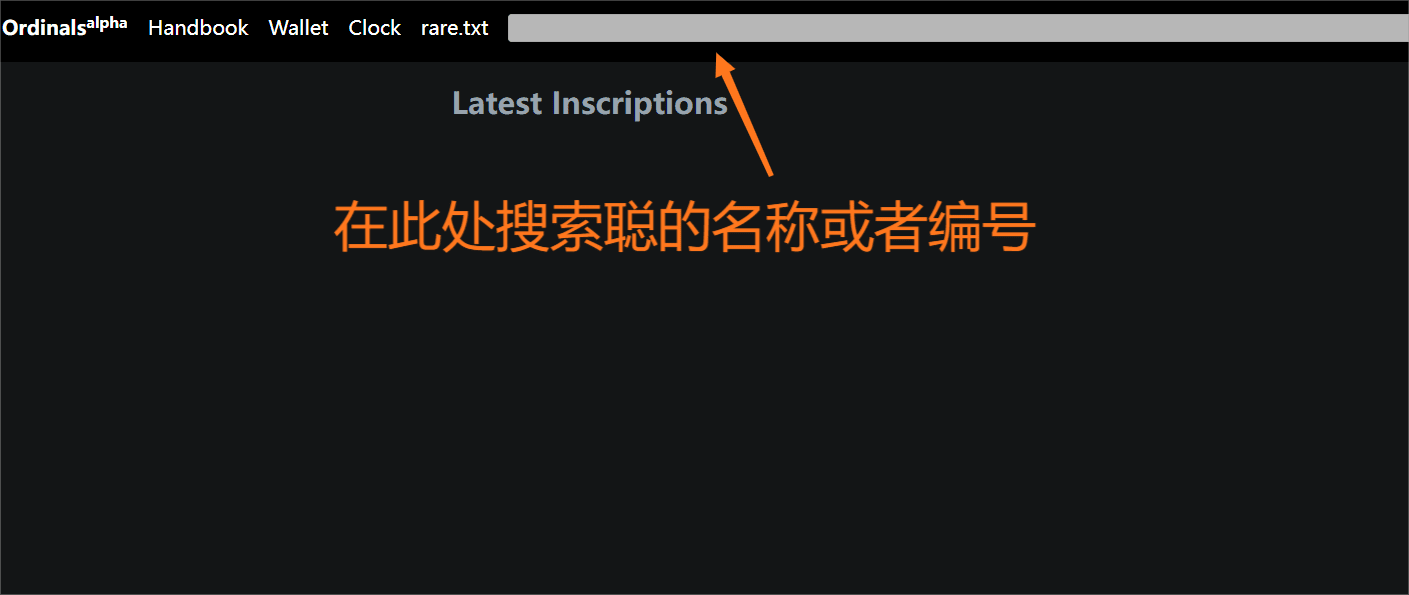
The five mainstream representation methods of Cong are explained below, which can be understood as the identity ID of Cong (satisfying the bijective concept in the set). That is, any representation method can accurately lock a certain Cong, which is a one-to-one correspondence.
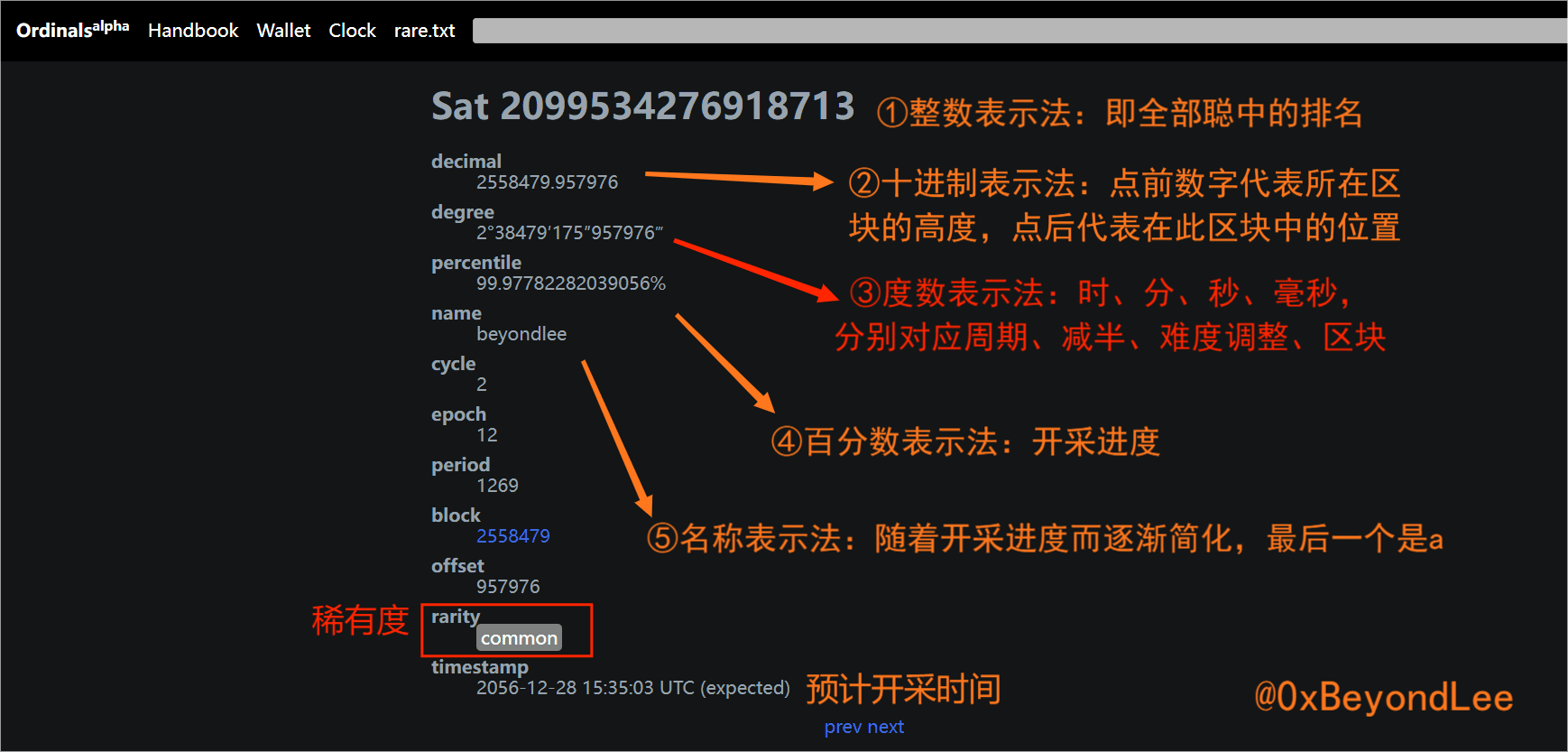
1. Integer notation
This is easy to understand, that is, the ranking among all Satoshi. But one thing needs to be emphasized, the exact value of the maximum amount of Satoshi mined is not 210 trillion, but a strange number like 2099999997690000. The specific reason is related to the halving of Satoshi, which will not be described in this article.
2. Decimal notation
A series of numbers separated by a period. The number before the period represents the height of the block, and the number after the period represents the specific position in the block.
3. Degree notation
Hours °, minutes ′, seconds ″, milliseconds ‴ correspond to the period, halving, difficulty adjustment, and block height, respectively. Rarity is determined based on this notation, so it is crucial to understand this notation. These four concepts will be explained in detail later.
4. Percentile notation
That is, the mining progress of the total approximately 210 trillion satoshis is currently about 92.5%. The difficulty of mining will continue to increase with the progress, and the last satoshi is expected to be mined sometime in 2140.
5. Name Notation
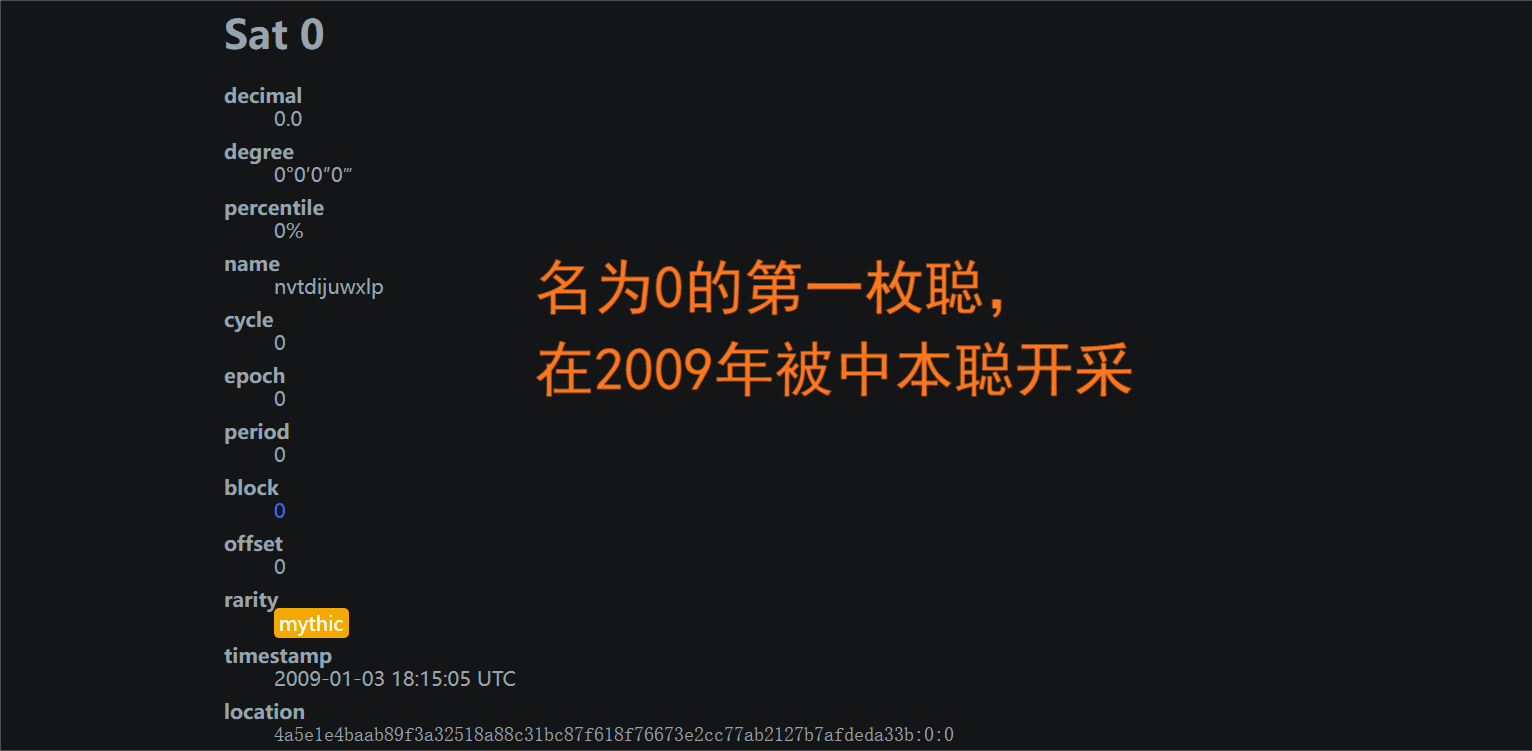
Each satoshi has its own name, from nvtdijuwxlp to a, which is getting simpler as mining progresses. The good news is that there are a lot of satoshis with special meanings, including your name, but the bad news is that they are highly ordered and almost all of them can only be mined after a hundred years.
Special reminder: the numbers involved in the above five representation methods all start with 0, not 1.
If you carefully observe the representation of satoshis, you will easily find some interesting things. The satoshis named 0 and a echo each other at the two ends of time and space, connecting this epic spanning 210 trillion satoshis and lasting more than 130 years...
Now that we understand how to represent Satoshi, let’s delve deeper into the four elements that define rare Satoshi, namely blocks, difficulty adjustment, halving, and cycles.
1. Blocks
A new block is mined approximately every ten minutes, and this interval is relatively stable.
2. Difficulty adjustments
Every 2016 blocks, or about two weeks, the Bitcoin network responds to changes in the hash rate by adjusting the block mining difficulty target to ensure a stable block production rate.
3. Halvings
Every 210,000 blocks, or about four years, the number of satoshis contained in each block is cut in half. This is by far one of the most important narratives driving Bitcoin’s cyclical changes.
4. Cycles
After every six halvings, something magical happens. The halving and difficulty adjustment happen at the same time, which is called a "coincidence". The interval between the coincidences is the cycle, and it happens about every 24 years. It is predicted that the first coincidence will occur at some point in 2032.
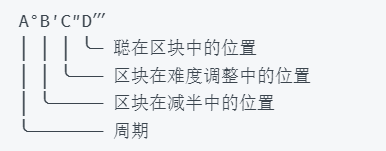
Using decimal notation, it is very convenient to find the position of Satoshi. However, it should be noted that in decimal notation, difficulty adjustment and halving are not a system relationship, but two independent statistical mechanisms that only occasionally overlap.
For more information about Satoshi, see the official documentation on ordinals.
2. What is rare intelligence?
With the above concepts understood, you will naturally find that Satoshis that play an important role in these periodic events, Satoshis with unique names, and Satoshis that have experienced historical events will have unique rarity and premium.
To give a vivid example, the Cong is like a hundred-yuan RMB in circulation. Its purchasing power does not vary due to the printing batch or the number of times it changes hands. However, due to the appearance of the prefix number, a small number of banknotes with special numbers have a premium. The same is true for Cong. Based on a certain consensus criterion, a small number of Cong with special properties have generated an incredibly high premium in the market circulation. Relatively speaking, the consensus criterion for the mainstream Cong is much stricter than the Leopard Number of the RMB prefix number.
Below, this article will briefly introduce two mainstream criteria, namely rare satoshis and interesting satoshis. Since these two types of satoshis are rare in number, they are sometimes collectively referred to as rare satoshis.
1. Rare Sagittarius
By arranging and combining the four basic events covered by the decimal notation, the six rarities of Satoshi can be clearly defined, namely Common, Uncommon, Rare, Epic, Legendary, and Mythical.
It should be noted that the foreign community collectively refers to these five categories (excluding common) as rare satoshi, and the rare satoshi among them is named Rare Satoshi in capital letters.
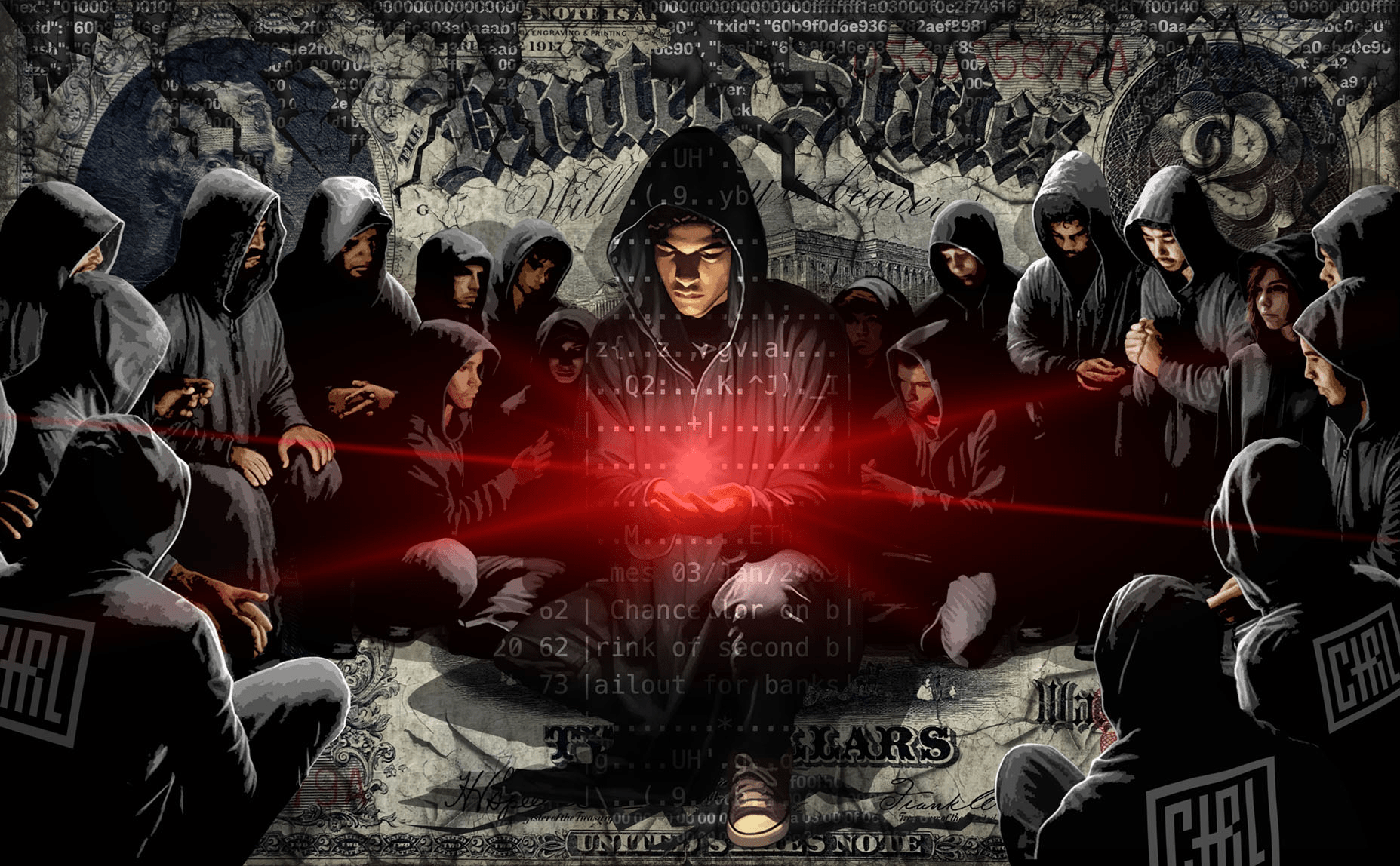
On May 23, the inscription with serial number 8669069 was released, sparking heated discussions in the ordinals community and the rare satoshi community. The reason why it attracted so much attention is that it is the first inscription engraved on a rare satoshi. You should know that among the current 190 trillion satoshis, there are only 370 rare satoshis, which makes this inscription very likely to become the most expensive crypto artwork in history. In addition, the "The Times 03/Jan/2009 Chancellor on brink of second bailout for banks." included in the picture was once engraved by Satoshi Nakamoto in the Genesis Block, which gave it unparalleled significance. You should know that in the world of artworks, the superposition of rarity can often achieve the effect of 1+ 1>>>2.
2. Interesting and smart
The definition of interesting cong is quite flexible, and you can even define a certain type of cong as having the characteristics of interesting cong because of its special meaning. The current mainstream interesting cong mainly includes the following categories.
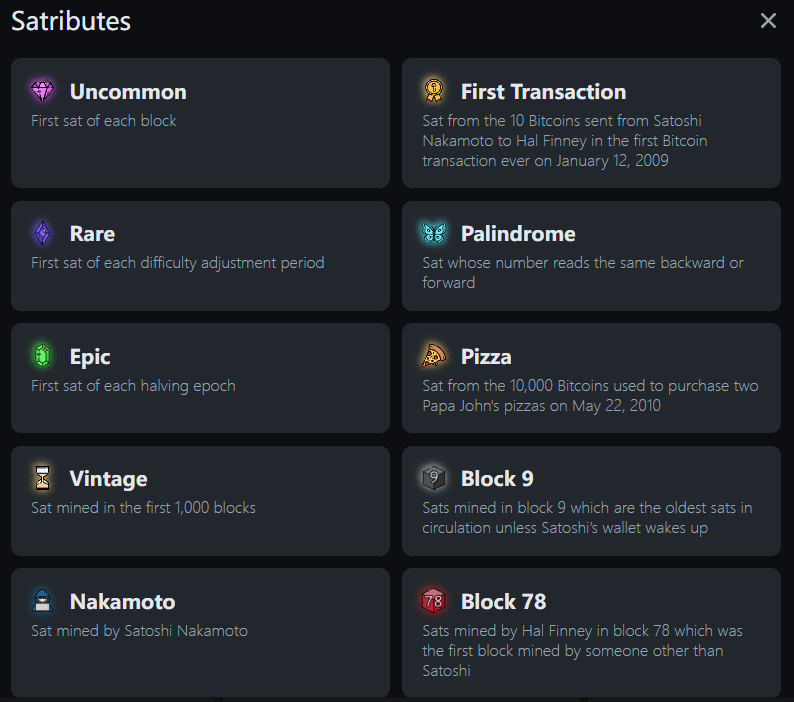
1 st TX The first sent Satoshi: On January 12, 2009, Satoshi Nakamoto sent 10 bitcoins to Hal Finney, which was also the first on-chain interaction in history.
JEPG Satoshi: Probably the first purchase of Bitcoin ever took place on February 24, 2010.
Digits Palin A digit is a palindrome, i.e. a satoshi whose number is a palindrome in integer notation, e.g. 15951.
Name Palin: A palindrome of the name, such as btcctb.
Pizza Satoshi: The Satoshi used in the transaction of purchasing pizza with 10,000 Bitcoins. This transaction is also the source of Bitcoin’s nickname “Pie”. It took place on May 22, 2010, and this day has since been designated as Pizza Day.
Vintage Satoshi: The Satoshi contained in the first 1000 blocks.
Nakamoto: Satoshi Nakamoto is the Satoshi mined by Satoshi Nakamoto. I have to say that the name is very interesting.
Block 9: This is the oldest Satoshi in circulation, unless the address belonging to Satoshi Nakamoto is revived again.
Block 78: Satoshi mined by Hal Finney. This was the first time that someone other than Satoshi Nakamoto participated in mining.
Descriptions of these categories can be easily found on the ord.io marketplace.
3. Inventory of mainstream projects
Unlike other Bitcoin ecosystems, this time, the projects and communities related to the rare satoshi sector are mainly dominated by foreign players, and the Chinese community had a low level of participation in the early stage. Among them, @RareSatSociety, or RSSC, the rare satoshi community, is the most popular. The community also created an identity for OG using the .sats domain name.
This article will review the top ten rare satoshi-related projects. It does not constitute any investment advice and is for learning reference only.
1、CTRL
The super rare inscription No. 8669069 mentioned above comes from the @SeizeCTRL project. Each of their added artworks will be engraved on rare Satoshi, which establishes its king status in the rare Satoshi plate.
2、Nullish
@null_ish is a collection of NFTs inscribed on uncommon Satoshis, sold via PSBT (Partially Signed Bitcoin Transactions) on the Gamma platform.
3、Ordinal Maxi Biz (OMB)
@OrdinalMaxiBiz is the leading rare Satoshi NFT project. All collections are engraved on Block 9, and the current floor price is about 2.88 BTC.
4、BitPepe
@BitPepe 3333 There are 3333 Pepe NFTs in the whole series, which are composed of six rarity attribute NFTs.
5、Cypherpunk Ghosts
@GhostsBtc The entire series totals 777 ghost nfts, which is also the first dynamic HTML engraved on uncommon satoshis.
6、Inscribed Pepes
@InscribedPepe is made up of 420 pepe nft, inscribed on uncommon satoshis.
7、Bitcoin Bees
@OrdinalBees is a 1000+ NFT that is all inscribed on antique satoshis, palindrome satoshis and other rare satoshis.
8、Pixel Panda Wars
@pixelpandawars The panda nft collection inscribed on block 78 satoshi.
9、Satributes.art
@satributes nft collection inscribed on Vintage antique satoshi.
10、$XING
@xingbrc 20 is the first BRC 20 to be inscribed on uncommon satoshis.
4. Relevant Platforms
It can be roughly divided into tool platforms and trading platforms. The participants of the rare satoshi sector are mainly overseas users. There are still few tutorials for Chinese users. The author will update relevant information in the future. I would like to reiterate that the following information does not constitute investment advice. The author cannot guarantee the credibility of these platforms. It is for learning reference only.
1. Ordinals Browser
When used in conjunction with official documentation, all information about Cong can be queried. It is the most reliable tool platform so far.
2、Satin
@satingio is currently the most powerful comprehensive platform for rare and interesting satoshis, integrating multiple functions such as retrieval, minting, and transfer. The usage tutorial will be updated later.
3、Ordinal Hub
@ordinalhub is a rare satoshi search and analysis platform. You need to bind your email address to use it.
The above are tool platforms, and the following are trading platforms.
4、f 2 pool
The fish pool @f 2 pool_official developed by the god fish @bitfish 1 can participate in the auction of rare satoshis. The current price is about 500-700 u per uncommon satoshi. This is also the channel with the lowest price at present.
5、ord.io
@ord_io is the most mainstream exchange for rare Satoshi inscriptions, with clear and efficient retrieval for inscriptions of different rarities.
6、gamma.io
@trygamma can also trade rare Satoshi inscriptions, but the search function is not perfect.