

1. What is MXC?
Machine Xchange Coin (MXC) provides a unique distributed "IoT data trading network" for the global token economy. IoT data can be shared on a large scale while ensuring complete end-to-end privacy. The MXC Foundation is committed to the research and application of low-power wide-area IoT (LPWAN) and blockchain technology. The MXProtocol is the core of MXC. It is a fully decentralized standard protocol based on LPWAN, solving the following problems:
1. Solve the IoT conflict problem in free frequency bands through ACC;
2. Solve the problem of LPWAN IoT downlink resource allocation through intelligent bidding technology;
3. Solve the cross-chain transaction and service problems of IoT data through the cross-chain data market.
Machine Xchange Coin is the first cryptocurrency-based token designed to connect existing IoT devices and can be used to reward network participants, pay for services, and conduct transactions.
2. IoT and blockchain converge, MXC gets support from Arbitrum
Due to the large number of devices in the Internet of Things, which are scattered and heterogeneous, issues such as security, privacy, deployment, and data transmission between devices have become important challenges facing the Internet of Things. In recent years, people have solved many problems by combining the Internet of Things with blockchain, and have produced good results. Therefore, the combination of the Internet of Things and blockchain has become a focus of attention.
Blockchain technology is a distributed ledger technology that ensures data security and privacy through decentralization. It also uses token incentives to attract users to deploy nodes to ensure stable network operation. Blockchain technology can achieve data security and reliability without relying on centralized institutions. In addition, blockchain can ensure data integrity and immutability. The decentralized nature and immutability of blockchain make it an important direction for solving problems in the Internet of Things.
The current main bottleneck of blockchain is accommodating large amounts of data and transactions. Layer 2 has been the main direction of blockchain development in recent years.
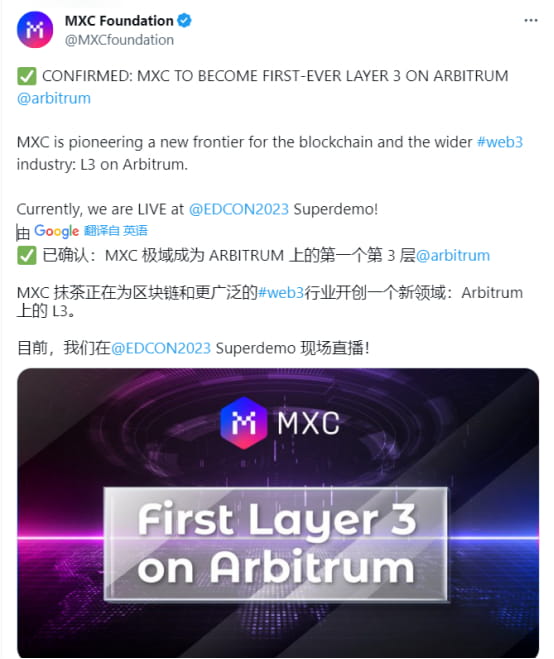
Layer2 is the main solution for Ethereum expansion, and its vigorous development has also been recognized by the market. The high-performance demand of the Internet of Things, which relies on blockchain, has also ushered in the dawn of development. Recently, the well-known Ethereum Layer2 project Arbitrum announced that MXC will choose the first Layer3 blockchain built on Arbitrum, which has become the focus of news, thus pushing MXC and Layer3 onto the stage. MXC, a blockchain project established in 2018 with the Internet of Things as its main direction, has attracted market attention.
MXC ensures the security of IoT device data by combining the Internet of Things with blockchain. After years of development, MXC has now cooperated with communities in 177 countries around the world, and its network covers Europe, North America, East Asia and other regions. It also has multiple application scenarios, which has promoted the large-scale application of blockchain and its integration into real life, producing positive results.
According to media reports, MXC will migrate to Arbitrum and become the first L3 blockchain on the chain. It will also build the IoT platform MXProtocol and use ZK-Rollup zero-knowledge proof technology to build the EVM network, thus ensuring the security and stability of IoT node data transmission. In addition, MXC also announced that it will issue airdrops to Arbitrum community users to integrate into the Arbitrum ecosystem.
3. Layer 3 brings new changes to the Internet of Things
Public chains have been facing the problem of capacity expansion since Layer 1. With the increase in on-chain transactions, it is difficult for public chains such as Ethereum to process a large number of transactions in a short period of time. If they want to cover a large number of user groups, they must improve the overall performance of blockchain transmission. Therefore, capacity expansion has always been a hot topic.
Public chains have been facing expansion issues since Layer 1. With the increase in on-chain transactions, it is difficult for public chains such as Ethereum to process a large number of transactions in a short period of time and cover a large number of user groups. Therefore, the emergence of Layer 2 and Layer 3 provides new possibilities for the development of public chains. With MXC's choice of Layer 3 blockchain built on Arbitrum and the construction of MXProtocol, MXC will become a powerful IoT platform, providing strong support for the development of the IoT.
As one of the expansion solutions, layer2 has produced positive effects in the current market. For example, to complete a transaction on the Ethereum mainnet, it may cost 2-3u gas fees, but if it is on Arbitrum, it only takes less than 0.1u gas. Therefore, Layer2 accommodates many ecological projects such as DeFI, GameFi and Metaverse, and the ecology on Arbitrum has also begun to prosper.
However, Layer 2 cannot fully meet all application scenarios of blockchain. If we divide blockchain scenarios into three categories, the first category belongs to the underlying needs, such as transfers, staking, etc. The second layer is more suitable for DeFI, GameFi, the metaverse, and various DApp worlds, which are also what the market is paying attention to now. The third layer is more inclined to the large-scale application scenarios brought by blockchain, such as the combination of blockchain with business, government affairs, the Internet of Things, big data and other industries, so as to realize the large-scale application of blockchain, bring blockchain to each of us, and make it an integral part of life.
In this process, not only the on-chain transaction fees need to be further reduced, but the speed and efficiency also need to be improved. However, due to the existence of the impossible triangle in the blockchain, people often choose to sacrifice performance for security and stability, which also makes it difficult for blockchain to be implemented in the field of Internet of Things.
However, Layer3 can avoid this problem. Layer3 can make the chain's functions and development direction relatively more specific. Coupled with the improvement in transaction speed, it can meet the existing IoT transaction needs. MXC Polar can realize the combination of blockchain and IoT by building Layer3 on Arbitrum, ensuring the security and privacy of IoT data without affecting performance.
4. MXC IoT application
MXC is one of the earliest projects to study the integration of blockchain and the Internet of Things. It has successfully implemented some scenarios for the application of blockchain in the Internet of Things. For example, it has carried out practical applications of smart city railways in Germany and established data collection on personnel flow, parking spaces and even trash cans between Berlin train stations, enabling city managers to collect and summarize key data.
In addition, MXC has launched the ISO plan. ISO (Initial Sensor Offering) is a plan launched by MXC to promote the large-scale implementation of the Internet of Things and blockchain. By supporting the construction of IoT projects on MXC, developers can use DataDash and the community as a launchpad, use MXC to raise funds, launch tokens, and allow the MXC mining network to detect, and miners to certify sensors and mine tokens. Through the ISO plan, MXC can attract a large number of IoT sensors to join the network and earn revenue, while the data in the MXC network is further enhanced.
In addition, MXC also cooperated with the New York City government to carry out a project on garbage can management, helping garbage collection companies optimize routes for garbage collection. MXC also cooperated with the municipal governments of Hangzhou and Shanghai in China to open multiple IoT application cases, including the chaining and transmission of parking spaces, garbage cans, street lights, pedestrian and vehicle traffic data.

It can be seen that MXC Polar's main cooperation direction is the improvement of smart cities. By integrating blockchain technology into it, efficient and stable operation of all aspects of the city can be achieved. There are many similar scenarios, such as the governance of forests, oceans or villages. These scenarios require stable and secure data transmission on the one hand, and on the other hand, they also need to be able to obtain data in the first time. At the same time, the blockchain cannot be tampered with, which ensures the reliability of the data.
In addition, by integrating 5G technology, MXC only needs 20 to 30 node devices in a city to complete the upgrade of the Internet of Things, and use blockchain to ensure the security of IoT data. The Internet of Things will also better play its role in urban operations, thereby leading the development of smart cities.
5. Bridge between the digital and real worlds
The essence of the Internet of Things is the data management process of the real world. A large number of sensors continuously collect data and transmit it through nodes, forming the current smart cities and various scenarios that facilitate human life and work. In the long run, the popularization and development of the Internet of Things is an inevitable result of scientific and technological progress.
For blockchain, more attention is paid to the protection of ownership in the virtual world. From encrypted assets to privacy data, to decentralization and Web3 governance processes, all of these demonstrate the fairness that blockchain currently brings to the virtual world. Through MXC, real-world data can realize its true value through blockchain. At the same time, the outbreak of AI will further increase human demand for data collection. The importance of data is self-evident, and MXC will also realize more potential value in this transformation.