

Written by: zf857.eth
Recently, Nvidia released its first quarter earnings report, with revenue of $7.19 billion, exceeding the market expectation of $6.52 billion, gross profit margin of 64.6%, and adjusted earnings per share of $1.09, while the market expected $0.92. As Nvidia's financial report exceeded expectations, US chip stocks rose collectively after the market. Nvidia once rose 29.35% after the market, and its stock price reached a record high of $395, with a market value approaching "trillion". The demand for AI chips far exceeded expectations. Nvidia's market value soared by $184 billion in one trading day, which was more than the total market value of 3 bitcoins.
When releasing the financial report, Nvidia CEO Jensen Huang mentioned the broad prospects for AI applications, saying that the computer industry is undergoing two transformations at the same time - accelerated computing and generative AI. Companies are competing to apply generative AI to various products, services and business processes, and the world's trillion-dollar installed data centers will shift from general computing to accelerated computing.
At present, almost all the top dollar funds and institutions are keeping a close eye on the AIGC track, and are actively establishing investment selection coordinates to quickly build a screening system, for fear of missing the train to the era. Relevant data show that in the first quarter of 2023, the total financing of the global AIGC industry reached 3.811 billion yuan, with a total of 17 financing times. The rise of one outlet often represents the decline of another outlet. People gradually raised various questions about WEB3: "Capital has gone to see AI, Web3 supervision has tightened, and narratives are no longer working", "AI looks more reliable than Web3, and it is easier to produce unicorns."
Since the dawn of human history, collective stories have been defining our culture and enriching our understanding of the world. The importance of narrative is self-evident. Today, AI narratives are gaining popularity and have even penetrated into the Web3 field. Some industry insiders have begun to say that "Web3 without AI is soulless", and more than half of Web3 companies have begun to turn to AI. So, how will AI+Web3 merge? Recently, ZKML narrative, an emerging combination of zero-knowledge proof and machine learning, has become popular. How will it work with AI and Web3 to build a trusted, decentralized future?
1. AI needs Web3, and vice versa
“It’s a mistake to think of cryptocurrency and AI as unrelated technologies,” said Michael Casey, chief content officer at CoinDesk. “They complement each other and each improves the other.”
Web3, cryptocurrencies, and blockchains solve a social challenge that has existed since the beginning of the Internet: how to keep valuable information safe in a decentralized environment. They address the issue of human trust in information through new systems that employ distributed records and incentive mechanisms. These systems help communities of untrusting strangers collectively maintain open data records, enabling them to distribute and share valuable or sensitive information without middlemen.
We are rapidly moving toward an era of comprehensive artificial intelligence, and the challenges it brings are daunting. These challenges cover a wide range of aspects, from protecting the copyright of the inputs to large language models (LLMs), to avoiding erroneous biases in their outputs, to the "liar's dividend" brought about by our current inability to accurately distinguish between real content and false information created by AI. There are no simple solutions to ensure that humans are not negatively affected by artificial intelligence. Any solution cannot rely on outdated 20th century regulatory and technical frameworks to solve these problems. We urgently need a decentralized governance system to meet the challenges of how information is produced, verified, and shared in this new era.
Regardless of whether the current Web3 can provide the needed solutions, blockchain technology does play a role in solving these problems. Immutable ledgers allow us to track the origins of images and other content, thereby preventing deep fakes. This technology can also be used to verify the integrity of data sets for machine learning AI products. Cryptocurrency provides a borderless digital payment method that can be used to remunerate people who contribute to AI training around the world, and projects such as Bittensor are working to establish tokenized blockchain-government communities to incentivize AI developers to build human-friendly models. In contrast, AI systems owned by private companies often put shareholder interests above user rights.
We still have a long way to go before these ideas can be realized and scaled. We will need to integrate a range of other technologies, such as zero-knowledge proofs (ZK), homomorphic encryption, secure computing, digital identity and decentralized credentials (DID), the Internet of Things, etc. In addition, we also need to solve many challenges such as privacy protection, punishing bad behavior, encouraging people-centered innovative intelligence, and multi-party legislative supervision.
2. How does ZKML build a bridge between AI and blockchain?
Recently, ZKML, an emerging combination of zero-knowledge proof and machine learning, has been widely discussed. Currently, the deployment of machine learning (ML) is becoming more and more complex. Many companies rely mainly on service providers such as Amazon, Google, and Microsoft to deploy complex machine learning models. However, these services are becoming increasingly difficult to audit and understand. As consumers of AI services, how can we trust the validity of the predictions provided by these models?
As a bridge between artificial intelligence and blockchain, ZKML solves the privacy protection issues of AI models and inputs while ensuring the verifiability of the reasoning process. It provides a solution that makes it possible to use public models when verifying private data, or to use public data when verifying private models. By adding machine learning capabilities, smart contracts can become more autonomous and dynamic, enabling them to process based on real-time on-chain data rather than static rules. In this way, smart contracts will be more flexible and able to adapt to more scenarios, even those that may not have been anticipated when the contract was originally created.
Currently, one of the difficulties in the widespread adoption of machine learning algorithms on the blockchain is its high computational cost. Since millions of floating-point operations cannot be performed directly on the Ethereum Virtual Machine (EVM), running these models on the chain becomes a challenge. In addition, the trust issue of machine learning models is also an obstacle, because the parameters and input data sets of the model are usually private, and the algorithm and operation process of the model are like an opaque "black box", which may cause trust issues between the model owner and the model user. However, through ZKML technology, we can overcome these problems. ZKML allows anyone to run a model off-chain and generate a concise and verifiable proof that the model did produce a specific result. This proof can be published on the chain and verified by a smart contract. This means that model users can verify the results of the model without knowing the specific parameters and operation details of the model, thus solving the trust problem.
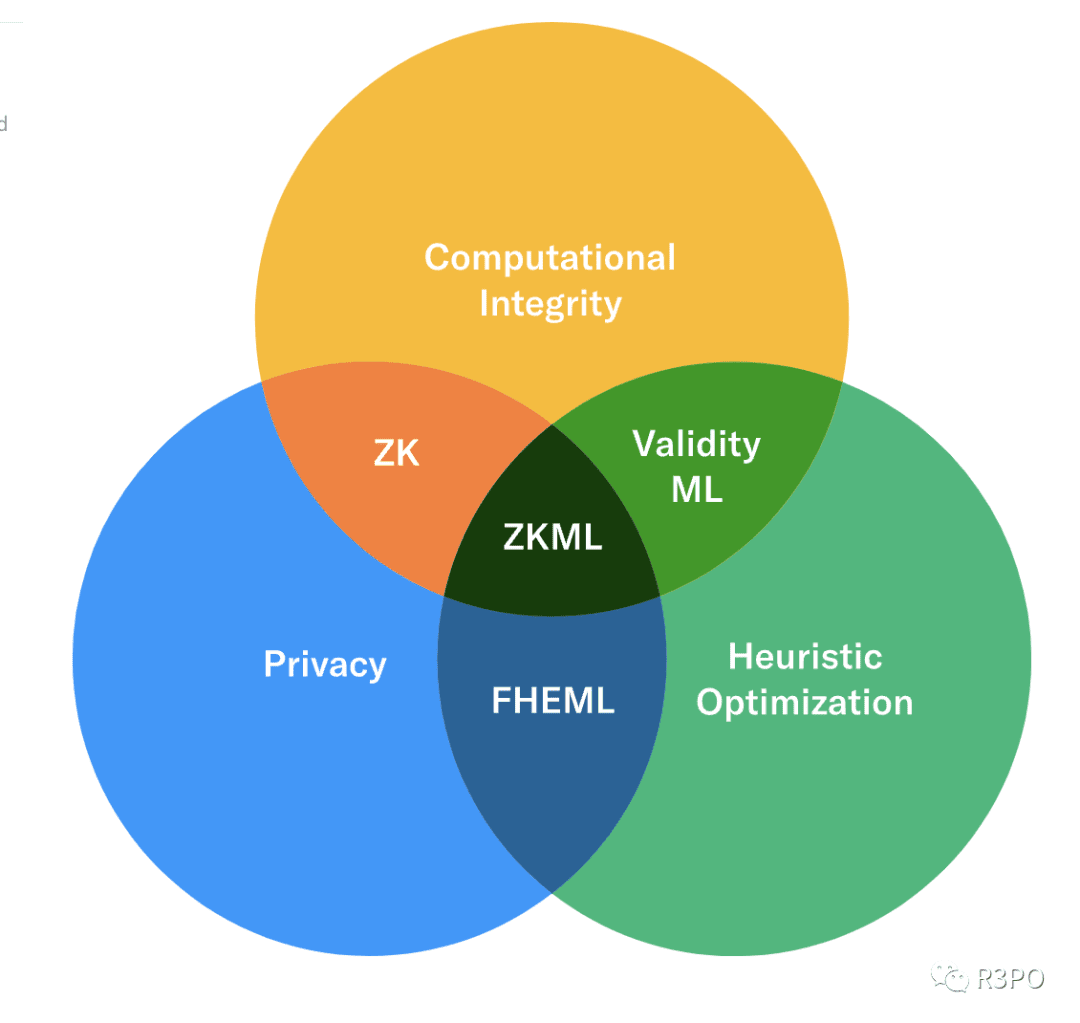
From the above chart, we can see that ZKML technology has the characteristics of computational integrity, heuristic optimization and privacy protection. This technology has broad application prospects in the Web3 field and is developing rapidly. More and more teams and individuals have joined this field, promoting the development of various ZKML projects with great potential.
3. ZKML Project Analysis
Here are some potential ZKML projects.
1、Worldcoin
Worldcoin is applying ZKML in an attempt to build a privacy-preserving proof-of-personhood protocol. World ID users will be able to self-custody their biometrics (such as irises) in encrypted storage on their mobile devices, download the ML model used to generate the IrisCode and create a zero-knowledge proof locally, and the receiving smart contract can prove that their IrisCode was successfully created.
It can then be used to perform useful operations such as membership authentication and voting. They currently use a trusted execution environment with a secure enclave to verify camera-signed iris scans, but their ultimate goal is to use ZKP to prove correct reasoning of neural networks with cryptographic-level security guarantees and guarantee that the output of the ML model does not reveal the user's personal data.
2、Modulus Labs
Modulus Labs is one of the most diverse projects in the ZKML space, working on research while also actively building on-chain AI application examples, demonstrating zkML use cases through RockyBot (an on-chain trading bot) and Leela vs. the World (a chess game where everyone plays against a verified instance of the Leela chess engine). The team also ventured into research, writing The Cost of Intelligence, a paper that benchmarked the speed and efficiency of various verification systems for models of different sizes.
3、Human
Giza is a protocol that can deploy AI models on-chain in a completely trustless way. The technology stack it uses includes the ONNX format for machine learning models, the Giza Transpiler for converting these models to the Cairo program format, the ONNX Cairo Runtime for executing models in a verifiable and deterministic way, and the Giza Model smart contract for deploying and executing models on-chain. Giza is generally an on-chain compiler from machine learning models to proofs, providing an alternative path for the development of on-chain AI.
4、Zkaptcha
Zkaptcha focuses on the robot problem in Web3, providing captcha services for smart contracts, protecting smart contracts from robot attacks, and using zero-knowledge proofs to create smart contracts that are resistant to Sybil attacks. Currently, the project enables end users to generate a proof of human work by completing a captcha verification code, which is verified by an on-chain verifier and accessed by smart contracts through a few lines of code. In the future, Zkaptcha will inherit zkML and launch a captcha service similar to the existing Web 2, and can even analyze behaviors such as mouse movements to determine whether the user is a real person.
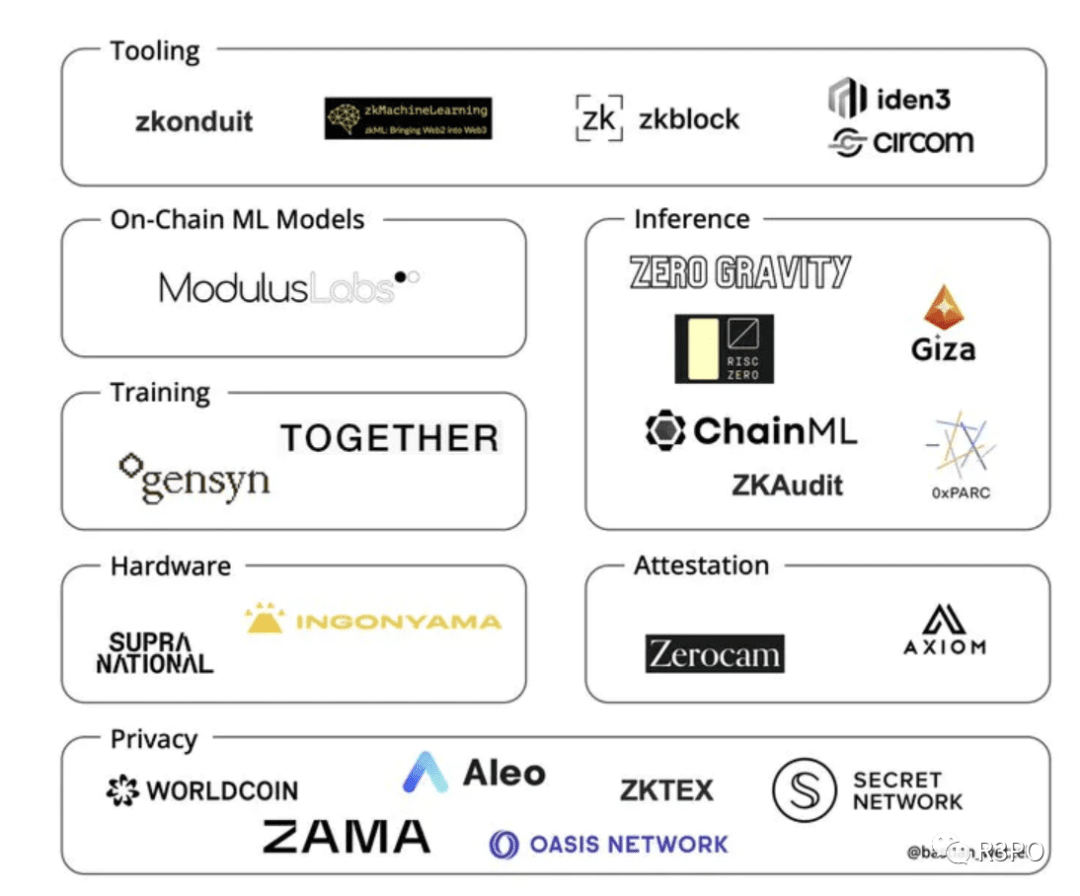
At present, the zkML track is still in its early stages, but we have reason to believe that the power of zkML can bring better prospects and development to crypto, and we also look forward to more diverse products in this field. zk technology and crypto provide a safe and reliable environment for the operation of ML. In addition to product innovation in the future, it may also stimulate innovation in crypto business models, because in this wild and anarchic Web 3 world, decentralization, crypto technology and trust are the most basic facilities.
Conclusion
Building trust in an increasingly complex and uncertain digital world has always been a core challenge facing AI and Web3. However, integrating AI with Web3 holds great promise for building a trusted, secure, decentralized future. It is critical for developers, technologists, policymakers, and society as a whole to jointly shape the future of AI and Web3, so that we can create an era of smarter Internet than we could ever imagine.