
Proof of Stake or proof of ownership is a process that allows someone to demonstrate their involvement in a crypto-economic system through a signature algorithm, within the framework of access rights. This means generally intervening in the consensus model of distributed systems that manage digital units of account. Validators are selected based on the number of units they own or based on other related parameters.
Proof of stake is often described as “virtual mining” because digital tokens play the same role as electrical power in proof of work. Thus, in many digital currencies, the probability of validating a block is proportional to the number of tokens held by the validator.
To incentivize them to secure the system, validators are rewarded with the issuance of new tokens and transaction fees called staking. Moreover, validators are not called miners, but counterfeiters.
Where does proof of Staking come from?
The concept of Proof of Stake proofs used in distributed systems appeared quite early. In 1998, Wei Dai envisioned b-money, a model in which each server had to deposit a certain amount of b-money into a special account to participate in network operations. In this model, this amount serves as collateral to punish the server for its bad behavior.
Despite this initial conceptualization, it was not until the emergence of Bitcoin (and proof of work) that the implementation of a proof-of-stake system was considered. Bitcoin does show that a decentralized system based on economic security is possible.
The term Proof of Stake was introduced by Sunny King and Scott Nadal in August 2012 in the PPCoin white paper. PPCoin, now known as Peercoin, is also the first digital currency system to make practical use of proof of stake: it implements a hybrid model that combines electrical energy and coin age (proof of stake) for validation.
In 2015, Ethereum was launched: although the platform still works thanks to mining, it has been planned since its launch that it would switch to a proof-of-stake model. The algorithm under consideration today is called Casper .
How Proof of Stake Works and Variants
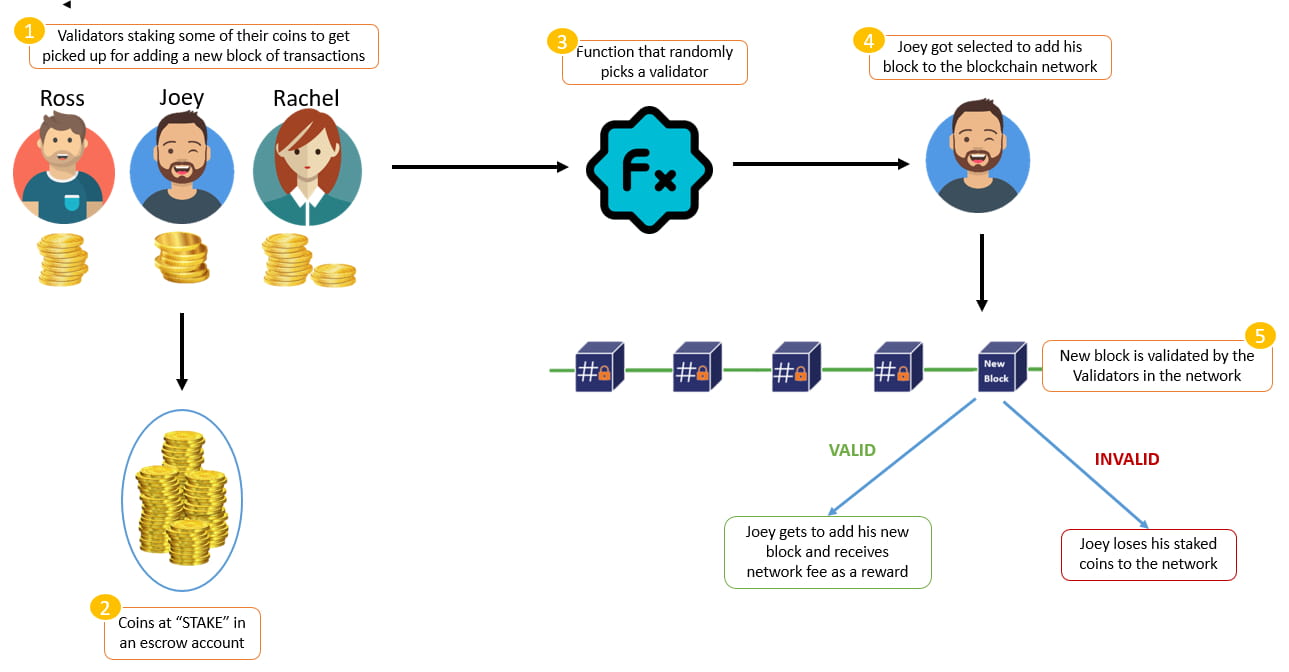
Proof of stake validation models are very diverse, and it is difficult to present them all in this article. Therefore, we will focus on Nakamoto's proof-of-stake algorithm, a transposition of the Bitcoin consensus algorithm for proof-of-stake. The algorithm is based on a chain of blocks that are added to regularly by validators.
The operation of this algorithm consists of virtually reproducing mining. Every time a block needs to be created, a random generation protocol is used to select validators based on the number of tokens they hold.
The selected validator then groups all new transactions and builds a new block by including the identifier of the previous block (to connect the two blocks). Then, he signs this block using a digital signature algorithm to prove that he is the owner of the account. Finally, he publishes his block publicly so that other members of the network can confirm its validity.
Varian Proof of Stake
The criteria for selecting a validator is not necessarily based on the number of tokens it holds (Proof of Stake), and other variables derived from this can be used. Thus, the PoS models obtained are very diverse. We found in particular:
Proof of conservation (PoH): the probability of being selected depends on the “coin age,” a metric that is the product of the UTXO value and the time during which the coin has not moved. This model is combined with proof of work at Peercoin.
Proof of interest (PoI): implemented in the NEM protocol, this proof combines ownership of XEM tokens with a reputation system.
Proof-of-service (PoSe): This is a model used to incentivize Dash masternodes to guarantee InstantSend transactions, manage dash mixing via PrivateSend, and prevent miner 51% attacks.
Delegated proof-of-stake (DPoS): the probability of validation depends not only on the number of tokens the counterfeiter holds, but also on the number of tokens that have been delegated to them through voting.
So, that was a brief explanation about Proof of Stake and several of its variants. Maybe there is still a lot that we haven't spoken yet, and we will continue on another occasion.