


Original author: Jiang Haibo
Original source: Glassnode
In the current bear market of cryptocurrencies, giants such as Celsuis and FTX have gone bankrupt and closed. Although creditors may finally receive partial compensation, complex bankruptcy procedures and financial problems may make the litigation last for several years.
Kyle Davies and Su Zhu, co-founders of Three Arrows Capital, and co-founders of CoinFLEX jointly created Open Exchange (OPNX), a cryptocurrency debt (or claims) exchange that allows users to tokenize debt Cash out in advance. OPNX is currently online. At the beginning of its establishment, the trading volume of the platform was extremely low. Recently, with the issuance of a new governance token $OX, and the opening of Celsius's claims and transactions, has OPNX ushered in new opportunities for development? PANews observed that OPNX has gradually turned into a trading platform, and the gimmick trading volume of the debt platform it originally built is only a handful.
Plans to support debt transactions of 10 companies, the recent trading volume of rvUSD and CELSIUS is 0
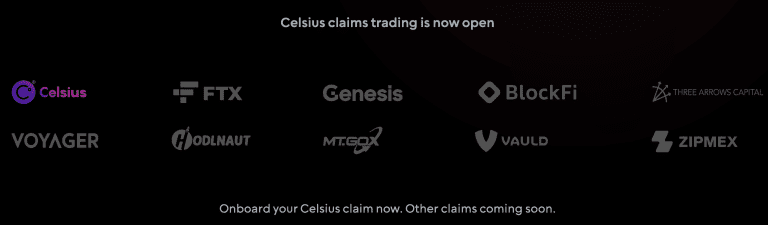
As a platform featuring claims trading, OPNX plans to support claims trading for multiple bankrupt companies, including Celsius, FTX, Genesis, BlockFi, and others.
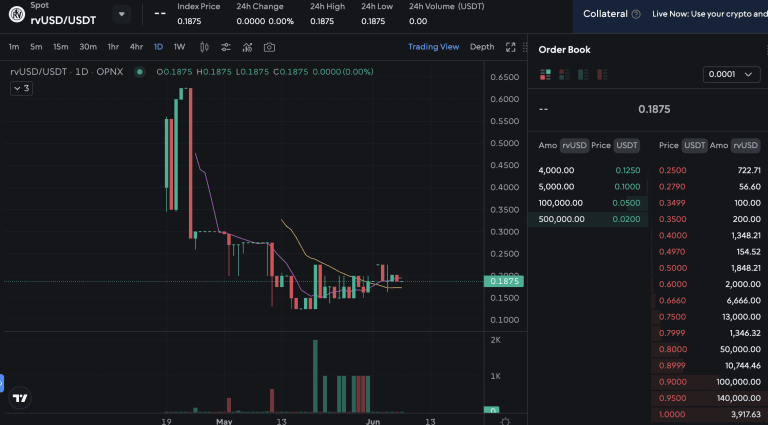
The first debt token launched by OPNX is a debt based on CoinFLEX. Under the terms of the reorganization approved by the Seychelles Supreme Court, CoinFLEX distributed 83.65 million rvUSD (Recovery Value USD Tokens) to creditors. The CoinFLEX exchange has ceased trading in April this year because OPNX acquired CoinFLEX. The co-founder of CoinFLEX is also the co-founder of OPNX. The KYC information and account balances of CoinFLEX users can be seamlessly migrated to OPNX, which also brings OPNX the first batch of users.
Since going live in April, the price of rvUSD has fallen from a high of over $0.6 to currently $0.1875 as of June 7, with zero trading volume in recent days and less liquidity around the market price.
On June 1, OPNX opened Celsius claims and transactions, and the token name is CELSIUS. Considering the size of Celsius’s 600,000 creditors, 85% of which are composed of retail investors who owe less than $5,000, it is difficult for these people to complete transactions through OTC and other channels. OPNX also needs to acquire a user base when it is first established, but currently OPNX also has no transaction volume.
Although rvUSD and CELSIUS are both claim tokens, OPNX believes that the first claim transaction opened on the platform is CLESIUS. Possibly due to the relationship between CoinFLEX and OPNX, rvUSD was issued by a special purpose company and the claim process did not occur on OPNX. Debt tokens such as CELSIUS and subsequent FTX can be collected directly from the OPNX exchange. According to OPNX rules, the following four steps are required to complete a CELSIUS debt transaction.
Registration: Create an OPNX account and complete KYC;
Application: Provide details of the creditor's rights and submit an application for transfer of the creditor's rights;
Signing: Signing the creditor's rights transfer agreement;
Trading: Trade claims and obtain liquidity.
Almost all trading volume comes from perpetual contracts
While supporting tokenized debt transactions, OPNX also enables spot and futures trading of mainstream cryptocurrencies such as BTC and ETH. Unlike debt tokens, which are almost untraded, OPNX’s perpetual contract trading volume is on the rise. According to official website data, the total daily transaction volume of OPNX is approximately US$15 million recently.
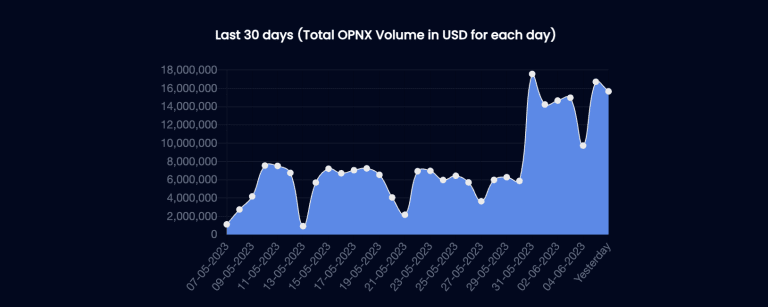
As of June 7, the total trading volume in the past 24 hours was US$8.508 million, of which spot trading volume was US$148,000, perpetual contract trading volume was US$8.36 million, and perpetual contract trading volume accounted for 98%. The trading volume of debt tokens is included in spot transactions, and the spot trading volume all comes from transactions of popular currencies such as BTC and FLEX. The trading volume of debt tokens rvUSD and CELSIUS is both zero.
According to the current situation, OPNX has not developed into a debt trading platform, but is similar to a traditional cryptocurrency exchange. The vast majority of trading volume comes from perpetual contract trading of mainstream currencies such as BTC, and spot trading volume also comes from Compared with mainstream currencies, debt tokens are rarely traded and lack liquidity.
FLEX and OX Tokens
Since the co-founder of CoinFLEX is also the co-founder of OPNX, CoinFLEX user information and account balances can be directly migrated to OPNX. OPNX also decided to directly use CoinFLEX’s native token $FLEX as the platform currency of the new exchange at the beginning. This made $FLEX jump from the platform currency of the bankrupt exchange to the platform currency of Su Zhu’s new exchange, with a price of 3 It rose more than 50 times in a few months.
As can be seen from the OPNX official website, $FLEX is indeed the native token of the OPNX exchange. But on May 31, OPNX reissued a governance token $OX and launched the staking platform The Herd. OX is taken from the two capital letters of Open eXchange. The names OX and Herd may also be for the purpose of The Chinese title appears auspicious. Although $FLEX will be gradually deprecated, the rights and interests of holders have not been sacrificed.
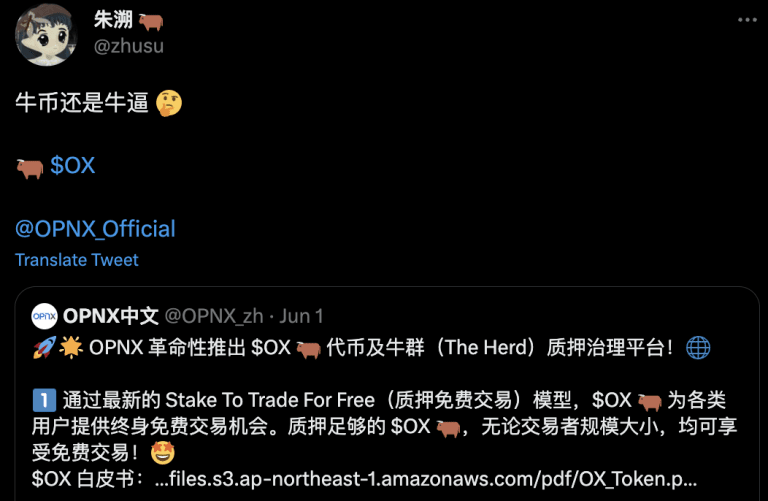
According to the OX token’s white paper, the maximum supply of $OX is 9.86 billion, which is derived from the maximum issuance of $FLEX of 100 million minus the 1.4 million that have been burned, multiplied by 100. $FLEX can be exchanged for circulating $OX at a ratio of 1:100. If you choose to exchange $FLEX for staked $OX, you can do so at a ratio of 1:125, with the additional portion paid for by the OPNX Treasury.
Compared with other exchange platform coins, the special thing about $OX is that you can obtain the same proportion of free transactions (refunded in the form of rebate) in OPNX according to the pledge ratio, and the excess amount only requires 50% of the handling fee. If a user's pledged $OX accounts for 2% of the total pledged volume, and the transaction volume accounts for 4% of the total OPNX transaction volume, then 2% of the transaction volume can be fully exempted from handling fees, and the excess 2% of the transaction volume can also only cost 50 % handling fee.
At this stage, in order to attract staking, OPNX also has an additional staking multiplier, which is currently 12 and will decrease year by year. This means that as long as the pledged $OX accounts for 1% of the total pledged amount, transactions within 12% of the total transaction volume will be free of fees.
In addition, $OX is also a governance token that can vote to change the basic functions of the exchange, including fees, burning mechanisms, currency listing, etc. In addition, stakers can also profit from OPNX’s Real World Assets (RWA) business, reducing handling fees when generating tokenized real-world assets.
As a new exchange, OPNX’s business does not appear to be compliant. The Dubai Virtual Asset Regulatory Authority issued a written reprimand to the co-founders and CEO of OPNX on April 18, accusing them of operating without the necessary local licenses. operate and promote their digital asset exchange OPNX.
summary
Although OPNX is characterized as a debt trading platform and has launched Celsius debt trading, the current trading volume of OPNX mainly comes from the perpetual contract trading of mainstream currencies. The trading volume of debt tokens in the past 24 hours was zero. While its trading volume is trending upward, total trading volume of $15 million per day remains low.
OPNX initially used CoinFLEX’s platform currency $FLEX as its native token. Although $OX was recently reissued as a governance token, the rights and interests of $FLEX have not been diluted and can still be exchanged for the same proportion of $OX. With $OX staking fee-free and now additional staking multipliers, it doesn’t cost much to implement free trading in OPNX.
(The above content is excerpted and reprinted with the authorization of our partner PANews, original text link)
Statement: The article only represents the author's personal views and opinions, and does not represent the objective views and positions of the blockchain. All contents and opinions are for reference only and do not constitute investment advice. Investors should make their own decisions and transactions, and the author and Blockchain Client will not be held responsible for any direct or indirect losses caused by investors' transactions.
This article takes a look at OPNX co-sponsored by Su Zhu: Launch of new governance token OX, debt trading has 0 transactions for many days. First appeared on Blockchain.