



Recently, the U.S. Securities and Exchange Commission (SEC) filed a lawsuit against Binance. With the regulatory stick being swung, the most influential exchange in the crypto world is facing a strong legal crisis. The freeze order applied by the SEC against Binance.us has brought another wave of FUD.
DeFiLlama data shows that Binance's 24-hour net outflow was US$660 million; from June 6 to date, US$1.82 billion has flowed out.
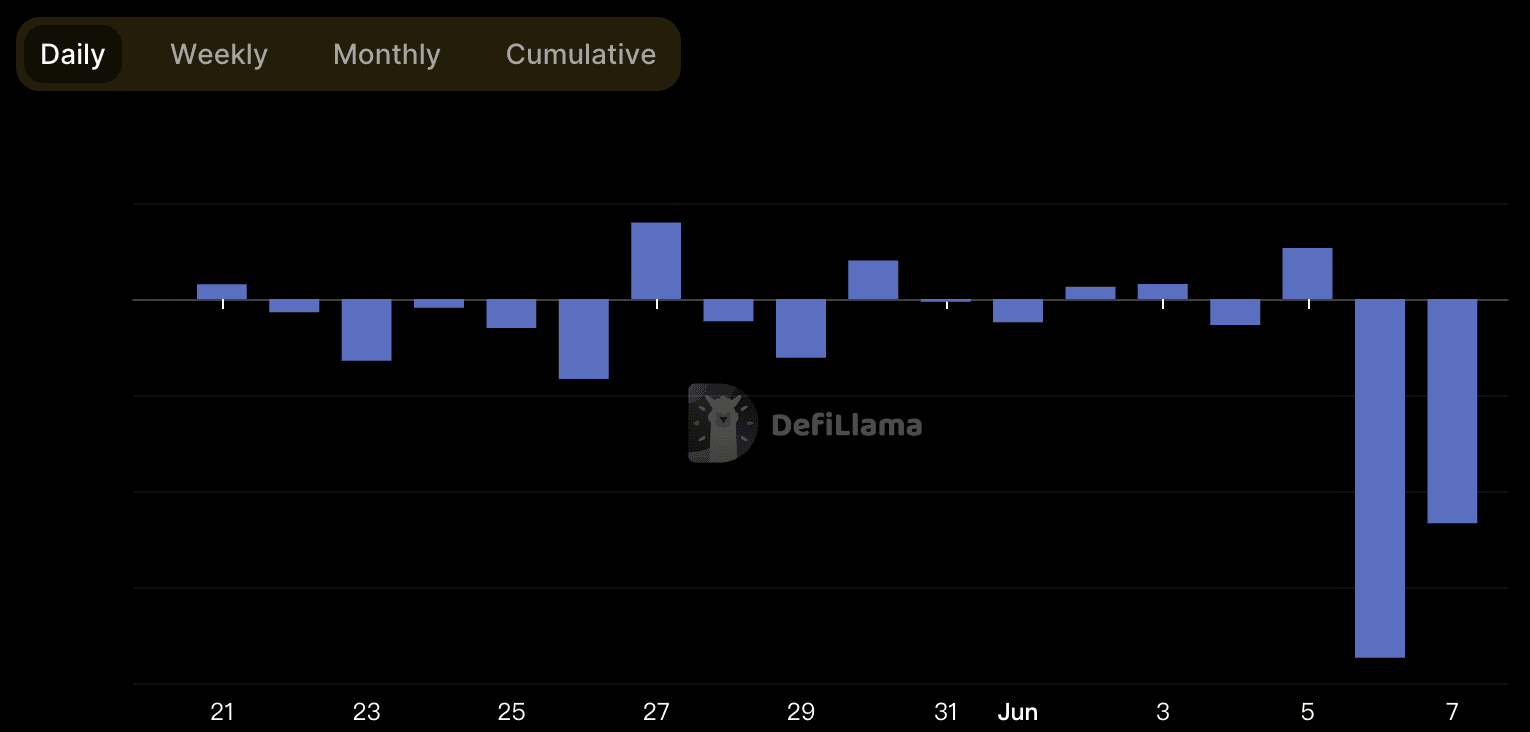
In terms of net assets, Binance generated a net outflow of billions of US dollars. Although this figure seems huge, it is less than eleven percent of Binance’s total assets.
DeFiLlama data shows that Binance still has a net asset of up to US$50.8 billion. Judging from the asset curve, the recent decline in assets has not been strong.

A Binance spokesperson told foreign media: "When news like this spreads, it is expected that capital outflows will be higher than normal." But he does not think it is worth worrying about, "capital outflows now seem to have stabilized."
Coinbase, which was hit by the SEC shortly afterwards, also issued a statement with Binance, both of which expressed dissatisfaction with the SEC's actions and said they would "do their best to defend our platform."
Where are the billions of dollars going?
DeFiLlama data shows that several exchanges have generated significant net inflows in the past week.

Specifically, OKX has seen a net inflow of about $300 million in recent days. MaskEX ranked second in the 7-day inflow data, with a net inflow of about $270 million. ByBit received a net inflow of $120 million.
Only the above three exchanges received net inflows of US$100 million. There were two exchanges with net inflows of US$10 million, namely Huobi and Phemex. In addition, Bitfinex also received a net inflow of tens of millions of dollars after the incident, but due to the large net outflows in the previous few days, it performed poorly in the 7-day data.
It should be noted that DeFiLlama does not include data from platforms such as Coinbase, MEXC, Kraken, and Bithumb, so its data only represents one aspect of the market.
Overall, the CEX data included in the DeFiLlama platform has generated a total net inflow of approximately US$860 million in the past 7 days.
Binance has generated a net outflow of $1.8 billion in the past 7 days. According to Fortune data, Coinbase also generated a net outflow of $1 billion. With a net outflow of about $3 billion, other CEXs cannot fully handle it. We speculate that more funds have flowed to decentralized wallets and unmarked addresses.
Odaily Planet Daily learned that, taking OneKey's hardware wallet as an example, its sales data this week increased by at least 300% compared with usual days. KeyStone, another hardware wallet brand, also recorded a three-fold increase in sales.
Are Traders Migrating to DEXs?
Due to the drastic changes in the regulatory environment, some traders have also begun to migrate to DEX. CoinGecko data shows that between June 5 and June 7, the trading volume of the top three DEXs surged by 444%. The daily trading volume of Uniswap V3, Uniswap V3 (Arbitrum), and Pancakeswap V3 accounted for 53% of the total DEX trading volume in the past 24 hours, an increase of more than US$792 million. In addition, the trading volume on Curve, a DEX that supports stablecoin trading, soared by 328%.
The comparison with DEX is even more obvious. Let's take the trading volume data of the past 24 hours as an example. The "regulatory market" has gradually come to an end, and the trading sentiment of the crypto market has declined in the past 24 hours. CoinGecko data shows that the 24-hour trading volume of CEX has dropped by 20.92%. The trading volume of DEX has dropped significantly less, only 13.11%.

From a more macroscopic time scale, the migration of CEX to DEX has already shown a trend. The Block data shows that since the beginning of this year, the DEX/CEX transaction volume data has continued to rise, and in May it even exceeded 20%, reaching a historical high. Regardless of whether this lawsuit occurs, the migration of CEX users to DEX is a long-term trend.
Institutions and projects have mixed reactions to FUD
After the SEC filed a lawsuit, as the news continued to ferment, the crypto industry also expressed its support or concerns through practical actions. The most direct way is the flow of real money.
Despite massive outflows from both Binance and Coinbase, some people are still depositing money into them against the trend.
After reports of the SEC suing Binance were published, FalconX received 37 million USDC from Circle and deposited 29.5 million USDC into Binance. Jump Trading transferred approximately $50 million in ETH and stablecoins into Binance.
Before the lawsuit, FBG Capital had withdrawn a total of 44 million USDT from two exchanges. After this incident, FBG Capital deposited all the previously withdrawn 44 million USDT into Binance.
The mysterious whale on the chain also began to use CEX to express its support. The whale address starting with "0x 3356" deposited 100 million USDT to Binance through multiple operations in just 12 hours.
According to 0xScope monitoring, even under the pressure of the SEC, assets worth US$915 million still flowed into Binance in the past 24 hours.
Of course, there are also institutions withdrawing assets. For example, investment institution Arca withdrew more than 1.48 million ARB worth approximately US$1.68 million from Binance.
The crypto market maker Cumberland is puzzling - it withdrew 67.9 million USDC from Circle and deposited 67.1 million of them into Coinbase. It also made a large number of withdrawals from Coinbase and Binance, withdrawing a total of 37,600 ETH and varying amounts of AXS, SHIB, COMP, LINK, CRV, AAVE and RNDR tokens.
Back to this lawsuit, although the capital flow is quite strong, compared with the huge asset stock of major firms, the outflow is still only a small part. And this strong FUD sentiment is more or less filled with some exaggeration.
From the perspective of the entire industry, no matter which direction the situation will develop, the contradictions surrounding supervision will inevitably promote the improvement of supervision itself. Looking at the longer-term future, the current disputes may just be the pain on the road to a new stage.
Jake Chervinsky, chief policy officer of the Blockchain Association, expressed the most interesting feelings about this incident, "Relieved, the SEC finally took action, and the result was not that bad, right? Life and business go on." Despite the current legal crisis, the future prospects of the crypto industry remain optimistic for crypto investors.