
A recently released white paper revealed China's views on Web3, indicating that China is willing to include it in the future Internet. The white paper defines "Internet 3.0" as a three-dimensional space that combines virtual and real fields and has a highly immersive interactive experience, and describes a highly intelligent future world where the virtual and physical worlds merge. Among them, "Web3" is an element of the Internet 3.0 concept, which also includes technologies such as augmented reality, virtual reality, and the metaverse.
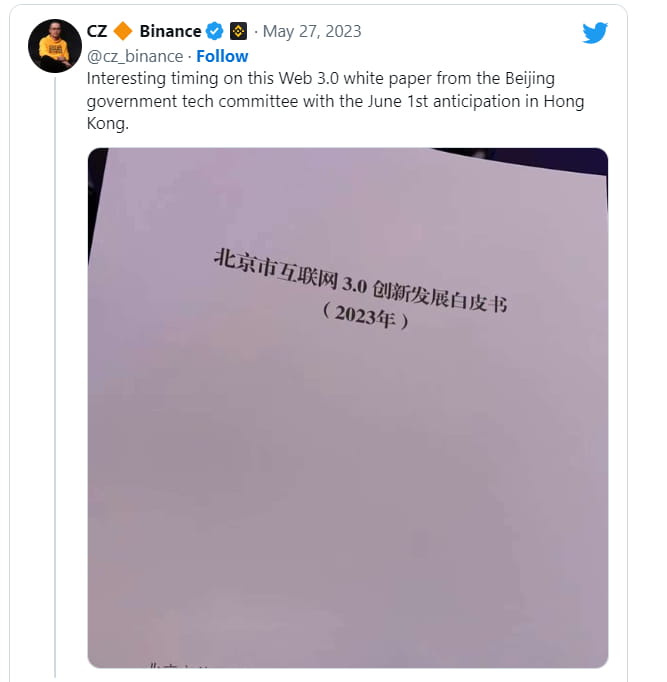
It is important to note that the white paper is not an official government document and does not necessarily reflect the official position of the Chinese government. However, it provides insights into how Chinese officials discuss and think about terms such as "Internet 3.0" and Web3.
In addition, Hong Kong has recently taken a series of measures to make the city more attractive to digital asset companies, including the introduction of a new regulatory regime for cryptocurrencies and allowing licensed exchanges to serve retail investors. This is in stark contrast to the crackdown on similar activities in mainland China in recent years. Although these new regulations only apply to Hong Kong residents and remain inaccessible to mainland Chinese users, it suggests that China's stance on digital assets may be softening.
Overall, these developments suggest that China’s attitude toward Web3 and digital assets may be gradually evolving, but specific policies and stances still need to be closely monitored.