


Author: 1kx, Translator: Golden Finance xiaozou
Meme coins are the intersection of digital currency and internet culture, attracting participants at every stage of the crypto cycle. Once again, they have captured the zeitgeist with their relatability, virality and tantalizing potential for profit returns.
In this article, we will introduce the following content:
The origins of Memecoin: the proof-of-work meme blockchain
How Memecoin evolved through cycles: ICOs, tokens, DeFi summer, Solana
How NFTs are impacting the meme currency landscape
Recent developments and new trends
Potential risks and opportunities
1. What is Meme?
A meme is a piece of culture that carries ideas and symbols that spread from person to person. Like genes, memes vary in their ability to spread, with those that resonate surviving and those that have less influence quickly forgotten.
The Internet gave rise to the concept of "Internet memes," which allowed memes and cultural ideas to spread faster, often in the form of images, videos, GIFs, and jokes. One study likened the spread of Internet memes to a disease: "Memes spread in a viral pattern, "infecting" an individual, a pattern reminiscent of the SIR model of disease transmission."
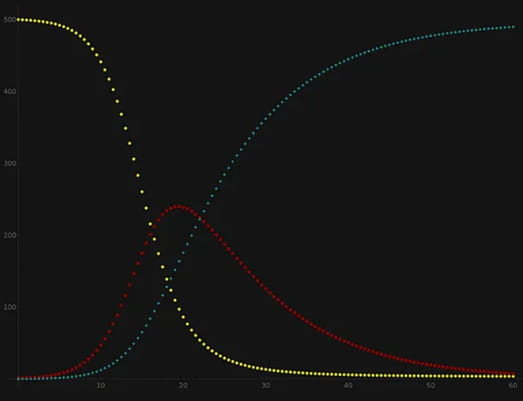
A “memecoin” is a cryptocurrency whose value comes entirely from the memes associated with it, essentially bringing economic value to the concept of memes.
With the advent of memecoins, cultural ideas and symbols and their dissemination can be traded and speculated on. Their value is based on memes’ relevance and ability to garner attention, creating a new market in which cultural resonance is quantifiable and economically valuable.
2. A brief history of Memecoin
Let’s take a brief look at each crypto cycle and the memecoins created during those cycles:
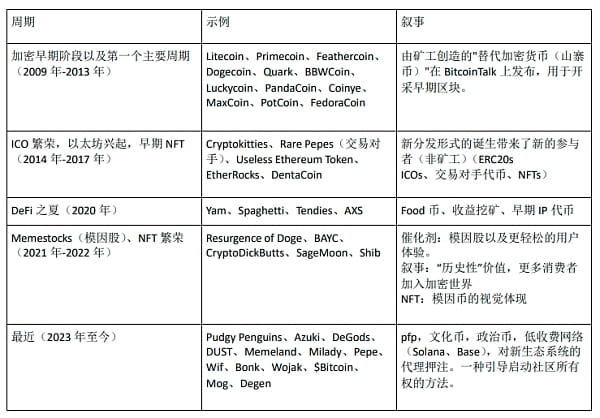
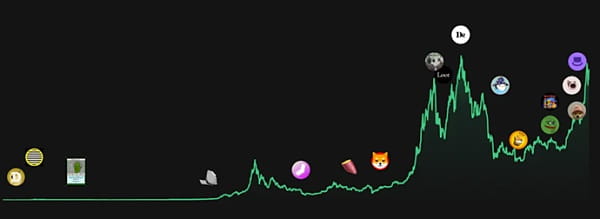
3. Proof of Work Meme Coin
Proof-of-work memecoins are primarily designed for miners to allocate their resources to new coins for mining and selling. Many of these meme coins debuted on Bitcointalk’s alternative cryptocurrency forum. While a significant number of memecoins failed to be listed on exchanges, those that were successful were able to be traded on centralized platforms such as Cryptsy and BTC-E, which are now closed. Each memecoin typically has a different name and brand, hashing algorithm, block time, and supply, all of which together make up their overall narrative or "meme."
The first wave of tokens after Bitcoin were “memecoins,” in the sense that they had little value other than providing a new idea. For example:
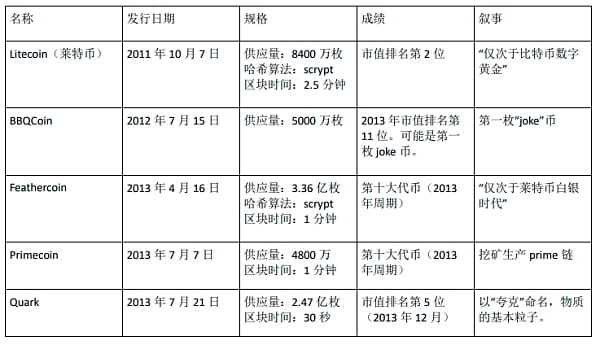
These coins (except Litecoin) are dead (low trading volume and market cap, no exchange support, vulnerable to 51% attacks). This may be due to several reasons: memes are not durable (lack of longevity culture) and their access issues (each memecoin is an entire blockchain).
Litecoin’s survival is likely due to the sheer appeal of Bitcoin’s meme value (“digital gold”), its longevity compared to other memecoins, and its continued support from modern exchanges.
4. Dogecoin: the first meme coin
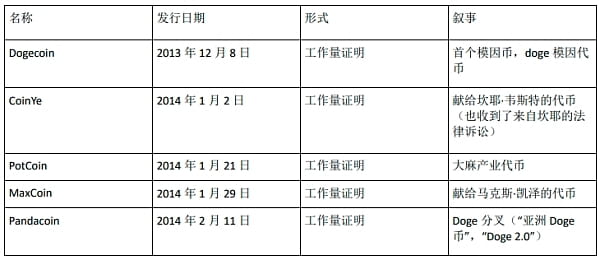
The earliest doge memes began circulating on 4chan and Reddit in the summer of 2013. Capitalizing on this cultural trend, on December 8, 2013, Jackson Palmer and Billy Markus launched Dogecoin on Bitcointalk. It is the first cryptocurrency based on an internet meme.
The success of Dogecoin has given rise to a new “category” of tokens that are rebellious, humorous, ironic, utilizing celebrities (Kanye West, Max Keizer) and animals (Pandacoin), or trying to Attract the attention of a specific community. These are all proof-of-work tokens launched on Bitcointalk’s “Alternative Cryptocurrency” subforum. The "specs" became less important and more important the "meme". Examples are as follows:
5. ICO boom and the rise of Ethereum
The rise of Ethereum has brought a wave of innovation, enabling new use cases, better user experiences, and attracting new users.
Some specific improvements include:
Easier to issue tokens (ERC20 standard)
Bring new user base (non-miners)
Token creators can make more money (unlike no-premine PoW tokens, ERC20s are sold through ICOs)
Introducing interoperability/one ecosystem/one wallet (via ERC20)
The ICO era brought a wave of more “serious” projects: theDAO, Filecoin, Tezos, EOS, Cardano, Tron, and Bancor, which attempted to have some kind of utility or purpose beyond meme value.
There are also a handful of meme coins that aren't particularly noteworthy but still garner some attention.
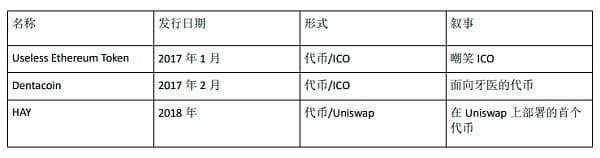
One example is the Useless Ethereum Token, which was launched in June 2017 and mocked the idea of an ICO and raised 310 ETH.
Although Dentacoin started out as a “dentist cryptocurrency,” it was viewed as a meme coin and reached a peak market capitalization of $2 billion in January 2018.
HAYCOIN was the first ERC20 deployed to Uni v1 and a meme coin created in this era (2018). Hayden Adams, the founder of Uniswap, created the token as a test for the Uniswap protocol. It didn’t have much usage and transaction volume at the time, but it revived in 2023 due to its historical significance.
6. Meme Collections and Early NFTs
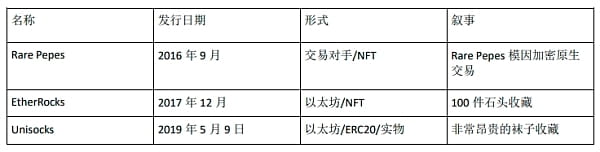
Cryptocurrencies aside, one part of the Pepe the Frog meme is "Rare Pepes," which are memes that are not released publicly but, if released publicly, would carry the "RARE PEPE DO NOT SAVE" watermark.
Between 2016 and 2018, a group of counterparty developers (a smart contract protocol developed on top of the Bitcoin network) and Pepe meme supporters created the Rare Pepe wallet Pepe Cash and curated "Rare Pepe memes" to facilitate trading on Transactions are conducted on counterparty protocols.
Rare Pepe is often considered the second batch of NFT collections that will continue to maintain value, with some Rare Pepe selling for more than $500,000.
With the release of CryptoPunks, MoonCats, and CryptoKitties, NFTs are beginning to enter the Ethereum zeitgeist: non-fungible tokens that can point to images and other media. Posted as a joke on Reddit in 2017, EtherRocks is a collection of 100 colored stones. The series was hardly popular at the time (only 30 were minted), but later recovered strongly, triggering frantic buying, reaching a floor price of 305 ETH in August 2021 (worth $1 million at the time).
Another collectible meme coin is Unisocks (SOCKS), which was released on May 9, 2019 by Hayden Adams. 500 physical socks were created and they can be redeemed using 1 SOCK (one ERC20). At the time of writing, at $53,000 each, they may be the most expensive socks in the world.
7. DeFi Summer
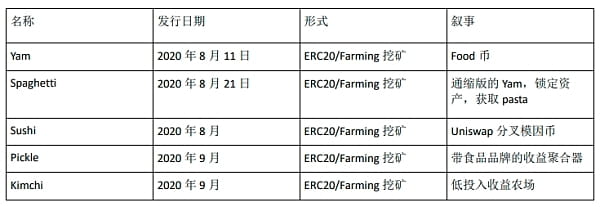
In June 2020, Compound Finance pioneered a new token distribution method: "liquidity mining" or "yield mining". Users will lock their assets to provide liquidity and be rewarded with tokens.
This new primitive kicked off the “Summer of DeFi” which culminated in “foodcoin” yield farms that offered 10,000% APY (in memecoin) in exchange for having your tokens locked up in a Yam or Pickle contract.
8. Meme stocks and Dogecoin
Suppressed incentives, interest rate cuts, cheap money and COVID-19 lockdowns make the entire year 2021 fraught with high risks.
In early 2021, retail traders gathered on Reddit and began to spread the "Gamestock" meme, posting pictures/videos, and driving the stock price up rapidly. Thanks to Robinhood's superior user experience (mobile app, free), many ordinary users were able to participate.
The "GME" mania has led many people to start speculating on other assets, especially those that can be purchased on Robinhood. DOGE was listed on Robinhood in 2018 and was priced at 0.008 cents at the end of January, which was a very attractive "price" for retail investors. In early February 2021, Elon Musk began posting a large number of tweets spreading the "Doge" meme. DOGE coin peaked in May 2021 with a market capitalization of $90 billion.
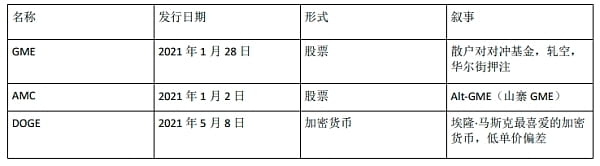
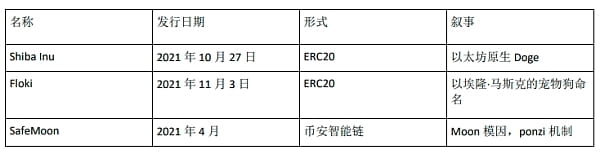
DOGE’s popularity has led to a number of crypto-native memecoins, including Shiba Inu, Floki, and Safemoon, all of which have reached fairly high valuations within a few months.
9. NFT boom: “Meme coins with pictures”
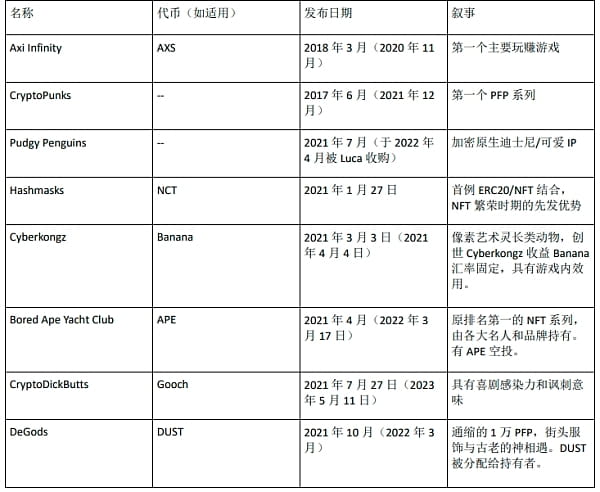
With the standardization of ERC721 and the emergence of universal marketplaces like OpenSea, NFTs create a new “class” of crypto assets: a unique visual representation of an overarching “culture” or “meme.”
Some of the most well-known NFTs include: CryptoPunks, Bored Apes, Squiggles, and Pudgy Penguins. NFTs are shown off as avatars on platforms like Twitter and Discord, and people use them virally as their status symbols. These PFPs signify prestige and "membership of a certain cultural club." Many collectibles make their holders wealthy, but holders cannot sell their NFTs “without leaving the community.” In order to reward loyal holders, some NFT projects have released "meme coins" (ERC20) in their communities, treating them as a form of liquidity, "utility" and cultural "currency".
Some examples of NFT projects (and their meme coins) in this era are as follows:
10. Near term (2023 to present)
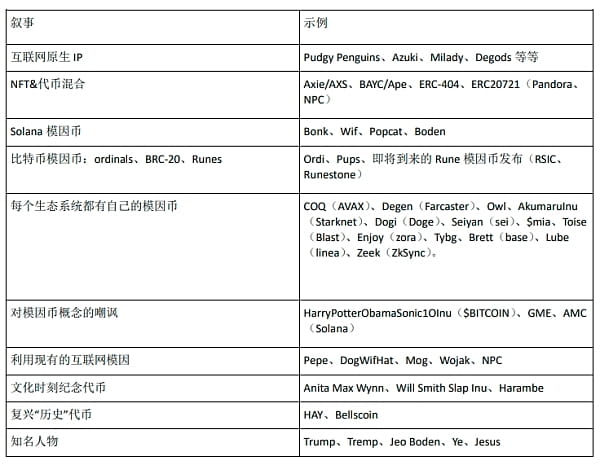
As cryptocurrencies recover from the bear market, new memes, cultures, ideas, and ecosystems continue to emerge. Memecoins have been one of the few categories that continue to gain traction (volume, market cap appreciation, social interest), and have recently shown a surge in interest.
Some recent accounts include:
11. Common patterns
Every cycle has some form of memecoin: Memecoins manifest themselves in different ways depending on the underlying technology (PoW coins, ERC20s, and NFTs), and they are one of the earliest "applications" of a new technology or form. .
Although memecoins appear in a variety of different types of media, they all accumulate value in the same way: they all require attention, narrative, and publicity to survive and spread. Although there is no lack of attention and excitement about new media in the beginning, long-term value can only be retained through sustained attention. Just NFT is not enough, just Ordinal is not enough. Attention is highly cyclical, and after the initial media hype cycle, more factors are needed to drive basic attention.
First there were memes, then there were memecoins: For the most successful memecoins, such as doge, pepe, and dogwifhat, the internet memes came first, and the memecoins capitalized on existing awareness and spread.
Crypto memes are just getting started: crypto natives are already creating memes that successfully expand beyond web3. A prime example of this trend is the emergence of crypto intellectual property, especially NFT projects like Pudgy Penguins.
Low Price Becomes a Meme: From the very early days of altcoins, users have loved speculating on tokens at lower “prices” (because of high supply). There is a psychological incentive that if a humble token reaches $1, it may turn the holder into a millionaire overnight. The price itself is a meme.
Strong community + marketing: Meme coins require a strong community, founders or “spokesmen” to create content, promote the brand and spread the “meme”.
Organic Release to Dedicated Teams: The first wave of meme coins were released organically, often fairly, with no internal staff or team allocations. There are many benefits to publishing organically, but there are also risks, like rugs being pulled or funds being stolen. An emerging solution is that meme coins have dedicated teams incentivized to direct attention around them, such as the PFP project.
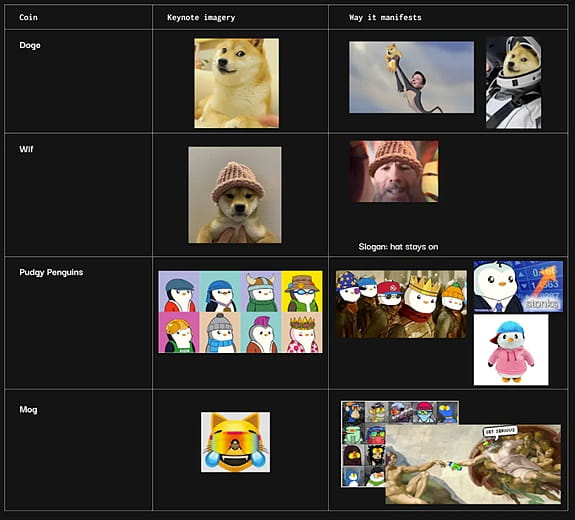
Eye-catching images, derivative images and slogans spread memes: Images are the main way memes spread on social networks. Usually, there is a theme at the beginning, which is then expressed in many different ways.
12. Opportunities
The total market value of Memecoin exceeds 60 billion US dollars, and the daily trading volume exceeds 13 billion US dollars, which has huge financial value.
Since the only function of a meme is to spread into other people's minds, catching the next "meme" early on can be a lucrative opportunity. Creators and investors “work for” the meme by expanding its reach and are rewarded in the process for becoming early backers.
Whether it’s a lottery ticket to get rich, following an influencer’s choice, or speculating on social trends and ideas, memecoins have been experiencing explosive growth since the inception of cryptocurrencies.
13. Risks
Despite the opportunities, memecoins are not without risks. Many memecoins tend to appeal to users who are trying to make quick money effortlessly, viewing it as a lottery or a form of gambling.
Another common trend is “rug pulling” and “pump-and-dump” operations, which are played out almost daily on decentralized networks via memecoins. According to a recent report from blockchain analytics company CipherTrace, rug-pulling accounted for 99% of all crypto fraud in 2023, with total losses of $2.1 billion. It is important to check some key characteristics of memecoins, such as the status of LP tokens (are they burned or held centrally?), team allocation, transfer taxes, and whether the contract is abandoned.
Additionally, there is a lack of clarity regarding the regulation of memecoins. The most noteworthy regulation regarding memecoins is that in June 2021, Thailand’s Securities and Exchange Commission banned tokens that “have no clear purpose or substance” and whose prices are influenced by social media trends and celebrities.
Another major problem is that a meme may not survive purely due to a lack of interest, attention, and ideological buy-in, rather than due to any malicious behavior. These investment losses can create a hostile or indifferent community of holders.