

Main topics of the post:
Money transfer scams are a common threat to cryptocurrency users. They can occur in two scenarios: P2P trading or everyday transactions when purchasing goods or services.
Always ensure that you are trading on a reputable P2P platform with robust security measures and that your counterparty is a trustworthy person or entity.
Have you been the victim of a scam? Report the incident immediately to the appropriate authorities and the Binance Support team.
Money transfer scams involve criminals trying to trick victims into sending money under false pretenses. These scams generally occur in two types of scenarios:
Peer-to-Peer (P2P) Trading. In peer-to-peer (P2P) markets, buyers and sellers can interact directly with each other to negotiate prices, payment methods, and the amount of cryptocurrency to be exchanged. Although P2P cryptocurrency trading offers more control over the process than any other trading method, it still comes with its own risks – like scammers trying to steal your money.
Transactions involving goods or services. Be careful if you accept cryptocurrency as a payment method. Scammers are targeting people like you, using fake emails that claim delays or require a “deposit fee” to complete the transaction.
In this article, we'll explore how money transfer scams typically unfold, look at some real-life examples, and discuss how you can identify and avoid these scams.
How do money transfer scams work?
Finding the target
Scammers often find their victims on social media or cryptocurrency platforms. They may offer a price well above the market rate to an unsuspecting user trying to sell their cryptocurrencies. Or they identify merchants who accept cryptocurrency payments in exchange for goods or services.
Gaining trust
To gain a victim's trust, scammers use a variety of tricks, such as creating fake documents that show proof of payment or expressing strong interest in purchasing products or services from a merchant.
Induction Action
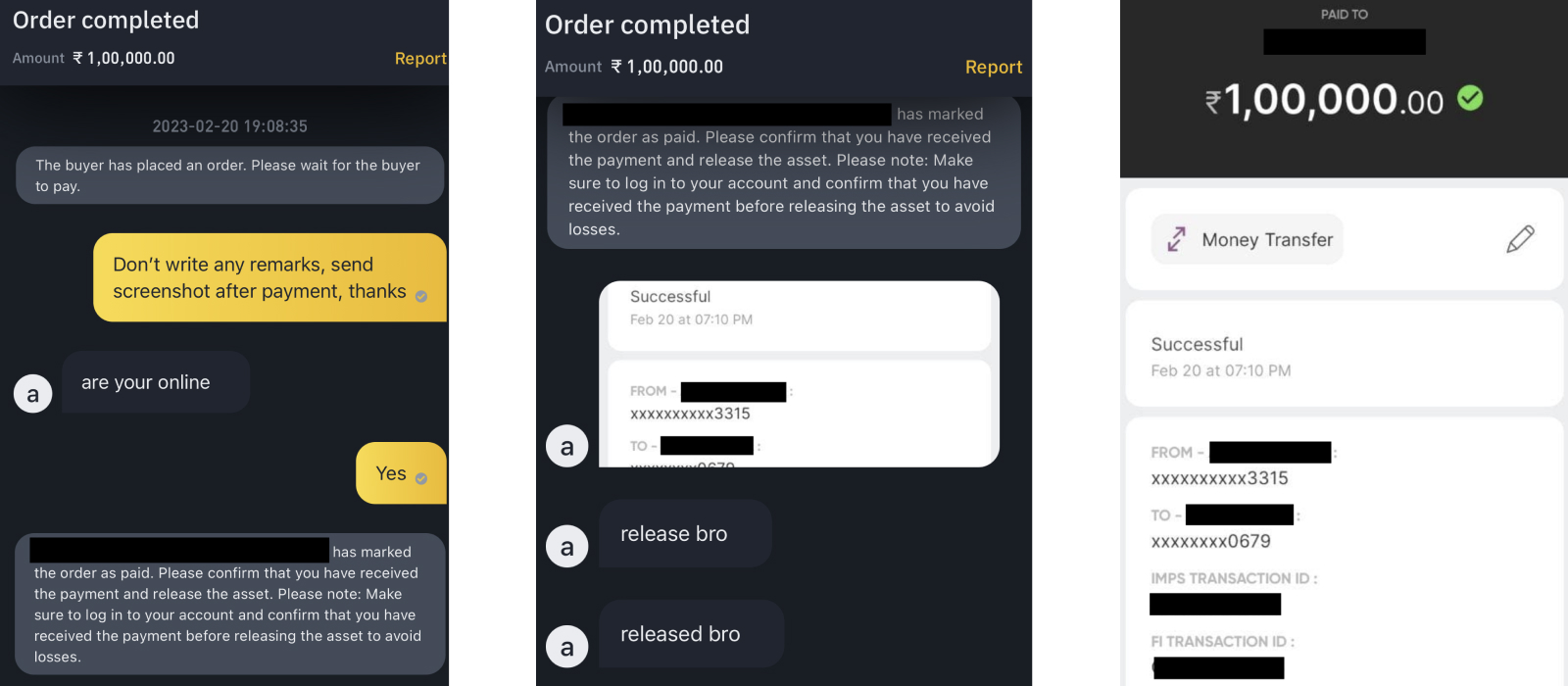
In fraudulent P2P trading, scammers often pressure their target to release the cryptocurrency as quickly as possible. This is based on several screenshots or documents of the supposed “bank transfer”. Many times, the scammer will initiate a bank transfer and cancel it immediately after receiving the cryptocurrency from the P2P seller.
If the transaction involves goods or services, the scammer will provide victims with “proof” of a cryptocurrency transfer, followed by doctored emails claiming a delay in the transfer. The scammer will ask the victim to transfer back “extra cryptocurrency” or pay a “transfer fee”, promising that the pending transfer will be completed soon.
Completing the coup
The victim releases their cryptocurrency to the scammer, only to discover that the screenshots or documents were fake or that the scammer canceled the bank transfer.
In the scenario involving payment for goods or services in crypto, the scammer will disappear after receiving the “refund” or “transfer fee”. By the time the victim realizes that the screenshots, documents and emails were all fake, it is already too late.
See two examples in practice
Example 1: Crypto trading
A P2P cryptocurrency trader, who we’ll call Mark, receives an order from a potential “buyer.” The “buyer” provides a fake bank transfer invoice, pressuring Mark to release the cryptocurrency immediately, before Mark receives confirmation of receipt of the money from his bank. Mark relents, later discovering that the bank transfer has been cancelled. With the cryptocurrency already sent to the scammer, Mark is left empty-handed.
Example 2: Purchasing art
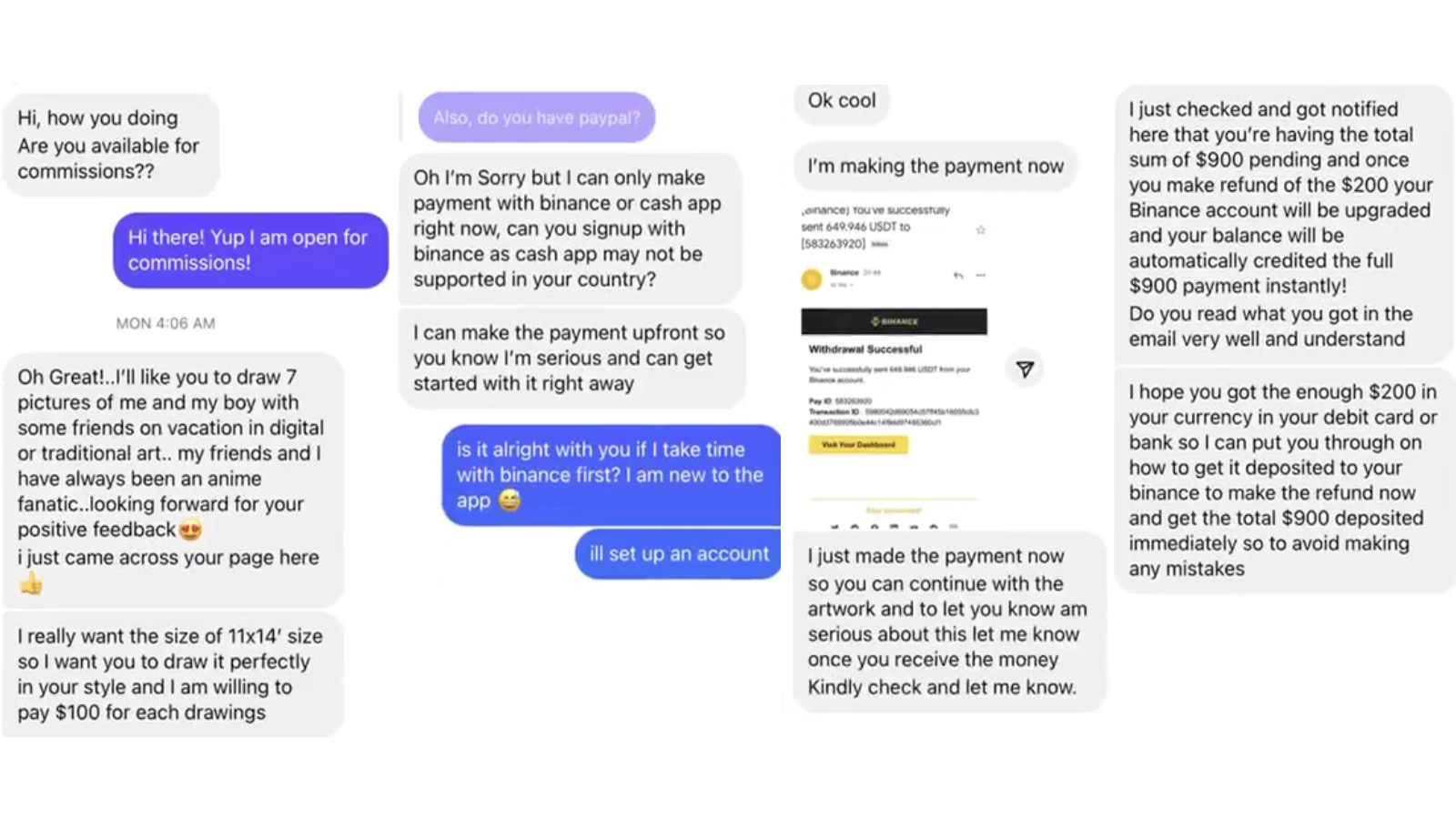
An artist, who we will call James, is approached by a collector interested in his work. The two make a deal and the counterpart claims to have transferred US$700 in exchange for a painting. He convinces James that the payment is on hold due to an “account update.”
The scammer asks James to return $200, claiming he needs the money while his $700 is blocked in the pending transfer. Believing he would receive the funds once the “account update” was completed, James complied. Eventually, James realizes that all of the "collector's" claims were false and that the scammer will not return his $200.
Tips to protect yourself from money transfer scams
Check your account
Always ensure that the correct amount of funds have been successfully transferred to your account before releasing cryptocurrency in a P2P transaction. Scammers often cancel the transfer after sending the screenshot.
Beware of fake screenshots, documents or emails
Scammers often use fabricated screenshots, documents, and emails to scam you. Carefully check the legitimacy of the evidence before releasing your cryptocurrency.
Use a trusted platform
Make sure the P2P platform you are using has a system to moderate transactions, keep money in escrow, and support users who are experiencing difficulties. Binance P2P has robust security measures — including rigorous know-your-customer (KYC) checks and an escrow service — to protect users against scams and fraudulent activity.
Check your counterparty
P2P platforms and general e-commerce websites often show reviews and ratings of the person or entity you are transacting with. Be wary if their profile has an unusually high number of reviews with perfect scores, or no reviews at all. If you are a P2P cryptocurrency trader, Binance P2P has a large selection of “verified traders” that we have rigorously verified, who can be easily identified by the yellow badge next to their username.
For more information on how to stay safe when trading P2P, you can read the following Binance Academy guide: How to Protect Yourself in Peer-to-Peer (P2P) Trading.
If you have been a victim of a crypto money transfer scam
If you have been the victim of a scam, take immediate action to protect your finances. Lock your bank and financial accounts and change passwords for all your accounts, including email and social media.
Report the incident to the police and provide all necessary details. Share any information you've collected, including evidence of any interactions with the scammer, such as the payment documents they sent you. Binance works closely with law enforcement authorities, and our cooperation regularly results in detections and seizures. Although recovery of your money is far from guaranteed, this is, in most cases, the only chance to recover stolen funds.
If your Binance account has been compromised, deactivate your account and follow the steps outlined in this guide: How to report scams to Binance support. If you suspect that your Binance P2P trading counterparty may be a scammer, please contact our customer support immediately.
Be cautious with “recovery services”. While some may offer legitimate assistance, many often make false promises or demand upfront payments. Don't be fooled twice.
We also encourage all users, new and old, to read our anti-scam series to better prepare against common crypto scams.
Further reading
Know the Scams
Know the Scams: how to identify fake shopping sites
Know the Scams: how to identify and avoid Ponzi Schemes