

#brc-20#ordinals
1
Main
The NFT segment on Bitcoin is experiencing rapid growth, with approximately 10 million “inscriptions” issued since the launch of Ordinals.
The experimental BRC-20 standard, which appeared in March 2023, sparked a new wave of discussions in the community with calls to “ban” digital artifacts through a “spam filter.”
The rise in popularity of a new type of asset stimulates the development of infrastructure, significantly affects on-chain activity and lays the foundation for the development of a DeFi ecosystem based on Bitcoin.
2
What are Ordinals?
Introduced in January 2023, the Ordinals project opened up the possibility of placing images and other types of data on the blockchain of the first and largest cryptocurrency by market capitalization without the use of a separate token or sidechain. The idea of non-fungible tokens based on Bitcoin is not new - experiments with such assets began with the advent of solutions like Colored Coins and Counterparty in 2012 and 2014 respectively. Only after a long time did the concept truly gain popularity.
NFTs from Ordinals have a completely different architecture compared to their analogues.
Created by developer Casey Rodarmore, the system uses Satoshi numbering (serialization) to record data in the “witness” part of a Bitcoin transaction.
The Ordinals phenomenon became possible thanks to the implementation of Segregate Witness (SegWit) in August 2017 and the Taproot soft fork implemented a few years later. The latter, among other things, contributed to making transactions cheaper and more private.
Aimed primarily at solving the scalability problem, SegWit changed the structure of the block, allowing signatures to be separated from the process of their transmission. The update also eliminated the problem of transaction malleability and laid the foundation for the development of the Lightning Network.
As NovaBlock Capital partner Lior Shimron noted, SegWit increased the Bitcoin block size from 1 MB to 4 MB. In turn, Taproot has relaxed data limit requirements, theoretically allowing an entire 4MB block to be filled with NFTs from Ordinals.
The “inscriptions” created thanks to Ordinals are positioned as “digital artifacts.” They contain raw data written directly to the Bitcoin blockchain. For example: images, audio, video, text, and even entire applications like a simplified version of the game Doom. The Ordinals website says:
“Digital artifacts are perfect. An NFT pointing to off-chain content on IPFS or Arweave is imperfect and therefore not a digital artifact.”
The popularity of Ordinals is evidenced by on-chain data - since the launch of the project, ~10 million “inscriptions” have been created (as of May 30, 2023).
3
What is the BRC-20 standard?
BRC-20 is an experimental standard for fungible tokens for the Bitcoin blockchain, created by a developer under the pseudonym domo in early March 2023.
An experiment into «brc-20’s» and fungibility on bitcoin with ordinals 1/x pic.twitter.com/9khKLbEPk6
— domo (@domodata) March 9, 2023
The name is similar to the ERC-20 of the Ethereum ecosystem. However, BRC-20 does not involve the use of smart contracts - tokens are based on the mechanism of the Ordinals project. They are deployed by adding JSON text files to the blockchain. The latter determine the main features of coins: supply, emission limit, etc.
“BRC-20 is simpler and more limited than ERC-20 due to the intentionally limited programmability of the Bitcoin blockchain,” Chainlink said in a blog post.
The new type of tokens inherits the security and decentralization of the network of the first cryptocurrency. They can be sent to the wallets of other market participants just like any other crypto assets.
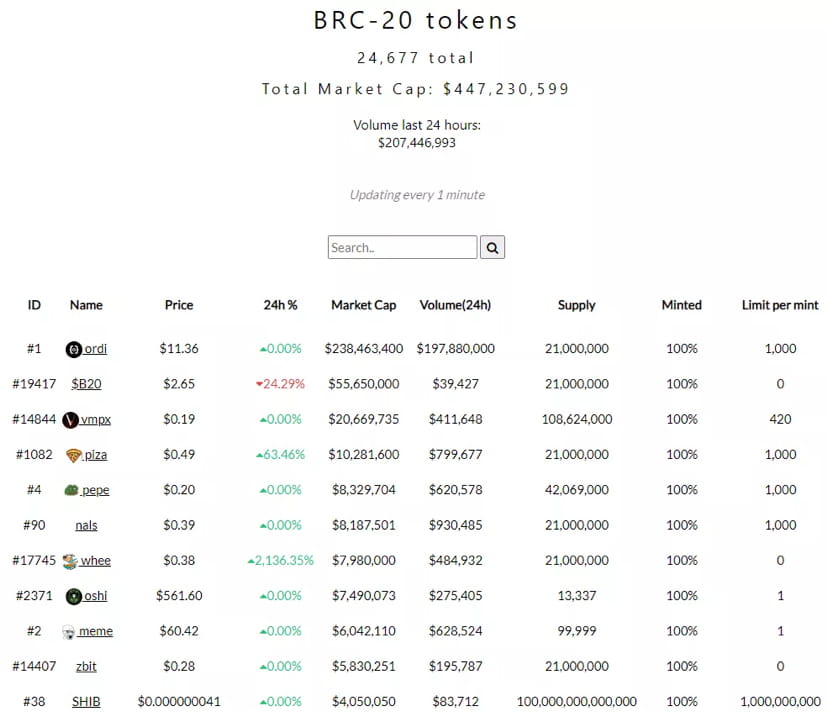
ORDI is the first token of the new standard. As of May 28, it is trading just above $9, with a market capitalization of $191 million. The asset is listed on well-known centralized exchanges like OKX, Gate.io and Huobi.
The total market value of BRC-20 tokens is approaching $500 million. The ORDI token dominates in capitalization and daily trading volume.
~25,000 coins of the new standard have already been created.
4
What are the uses for the BRC-20?
BRC-20 tokens can be freely moved between wallets, like any other crypto assets. Transaction fees are charged in Satoshi.
New use cases are gradually being developed. Shortly after the standard emerged, the Ordinalswallet.com platform for trading BRC-20 and “inscriptions” began operating.
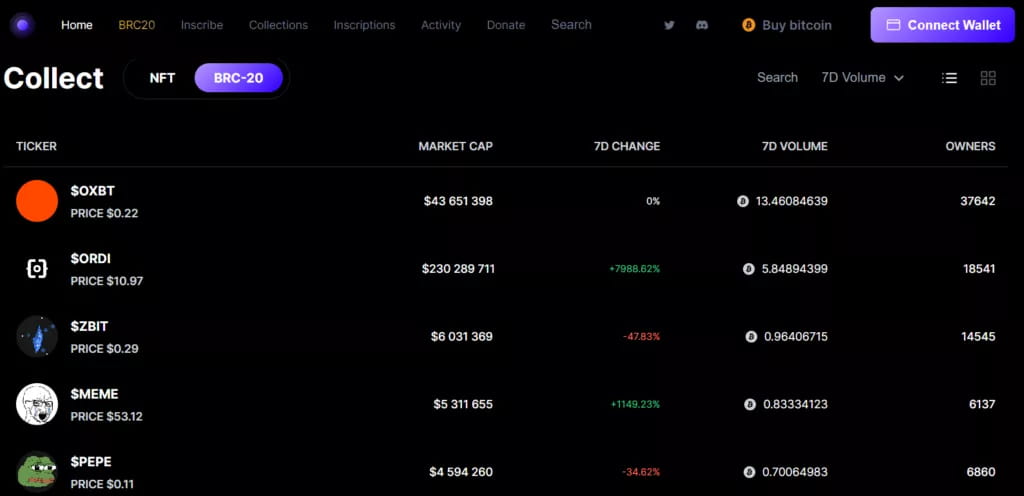
Data: ordinalswallet.com.
A new type of asset could become a key element of the DeFi ecosystem based on the Bitcoin blockchain, the infrastructure of which is already being developed.
There are many possible uses for assets. Tokens can be integrated into decentralized exchanges, landing protocols, and yield farming platforms.
An important milestone in the development of Bitcoin-based DeFi should be the development of cross-chain bridges connecting “wrapped” BRC-20 tokens with other blockchains. Another obvious use case is tokenization, where the BRC-20 standard could serve as support for the issuance of USDT analogues from Tether and other virtual representations of real-world assets.