
BTC Dominance, commonly referred to as BTC dominance, is a measure of the percentage of cryptocurrency market capitalization represented by Bitcoin. It is calculated by dividing Bitcoin's market capitalization by the total market capitalization of all cryptocurrencies.
In other words, it is Bitcoin's share of the overall cryptocurrency market. Understanding BTC dominance and its impact on the crypto market is essential for anyone interested in investing in cryptocurrencies.
What is meant by BTC Dominance?
BTC Dominance is the most widely used metric to measure Bitcoin's market share in the cryptocurrency market. As the first and most well-known cryptocurrency, Bitcoin has always been a dominant force in the crypto market, with a market share that has historically ranged between 60-70%.
BTC dominance calculation is relatively easy. It is calculated by taking Bitcoin's market capitalization and dividing it by the total market capitalization of all cryptocurrencies. For example, if Bitcoin's market capitalization is $1 trillion, and the total market capitalization of all cryptocurrencies is $2 trillion, then BTC dominance is 50%.
Let's say Bitcoin's market cap is $1 trillion, and the total market cap of all cryptocurrencies is $2 trillion. To calculate BTC dominance, we will divide Bitcoin's market capitalization by the total market capitalization of all cryptocurrencies:
BTC Dominance = Bitcoin Market Cap / Total Market Cap of All Cryptocurrencies
BTC dominance = $1 trillion / $2 trillion
BTC Dominance = 0.5 or 50%.
This means Bitcoin represents 50% of the total cryptocurrency market capitalization. When the market capitalization of other cryptocurrencies increases or decreases, BTC's dominance will also change.
How BTC Dominance affects the Crypto Market?
BTC Dominance plays an important role in the cryptocurrency market. Here are some ways how BTC dominance is affecting the crypto market:
1. Bitcoin dominance affects Altcoins
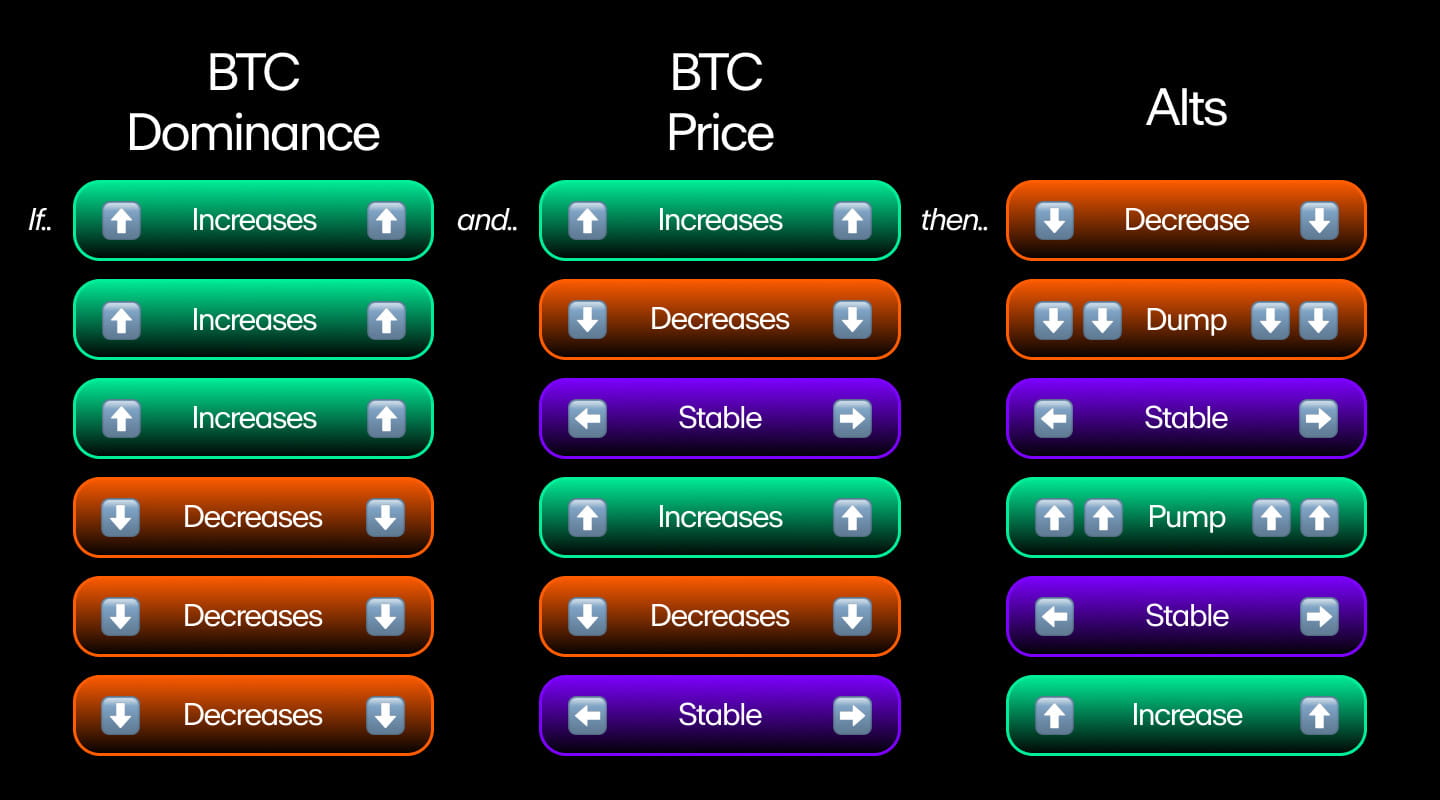
Altcoins are cryptocurrencies other than Bitcoin. When BTC Dominance increases, altcoin market share decreases, and when BTC dominance decreases, altcoin market share increases. This means that as Bitcoin becomes more dominant in the cryptocurrency market, altcoins may struggle to gain momentum, and their prices will decline.
2. Price Correlation
Cryptocurrency markets are highly correlated, and Bitcoin's dominance plays an important role in this. When the price of Bitcoin rises or falls, this affects the prices of other cryptocurrencies. When Bitcoin prices rise, altcoin prices tend to rise, and when Bitcoin prices fall, altcoin prices tend to fall.
3. Investor Sentiment
BTC dominance is also an important indicator of investor sentiment. When BTC dominance is high, it shows that investors have more confidence in Bitcoin than other cryptocurrencies. Conversely, when BTC dominance is low, it indicates that investors prefer to invest in altcoins rather than Bitcoin.
4. Altcoin Trading Volume
As BTC dominance increases, altcoin trading volume may decrease. This is because investors may focus more on Bitcoin trading than altcoins, which can lead to a decrease in altcoin liquidity and trading volume.
Conclusion
BTC Dominance is an important metric in the cryptocurrency market, and plays an important role in altcoin performance. As Bitcoin's dominance increases, the altcoin's market share may decline, and its price may decline. However, BTC dominance is not a perfect indicator, and it is important to consider other factors such as market sentiment, adoption, and development when investing in cryptocurrencies.