

Original author: Karen
Original source: Foresight News
The tokenization of Real World Assets (RWA) is not only the key to DeFi and Web3 becoming mainstream, but also has the potential to subvert certain financial fields.
"Everything can be tokenized" is not empty talk. On the blockchain, any tangible or intangible value can be represented on the chain, including gold, real estate, debt, bonds, artwork, carbon credits, and even ownership and content. license. Due to the huge advantages of RWA tokenization such as low cost, high efficiency, wide accessibility due to split ownership, high liquidity, and DeFi adoption, more and more financial giants have begun to test the waters and layout in this field. .
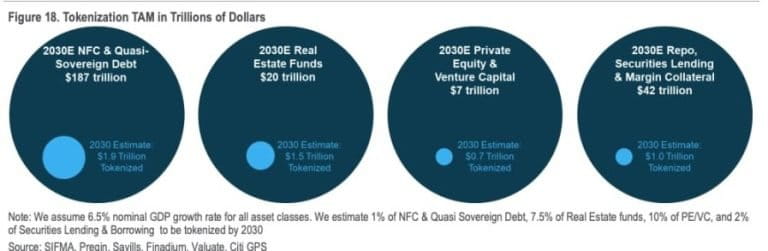
A recent research report released by Citi predicts that by 2030, there will be US$4 trillion to US$5 trillion in tokenized digital securities, and the volume of trade finance transactions based on distributed ledger technology will also reach US$1 trillion. This aggressive forecast is based on the following assumptions:
1. There is an estimated $1.9 trillion tokenized market (accounting for 1%) of the $187 trillion non-financial corporate and quasi-sovereign bond market;
2. It is estimated that there is a tokenization market of US$1.5 trillion (occupying 7.5%) of the US$20 trillion real estate fund market;
3. It is estimated that the tokenization market will account for $0.7 trillion of the $7 trillion private equity and venture capital fund market (accounting for 10%);
4. It is estimated that there is a $1 trillion tokenization market (2%) out of the $42 trillion securities financing and mortgage activity market.
5. It is estimated that there will be a tokenization market of US$1 trillion out of the US$12 trillion trade finance market.
The Hong Kong Monetary Authority also mentioned in the digital Hong Kong dollar pilot program announced this month that 16 selected companies from the financial, payment and technology sectors will conduct the first round of trials this year to conduct in-depth research on the potential use cases of the digital Hong Kong dollar in six areas. Including comprehensive payments, programmable payments, offline payments, tokenized deposits, Web3 transaction settlement and tokenized asset settlement. In fact, in February this year, the Hong Kong SAR government successfully issued HK$800 million in tokenized green bonds. This is the world’s first tokenized green bond issued by a government.
In this article, the author will summarize and sort out the exploration and layout of financial giants in RWA tokenization. Among them, financial institutions such as JPMorgan Chase, Goldman Sachs, DBS, UBS, Santander, Société Générale, and Hamilton Lane have moved from the research and exploration stage to the actual testing/practical stage. Temasek, HSBC, and BlackRock and other institutions are still in the exploration and preparation stage.
In recent years, several major banks in China have also adopted blockchain technology in supply chain finance, trade finance, payment and other fields, and released related platforms such as blockchain trade finance platform, asset securitization platform, Internet e-commerce financing system, etc. , is more used for digital transformation and improving the efficiency of financial services.
Overall, although asset tokenization is still far from reaching mass adoption, the momentum of RWA tokenization adoption has already changed as some of the giants that dominate the financial market gradually shift from research, exploration, and experimentation to the promotion stage. obvious changes.
JP Morgan: Tokenization is the killer app for traditional finance
As a multinational investment bank and financial services company headquartered in New York, JP Morgan (JP Morgan) is also constantly actively testing the waters and deploying in the RWA field.
"Tokenization is the killer application of traditional finance." Tyrone Lobban, head of Onyx Digital Assets, JPMorgan's digital asset platform, has a view that best shows the bank's firm vision and emphasis on RWA tokenization.
In an interview with CoinDesk in April, Tyrone Lobban said the company remained steadfast in its plans to tokenize traditional financial assets and was largely unaffected by the crypto bear market and regulatory uncertainty. The bank processed nearly $700 billion in short-term loan transactions using its Onyx Digital Assets platform. Clients using Onyx-based repo services include Goldman Sachs, BNP Paribas and DBS, with fifteen more banks and broker-dealers currently seeking to sign up. As the platform develops, Onyx will focus on traditionally difficult-to-fund assets, such as money market funds, and use them as collateral, and is expected to issue a wider range of blockchain-based assets, including private equity funds.
Launched by JPMorgan in November 2020, Onyx Digital Assets is a blockchain-based, enterprise-grade platform designed to tokenize traditional assets and unlock liquidity. Onyx Digital Assets’ Tokenized Collateral Network (TCN) leverages blockchain to enable the transfer of tokenized ownership interests in money market fund (MMF) shares, allowing asset managers and institutional investors to pledge or transfer MMF shares as collateral Taste.
JPMorgan Chase’s exploration of RWA is not limited to Onyx, but also:
In May 2022, Bloomberg reported that JPMorgan Chase was exploring the use of blockchain for collateral settlement. The first such transaction occurred on May 20, when two subsidiaries of JPMorgan Chase tokenized Bailey German money market fund shares were used as collateral for transfer settlement on its private chain. JPMorgan plans to expand tokenized collateral to include equities, fixed income and other asset types in the coming months.
In October 2022, JPMorgan Chase implemented tokenized U.S. dollar deposits through JPM Coin, and plans to enable blockchain-based euro deposits soon. JPM Coin is a U.S. dollar-pegged stablecoin that runs on the Quorum blockchain and allows JPMorgan clients to transfer U.S. dollars deposited with JPMorgan.
In November 2022, the Monetary Authority of Singapore (MAS) launched a digital asset pilot and decentralized finance (DeFi) service. The first industry pilot under its Project Guardian explores potential decentralized finance (DeFi) applications in the wholesale financing market. of companies have completed their first live transactions and are testing asset tokenization and the application of DeFi to wider use cases in finance. Under the first industry pilot, DBS Bank, JP Morgan and SBI Digital Asset Holdings conducted foreign exchange and government bond transactions against liquidity pools that included tokenized assets.
Goldman Sachs: Entering RWA through tokenization platform GS DAP
Goldman Sachs, another top investment bank comparable to JPMorgan Chase, is also continuing to explore the RWA field.
In April 2022, Mathew McDermott, global head of digital assets at Goldman Sachs, said at the Crypto and Digital Assets Summit that as investment banks delve into the field of cryptocurrency, Goldman Sachs is studying NFTs, especially "the tokenization of physical assets."
According to a report by June 2022, the GS Digital Assets department is using blockchain technology and smart contracts as basic technologies to provide customers with digital issuance of debt, stocks, funds and derivatives, and its subsequent end-to-end Digitizing the end life cycle, including transactions, settlement, custody and asset services on decentralized ledgers on public and private blockchains, including establishing a strategic GS DAP digital tokenization and life cycle platform.
In November 2022, the European Investment Bank (EIB) announced that it would cooperate with Goldman Sachs Bank Europe, Santander and Société Générale to launch a euro-denominated digital native bond project Venus, a €100 million two-year bond using issuance, recording and settlement based on private blockchain technology, represents the first issuance of Goldman Sachs’ tokenization platform GS DAP.
In January this year, the digital asset platform GS DAP launched by Goldman Sachs has been officially launched. The platform is developed based on Digital Asset's Daml smart contract language and privacy blockchain Canton. Digital Asset ensures that data is only shared with qualified stakeholders through its privacy agreement. sharing while enabling the scalability required for globally connected assets.
In February this year, the Hong Kong SAR government announced the successful issuance of an HK$800 million Government Green Bond Plan (GGBP) using Goldman Sachs’ tokenization platform GS DAP.
Citigroup: Asset tokenization is approaching a growth inflection point
Citigroup noted in its “Currencies, Tokens and Games” report released in March this year that the potential of tokenizing assets through blockchain, while transformative, has not yet reached the point of mass adoption and is currently being Approaching a growth inflection point. Expected to be measured in billions of users and trillions of dollars in value.
Citigroup believes that if the tokenization theory holds true, the 21st century may see the creation of regulated, global, token-based multi-asset networks. Back in 2020, Citi analysts were vocal that banks could explore opportunities such as loans backed by tokenized real estate assets as new liquid secondary markets are created.
In June 2022, Citi announced that it had selected Metaco, a Swiss cryptocurrency custody company, to develop and pilot digital asset custody functions, with a focus on tokenized securities.
In April 2023, Citi India completed its first blockchain letter of credit (LC) transaction for its client Cummins India Limited. Contour is a global digital trade finance network powered by blockchain technology that enables multiple parties (banks, corporates and logistics partners) to seamlessly and securely collaborate in real-time on a single platform. Citi is a founding member bank of Contour.
DBS Bank: Participating in the Monetary Authority of Singapore’s digital asset pilot and DeFi services
Singapore's DBS Bank is one of the first financial companies to enter the field of digital assets. In the early days, it mainly involved services such as digital asset trading, security token issuance (STO), and custody. Although STO is also a tokenization of real assets, it is intended to be used for fundraising and is subject to more restrictions. For example, it may only be issued on a private chain and is subject to strict regulatory restrictions.
In August 2020, DBS Group announced the launch of the digital exchange DDEx (DBS Digital Exchange) for qualified investors, financial institutions and family offices to provide tokenization, trading and custody services for institutional and qualified investors.
In June 2021, DBS Bank launched its first security token offering (STO) by issuing digital bonds, issuing US$11.35 million in digital bonds.
In November 2022, DBS said it had completed trading in fixed income products through JPMorgan's Onyx, becoming the first Asian bank to use the network.
In November 2022, the Monetary Authority of Singapore (MAS) launched a digital asset pilot and DeFi services. Under the first industry pilot under its Project Guardian, DBS Bank, JPMorgan Chase and SBI Digital Asset Holdings targeted tokenized assets. The liquidity pool conducted foreign exchange and government bond transactions.
Temasek: Preparing for tokenized assets
Temasek began exploring the application of blockchain technology and asset tokenization a few years ago, but has not yet launched formal services. It is worth mentioning that Temasek suffered heavy losses in the FTX crash last year. The company invested a total of approximately US$275 million in FTX and FTX US from October 2021 to January 2022, and decided to write down all of them last year.
In January 2021, Singapore Exchange (SGX) and Temasek announced the establishment of a joint venture (JV). The new joint venture will focus on capital market workflows through smart contracts, ledgers, and tokenization technologies.
In May 2022, Pradyumna Agrawal, managing director of Temasek Blockchain Investment, said that he did not hold Bitcoin but was preparing for tokenized assets.
HSBC: Exploring asset tokenization use cases
HSBC is relatively cautious in its exploration of asset tokenization, and its current scope of asset tokenization is also relatively limited.
In November 2022, HSBC announced plans to launch HSBC Orion, a DLT-based bond tokenization platform. The solution can tokenize digital bonds and currencies used for settlement, enabling atomic settlement or delivery and payment (DvP) . However, the digital bond initiative does not involve cryptocurrencies, but instead uses permissioned blockchain infrastructure.
In the first quarter of 2023, the European Investment Bank (EIB), in partnership with BNP Paribas, HSBC and RBC Capital Markets, issued a sterling-denominated digital bond on a private blockchain, saying that the 50 million pound (61.6 million USD) floating rate bonds are registered on a private blockchain.
In a 2023 job announcement, HSBC is hiring a product director for its global private banking and wealth business, a position that will focus on asset tokenization use cases.
In the digital Hong Kong dollar pilot scheme launched by the Hong Kong Monetary Authority in May this year, HSBC was among the 16 selected companies from the financial, payment and technology sectors to participate in the first round of trials.
Fidelity: Radical layout of cryptocurrencies, may take a wait-and-see attitude towards tokenization of real assets
As one of the world's leading asset management companies, Fidelity began research and exploration in the crypto field in 2014, and its layout is relatively radical. The Fidelity Digital Assets subsidiary launched in 2018 helps institutions Using digital assets, it provides digital asset custody, trading and asset management services. In 2022, it will launch the crypto investment product Fidelity Cryptocurrency for retail customers. It is worth mentioning that Fidelity also planned to allow investors to open Bitcoin accounts in their 401(k)s last year, but this was later blocked by regulatory issues.
However, Fidelity’s layout and progress in real asset tokenization is not obvious and seems to be in a wait-and-see stage. However, with the development of real asset tokenization, Fidelity may further expand this area in the future.
Singapore Exchange: Exploring tokenized asset settlement with Monetary Authority of Singapore
In November 2018, the Monetary Authority of Singapore (MAS) and the Singapore Exchange (SGX) developed the Delivery and Payment (DvP) feature for settling tokenized assets across different blockchain platforms.
When DBS launched the Digital Asset Exchange in 2020, Singapore Exchange held a 10% stake in DBS Digital Exchange.
In January 2021, Singapore Exchange and Temasek announced the establishment of a joint venture (JV) Marketnode. The new joint venture focuses on capital market workflows through smart contracts, ledgers and tokenization technologies.
BlackRock: Is exploring tokenization of stocks and bonds
BlackRock, the leader in the asset management industry, is also relatively active in the field of cryptocurrency, such as through blockchain ETFs, spot Bitcoin private trusts, providing a US$17 million loan to Bitcoin mining company Core Scientific, and through Coinbase Prime for its institutions. Clients tap into the cryptocurrency market by providing crypto trading and custody services.
In terms of real asset tokenization, although BlackRock has made it clear that it is exploring this field, there is currently no obvious substantial progress.
In March 2023, BlackRock CEO Larry Fink stated in his annual letter to BlackRock shareholders, “BlackRock will continue to explore the digital asset ecosystem, especially in areas most relevant to our clients, such as licensing. Blockchain and the tokenization of stocks and bonds.”
Bank of New York Mellon: Tokenization has the ability to revolutionize the financial landscape
BNY Mellon has also been actively exploring and practicing in the field of cryptocurrency and real asset tokenization, and is open to the application prospects of real asset tokenization. The bank is not only the main custodian of USDC reserves, but is also approved by New York regulators to provide cryptocurrency custody services.
In September 2022, the official website of Bank of New York Mellon released the report "The Rise of Tokenization", believing that tokenization has the ability to completely change the financial landscape and fundamentally change the way investments are managed, used and monetized.
In May this year, Bank of New York Mellon stated that it is currently advancing initiatives involving distributed ledger technology, tokenization and digital cash, including providing custody and clearing services for digital assets, as well as realizing new technologies such as tokenization of securities. Use cases etc.
UBS Group: Substantial progress has been made in tokenizing assets
As a multinational investment bank and wealth management company headquartered in Zurich, Switzerland, UBS has made substantial progress in tokenizing assets.
In October 2019, finews.com reported that UBS was looking to tokenize the assets of its securities arm, including debt, structured products and physical gold.
In May 2021, UBS Group AG has launched a pilot program for more than 100 institutional clients to tokenize real assets. The project runs on the Ethereum platform.
In November 2022, UBS Group announced the listing of the first blockchain-based digital bond. The three-year bond is worth approximately US$370 million and has a coupon rate of 2.33%. The bond will be issued on the SIX Digital Exchange blockchain-based platform and traded on SDX and SIX Swiss Exchange.
In December 2022, UBS London branch issued $50 million in tokenized debt securities on Ethereum to high-net-worth individuals and family offices in Hong Kong and Singapore.
Santander: Testing tokenization of bonds, agricultural products, used cars and real estate
In September 2019, Santander announced the issuance of the first end-to-end blockchain bond (valued at $20 million) on Ethereum.
In March 2022, the Spanish multinational bank Santander cooperated with the Argentine agricultural product tokenization platform Agrotokeon to provide Argentine farmers with loans collateralized by tokenized commodities. The credit collateral is based on soybeans (SOYA) launched by Agrotoken, Corn (CORA) and Wheat (WHEA) tokens.
In October 2022, Santander Brazil began testing a tokenization system for used cars and real estate transfers.
In January 2023, the European Commission and the German Banks Association jointly launched an initiative on the importance of tokenization, with the participation of more than 20 well-known partners from the private, industrial, financial and digital sectors, including Santander.
Deutsche Bank: Launching Tokenized Fund on Memento Blockchain
In May 2021, Deutsche Bank Singapore Securities Services and Hashstacs (STACS) announced the completion of a proof of concept (POC) called "Project Benja", a "bond in" that uses DLT for digital assets and sustainability-linked bonds. a box" proof of concept. Deutsche Bank said the POC enables it to assess the practical handling of tokenized assets, as well as the opportunities and challenges that may arise from their commercialization in Singapore and other markets.
In February 2023, Deutsche Bank launched a tokenized fund on the Memento blockchain.
Société Générale: Participating in RWA Tokenization DeFi
Societe Generale has also maintained a positive attitude in the field of digital assets and is one of the few financial companies participating in DeFi.
In April 2019, Societe Generale SFH, a subsidiary of Societe Generale, issued 100 million euros of guaranteed bonds on Ethereum.
In May 2020, Societe Generale SFH issued a €40 million covered bond as a security token registered directly on the public blockchain.
In April 2021, Société Générale launched structured products on the Tezos public blockchain.
In August 2022, MakerDAO agreed to provide a loan of up to US$30 million to SG Forge, a subsidiary digital asset company of Société Générale. In January of this year, SG Forge withdrew the first tranche of $7 million in DAI stablecoins as part of the loan.
In April 2023, SG-Forge, a subsidiary of Société Générale, launched EUR CoinVertible, a stable currency pegged to the euro, for institutional clients. The EURCV stablecoin is only available to institutional investors onboarded by Société Générale through its KYC and AML procedures.
Hamilton Lane: Providing tokenized access through a tokenized fund
Hamilton Lane is a U.S.-based private markets investment management firm that lowers investment barriers for clients by partnering with blockchain-based financial services companies to provide tokenized access opportunities.
In March 2022, Hamilton Lane partnered with digital securities exchange ADDX to provide tokenized access to the Hamilton Lane Global Private Assets Fund.
In October 2022, Hamilton Lane established a partnership with digital asset securities company Securitize to expand investor access to Hamilton Lane funds through tokenization.
In October 2022, Hamilton Lane and blockchain financial services company Figure are preparing to cooperate to launch a blockchain-native registered investment fund focusing on the private equity market. The fund uses Figure’s Digital Fund Services (DFS) platform to digitize fund share ownership records on the Provenance Blockchain.
In January 2023, Hamilton Lane opened a tokenized fund. The minimum investment amount of this tokenized fund has been reduced from US$5 million to US$20,000, and it is deployed on Polygon.
State Street Bank: Creating a range of tokenized solutions
State Street is one of the leading providers of financial services to institutional investors, with $37.6 trillion in assets under custody and $3.6 trillion in assets under management as of March 31, 2023.
The digital asset service platform called "State Street Digital" launched by State Street provides a series of custody, fund management, collateral management, tokenization and payment tools.
In August 2022, State Street said it saw "significant opportunities" in tokenization and was committed to tokenizing funds and private assets in 2023 to improve customer efficiency and accessibility.
State Street has also invested in Securrency, a blockchain-based financial and regulatory technology company, and has created a range of tokenization solutions, including:
1. Proof of concept for tokenizing fund shares with asset management companies;
2. Automated foreign exchange non-deliverable forward OTC trading life cycle;
3. Digital transaction processing on State Street Alpha, providing aggregated data, analysis and real-time insights.
Bank of China layout
In recent years, several major banks in China have also adopted blockchain technology in supply chain finance, trade finance, payment and other fields, and released related platforms such as blockchain trade finance platform, asset securitization platform, Internet e-commerce financing system, etc. , is more used for digital transformation and improving the efficiency of financial services.
In August 2017, the Agricultural Bank of China launched a blockchain-based agricultural Internet e-commerce financing system.
In 2018, China Construction Bank tested "blockchain + finance" and completed the construction of the BCTrade blockchain trade finance platform, and then released the BCTrade2.0 blockchain trade finance platform in 2019. Through the application of blockchain technology, the platform realizes the transmission of domestic letters of credit, forfaiting, international factoring and other trade financial business transaction information, the confirmation of claims and the transfer of documents in a fully electronic process, making up for the lack of relevant system platforms and avoiding non-encrypted Reduce possible risks caused by transmission and improve business processing efficiency.
In June 2018, Bank of Communications officially launched the "Jucai Chain", a full-process blockchain asset securitization platform for investment banks, through providing internal services to Bank of Communications, BoCom Guosen and other group internal institutions, as well as PricewaterhouseCoopers, Zhong Lun, China Bond Ratings, Intermediaries such as China Chengxin Deploy blockchain nodes to achieve dual uploading of asset securitization project information and asset information, simultaneously implement the process of cross-agency due diligence based on smart contracts, and comprehensively reshape the investment bank's asset securitization business operation process. .
In December 2019, Bank of China completed the issuance and pricing of the first phase of 20 billion yuan of special financial bonds for small and micro enterprise loans in China in 2019, and the raised funds were specifically used to issue loans to small and micro enterprises. In this issuance, Bank of China simultaneously used a self-developed blockchain bond issuance system. The system uses the blockchain network as the underlying platform to support on-chain interaction and evidence storage of key information and documents during the bond issuance process.
In August 2020, the China Banking Association organized and joined the five major banks to jointly build the China Trade Finance Inter-bank Transaction Blockchain Platform (CTFU Platform).
In January 2021, the "ICBC Xi Chain" blockchain platform independently developed by the Industrial and Commercial Bank of China passed the five trusted blockchain technology evaluations of the Ministry of Industry and Information Technology.
In March 2021, Shanghai Pudong Development Bank, as the joint lead underwriter, and CCDC used blockchain technology for the first time to support DBS Bank (China) Co., Ltd.'s issuance of 2 billion yuan in secondary capital bonds.
In June 2021, China Merchants Bank launched the blockchain portal "One Link". The blockchain application scenarios that CMB has explored include supply chain, electronic bills, fund settlement, cross-border finance, multi-party collaboration, contract deposit, etc.
Summarize
Although the current DeFi and Web3 markets are still far behind the size of traditional financial markets, RWA tokenization is expected to introduce the next trillion-dollar market for Web3.
However, the current market size of asset tokenization involved in attributes such as mortgage lending, credit, and composability in DeFi is relatively small. It also faces challenges such as poor liquidity, fragmented liquidity, and imperfect infrastructure. In addition, More clarity from regulators, relative consistency in relevant standards, etc. will also be critical to stimulate the growth of RWA tokenization.
(The above content is excerpted and reprinted with the authorization of partner MarsBit, original text link | Source: Foresight News)
Statement: The article only represents the author's personal views and opinions, and does not represent the objective views and positions of the blockchain. All contents and opinions are for reference only and do not constitute investment advice. Investors should make their own decisions and transactions, and the author and Blockchain Client will not be held responsible for any direct or indirect losses caused by investors' transactions.
This article Global financial giants are vying to get in! What is the potential for tokenization of “real world assets” RWA? First appeared in Block Guest.