

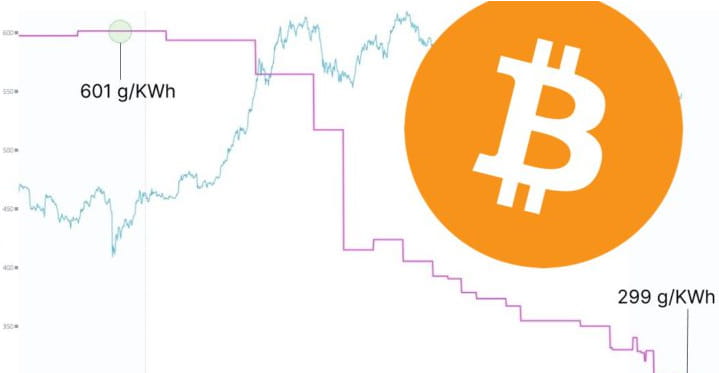
Bitcoin mining’s high energy consumption and carbon emissions have been criticized by environmentalists. Bitcoin environmental, social and governance (ESG) analyst Daniel Batten said yesterday that Bitcoin’s carbon emissions have dropped significantly since 2021, and today’s carbon intensity has dropped below 300 g/KWh for the first time, setting a record low record.
The energy consumption and carbon emissions of cryptocurrency mining have been criticized by governments and environmentalists around the world. At the beginning of this year, a research report by the data analysis agency Forex Suggest named the top eight cryptocurrencies with the worst impact on the environment throughout 2022. Among them, the annual carbon emissions of Bitcoin, the number one, are estimated to reach 86.3 million tons, an annual increase of 52%, and require planting of 432 million tons. A tree can offset it.
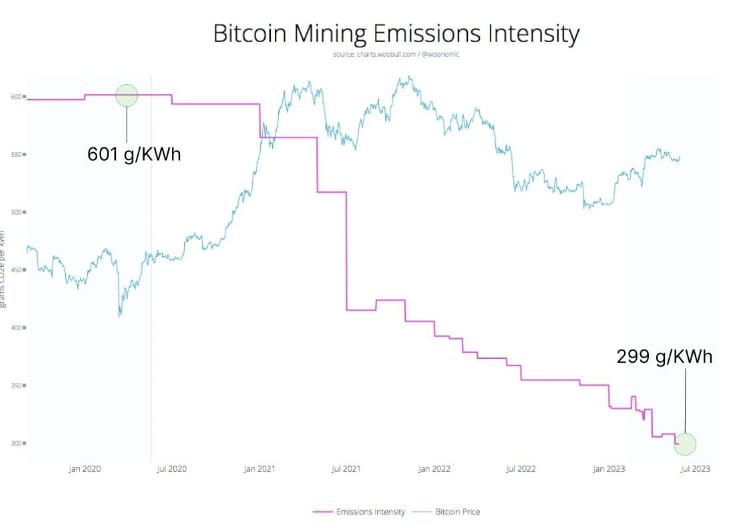
However, statistics from Bitcoin Environmental, Social and Governance (ESG) analyst Daniel Batten show that Bitcoin’s carbon emission intensity has been significantly reduced since 2021. He tweeted yesterday (29th):
For the first time in history, Bitcoin’s carbon emissions intensity per kilowatt-hour fell below 300 g/KWh, setting a new record low.
It took the Bitcoin network just over 3 years to halve its emissions intensity, and no other industry has reduced its emissions intensity at the same rate.
Bitcoin mining turns to sustainable energy
Daniel’s research believes that the carbon emissions generated by Bitcoin per kilowatt hour (1 kilowatt hour of electricity) have been halved compared to three years ago. In comparison, CoinWarz data shows that Bitcoin’s computing power (hash rate) It is currently about 403.41 EH/s, an increase of nearly 3.5 times from 116.19 EH/s three years ago. The current Bitcoin difficulty has also reached a record high of 49.55 T, which is more than three times higher than the 15.14 T three years ago.
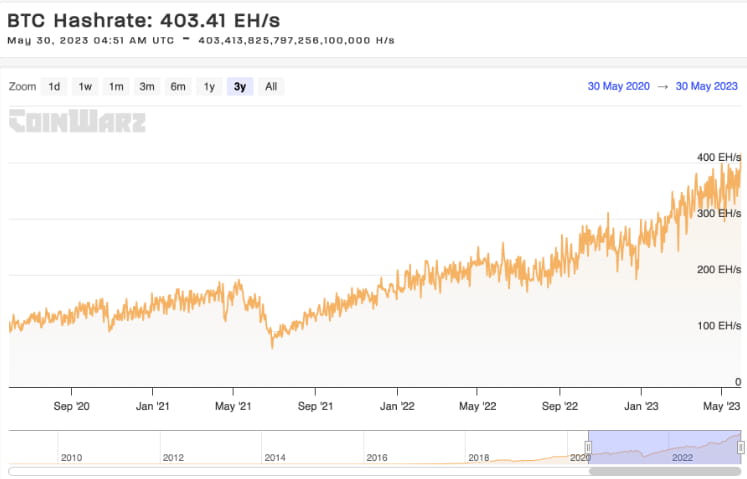
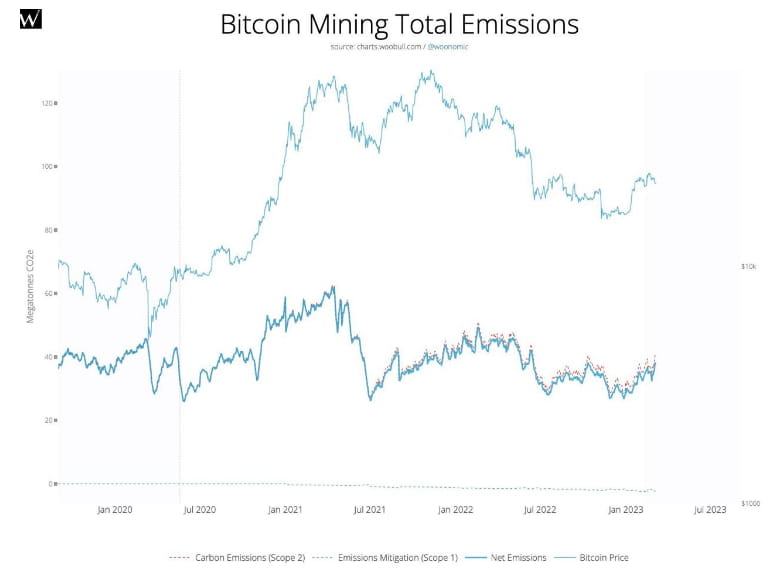
It is generally believed that the increase in Bitcoin computing power and difficulty means that the competition among miners will become more intense, and energy consumption and carbon emissions will also increase accordingly. However, Daniel said in March this year that the difficulty of Bitcoin has dropped significantly after 2021, which means that since China introduced a mining ban in 2021, the previous trend of increasing carbon emissions has been reversed.
Even as computing power and electricity consumption increase, Bitcoin network carbon emissions are still on a downward trend, and miners' shift to "sustainable energy" is an important driving force for this trend.
More than half of the energy used is zero-carbon
According to his estimate, the Bitcoin network uses at least 52.6% zero-carbon energy. Previously, the Bitcoin Mining Committee (BMC) reported in Q2 2022 that 59.4% of Bitcoin mining electricity used sustainable energy, while the Cambridge Center for Alternative Finance (CCAF) report in October last year came to a much lower figure of 37.6%.
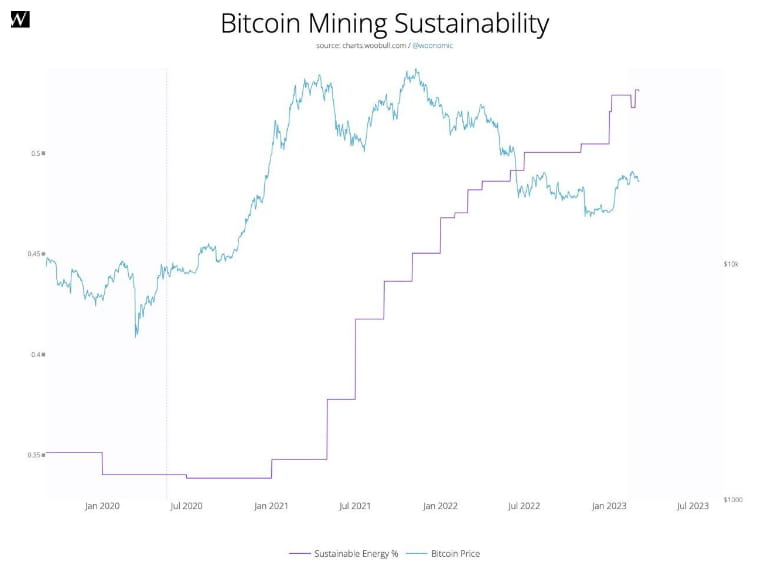
In April this year, Daniel refuted a New York Times report that 26 Bitcoin mining companies in the United States and Canada use 90% sustainable energy to power their mining activities. For example, this year, TeraWulf, a mining company based on ESG (corporate sustainable development) principles, has operated the first nuclear mining in the United States, claiming to achieve 100% zero-carbon mining.
Bitcoin miners are flocking to countries with sustainable energy sources to monetize excess electricity, such as the Nordic countries, Brazil, and Paraguay.
In addition, more and more mining companies are cooperating with oil companies to use associated gas (natural gas produced by oil extraction) to mine Bitcoin. In the past, oil companies usually chose to directly burn natural gas. According to research, the carbon emissions corresponding to the use of electricity in the Bitcoin mining industry in 2021 were only 8% of those from natural gas combustion. Daniel Batten believes that using associated gas for Bitcoin mining will help Bitcoin embark on the path of a zero-carbon currency.