

(Author: Zoey, Port3 Researcher)
After less than two years of development, the Web3 task-based marketing tool (hereinafter referred to as Quest) has seen hundreds of projects and is becoming a new traffic center in the encryption world. Through the discussion of Web3 marketing, we will gain insight into the development status and trends of the Quest field in this article, thereby predicting the final pattern of the Quest platform and guiding the development of SoQuest.
Read the key points at once: Quest field development and trends
(1) The Quest track started with Gleam and is now in full bloom.
(2) Galxe is currently leading and still has the largest traffic, and the growth of each platform has shown a bottleneck.
(3) The development of niche and vertical platforms requires a high degree of cooperation between track and industry development, making overall development more difficult.
(4) A platform with rich product functions, covering comprehensive scenarios, and the ability to introduce new users is expected to develop into a new leading platform.
(5) The Quest track carries high user traffic and high-frequency user behavior, so it will expand to lower-cost chains in the future.
(6) Platforms that can achieve profitability are more likely to win Quest
(7) Quest’s feature competition has come to an end, and SoQuest has built a complete product infrastructure
Quest Origin
Following DeFi Summer, the development of the on-chain world and on-chain applications are experiencing new changes. The leading ecosystems in the crypto industry have technological and resource advantages and drive development through continuous iteration. Although the number of encryption projects continues to grow, there are still only a few leading projects. For most projects, in order to become a leading brand, in addition to a good and reasonable narrative, they also need to use marketing to build brand awareness, gain more users, reduce costs and improve efficiency.
Unlike Web2 companies, Web3 organizations are more able to attract new users and promote activity through crypto-native methods, such as token airdrops, NFTs, POAP, whitelist qualifications and other rewards to attract crypto users to join the community and follow on social media. and other tasks to expand the scope of brand communication. After 2020, Web 2 social media marketing service provider Gleam.io gradually became the main tool for early launch of encryption projects and new promotions. It also provided early inspiration for the future development of the Web3 task-based marketing tool track.
Web3 Marketing Pioneer Gleam.io
In the Web3 field, the first tool used for marketing was a Web2 product Gleam. Gleam.io is from Australia and offers a variety of marketing tools such as contests, sweepstakes and promotions to promote brand and product exposure. Its target customers are mainly digital marketers, social media managers and online business owners. They can quickly increase fans or promote products on social platforms such as Facebook, Blog, and Instagram. Its services are paid, priced from $29 to $997.
In the early days of the development of the encryption industry, operations, promotion and marketing were usually disseminated through communities, KOLs, social media and other channels, and it was hoped to achieve user growth and conversion through incentives and other methods. However, during the implementation process, there will be some problems, such as lack of reference for task transformation design, narrow reach, complex process monitoring, cumbersome data statistics, and inaccurate reward distribution. Ultimately, the activity resulted in poor results, including limited participating users, inaccurate user reach, a high proportion of robots, and extremely poor user stickiness.
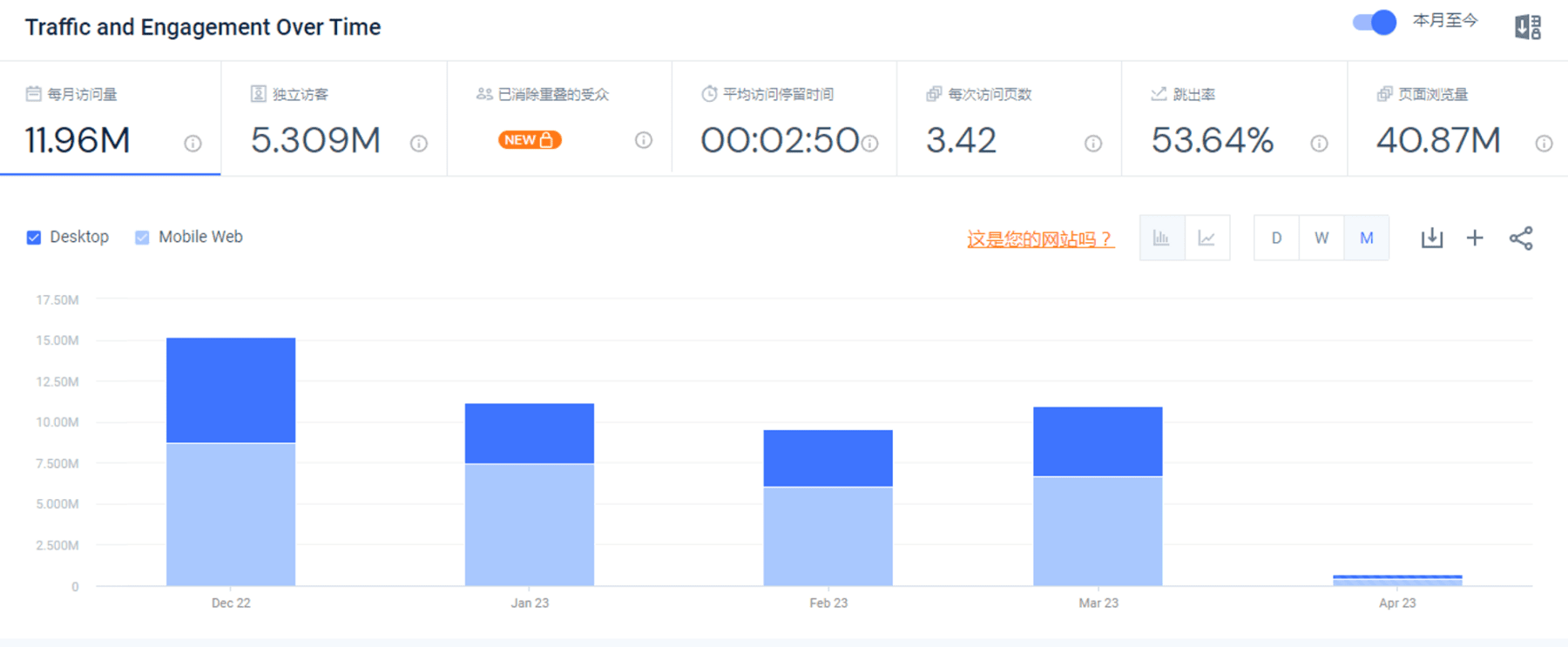 Gleam.io’s website traffic in the past six months, source SimilarWeb
However, Gleam serves Web2 scenarios and is not compatible with Web3 related components, causing it to be unable to meet the requirements of tasks on the Web3 chain. Especially after various equity NFTs such as POAP and OAT are further used to attract new users and promote activity, Gleam's own limitations in supporting Web3 marketing have become increasingly obvious (especially it does not support NFT casting, token holders, etc.).
POAP and Project Galaxy tried to build a traffic platform based on large-scale NFT Mining, starting more than half a year ahead of other competing products. SoQuest had insight into the direction of Web3 task detection in early 2022 and built the Quest platform. Subsequently, more native tools that can match the needs of Web3 began to emerge.
Web3 Quest track status
Nowadays, Web3 marketing tools are in full bloom. We have selected 19 representative projects from the track and divided them into three categories according to the characteristics of the platform: traffic, education and subdivided vertical categories. Different classifications are just differences in the entry points of each project. For all these projects, we compare them based on some common indicators to derive their strengths.
Traffic class
Traffic platforms usually import user traffic for Web3 operators in the form of building tasks, aiming to bring early start-up users, brand exposure, etc. to encryption projects.
(1)Galge
Galxe (formerly Project Galaxy) is currently the largest Web3 traffic platform. Galxe allows project parties to issue NFTs on the platform. Users who meet the conditions can obtain Mint qualifications. Project parties can also provide customized services through Project Galaxy's data certificates. Users can see the tasks released by various projects on the platform, and can look for potential airdrops, participate in community activities, and discover new projects.
Galxe has built its own digital identity certificate, Galxe ID, and marked OAT from the chain. Through the analysis of on-chain data, it labels different users with various labels. For each Quest, a Credential set will also be generated and exported as a whitelist to third parties for application (such as Token distribution).
(2)SoQuest
SoQuest is affiliated to Port3 Network and is one of the BNB Chain MVB V incubation projects. Port3 closed a $3 million seed round in early 2023. The project's development vision is to build a "decentralized social data layer" and aims to aggregate on-chain and off-chain data to provide data-driven services for SocialFi applications. Its product SoQuest is the first one-stop task platform in the industry to be launched in a Web3 native and free manner in the form of Gleam. It aggregates Web2 and Web3 data in multiple dimensions to assist project operations.
SoQuest's proven one-stop Quest and data analysis tools, as well as proactive operational support are key features. And various scenarios surrounding the traffic pool, such as Twitter Space, games, apps, etc., are covered.
(3)TaskOn
TaskOn is part of the Moonbeam family of apps. As a commonly used Web3 operation growth platform, it can provide some automated functions and reduce operational processes. For example, API-Verified can help automatically verify that participants perform product-specific actions. The platform also has an automatic reward distribution function, which can immediately distribute rewards on behalf of the active party after the event. All the activities of the active party are to create an event and charge enough rewards (Token or NFT) into their own TaskOn account; TaskOn can also Create events for the event organizer to further reduce the organizer's operations. Among the current Web3 task platforms, TaskOn is one of the platforms with streamlined and easy-to-use functions and rapid development.
The platform has one of the highest real user rates (up to 92.9%) due to its series of anti-bot measures.
(4)QuestN
QuestN (formerly Quest3) is a Web3 task activity platform incubated by Hogwarts Labs and is one of the GRT14 donation projects. As a Web3 advertising and traffic distribution platform, the project team does not need permission to create a community. Users can obtain tokens and NFT badges by participating in tasks and activities, and is committed to providing various on-chain and off-chain services for GameFi, DAO, communities and other projects. Next task is to provide traffic guidance services for the project party.
From an operational perspective, Quest3 is a tool platform that focuses more on Quest. It has obvious advantages in Banner traffic and a unique UI style. It also opens up an App channel, and its App functions are similar to those on the Web.
(5)Noox
Noox aims to build a decentralized proof of achievement platform. After users meet the corresponding conditions, they can cast the corresponding NFT, called a "badge." Noox badges record users’ on-chain behaviors, allowing users to visualize what they do. For example, through SushiSwap’s badge, users can understand the range of the number of transactions they have made on SushiSwap.
Noox badges are non-transferable and can only be obtained by verifying a user’s historical on-chain behavior. Therefore, users can use this badge to prove their on-chain activities in a permissionless, composable, and trustworthy manner. The current minting fee per badge is 0.002 ETH. The fees collected by the platform will be deposited into the national treasury to support future ecological development.
(6)Click
Clique is an ID oracle that puts Web2 user behavior and identity data on the chain, aiming to bridge the gap between value creation activities in Web2 and the incentive distribution layer in Web3. The goal is to enhance strong on-chain identity and reputation systems and unlock more sustainable use cases for Web3. C-end users can bind to social networks, meet certain conditions based on their activity and contribution to projects on Clique, and receive SBT, NFT, whitelist and other rewards from the platform or project. Clique's data is highly refined and has excellent monitoring and analysis depth.
(7)DappBack
DappBack is more similar to the Web3 version of Gleam. There are many early projects on the platform, and the tasks are relatively simple, mainly social tasks, such as following the project on Twitter, entering Telegram, Discord communities, etc. The platform adopts a points model. After reaching a certain score, you can receive rewards such as NFTs and tokens.
From an operational perspective, DappBack requires operators to pay fees to provide services, which means that the platform is not free. These payments will go to the community, which will also include its profits.
(8)SME
Pyme is a Web3 task airdrop platform for users to obtain tasks to earn rewards. The platform will increase its "Pyme Points" based on users' behavior, and these points will determine the number of tokens users can obtain when airdrops are issued in the future (Pyme's litepaper claims that tokens will be pre-sold in the fourth quarter of 2022). Pyme is a product developed by a team that transitioned from the Web2 professional marketing team to the Web3 growth platform field, so the product performs well in terms of support for the operations side.
Although the team transitioned from a dedicated Web2 marketing team, the Web3 growth platform they developed has served them well across all projects. However, the platform is currently free to use, but fees may be charged in the future, and there is no open access to data for business users, which is a drawback of the product.
Education
The education category focuses more on increasing users’ awareness of different encryption project products, including guiding users to recognize, understand, and use products to achieve the purpose of education and growth.
(1)Layer3
Layer 3 is part of the Web3 marketing platform, which guides users to experience Web 3 products through a combination of on-chain and off-chain operations. After users complete tasks, they can earn experience points (XP), Layer3 achievements, and commemorative NFTs for their participation.
Layer 3 is a platform that connects users and project parties to guide projects. Based on airdrop expectations or reward expectations, users complete various project release tasks on the interactive incentive platform. The project party mainly aims to obtain customers and will also cooperate with various interactive platforms. The project side needs to pay a certain fee to the platform side and provide certain incentives to users, which may be airdrops or other incentives.
(2)RabbitHole
RabbitHole is an established decentralized on-chain incentive interaction platform. The current product is divided into two parts: web3 new user education platform Skill and advertising placement Quest. Skill guides new users to complete on-chain interactive tasks by issuing NFT rewards and quickly enter the web3 industry. NFT serves as a certificate of interaction on the chain, making it more convenient to screen target users.
Quest distributes rewards through tokens provided by partner protocols, matching them with target users to help the protocol achieve high-quality user growth.
(3)Link3
Link3 is a Web3 linktree+AMA vertical tool incubated by Cyberconnect. We think its significance lies more in user education, so we also put it in the user education section.
Link3 is currently a must-have tool for most crypto project AMAs. Essentially, Link3 is a verifiable Web3 social network. The platform mainly encourages users to participate in online meetings such as AMA and Space by issuing SBT, NFT and other rewards. As one of the few AMA tools in the Web3 field, it has attracted a large amount of traffic and recently announced its Token issuance plan, which will be sold on CoinList.
(4) Zealy (formerly Crew3)
Zealy takes Web3 Discord as its development positioning and has high social attributes. There are many activity templates in the community, including daily check-in, content creation, invitation tasks and other operational tasks. Compared with other platforms, Zealy is more focused and clearly classified. The platform also has a points ranking system. In Zealy, some project tasks require writing, screenshots, invitations, etc. to complete, in order to filter out many automated fools and ensure user authenticity.
The platform was previously named Crew3, but was renamed Zealy due to the same name as a well-known space mission.
(5)101.xyz
101 is a Web3 learning platform mainly for user education. Users can obtain NFT badges, cryptographic rewards, token gating and other rewards by learning and answering questions. After completing tasks, users can also continue to accumulate reputation on the platform. The platform gained a certain amount of attention in the short term, but because the team considered that this direction was not profitable, they gave up continuing operations.
(6)Trantor
Trantor is a mission platform incubated by StarryNift that facilitates interconnection between communities and brands through empowered decentralized identity (DID). As a one-stop hub for interconnection and information exchange, projects can advertise on the platform and attract new users to build and grow their communities and brands. Projects can also reward their loyal users with tokens that represent the various benefits and utilities of participating in the project.
To this end, projects, communities and DAOs will be able to create a variety of tasks, challenges and activities through customizable 2D templates and/or 3D scenes supported by the platform. For operators, Trantor’s features are streamlined and easy to use. Of course, Trantor also often takes the initiative to launch joint marketing activities for multiple projects, which is of great help in improving the stickiness of B-end users.
Subdivide vertical categories
Also as a Web3 task-based marketing tool, the subdivision categories are more inclined to certain specific fields, such as GameFi, DAO, etc.
(1)Phi Land
Phi Land is a social gaming metaverse focused on "on-chain Identity". It utilizes the Ethereum Name Service (ENS) to assign a unique Metaverse address to each address and creates an "On-chain persona" based on wallet activity history, allowing users to create their own identity in the Metaverse. Users can connect their own land through links to other landowners and Web3 sites. Phi Land also offers Adventure Banners, which can be personalized based on on-chain activity from connected wallets. In addition, Phi Land also supports the use of ENS to generate unique Metaverse Land for users.
Phi Land combines blockchain and the Metaverse to create a user’s unique identity using ENS and wallet activity history, and allows users to link their own or other people’s lands and sites. This kind of gamified Quest experience can indeed bring some novelty, but it will develop slowly when the game itself is not attractive enough.
(2)Dework
Dework is a Web3 native collaboration tool where DAOs can organize internal and external teams, manage tasks and rewards in a transparent manner, and help new members onboard. The whole process is roughly as follows: DAO first announces the task, then platform users apply, and finally DAO assists in screening by browsing their contribution experience.
The Dework platform has supported nearly 400 DAO organizations, including PandaDAO (now defunct), Nation3, CityDAO, etc. Users can log in through Discord, then bind their wallet, and click "Open Bounties" to find ongoing bounty activities. In addition, users can also filter tasks suitable for them based on their own skills, such as Writing, Research, and Translation. Similarly, the Dework platform will also recommend tasks based on the advantageous skills provided by users.
Users can also manage their own task information, including favorite marked tasks, tracking recently released tasks by DAOs they follow, viewing applied tasks, assigned tasks, completed tasks, etc.
(3)Dequest
Dequest is a gamification system that serves the reputation and mission of the Metaverse and GameFi. The platform enables verification of player achievements, activities and actions. Players can obtain rewards such as experience points (XP), badges (Soulbound Tokens), and tokens by completing game-related tasks on Dequest.
On the one hand, Dequest offers tasks that involve players learning basic skills and activities for Web3 games in the platform's skill tree path. On the other hand, the platform also offers specific content on well-known blockchain games.
(4)Real Player DAO
Real Player DAO is a task platform where players can earn tokens, NFTs, whitelists and stablecoins by completing various tasks. The platform currently has partnerships with more than a dozen games including Blast Royale, Angel, Epic League and Red Village. By partnering with Unlockd, Real Player DAO can already maximize efficiency and serve players while reducing risks and barriers.
(5)Carv
Carv mainly targets the GameFi field. It is a decentralized autonomous organization (DAO) that aims to establish a user-owned gaming identity to enable achievement display, friend and game discovery, direct monetization and display at any time. Users can participate in activities based on Carv to receive Dragon Ball fragments. After meeting the conditions, they can upgrade according to experience points and receive airdrops. They can also receive rewards by participating in DC AMA, answering questions and other tasks.
As a free ecosystem, it includes an on-chain protocol, a Web3 gaming credentials platform, a DAO for decentralized decision-making, treasury protection and inclusive growth stimulation, and a community for scaling and gathering!
Track Analysis and Conclusion
According to basic data trends, the Web3 marketing growth tool track as a whole will begin to enter the embryonic stage in 2021, and will begin to enter the explosive period of development in 2022. Except for the old Web3 task platform, mainly Galxe, which will be launched on the market in 2021, the rest will basically be launched in 2022, so this track is an early track with a short development period.
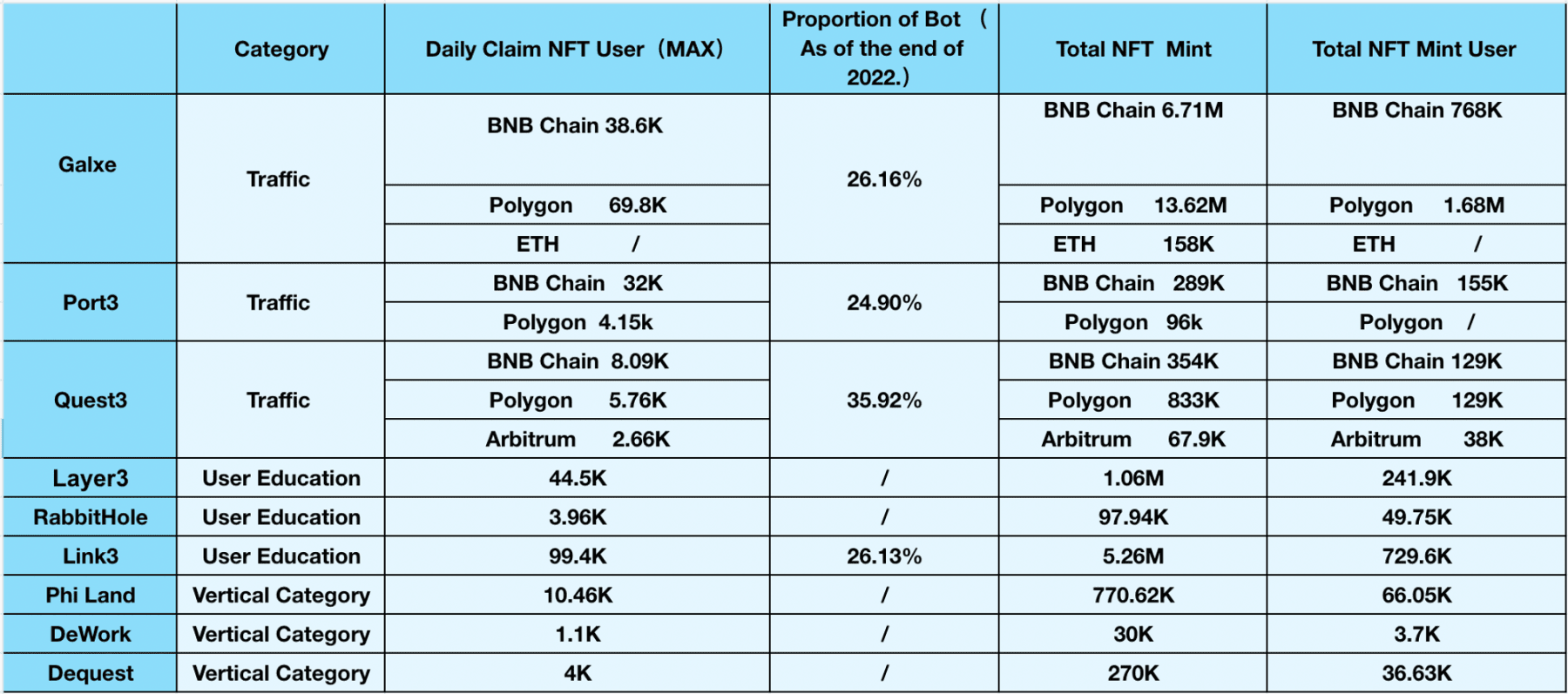 Comparison of NFT Mining indicators across platforms, data comes from Footprint
According to data, there are huge differences in user traffic between different platforms. Among them, Galxe occupies a unique position in the early market by virtue of its first-mover advantage and multi-chain layout, while other projects belong to the second tier.
The siphon on the head platform is obvious
As an OG-level platform in this field, Galxe has always maintained a "siphon effect" in its development process. Just like Opensea, early development accumulated a large number of users, allowing Galxe to still make gains even when the overall market popularity declined. Although user growth has slowed, Galxe still has clear advantages, one of which is its large size. The market has been improving recently and the market is active. Galxe can still maintain a high growth rate by relying on its advantages. For example, in the figure below, the proportion of new users of Galxe exceeds 50%. Therefore, judging from this trend, the platform represented by Galxe will still lead the track in terms of traffic in the medium term.
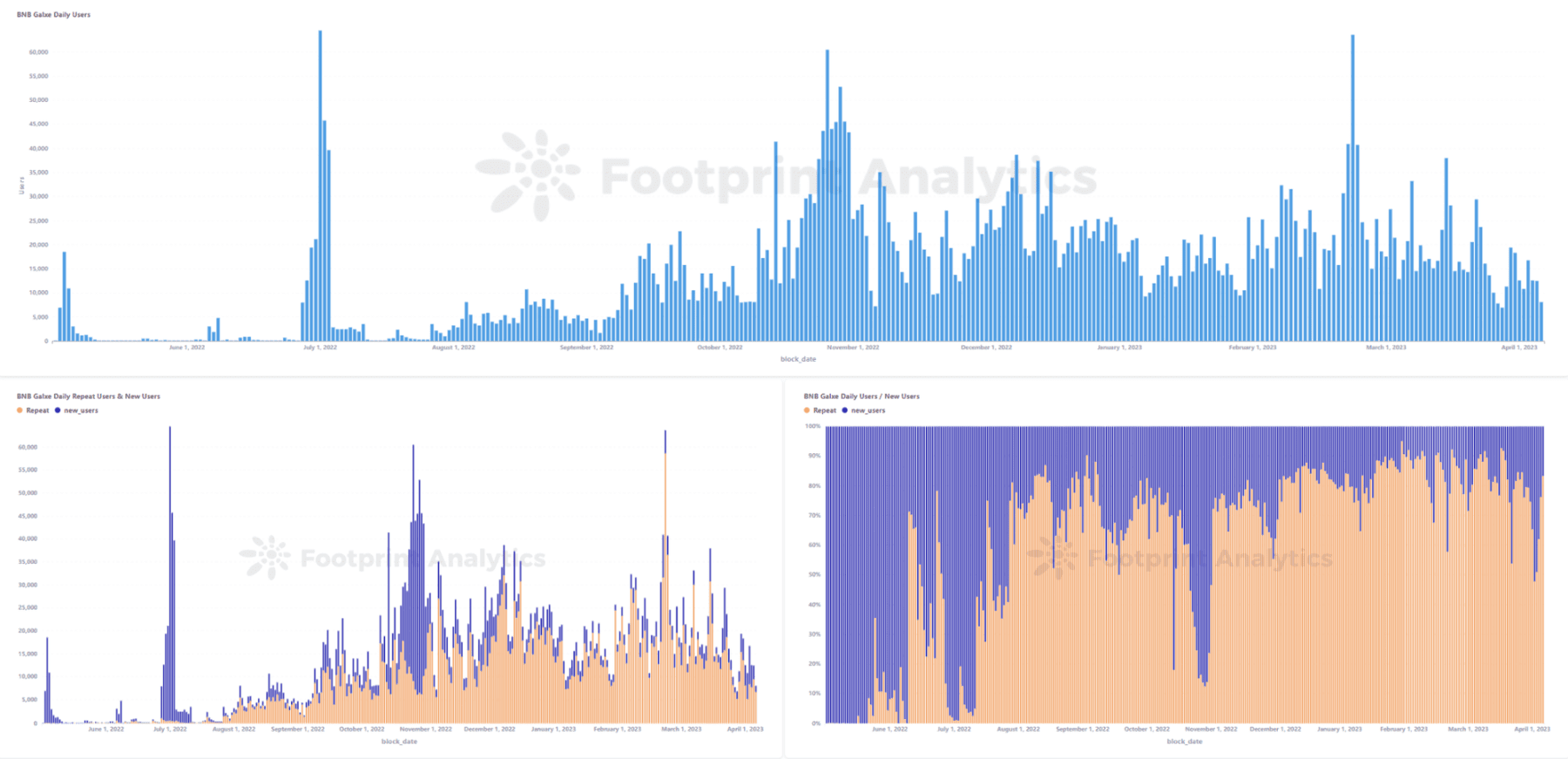 NFT Mining situation on the Galxe chain, data comes from Footprint Second-tier, long-tail platform growth grew slowly after a brief burst
Except for Galxe, other second-tier and long-tail platforms basically show a trend of first explosion and then sluggish growth. For example, the NFT Claim User growth curve of most platforms is gradually leveling off.
After 2023, cryptocurrencies have rebounded as a whole, and on-chain gas consumption has soared, indicating that there are always hot spots in the market. However, the overall number of projects in this field has increased, and users have been dispersed. At the same time, the head platform with overlapping functions with other platforms has always maintained a siphon effect. Therefore, most second-tier and long-tail task platforms will disappear after a short burst. It tends to grow slowly or even negatively. In particular, vertical segmentation platforms that overlap in certain functions with traffic and education platforms have a more difficult development situation (poor performance in terms of data).
Therefore, we believe that after the head and second-tier platforms have established a certain market share, it will be very difficult for niche and vertical platforms to develop unless they achieve No. 1 and require a high degree of cooperation from the development of the track industry. , it is possible to break through the siege.
Ecological bottom layers with lower costs are more popular
BNB Chain is currently the most popular underlying layer. The vast majority of task-oriented platforms will first choose BNB Chain, followed by Polygon. Because Claim NFT is a high-frequency behavior (70% of the platforms we reviewed use BNB Chain as their “home base”), on-chain transaction costs and response speed are priority factors. In fact, the main purpose of users participating in the task platform is to obtain potential benefits, but user Claim NFTs, medals, etc. cannot be directly converted into gains or benefits (only a small part can be directly realized).
Currently, various NFT medals are "flooded" on the mission platform, and many users say they often receive Claim NFT emails from Glaxe. There may be no users coming to claim these NFTs after the event is released, so participating users will be more concerned about the costs that may not bring in revenue.
Therefore, the lower the cost, the more popular the bottom layer will be, such as the Move language Layer1 public chain, ZK series, and OP series Layer2, which will become the new direction for the expansion and layout of such platforms.
The model based on NFT Mining can no longer support the growth of the Quest platform
Since the NFT craze has passed, the Quest platform has generally distributed a large number of NFTs, many of which are badges with low application value and cannot be used for transactions. They are more used for identification, and their appeal to users has gradually weakened. In a bear market, users pay more attention to the actual Token income they can obtain. Therefore, the number of NFT Mining on the chain can no longer represent its importance. What is more critical is what use these NFTs are for, and from the perspective of user psychology, which brands have entered the user's mind.
In addition to NFT Mining, only such platforms can continue to survive if they can develop scenarios that truly attract users and solve their pain points.
Products with rich product functions and more outstanding operational capabilities have better development prospects.
From an operational perspective, there is overlap in the capabilities of these Web3 mission platforms. They basically include 5 modules: on-chain tasks, off-chain tasks, reward distribution, data analysis and scene coverage. In general, there is little difference in the functional points of each platform. The overall situation is multi-scenario coverage, with off-chain verification as the mainstay and on-chain verification as a supplement. They are each highly replaceable.
However, in the case of overall homogeneity, projects with more outstanding operational capabilities are more likely to win in the market. Currently, the second-tier platforms on the market all have certain advantages in certain aspects and can better meet market needs. Therefore, when the overall functions of the track are too homogeneous, a platform that can follow hot spots in a timely manner and solve user pain points is more likely to be accepted by the market.
Existing users have the potential for sustainable activation
In task-based platforms, usually more than half of the users are not very active in participating in platform activities. We found that on the task platform, the proportion of users who have claimed NFT less than 5 times is usually between 60% and 80%. This means that the vast majority of users are "low-frequency" users. These users are expected to be continuously activated through innovative mechanisms, which also confirms the sustainability of the development of the task platform itself.
Of course, task-based platforms themselves still have problems with real users. Currently, the robot rate of most platforms is between 20% and 30%. For example, Galxe's bot rate is over 25%, while SoQuest, Quest3, Link3, etc. are almost all over 20%. In this regard, TaskOn does better, with a bot rate of only around 7%, which is more realistic.
In addition to learning from the experience of platforms such as TaskOn in preventing robots, further adoption of DID will also be more effective. Many task platforms are also developing into the identity layer field.
Among the three types of platforms: traffic, education, and vertical subdivisions, traffic has greater advantages.
The crypto industry is currently in the early stages of development. This means that on the one hand many projects are in the early stages of development, and on the other hand a large number of new crypto projects are emerging every day. From the perspective of the Web3 world, attracting user traffic into the ecosystem is the most basic and urgent need in the early operation and early launch of the project. After many encryption projects have passed through the early stages of development and have a certain ecological user base, further guidance is needed to further guide users to use, experience products, and understand the ecosystem.
Therefore, in the early stages of the development of the encryption industry, we are more optimistic about the development of traffic platforms (with the purpose of helping projects import user traffic). Galxe's performance has already set an example for us. Moreover, there are currently a large number of traffic platforms in this track. Although the competition is fierce, it is relatively in line with the tone of the early development of the industry.
A platform that can achieve profitability in a short period of time has long-term development prospects.
Of course, the Web3 task platform also needs to consider its own profitability. They need to stand out among many competitors and quickly attract users and investors, while also taking into account operational and marketing investments, so rapid profitability is particularly important.
In addition, rapid profitability can also help the platform provide competitive incentives and support, quickly gain market share and reputation, trust and security indicators, while also being able to withstand potential market risks and derived operational risks, etc. In addition to charging project parties fees and issuing tokens (actually issuing tokens may not be a good choice), currently the major platforms do not seem to have a better profit model to support them, and projects intending to issue Tokens do not have better scenario support. .
SoQuest layout and perspective
In the competition for the Quest platform, who can develop more maturely and who can more accurately judge the next new direction will win this competition. SoQuest has accumulated a mature functional system, and various functional modules are also available. SoQuest has accumulated 500,000 registered users in the general traffic pool and covered 7 million community users. These community users can be reached through robots, completing the first step of traffic accumulation.
SoQuest now has a complete product foundation:
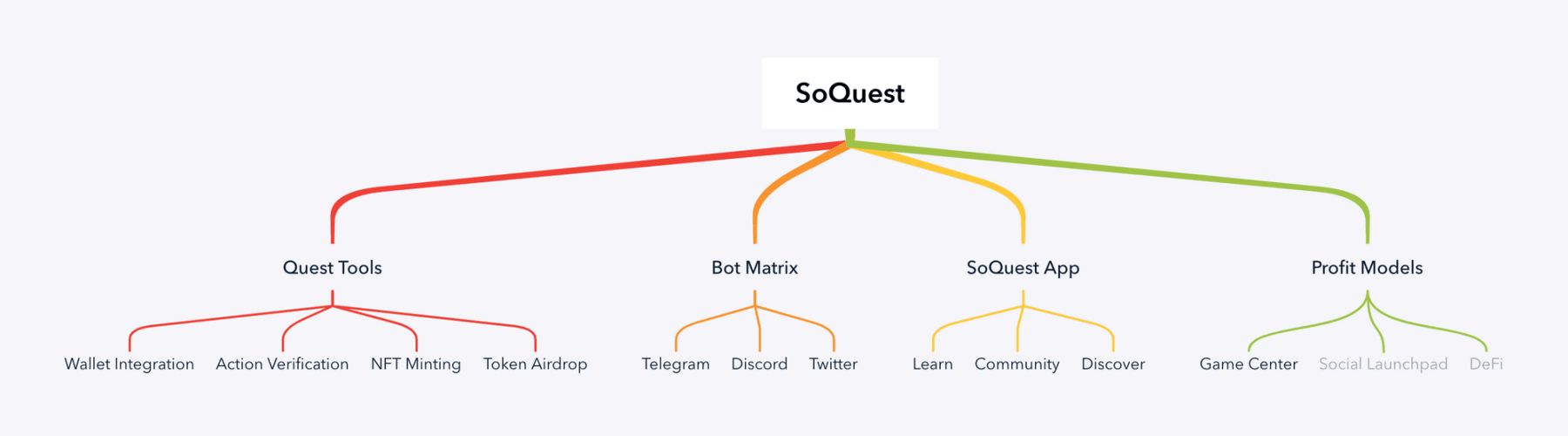 SoQuest product foundation and profit model
In fact, Quest's competition is already entering its second half. The arms race in the functional dimension has come to an end, and the iteration of functions has gradually matured. However, among all the Quest platforms, there is no particularly disruptive innovation, and no one really completely dominates the market and becomes the only one in the minds of users. The second half of the Quest competition will revolve around this theme.
We excerpt a few more representative projects from the table below to get an overview of the functional coverage of each platform:
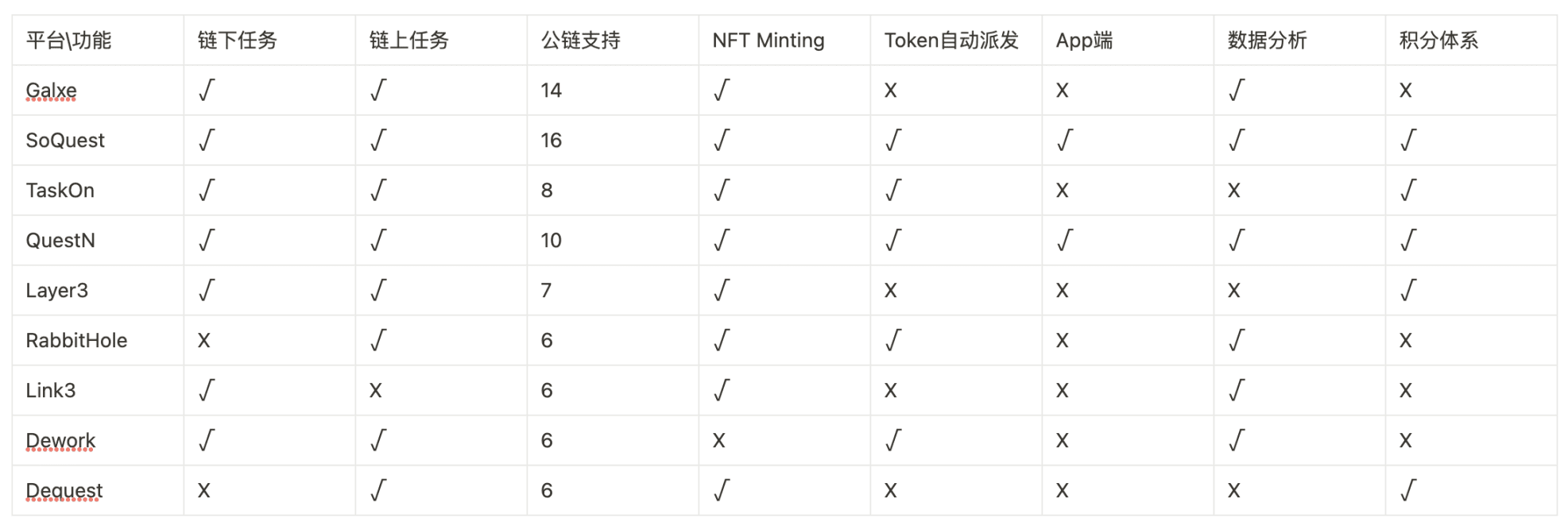 Comparison of mainstream functions and public chain support of each platform
Based on the current status quo, SoQuest will expand the imagination of the Quest track from three different angles:
Build a long-term value flow pool
Reconstruct the Quest experience, focusing on accumulating the value, belonging, fun and sociality of the platform
Build a unique profit model to convert traffic into revenue
Build a value flow pool
For the construction of traffic pool, SoQuest adopts the strategy of open source and deep cultivation.
The so-called open source is to find more projects to expand the traffic pool. SoQuest has recently been actively introducing well-known projects from various public chain ecosystems. For example, it has recently fully supported the Sui and zkSync ecosystems, and introduced multiple Sui ecological head projects such as Cetus, Suiet, and Martian. SoQuest's Dashboard provides a complete set of analysis tools for the public chain ecology, which can help ecological operation leaders and investors understand the Github and social dynamics of ecological projects or portfolio projects, so as to quickly provide feedback on the current status of the project, so as to conduct appropriate series cooperation and Survival of the fittest.
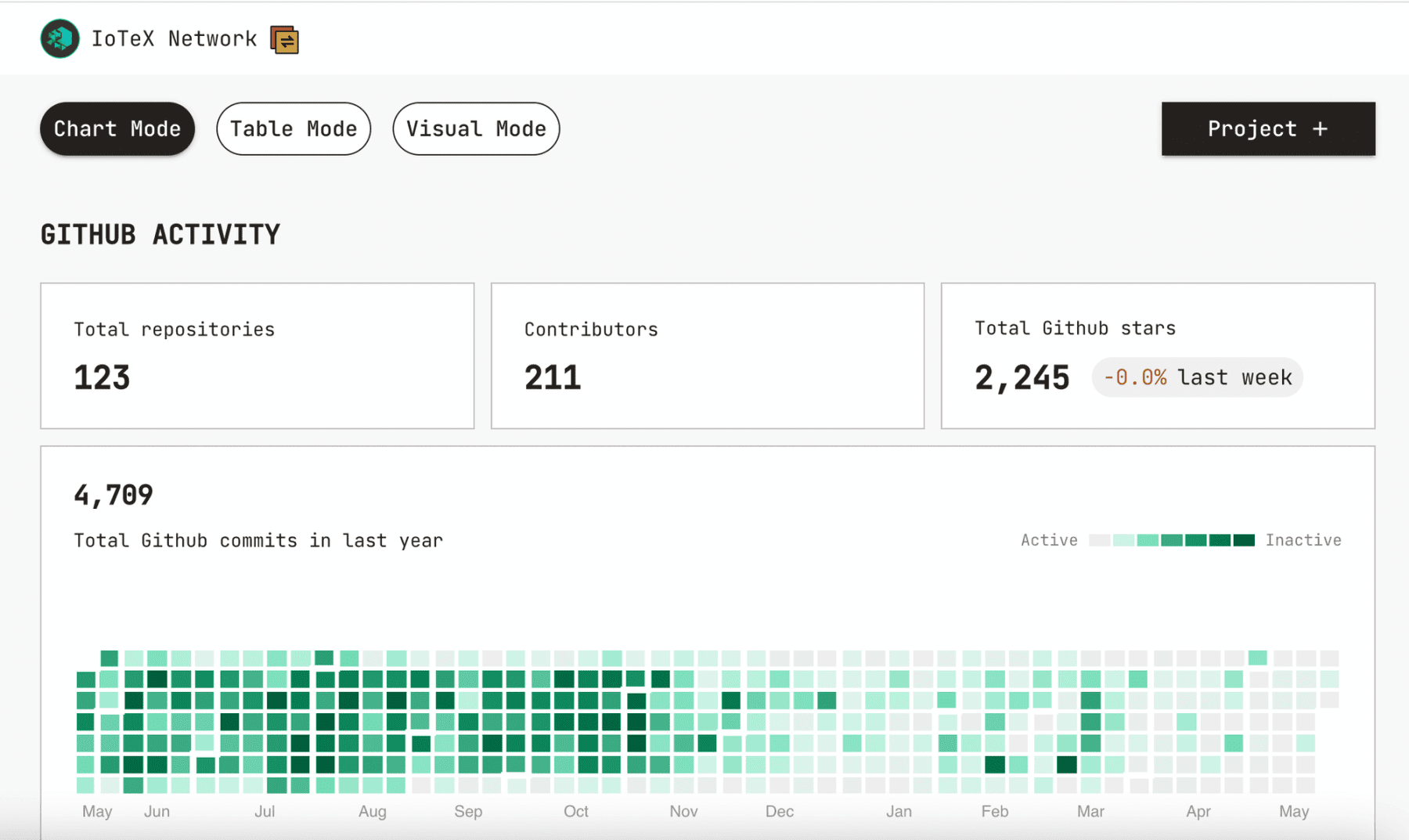 An analysis dashboard provided by SoQuest for the IoTeX ecosystem
In terms of traffic cultivation, SoQuest develops mobile terminals and allows users to retain conversions internally. In the next Quest competition, it doesn’t matter how many users pass through, but how many users stay is more important. In Web3, mobile users have always accounted for more than 60%. SoQuest released the app in April this year. It has been launched on the AppStore and Google Play and is available for download to users across the Internet. It has received more than 100,000 downloads so far. SoQuest App supports many Web2 login methods in order to attract more new Web2 users. In addition to the already covered channels such as Twitter, Telegram, Discord, etc., SoQuest will acquire new users through more channels such as Facebook, Youtube, TikTok, etc.
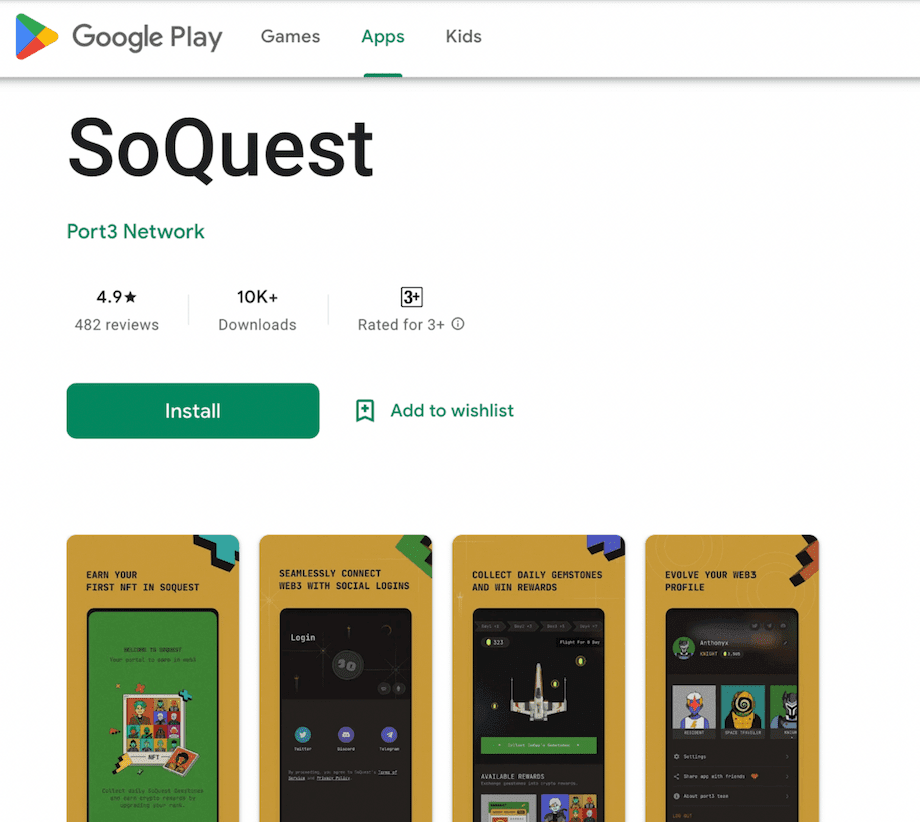 SoQuest App has received over 10k downloads on Google Play
Through the Learn, Community, and Discover modules in SoQuest App, we can guide new users to educate, explore, and discover, thereby achieving traffic conversion. This will give SoQuest the ability to host and convert these new Web2 users.
Reconstructing the Quest user experience
In terms of user experience, the previous Quest purely turned the user into a repetitive machine, and the entire task process was very boring. Users need to spend a lot of time completing tasks one by one, and the only reward is cash or NFT rewards, with no other social or emotional value, so users will not participate in each activity carefully. If you only focus on Quest itself, you will fall into a vicious cycle and become a buying platform, and the rewards will be swiped away by professional users. This is also the reason why the Quest platform has a high bot rate.
Therefore, SoQuest changed its old direction and tended to build a more benign encryption community, where both project parties and users can find value and a sense of belonging. This requires integrating four features into the product to deeply connect the platform and users.
value
For projects, SoQuest actually provides two aspects of value: tool value and traffic value.
In terms of tools, SoQuest supports 16 public chains and provides complete functions such as wallet connection (address collection), on-chain detection, NFT Mining, and Token distribution. These features are sufficient to meet most of the Quest needs of 80% of project parties. At the same time, using SoQuest’s AI-assisted design and automated token distribution can save users a lot of time in design and operation activities.
SoQuest is equipped with complete analytics capabilities for Quests and projects, helping projects gain a clear understanding of each Quest’s exposure and participation. At the entire project level, we also provide My Space analysis, track the key indicators of the project, and the overall growth of the project community, and draw a funnel chart.
At the traffic level, we bring exposure and traffic to the project side. By optimizing the recommendation algorithm, we provide users with recommendations such as top quality activities, Token reward activities, latest activities, high-quality projects, and latest projects. It is easier for users to find target activities through our categories. Projects and high-quality activities that use SoQuest for a long time will be given top priority and recommended support. High-quality projects are more likely to receive support and gain rapid start-up and growth from the traffic pool gathered by SoQuest.
Attribution
One problem with the Quest platform is that the platform has poor stickiness, and users focus more on rewards than on the project itself. In addition, the functions of various Quest platforms are mostly similar and are very substitutable. The migration cost for users to move from one platform to another is very low. When users transfer from the Quest platform to the project side, the Quest platform cannot form enough user stickiness, and the project side may not be able to retain useful user traffic. They can only expand the incoming traffic, and then filter it layer by layer, leaving what they want. loyal users.
Therefore, SoQuest strives to build long-term relationships between projects and users. After users join the community, they should be able to participate in many activities, such as paying attention to the latest developments of the project, entering the community, conducting purposeful on-chain interactions, gradually upgrading in the project, and becoming an OG from a novice. Therefore, SoQuest put more effort into the organization of Project Space.
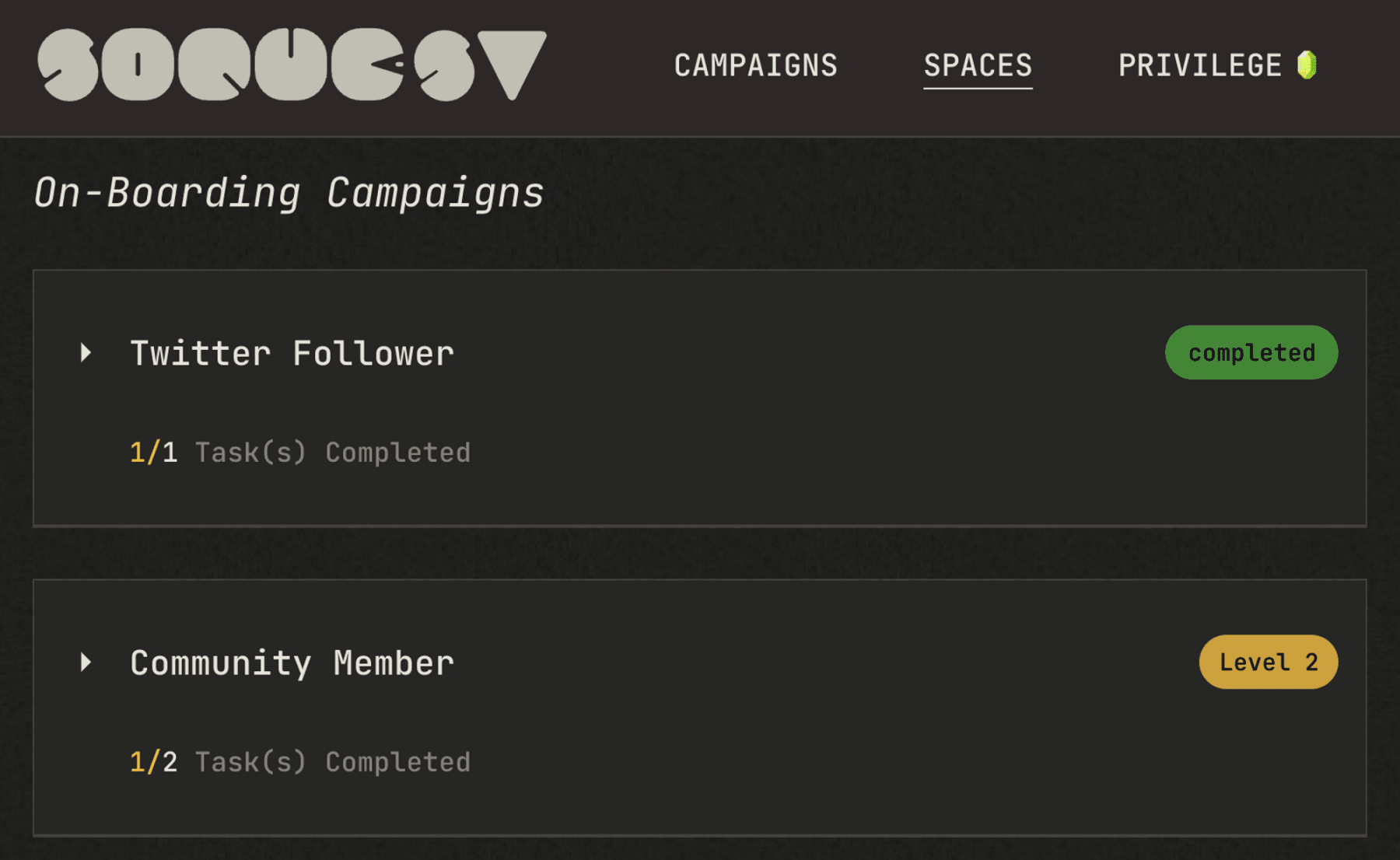
SoQuest introduces the OnBoarding activity type. Through Onboarding tasks, you can build an effective user growth path. Users complete tasks step by step and gain growth. This approach is a healthy development for the project and users. In addition, the Badge generated by Quest is no longer just a random souvenir, but can actually be used for level verification. Users gain a sense of belonging in the process of upgrading. They are no longer just passers-by to the project, spending time every day swiping back and forth for a little reward.
In addition, SoQuest has also created a points system, avatar NFT and user growth path to allow all users to gain a sense of belonging on the platform. We hope to provide more users with something other than ordinary rewards, allowing users to learn, communicate and make money on this platform. We also hope to help the project gain real users and further develop and grow.
Hobbies
Quest's work is generally boring, and SoQuest has introduced games to relieve users' boring mood in the process. Integrating the game directly into Quest cannot achieve the goal. Users can neither focus on Quest nor on playing the game. Therefore, the strategy we adopt is to speed up the user’s Quest process and save users’ time. The time saved by users can be used for entertainment. In the new version, SoQuest introduces the Game Center module to bring fun to users' Web3 experience by cooperating with third-party game platforms.

sociability
In SoQuest, we achieve coverage of more operational scenarios by connecting to external applications. The new scenarios introduced must have social attributes, so as to enhance the relationship between the project and users. Recently, SoQuest and Famlive reached a strategic cooperation to fully integrate the Twitter Space scene. We scan all Twitter Spaces related to Crypto across the entire network. Users can participate in the channels they are interested in and chat and interact in Twitter Spaces.
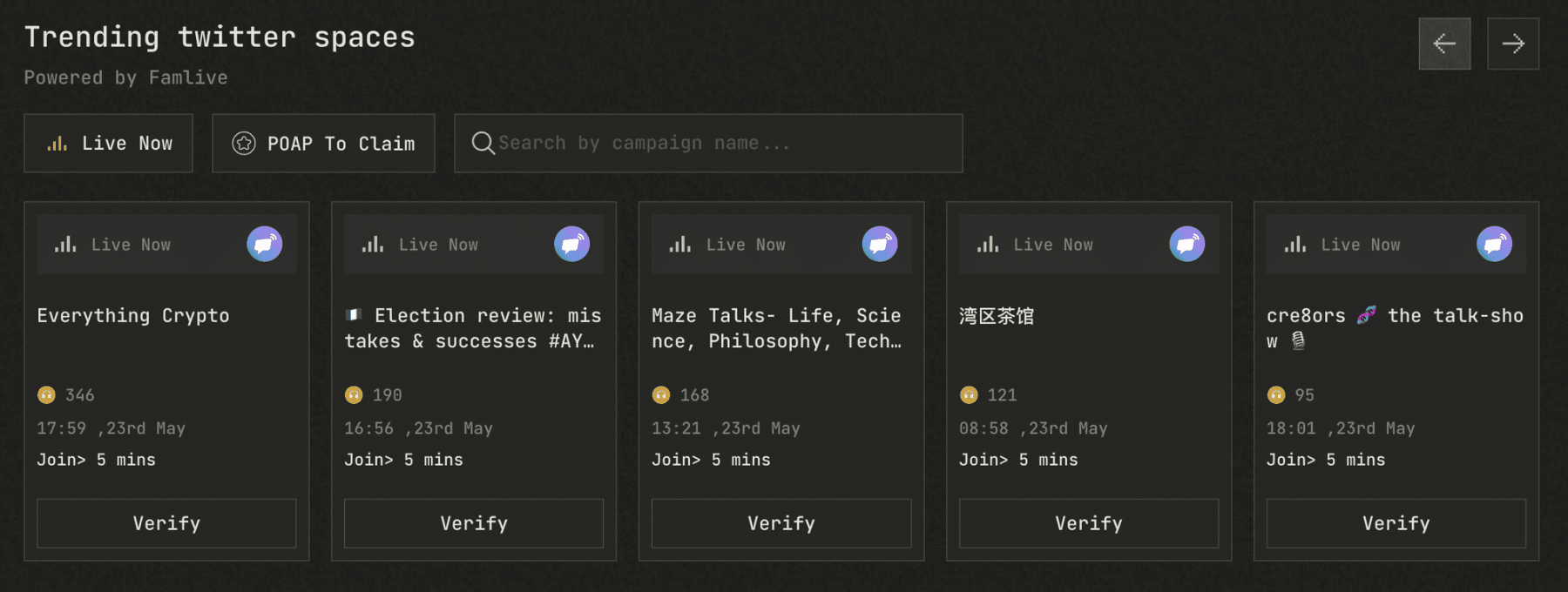 Network-wide Twitter Space module
In subsequent planned functions, SoQuest will continue to enhance social attributes to create chemical reactions between projects and users, and between users.
Build a unique profit model
The Quest platform has an advantage, that is, it has both B-side and C-side users, and develops C-side users through the process of serving the B-side. SoQuest has insisted on using the free strategy to serve B-side users for a long time, allowing it to quickly acquire a large number of users in the early stage. Some platforms have set high charging standards, but when project parties are unable to obtain value exceeding the fees through the platform, or save the same cost, relatively few projects are willing to pay, so we believe this strategy is unsustainable.
SoQuest takes a different approach. When all Quest platforms enter a period of slow growth, they should build more scenarios where users can retain them and allow users to circulate among them. This is the most direct way for the platform to gain revenue. Many people think that Quest users are just fools, but we found through on-chain tool analysis that we have a large number of users who overlap with DeFi. They have enough assets and DeFi needs, but what they lack is suitable scenario guidance and user discovery.
Earning revenue by guiding users in the traffic pool to use our games and DeFi modules, and charging fees in the process of serving users, is SoQuest's ultimate solution to the problem of profit model. Currently, the SoQuest Game Center module is online and has passed the grayscale version and is open to all users to experience. In the future, it is also planned to launch Social Launchpad and DeFi modules to achieve on-chain conversion of users.
The concept of Social Launchpad, as well as the DeFi module, also adhere to the above value principles and are centered on services and users. SoQuest will be integrated into Quest in the most appropriate way to achieve mutual benefit for the platform and users.
in conclusion
When the bear market comes and growth reaches a bottleneck, the competition on the Quest track has entered the second half, and the quality will no longer be judged by the number of functions and the amount of NFT Mining. But it depends on who can use the existing tools to unite project parties and users, become a real Web3 Portal, occupy users' minds, earn income and continue to live.
The Quest platform actually continuously indexes projects, users, contracts, events, and user behaviors in the entire Crypto field, thereby achieving the construction of user identities and covering almost all Web3 scenarios. SoQuest clearly saw this and proposed a new development strategy. Only by fully realizing the construction of traffic pool, reshaping of user experience, and realization of profit model can we become the new leader among many Quests.
This article Web3 Trend | What is a task-based marketing tool? SoQuest looks at the development of Web3 Quest first appeared in Chain News ABMedia.