


Often with drops, it goes like this: most people know about a certain drop, but don't do anything about it and only remember it when another story about a big reward comes out. According to Google Trends, after the announcement of the Arbitrum drop, the number of searches for the word "airdrop" doubled, and the number of new addresses in the zkSync testnet increased fivefold. And that's just in one week.
However, such a sporadic and emotional approach to giveaways usually results in disappointment in the form of an empty wallet or a couple of bucks in low-liquidity tokens. To really earn from drops, you need to turn the hunt for giveaways into a full-fledged activity. That's why today we'll take a detailed look at what drops are, why they are conducted, and how to organize a systematic drop-hunting for earning.
What are token drops and what types of drops exist?
During the early days of the crypto market, from 2014 to 2017, the format of ICO was used to raise investments: developers released tokens and early investors bought them with other cryptocurrencies or, less commonly, fiat. The team was supposed to create a promised product that would create value for the issued tokens with the money raised. However, over the 3 years of ICO existence, they proved themselves not to be the best option due to a large number of scam projects and lack of guarantees for token holders.
Therefore, since 2017, blockchain startups have started using a new strategy to enter the market: free or conditionally free token drops to active users.
Note: These giveaways are called "drops" or "airdrops" because developers "drop" tokens into wallets that meet certain criteria.
During the crypto winter of 2018, when retail investors were afraid to invest in crypto projects, drops were more effective at attracting attention and a new audience than the discredited ICO approach.
The first project to enter the market through a drop was AuroraCoin ($AUR) in 2014. The team planned to create an alternative currency for Iceland, and although it sounds crazy, the project is still alive. Press F for the pioneers.
Types of drops
Depending on who and for what the project distributes tokens, there are several types of drops:
Free drop: tokens are distributed to anyone interested with certain restrictions on the volume of distribution. To participate in a free drop, you usually need to provide your wallet address and complete simple conditions, such as subscribing to social networks. However, unconditional free drops are now practically non-existent, as the format involves developers giving away the conditional value of the project without receiving anything in return from users. Moreover, free drops are often used by scammers as bait: users are offered to connect their wallet and receive free tokens, but in the end, after approving access, they lose all their assets.
Hold drop: tokens are given to users who already have other tokens or NFTs in their wallet. The most well-known example of such a drop is $APE, which was created as the native token of the YugaLabs ecosystem. After the launch of $APE, free tokens were immediately distributed to owners of NFTs from the BAYC, MAYC, and BAKC collections, in proportion to the number of NFTs held. To participate in such a drop, you simply need to hold certain tokens in your wallet, and the list of addresses that qualify for the drop is determined automatically. The assets held serve as a marker of the potential audience's quality for developers.
Bounty drop: to encourage activity and expand their user base, some projects give out tokens as a reward for completing tasks. A good example is the Trader Joe's Arbitrum Adventure, where all Trader Joe's partner projects rewarded those who successfully completed quests in Crew3. These quests usually involve tasks like "open N number of orders" or "provide N liquidity volume to the pool," and various platforms often publish similar campaigns. We will discuss this type of activity in more detail below.
Lockdrop: a rare type of giveaway where a project distributes its native tokens among users who have locked their assets in another network. For example, to participate in the Edgeware (EDG) drop by Commonwealth Labs, users had to lock a certain amount of ETH in the Ethereum network. After the lockup period ends, the lockdrop participant receives both their ETH and the project's tokens. This asset lock is a kind of pledge that confirms interest in the new project. Although the owner does not actually risk their assets, the lock demonstrates their willingness to forego other income opportunities for the sake of the project.
However, the most potentially profitable type of giveaway is called a "retrodrop" - when a project launches and distributes tokens already having a working or test product. The feature of retrodrops is that the conditions for receiving them are not known in advance, so in theory, this distribution method allows to identify truly loyal and active users who interacted with the product without additional incentives. Projects such as Arbitrum, Aptos, 1inch, Uniswap, and others distributed their tokens through retrodrops.
However, rumors and speculations about the token launch and activities for participation in the giveaway often appear long before the official announcement. For example, rumors about the possible $ARB token appeared almost immediately after the network launch, and the official drop and participation conditions were announced only on March 16, 2023. During all this time, users were showing activity "at random" to meet hypothetical distribution criteria.
There are also "forkdrops" - when cryptocurrency owners receive a proportional amount of coins from a network fork: for example, BTC owners received BCH, and ETH holders were given ETC. However, this type of drop is related to cryptocurrencies, not tokens, works unconditionally, and exists due to blockchain technical features, so it is not the main goal for drop hunters.
What are the benefits of drops?
Airdrop has evolved into a full-fledged market entry strategy and is still used today thanks to the values it provides to developers and regular users. It is a kind of compromise, a win-win strategy in which the risks and potential benefits of both sides are more balanced.
The main advantage of airdrops for a project is that it is a more effective way to attract a loyal audience than just selling tokens to investors and listing them on exchanges. This is due to two features of the crypto market:
Speculators and those looking for easy profits are likely to be the ones buying tokens during an IDO or listing, and these people are often not interested in the product itself. This means that a direct sale to the market is likely to lead to subsequent dumping and a loss of project liquidity.
The ability to track on-chain wallet activity allows for the determination of a user's level of interest in cryptocurrency, which projects they have interacted with before, whether they are focused on a specific segment, and so on.
All of this allows new projects to do what traditional market marketers take years to do - find the most relevant target audience and attract their attention to a new product through the distribution of free tokens.
At the moment, the effect of these advantages is being nullified by a large number of abusers and increasing competition in the market, but drops still effectively solve the problem of "cold start" and the cost of attracting an audience.
Token giveaways are also used by developers to enter the competitive market through a so-called "vampire attack". A vampire attack is when a project distributes its tokens to a competitor's community to stimulate them to use their platform and "vampire attack" the audience of the opponent. That is, the startup is not looking for new users, but deliberately luring the established audience of the competitor.
Note: In 2020, the platform SushiSwap conducted a vampire attack, rewarding users with $SUSHI tokens for staking their LP tokens from Uniswap pools on SushiSwap. Although this was not a pure drop, the $SUSHI reward can be considered a hold-drop for Uniswap stakers.
Another example is the NFT marketplace LooksRare, which gave out native $LOOK tokens to OpenSea users who had conducted transactions worth 3 ETH in the last six months. The catch was that participants had to list an NFT on LooksRare to claim the drop.
For users, the value of drops lies in the fact that they:
Free activity: Drop hunters are primarily after profit. Drops allow them to get tokens much cheaper than the purchase price for public investors, which means that the ROI of drop hunters can be higher than that of investors. It is the possibility of getting a token without investment (excluding operational expenses) that attracts crypto enthusiasts. Especially considering that the entry threshold for a public investor buying tokens on launchpads is higher than that for a drop hunter.
The opportunity to become part of the community: Native tokens are needed to provide privileges when using the product or managing the project. In both cases, the drop recipient becomes part of the community, and bonuses or a share of power are provided to them through tokens when making decisions. That is, even if the hunter does not sell the tokens, they will receive indirect benefits when using the product.
Reward for activity and loyalty: Often, loyal users are willing to support a project simply because they see its potential and value for the market. Income is not their main goal, but thanks to the drop, they understand that their efforts have not gone unnoticed. Tokens for such crypto enthusiasts are primarily social and reputational capital, rather than financial.
By the way, participating in drops shows that the user is an active crypto enthusiast and allows them to earn a reputation in the community. If you are attracted to the fame of Twitter or TG influencers, but your wallet is empty, then active and systematic drop hunting is one of the shortest paths to recognition.
How much can you earn from drops?
Dropshipping is available to users with any deposit and level of experience in crypto, so literally anyone can earn from these activities. Of course, large holders earn more due to their financial capabilities, but even a beginner can catch their game-changer with diligence and a bit of luck. Here are a few examples:
Everyone who participated in the Aptos testnet and simply minted NFTs in their wallet received 150 $APT. The most patient ones could sell them at the peak for $19, but even those who immediately dumped the tokens received their $1000-1200. Just for minting NFTs in the testnet.
Uniswap dropped at least 400 $UNI to users' wallets on the DEX (although these are not the largest amounts). And again, you could immediately fix $1200 at a price of $3 per token or hold until $40 and get $16,000.
On average, 1inch gave loyal users about 600 $1INCH. At TGE, these tokens were worth about $600-800, and at the peak, such a bag could be sold for $4200.
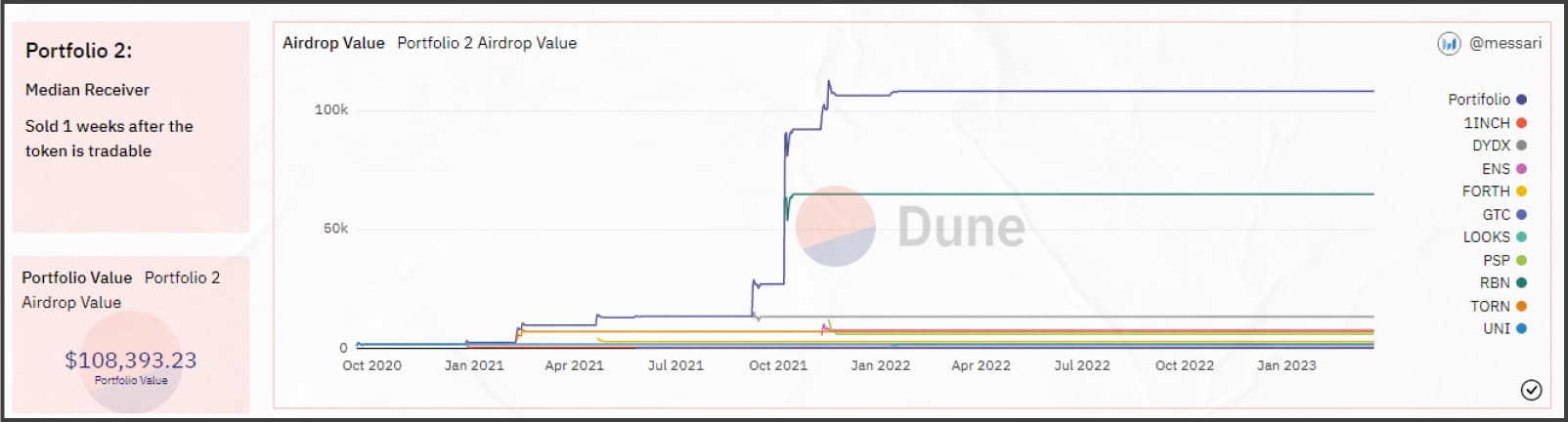
And this is just the tip of the iceberg. According to the Messari dashboard, users who received and sold 10 large drops (Uniswap, TornadoCash, GitCoin, dYdX, and others) within a week could earn an average of over $100,000:
But that's not the limit. According to lookonchain, Tier-1 dropshippers received anywhere from $50,000 to $250,000 in tokens from various projects:

Yes, this list includes holders of large deposits who provide the project with much more capitalization and value than the average user, but even a lack of deposit can be compensated by using multiple accounts.
For example, in Arbitrum, anyone who used a bridge to transfer assets to the network could earn 600-800 tokens. And it was possible to deposit a small amount in ETH through the bridge using 5, 10, or even 20 accounts, which means x5, x10, or x20 to 600 tokens. Therefore, if you consider drops as one of the main activities in crypto, it is also worth understanding the basics of multi-accounting.
If you are serious about making this a main source of income, you need to take it to an industrial level in one way or another.
This means learning how to automate actions (it's very difficult to achieve significant amounts manually), understanding the market (so you don't waste time on fake projects and understand the selection criteria for worthwhile projects), being disciplined and hardworking (so you can continue to take necessary actions even after initial failures).
But if you possess these qualities, in my opinion, it would be much more productive to engage in something more constructive, such as helping a project with tasks they can't handle, as a user (this is usually rewarded better than retro drops), or even starting your own project. In short, build! Drops will come anyway, albeit in slightly smaller amounts.
How big of a deposit is needed?
Typically, on one account, losses that cannot be recovered rarely exceed $50-100. This means that in terms of capital, you are only limited by proper portfolio management (how much you can afford to lose in case of an incorrect bet) and your technical capabilities (how many accounts you can create that don't look like the work of a bot).
How to get drops to your wallet
It is possible to earn money through drops, and we have even seen potential sums, but how do drop hunters manage to get free tokens in such large quantities? The key to effective results is systematic approach, so in order to become a professional drop hunter, it is important to clearly understand the following points.
What to do to get drops
The conditions for participating in giveaways and specific activities vary from project to project and depend on the product development stage. The actions of drop hunters can be divided into the following categories:
Interaction with the product: involves exchanging tokens, using bridges, providing liquidity, and using other product features. To receive a drop from a DEX, it is important to use liquidity pools and conduct swaps. NFT marketplaces reward users for transactions on the platform, and blockchains reward users for regular transactions, etc.
Note: expenses for this category of activities include paying fees, occasional losses, volatility, and other factors, so at least a small deposit is required to participate.
Quests: specific rewarded activities aimed at raising certain platform metrics (number of users, trading volumes, etc.). Projects usually conduct quests through third-party services such as Galxe, Crew3, or Layer3. The conditions of the quests are known in advance, which distinguishes participation in them from retro drops hunting, where it is not clear what exactly to do to receive a reward.
Note: Quest campaigns are conducted in a gamified form using NFTs and incorporating a background story, often fan-based. Such activities are easier to understand and more accessible to newcomers.
Testnets: Before launching in the main network, a project usually tests the functionality and security of the product in a testnet. For users, this is an accessible way to earn reputation in the project, get into the next testing phases, and gain advantages in the distribution of drops. Additional rewards are paid to testers who have found errors in the product's operation, but this is more about bounties than giveaways.
Note: Real tokens are not required to participate in testnets, so there is no risk of losing savings, and during testnet programs, users learn to interact with dApps and different types of platforms. This is also a good way for newcomers to start a career as a drop hunter.
Ambassador programs: Ambassadors help create and distribute content, translate materials, and increase brand awareness in their environment, for which they receive rewards, often in the form of native tokens.
In some cases, drop hunters can become project employees, providing value as researchers, community managers, translators, etc. If you don't have a deposit or the desire to abuse the project, you can go the alternative route of a worker and receive drops as a reward for work.
Where to find fresh airdrops
New drops are announced in crypto every day. Sometimes they are big and juicy like Aptos, sometimes smaller ones from DeFi platforms and other services, but there are always activities that allow you to claim tokens. To track them, you can use:
The Airdrops section on CoinMarketCap: among other information, CMC offers a list of rewarded activities from various platforms and services, with detailed step-by-step instructions. However, these are exclusive activities for CMC users, and the rewards are usually small projects and amounts.
The AlphaDrops airdrop aggregator: a new but rapidly gaining popularity service. The main advantage of AlphaDrops is that it collects a large number of activities, even from lesser-known projects, and offers additional tools for drop hunters within one platform. However, there are no detailed instructions on AlphaDrops, so it may be difficult for beginners.
Telegram channels: alpha hunters publish fresh announcements and activities on their social networks, often with tips based on personal experience or detailed step-by-step guides.
But it's important not just to search for new drops, but also to keep track of your activities. This will help organize your participation in various campaigns and systematize your actions, as it's simply impossible to keep everything in mind on 3-5 projects, especially if you use multiple accounts.
Note: the easiest way to keep records is an Excel spreadsheet, but you can use any other convenient tool, from Notion and organizers to a pen and paper notebook. The main thing is not to get lost in the flow of information.
Safety rules for dropshunters
A distinctive feature of dropshunter is the large number of beginners and their desire for quick and easy earnings. Scammers take advantage of this and hunt for drop hunters themselves, so it is important to understand the dangers that an inexperienced (and sometimes experienced) dropshunter may face:
Phishing: primarily fake sites for claiming tokens or "prizes," and less often fake pages with activities or mailings with offers on behalf of the project team. The goal of these tricks is to make the user click on a phishing link and give access to their wallet.
Rugpulls: since the flow of drops of different levels is quite large, often beginners perform all activities in a row, betting on the number of accounts and participations. Some of these projects are pre-scam and the main goal of their drops is to fill liquidity pools or earn commissions. After collecting funds, the team usually disappears, leaving the community with an unfinished product at best.
Hacks and exploits: drops usually announce services at an early stage of development, which have not yet properly passed security audits or have not encountered real stress tests. Therefore, during activities, exploits may be discovered that allow attackers to steal your assets.
To protect your assets from scammers when participating in activities, it is important to follow a few basic rules:
Verification of announcements: phishing links are often spread through private messages or announcements on social media. Such announcements are published by "clones" of the project or a hacked official account, so if you come across a suspicious announcement, check the information directly with the team. This can easily be done through the project's Discord, feedback form on the website, or DM on social media.
Special wallets: for participation in a drop, a "warmed-up" wallet with a transaction history is needed, but it is better if it is a special address for distributions with a dedicated amount of assets, rather than your main wallet. This will help protect most of your savings if you still encounter scammers.
Risk management: unknown projects should always be perceived as high-risk. Even if it is an honest startup, it may suffer from hackers and lose user funds, so when interacting with small and unknown platforms, it is better not to provide large deposits and not to open large orders.
Special services: use Rugpull detector to check a suspicious token or smart contract you are interacting with, as well as Revoke to quickly revoke permissions from suspicious dApps. To track connections between addresses, it is also worth mastering the Bubblemaps service.
Note: You can also monitor services like PeckShield Alert, which can warn you in advance about major scams or exploits.
DYOR: The more thoroughly you research a project or website, the less chance scammers have of taking your money. This applies to all areas of the crypto market and to crypto enthusiasts of all levels - don't rely on the conclusions and assessments of others, do your own research!
Important: Some protection tools commonly used by crypto enthusiasts may be incompatible with drop rules. For example, disposable burn wallets are often filtered out due to low overall activity or short lifespan, and using a VPN or mixer may be considered a sign of abuse.
Conclusion:
Native token drops are a market entry strategy that involves directly distributing tokens to active users. Drops have replaced ICOs, offering both crypto enthusiasts and developers a new compromise in terms of risk and project value distribution. However, in a bear market, drops remain one of the most effective ways to earn money, often surpassing trading and investing in ROI.
Professional drop hunters can earn tens or even hundreds of thousands of dollars by systematically participating in activities from different projects. Overall, this earning method is characterized by:
A low entry threshold;
Comparative simplicity;
Lower financial risks.
Usually, to participate in a token distribution, you need to:
Participate in the project's testnet;
Interact with products and services;
Complete quests and other activities;
Show activity in ambassador programs.
Some activities require initial investments and skills, while others do not require a deposit at all, so drop hunters can be crypto enthusiasts of different levels. The most important thing when hunting for drops is to follow safety rules and make activities systematic, without scattering on random projects and announcements.
Happy hunting!🤠