


Original author: Jiang Haibo
Original source: PANews
Funding on the blockchain has begun to decline since 2021, and it is difficult for new public chains to attract large amounts of funds. However, the recently launched PulseChain and the on-chain decentralized exchange PulseX are surprising. They attracted US$500 million in TVL for PulseChain within one week of their launch, pushing PulseChain’s TVL directly to eighth place. In this article, PANews will take you through the background and potential risks of PulseChain’s sudden rise.
Founder Richard Heart and the controversial HEX
The success of PulseChain is inseparable from the background of its founder, Richard Heart. Judging from Twitter data, PulseChain’s official Twitter rarely updates, while founder Richard is working hard on marketing and has achieved good results. It can be said that the success of PulseChain is mainly due to the background of founder Richard, which starts with the cryptocurrency HEX he once created.
HEX was issued on Ethereum through the Bitcoin UTXO snapshot in early December 2019, and Bitcoin holders can receive it for free. HEX is the world’s first high-interest blockchain certificate of deposit, also known as the encrypted version of traditional time deposits. Richard claims that HEX can monetize the time value of money in a better way. In the traditional world, currency issuance continues to increase and its value gradually decreases. HEX’s inflation rate is set to fall below 3.69% over the course of a year.
Holders of HEX can stake their tokens for a period of time (1-5555 days), receiving principal and interest on their investment when the specified period is reached. Stakeholders can enjoy a considerable appreciation rate. Users who hold HEX without locking it will encounter inflation and suffer heavy losses if they end their pledge early. For example, if the inflation rate is 3.69% and the staking rate is 10%, then the annualized return on staking for the pledger is 36.9%.
HEX faced a lot of criticism upon launch, including privacy issues in token claiming and a Ponzi scheme-like token structure. Although Bitcoin holders were initially able to receive HEX tokens for free, they also sacrificed their privacy. In addition to free collection, users can also send ETH to the fund pool to obtain newly issued HEX tokens.
From being worthless in 2019 to its peak in 2021, HEX has increased tens of thousands of times, which has also made the founder Richard behind it more famous. The myth of HEX’s sudden wealth has changed the fate of many losers. The founder Richard also has a similar failure background to these people.
This allowed HEX to attract countless followers for Richard, some of whom worked with Richard to build PulseChain and actively promoted it. Well-known figures including XEN founder Jack Levin are supporters of HEX and are actively cooperating with marketing.
Richard himself is a "marketing expert" (considered a scam by many) and is always passionate about his projects. According to public information, Richard has 324,500 followers on Twitter; 152,000 subscribers on Youtube, has uploaded 264 videos, and multiple HEX-related videos have been played more than 100,000 times. In addition, the HEX official website shows that Richard purchased the world’s largest cut diamond, weighing 555.55 carats and having 55 facets, which Heard renamed “The HEX.COM Diamond”. HEX.com also sponsors Triple Crown winner JJYeley in the Daytona 500.

PulseChain’s airdrop plan
After HEX reached its peak, Richard started another encryption project, PulseChain, which was an Ethereum fork chain that Richard built to reduce gas fees in transactions. PulseChain supports EVM and can be connected directly through Metamask. The block generation time is about 10 seconds.
Similar to HEX’s airdrop to Bitcoin holders, PulseChain’s marketing also started with airdrops. PulseChain was once promoted as the “largest airdrop in history” worth US$1 billion. Similar to forked chains such as ETHW, PulseChain intends to copy the state of Ethereum, so users holding ETH on Ethereum can also receive an equal amount of PLS airdrops of PulseChain's native token, and other tokens can theoretically be exchanged for PLS profits.
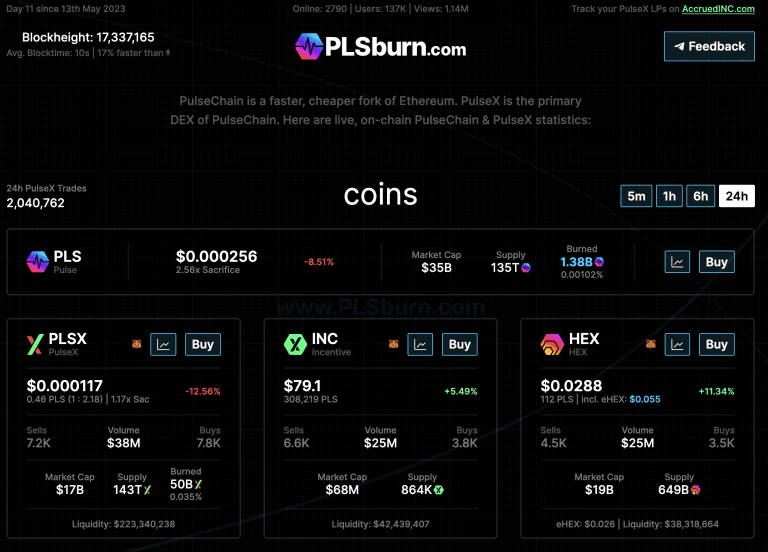
But the situation after going online is very different. As of May 23, PLSburn.com shows PLS supply at 135T, price $0.000256, and market cap of $35 billion. If you hold 1 ETH worth $1850 on Ethereum, you will only receive 1 PLS airdrop worth $0.000256 on PulseChain, which is almost negligible.
Unique “Sacrifice” attracts huge amounts of financing
When Richard was designing PulseChain, he also laid out the DEX on the chain. PulseX is the DEX on PulseChain, benchmarking Uniswap on Ethereum.
Both PulseChain and PulseX have conducted a financing method called "Sacrifice", which means that investors "give up" their cryptocurrency while receiving free, valueless PulseChain and PulseX native token airdrops. From the perspective of their own interests, users participating in Sacrifice obviously hope to profit from the airdrop, which can be considered as a financing method adopted by PulseChain to avoid legal risks.
Tokens that can participate in Sacrifice include HEX, USDC, ETH and other mainstream currencies. The earlier you participate, the more tokens you will receive. According to PulseX rules, before January 10, 2022, every $1 of Sacrifice tokens can earn 10,000 Sacrifice Points. After that, the funds required to obtain 10,000 points will increase by 5% every 24 hours until February 25. Sacrifice costs $9.91 to get 10,000 points.
Richard's reputation coupled with this FOMO approach to funding resulted in both PulseChain and PulseX receiving significant funding. According to Footprint, Sacrifice funding in PulseChain is $500 million. As of the end of the first phase of PulseX’s Sacrifice on January 10, 2022, participating funds had reached $940 million.
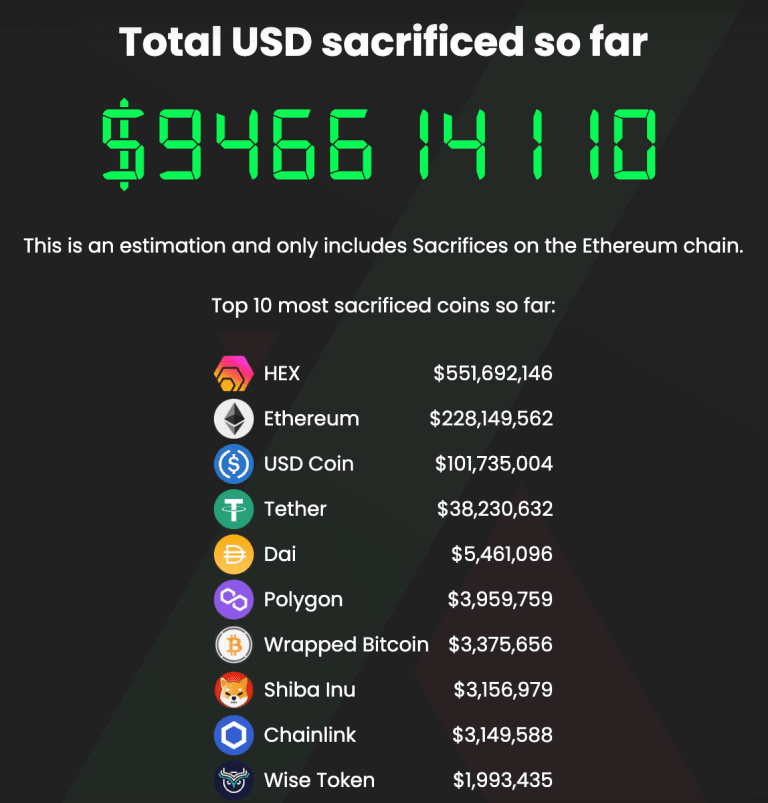
Sacrifice seems to have become a common financing method in PulseChain, and Hexpulse.info also counts multiple projects using this method of financing.
Liquidity mining boom after the launch of PulseChain
Through the above-mentioned financing method of Sacrifice, PulseChain’s native token PLS and PulseX’s native token PLSX also have a very high basic market value. The $1 billion funding round for decentralized exchange PulseX is also one of the largest in cryptocurrency.
As of May 23, the only project on PulseChain displayed by DeFiLlama is PulseX, and PulseX’s TVL is US$500 million. This makes PulseChain’s TVL directly rise to eighth, surpassing established public chains such as Solana and Fantom, and even It is ten times that of emerging public chains Aptos and Sui.
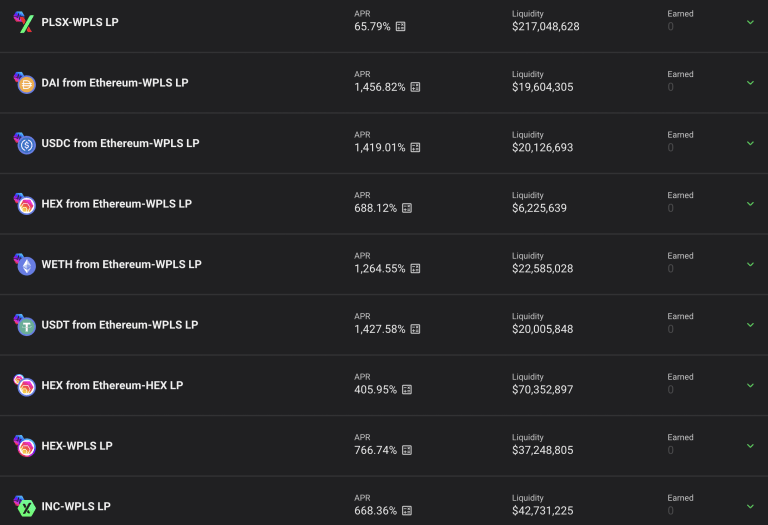
Driven by the high market capitalization of PLS and PLSX, the yield rate of liquidity mining on PulseX is almost above 1000%. Because there was too much demand for cross-chain from Ethereum to PulseChain, the official cross-chain bridge was once paralyzed. At one time, most funds were stuck on the cross-chain bridge and could not arrive normally.
According to data from PLSburn.com, the current prices of PLS and PLSX correspond to 2.52 times and 1.13 times the sacrifice price respectively, which may further strengthen the cohesion of the HEX community. HEX, which once had a high market capitalization, was perfectly transferred to new projects in this way and made profits during the downward phase of the crypto market.
Risks in PulseChain
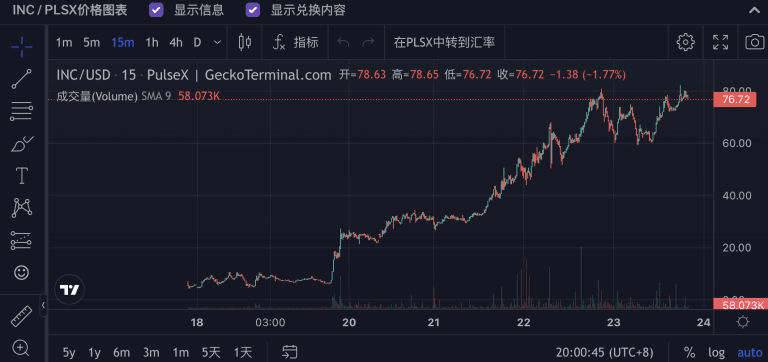
PulseChain has achieved rapid development, but it also comes with great risks. Liquidity mining in PulseX issues INC tokens (Incentive Token). As the liquidity in PulseX increases, the price of INC continues to rise. INC’s price has increased more than 10-fold from May 19 to now, according to GeckoTerminal. And liquidity in both INC-WPLS and INC-PLSX exceeds $40 million.
The most liquid trading pair in PulseX is PLSX-WPLS within the ecosystem. The liquidity of this trading pair is $213 million, and the corresponding APR is only 65%. The liquidity corresponding to mainstream currencies such as USDC, USDT, and ETH is not much, and the highest liquidity among related trading pairs, WETH-WPLS, is US$22.44 million. It shows that the funds in PulseX mainly come from the HEX and PulseChain ecology, and it is still unattractive to external funds.
Mining in PulseX almost always requires a trading pair with PLS, and the APR of PLSX-WPLS, the most liquid, is already relatively low. Once these funds start to be sold or INC starts to fall, it will easily cause a death spiral, leading to liquidity and Token prices both fell.
In short, PulseChain was built by Richard and his followers. Richard has extremely strong marketing capabilities, and the HEX community also has a very strong consensus on this. PulseChain and PulseX attracted a lot of funding in the short term, but most of it came from within HEX and PulseChain. The current market value of PLS is US$34 billion, and the market value of PLSX is US$160, which is already relatively high, and mining requires the purchase of PLS, which carries higher risks. Richard is also quite controversial personally. Many people think that the projects he does are all scams and investors should pay attention to the risks.
(The above content is excerpted and reprinted with the authorization of our partner PANews, original text link )
Statement: The article only represents the author's personal views and opinions, and does not represent the objective views and positions of the blockchain. All contents and opinions are for reference only and do not constitute investment advice. Investors should make their own decisions and transactions, and the author and Blockchain Client will not be held responsible for any direct or indirect losses caused by investors' transactions.
This article "Marketing Expert" Richard starts a business again! Why can PulseChain generate 500 million TVL a week? First appeared in Block Guest.