

In short, EigenLayer is a new solution for solving challenges related to innovation at the infrastructure level in the blockchain ecosystem. It is a re-staking protocol that enables ETH stakers to validate different networks and services built on Ethereum through a set of smart contracts on Ethereum. By re-staking ETH on EigenLayer, stakers can support new Ethereum projects by providing services to operate them and gain additional staking opportunities.
Today we’ll talk in detail about EigenLayer - including: what it is, how it works, why you should care about it, use cases, and the risks involved.
But first – why should you care?
Developers don’t need to bootstrap a new ecosystem: Developers have access to Ethereum’s staked capital and validator set, so they can now spend less time on secure bootstrapping. This means faster development cycles and new use cases.
More opportunities for ETH stakers: If you are an ETH staker looking for more options, then EigenLayer may be an attractive option. The protocol works with your existing Ethereum validation, allowing you to use your staked funds more efficiently and gain additional advantages without much additional cost.
Improved security: By extending Ethereum’s cryptoeconomic security to other applications, EigenLayer helps build an overall more secure and powerful decentralized ecosystem.
What is a feature layer?
As the white paper states:
EigenLayer is a set of smart contracts on Ethereum that allows consensus layer Ether (ETH) stakeholders to opt-in to validate new software modules built on top of the Ethereum ecosystem.
It is a “heavy staking” protocol that allows ETH stakers to secure different networks and services, such as data availability layers, sequencers, bridges, or other services built on top of Ethereum.
A trip down memory lane: understanding the blockchain landscape
First, let’s review; Bitcoin emerged as an application-specific blockchain, limited in scope, focused solely on peer-to-peer payments. It was designed for a single purpose. Every innovation during the 2011-2012 period required the creation of a new network.
Ethereum subsequently launched a general-purpose smart contract platform, allowing developers to build a variety of applications and making the blockchain ecosystem more programmable.
However, Ethereum has its limitations when it comes to innovation beyond the application layer. While Ethereum enables programmability at the application layer, it does not extend this flexibility to other underlying infrastructure components (e.g., consensus layer, data availability layer, new virtual machines, oracle networks); in other words, for services that cannot be proven on top of the EVM. Such infrastructure-level components require Active Verification Services (AVS) and their own verification.
This means that any innovation beyond the application layer must either build its own service/network (e.g., Chainlink, Solana, etc.) or go through a lengthy protocol development process (which, if accepted by the Ethereum community, will be implemented in the protocol).
Solving infrastructure challenges with EigenLayer
EigenLayer is a new approach to addressing the challenges associated with infrastructure-level innovation. The idea behind EigenLayer involves leveraging decentralized trust networks to build the infrastructure components required for advanced projects.
Very briefly - is this how it works?
EigenLayer introduces a method called restaking, which enables networks and services to be secured by staked ETH instead of their own tokens.
Ethereum validators may choose to offer new services that provide them with additional benefits. To do so, they must download and run any necessary software. These services may impose conditions that cause the validator to lose staked ETH if the validator behaves dishonestly.
This ensures that validators act honestly because their stake is on the line.
The core question that EigenLayer seeks to answer is: Can we borrow trust from these decentralized networks and make it available to anyone who wants to use it?
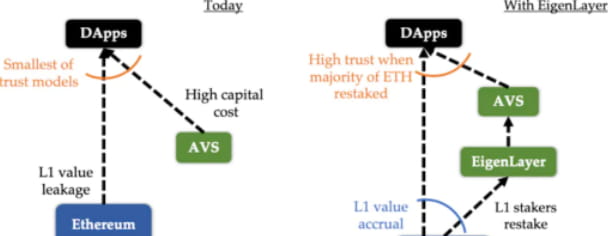
What is this “decentralized trust”?
Decentralized trust gets lost in translation, so I want to focus on that. (Honestly, I don’t like naming, but that’s how I feel about most terms in the blockchain space.)
Decentralized trust is a fundamental concept of blockchain. It refers to the ability of a system to establish trust between participants without relying on a central authority or third-party intermediary.
There are different trust models, each with their own tradeoffs. Let’s look at what decentralized trust means for Ethereum.
Ethereum is a decentralized blockchain network that uses a consensus algorithm called Proof of Stake (PoS) to achieve trust and security without relying on a central authority. Multiple independent nodes verify and validate transactions, making it challenging for any single participant to manipulate or control the network, providing censorship resistance.
In Ethereum's PoS, validators lock up a portion of their cryptocurrency (ETH) as collateral to propose and validate new blocks in the blockchain. Validators must deposit 32 ETH to run a dedicated staking node. If they do not follow the rules, they risk losing part of their staked ETH. This mechanism encourages participants to act responsibly.
Application developers can leverage Ethereum’s decentralized trust network to build secure and reliable applications. They can ensure that their smart contracts run as expected without the need for a central authority or third-party intermediary to establish trust.
Decentralized Trust Market
Putting things together:
In a decentralized network, participants can trust the system to operate securely, accurately, and reliably without a central management entity.
EigenLayer aims to create a decentralized trust marketplace: by taking the trust of Ethereum (capital + validator set) and making its components available to anyone interested.
How does it work?
EigenLayer creates a marketplace connecting ETH stakeholders who promise to provide services for additional products, and services/networks that require operators on the other end. This is a set of smart contracts on Ethereum that facilitate this.
The two main players involved in EigenLayer are:
Active Verification Services (AVS): Services/networks that require an external operator to operate their network - these are services that require decentralized trust. (Also known as service/middleware). AVS can be a data availability layer, decentralized orderer, bridge, oracle, etc.
Stakers: Participants who choose to provide specific services and receive additional income in return. Stakers can run software built on top of EigenLayer or delegate their stake to an operator.
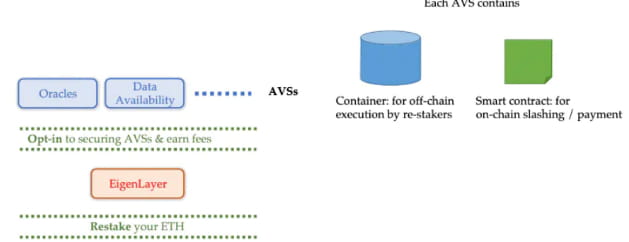
Actively verified services
First, to create an AVS on EigenLayer you need to:
An off-chain container that operators must download and run (e.g. a service might require validators to run specific software) An on-chain contract that specifies payment and penalty terms (slashing)

Redo in EigenLayer
Stakers can choose to use new modules built on top of EigenLayer to provide security and verification services. This is called re-staking.
To participate in re-staking, a staker must do one of the following:
1. Download and execute the node software required by these modules
2. Delegate their stake to an operator who does this
Once opted in, these modules enforce slashing conditions on staked ETH to encourage honest behavior.
Re-staking: Different (re)staking options
Now you might ask: Is this the same ETH that you need to stake to become a validator? What if I don’t have the 32 ETH required to become a validator?

EigenLayer offers different re-staking options. Each has its own risks and rewards.
Native Restaking: This option is for individual stakers/family stakers who want to re-stake the same staked ETH natively. When they stake in the Ethereum protocol, they need to specify a withdrawal credential, which is an account with the authority to withdraw the staked collateral. To participate in EigenLayer, you need to assign this credential to the EigenLayer smart contract. (L1 → Feature Layer)
Liquid Restaking: Liquid Staking is a service that allows users to deposit their ETH into a staking pool and receive a Liquid Staking token in return (such as the tokens provided by Lido and RocketPool). Stakers can deposit Liquid Staking tokens into EigenLayer. There are different options here, such as ETH LP restaking.
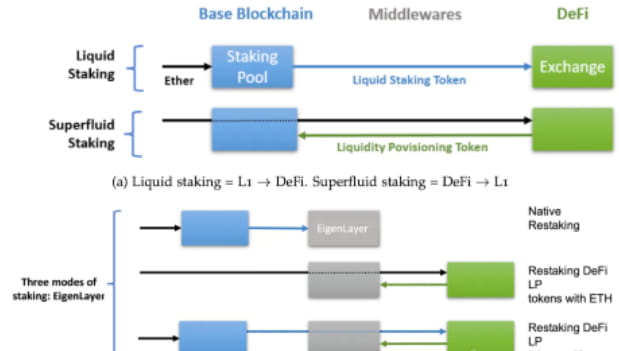
Developers have the flexibility to set specific conditions for their stakeholders. For example, they can decide which tokens to accept as stake and set rules for distributing rewards. A module that prioritizes decentralization might only accept locally re-staked ETH.
Now, a key question is: How does EigenLayer ensure that stakers remain honest?
Dishonest Players: Cut
To ensure stakeholders’ honesty, service creators implement slashing mechanisms, which are penalty conditions for rule breakers. Stakers agree to the terms and conditions when choosing to provide a specific service, and if they act dishonestly, they risk losing part of their staked ETH.
If you delegate to an operator, you also trust that the operator will act honestly and may face similar penalties.
Honest nodes are cut: Unintended Slashing
First - audit, audit, audit. Services must be security audited to avoid bugs and attacks.
It happens - there is a bug or malicious code. Let's say the bug or malicious code causes an unexpected slashing. EigenLayer relies on a governance committee to resolve these issues. The committee can undo the slashing caused by the bug or malicious code.
While some argue against human involvement, it’s important to stress that the committee’s role is simply to veto unexpected cuts. They do not make subjective judgements but rather act as a safety net for stakeholders.
Additionally, the committee operates transparently, with their actions and membership publicly available to ensure trust. Services and stakeholders alike can opt-in, fully understanding the committee’s roles and structure.
Risks and Challenges
Some questions that come to mind:
What happens if only a small fraction of restakers participate in multiple AVS and come together to attack? Will re-staking lead to over-leverage?
How and when do cuts and spending happen? What if it’s too late to make the cuts?
Who can run off-chain software specifications? Can everyone participate as an operator, or will the requirements be very high?
Do people use EigenLayer?
Operator Collusion: A Small Group of Heavy Stakers
If only a small fraction of stakeholders participate in re-staking across many services, the system could become cryptoeconomically insecure.
Here is an example of a white paper:
Consider an AVS that is secured by $8M of re-staked ETH and contains $2M in total locked value. Capturing $2M in locked value requires a 50% quorum and the application appears to be secure, as a successful attack would result in at least $4M of the attacker’s stake being slashed. However, this may not be the case if the same group of stakers also re-staked in other AVSs. In the simplest case, the exact same group of restakers participated in 10 other AVSs, each with $2M locked. Therefore, the total profit from corrupting this group of restakers is $20M, but the total value involved is only $8M, making the system cryptoeconomically insecure.
That is, if the same stakeholders participate in multiple services, the system is at risk, making it possible to gain more from an attack than losing all capital stake. (Attack > Stake)
Most of the risk mitigation depends on the AVS design. Applications can set some rules for the types of stakers they want; for example, you can only stake ETH locally. Additionally, applications can limit the amount of funds that can be stolen during an attack (for example, a bridge can limit the flow of value during a slashing period).
Staker cannot afford slashing fees
If the collateral rebalancing mechanism in EigenLayer fails due to slow adjustment, delays, or incorrect parameters, the system may be exposed to various security risks. Therefore, services on EigenLayer must maintain an appropriate ETH balance to ensure the security and stability of the network.
Consider a situation where a staker who re-stakes in multiple services acts dishonestly in various services (before slashing is implemented), and then they don't have enough ETH to pay the slashing fees. What if gas fees are high and the tx doesn't go through? The contract is on Ethereum L1, so when gas fees are high this can cause problems for deploying new AVS, but more importantly for stakers slashing and paying.
Crucially, if a staker behaves dishonestly, they can actually pay their slashing fees on time.
This again depends on the AVS design. For example, you could design the system so that if a slashing tx doesn't happen, stakers may not be able to run the service for a period of time. However, this introduces a new risk that no staker will be able to run the service that AVS needs at a specific time.
Operator Centralization: Off-chain Software Requirements Off-chain software specifications depend on AVS design.
If services place high demands on off-chain software, they create barriers to entry for potential stakeholders and operators. These complex specifications can lead to situations where only those with advanced infrastructure can participate, leading to centralization.
It is recommended that services have simple off-chain software requirements to encourage more people to participate. Easy-to-meet requirements allow many operators to join without having to upgrade their current systems. This way, more people can become operators and the network avoids becoming centralized due to onerous or complex requirements.
Guidance Service
The Big Question: Will ETH Stakers (Re)Stake?
This is one of the most attractive projects and has gained a lot of attention in a short period of time. However, as with any new ecosystem, education of stakeholders, service developers, and users is greatly needed. For those who wish to participate, I generally view this as an opportunity
EigenLayer Use Cases: What Can I Do?
EigenLayer supports many use cases including MEV management, data availability layer (DA), decentralized sorter, light node bridge, and fast mode bridge.
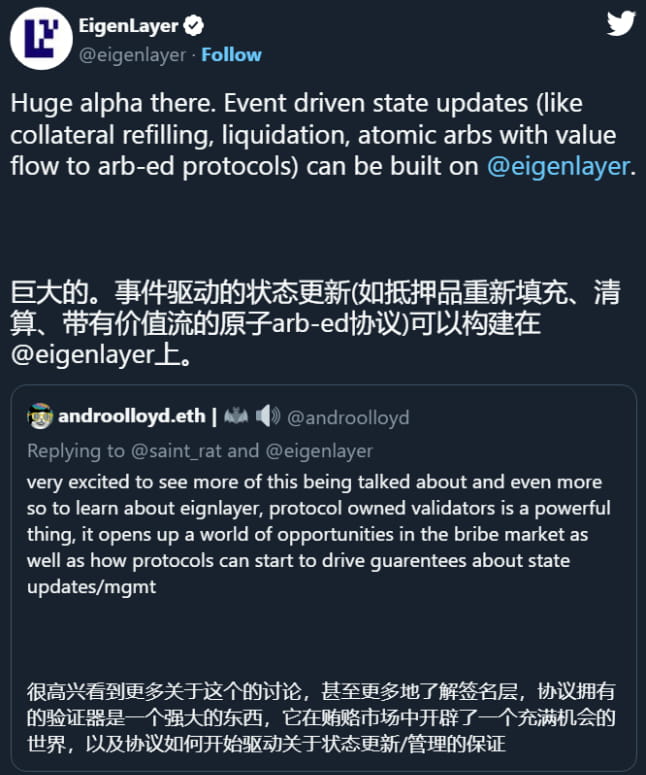
These are just a few possibilities, there are probably many more. For more information and potential use cases you can visit the EigenLayer forum. As with any new and evolving technology, some may work and some may not.
While there is no documentation available for most of these use cases, I wanted to provide an overview of the proposal for MEV governance with some resources I used. I am also grateful to the Discord moderators who directed me to these resources. (I wish it was docs > discord, but I have accepted that docs is the last place to be updated in the crypto world.)
Essentially, EigenLayer supports programmable staking and slashing, which are powerful tools for decentralizing the web. Let’s dive into some technical details to make this more concrete.
MEV Management w/EigenLayer - A Brief Overview
*This is a completely new topic. For this section, I will assume that you have some familiarity with MEV-boost and Proposer-Builder Separation (PBS). If you are not familiar with these, here is a full list of resources to get started.*
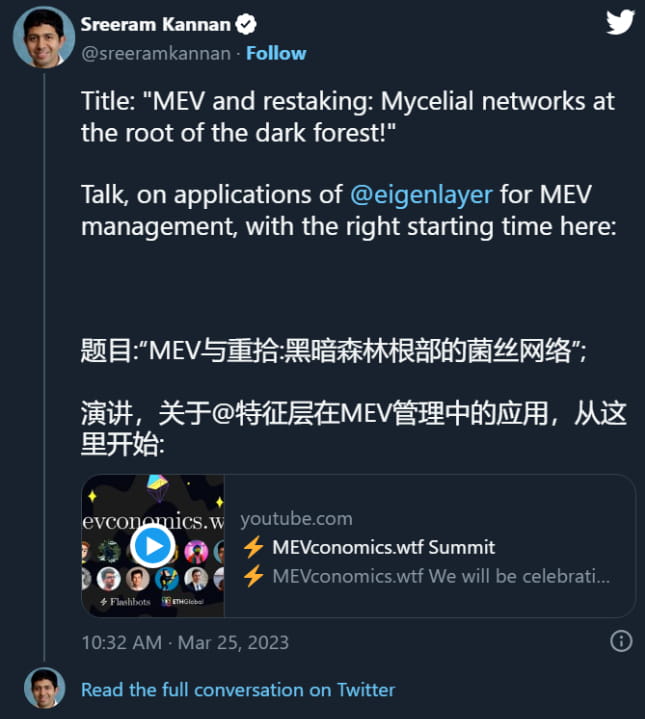
First, some background - mev-boost is a middleware software run by validators that implements proposer-builder separation (PBS). PBS is not currently implemented in the Ethereum protocol itself, mev-boost is a way to test and experiment while research continues.
PBS introduces a new role, the block builder, who is responsible for building the optimal block and providing it to the block proposer. The block proposer auctions the right to the entire block. The block proposer does not see the content of the block; they just choose the most profitable one.
The current MEV-boost implementation only allows full block construction, limiting the freedom of block proposers, who are a highly fragmented set.
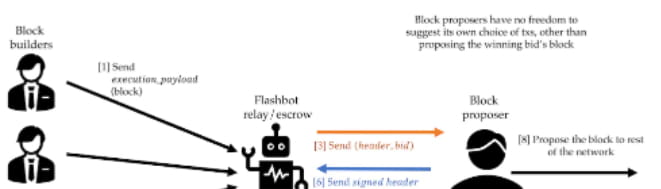
Let’s look at this proposal: Preserving Block Proposer Agency with MEV-Boost using EigenLayer
The proposal aims to improve MEV management by using a partial block building upgrade called MEV-Boost, using EigenLayer to provide more control to block proposers and increase censorship resistance.
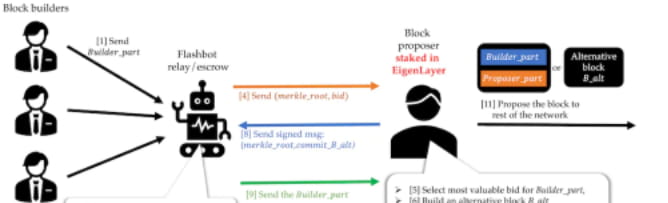
Under the proposal, block proposers must opt-in to EigenLayer and comply with the additional conditions, or risk losing part of their stake. They can now fill partial blocks with their transactions, giving them more control over block composition. If a proposer proposes a block that is not an alternative block they assembled, they must Builder_part that block, or they will be slashed by EigenLayer. You can find more details and potential risks of the proposed approach in the proposal itself.
The main idea is that when you think about your application, think about adding new customizable cut conditions, which can give you a more programmable and flexible network.
Projects interested in EigenLayer
1. EigenLayer is building EigenDA, a hyperscale data availability layer, which is the first use case built by the team itself.
2. Espresso Systems is developing Espresso Sequencer, and they plan to use EigenLayer for retargeting
3. Mantle plans to use EigenLayer's Data Availability (DA) layer
Current status of EigenLayer
The EigenLayer testnet was launched on the Ethereum Goerli network on April 6, 2023. This is an early, non-incentivized, experimental testnet.
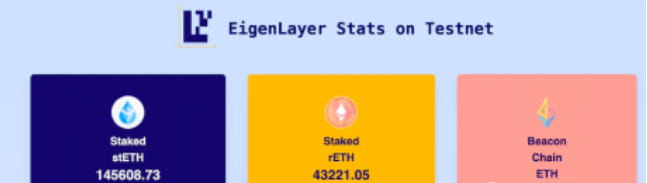
The protocol will be launched in three phases: Stakers, Operators, and Services. Currently, the first phase is for stakers. Stakers can participate in liquid re-staking and native re-staking, and you can follow the statistics here.
Summarize
EigenLayer is a re-staking protocol that enables ETH stakers to validate different networks/services built on Ethereum through a set of smart contracts.
EigenLayer aims to create a decentralized trust market by taking Ethereum's trust (capital + validator set) and making its components available to anyone interested. This allows developers to focus on innovation at the infrastructure level without the burden of launching a new network.
Stakers can earn rewards by helping to operate and secure various networks and services built on Ethereum, such as data availability layers, decentralized orderers, and bridges.
EigenLayer faces risks such as operator collusion, over-commitment, and bootstrapping challenges, requiring careful service/network design and monitoring.
EigenLayer is an innovative solution that addresses the challenges associated with infrastructure-level innovation. By leveraging a decentralized trust network and introducing re-staking, EigenLayer enables ETH stakers to support new Ethereum projects while gaining additional staking opportunities. However, it is important to play devil's advocate and acknowledge the potential risks involved, such as operator collusion, re-staking centralization, and bootstrapping the ecosystem.
After all the research, I can say that EigenLayer is one of the most innovative ideas I have seen in the Ethereum ecosystem in some time. As with any new technology, it is important to remain critical and be aware of the risks involved. By doing so, you can ensure that a strong and trustworthy ecosystem develops.