

Written by: Jarseed
Since the cryptocurrency market entered the MEME season, countless myths of benefit and overnight zeroing have been constantly staged. Everyone lamented the hundreds and thousands of times increase in $PEPE, $Turbo, $AIDOGE and $MILADY, but when they bought MEME, they lost money as soon as they bought it, and it went back to zero as soon as they took it. Many people spit on MEME for having no value, but some people say that speculating on MEME is speculating on emotions and attention. Both of these statements are somewhat mechanical epistemological. Today I will analyze MEME tokens for you from the perspective of chip allocation and how to query the association of on-chain addresses, and provide some support for you to choose to speculate on MEME tokens. I may not be able to help you choose the best increase, but I may be able to help you identify which ones are relatively poor.
If we view token issuance as a business, we need to understand the following points:
The project party is creating a product. Even though the entire product has no specific use, the project party has to find a way to get more people to buy it.
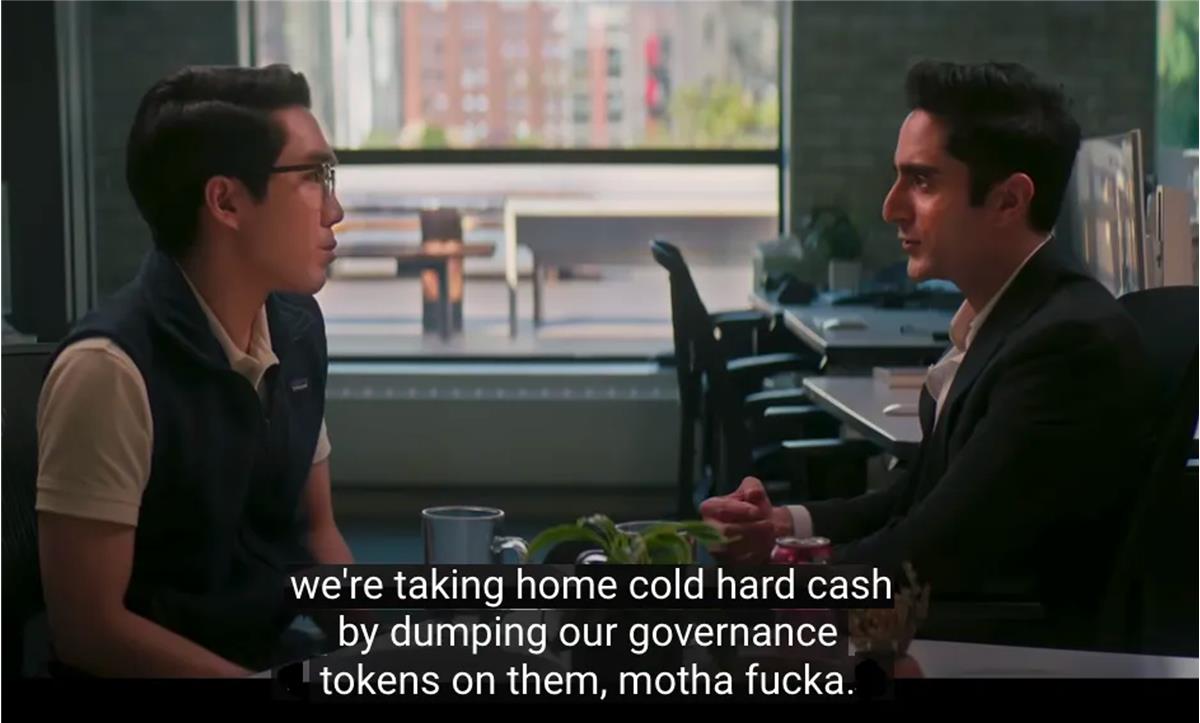
Any business needs to consider the input-output ratio. Project owners can choose to take more tokens when they are initially distributed (primary level) and then dump them when the time is right; they can also distribute them to the public at a low price initially and then buy them back from them (secondary level); or they can even directly rig the trading pool and run away with the money.
Some MEME tokens may even see a change of ownership. The tokens held by early project owners have been sold off, but the enthusiasm for speculation has not faded. As long as there is capital to continue the speculation, the story can continue.
So how should we start this business? I think we need to solve the following problems:
Locking seed users
There are many cases at this stage, such as vampire attacks such as $AIDOGE based on whether one is eligible to receive airdrops through Arbitrum; or setting up Presale or LGE/TGE (Liquidity Generate Event/Token Generate Event) through various IDO platforms or Alpha communities; or fake batch distribution (examples will be given below).
Creating initial liquidity
In order for on-chain assets to circulate and be traded, funds are needed to provide initial liquidity. The project will create a liquidity pool with tokens and ETH (usually) through the Uniswap factory function, so that everyone can buy and sell tokens through this liquidity pool.
Media Matrix Overlay
If everyone is talking about a certain MEME token in our CT information flow, curiosity will definitely drive us to take a look. The KOLs who promote the product include those who just do it to attract traffic, those who are paid to do things, and some who try to cater to the deconstructionist ideology and sell other products.
Both volume and price increase
In order to facilitate shipment, the project team held a large number of tokens in the early stage in order to achieve the effect of controlling the market and raising prices. With the surge in trading volume and prices, major quotation websites such as Dextool and Dexscreen will recommend tokens to the Gains list, entering the field of vision of retail investors.
Next, I will give you two specific examples to see how these two project parties locked in seed users to cold-start the project token distribution, and under such circumstances, what kind of trend will the token develop. It should be specially stated that there is no investment advice for the tokens mentioned below, and I hope everyone will be responsible for their own investment.
Case number one:
Simpson
Contract address: 0x44aad22afbb2606d7828ca1f8f9e5af00e779ae1
Main transaction pool: 0x7945819d6cab17f94c4089c28767e164ed4acf3e
Contract deployment address: 0xC43b6eCaF08b515001d58f4f427e03A4CE4758dd
Total Token Supply: 420,000,000,000,000,000
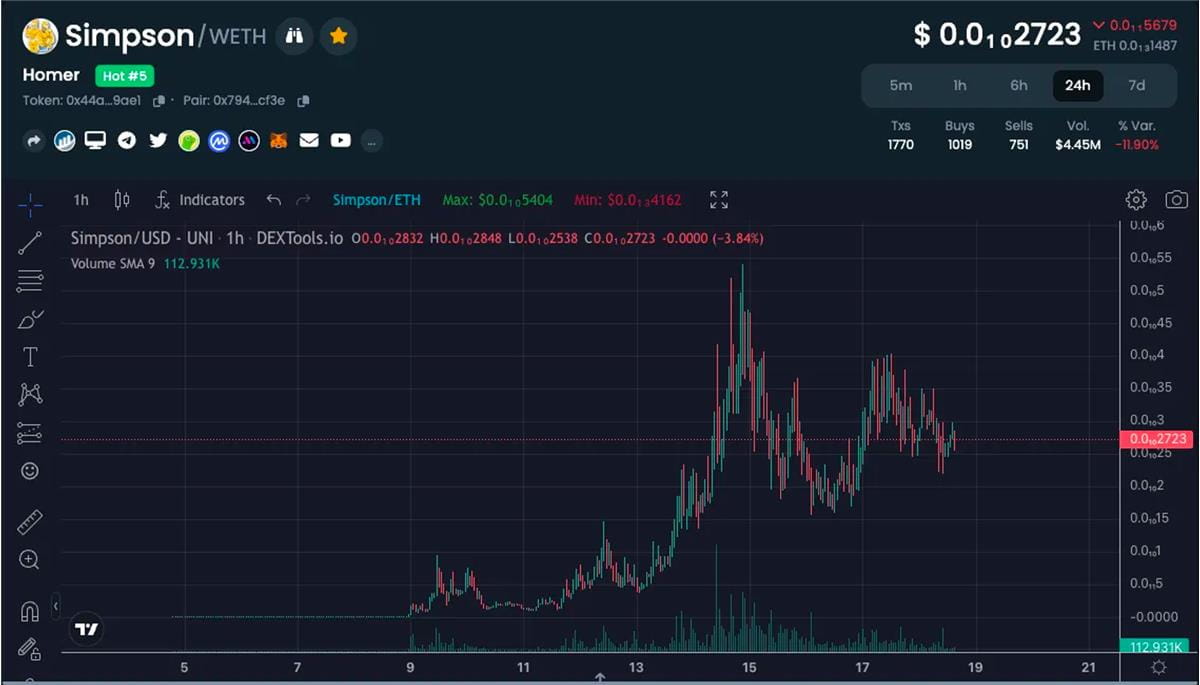
Let’s try to use Arkham to interpret the initial distribution of the Simpson token:
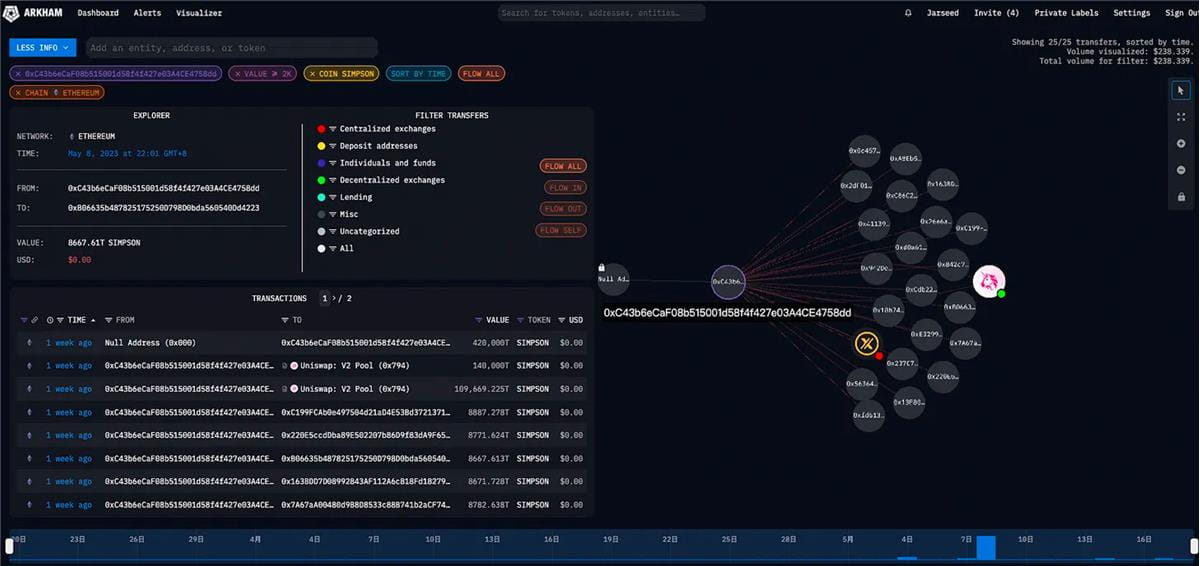
Simpson creator address distribution tokens
From the above figure we can see
The Simpson token creator deployed about 1/3 of the initial tokens in the Uniswap liquidity pool.
The token creator distributed 8,800T Simpson tokens to each of the 20 addresses, with each address holding approximately 2% of the total, for a total of 40%.
After this operation, 70% of the tokens have been distributed, and now it is time for the token creators to make their moves.
Through the on-chain behavior, we can see that the token creator used the Multisender function of the CoinTool tool. Friends who are familiar with on-chain data may be familiar with the CoinTool tool. It has been on the ETH Gas consumption list for a long time. The token creator used CoinTool to distribute Simpson tokens to a large number of addresses. Through the browser tool, we can see that the token creator used CoinTool a total of 4 times and sent a total of 800 addresses, with 1,000 Simpson tokens sent to each address.
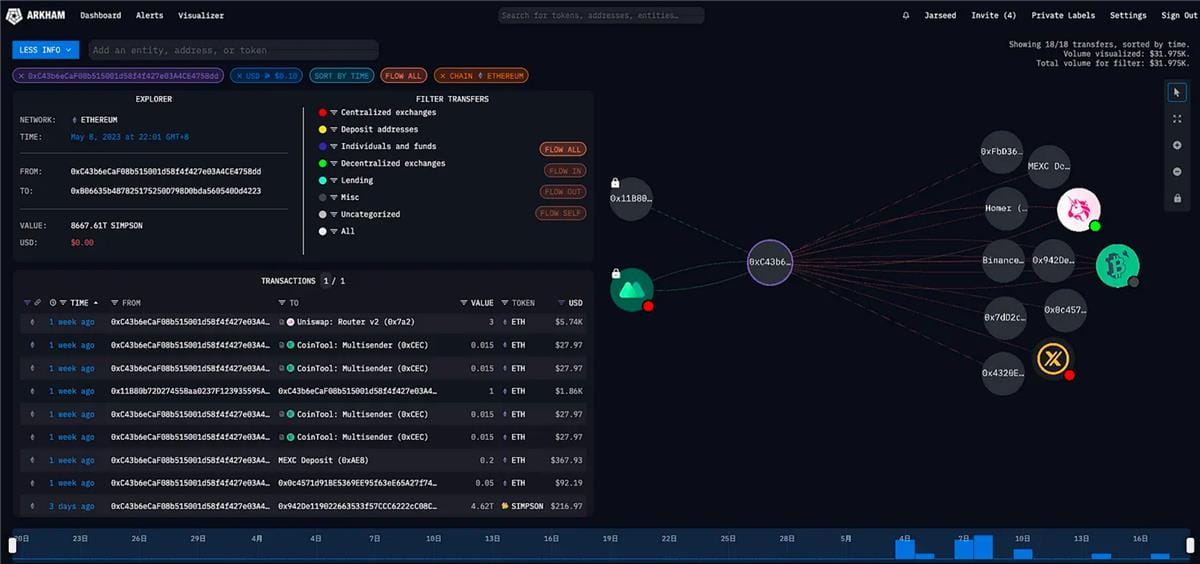
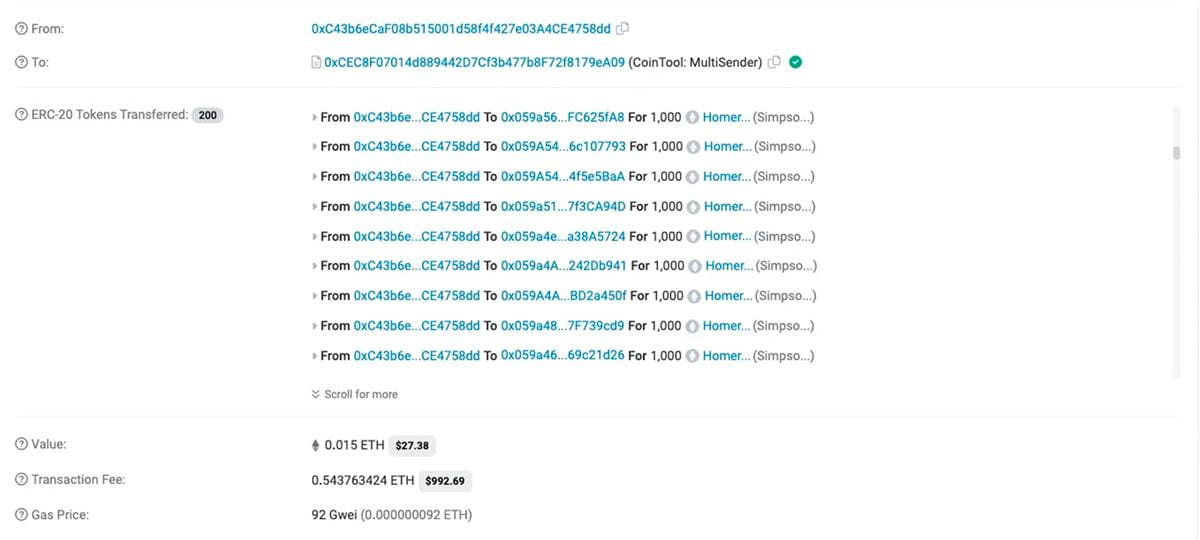
CoinTool distributes tokens
And we can find that the addresses sent by the token creators have a common feature, these addresses all start with 0x059a, then friends who are familiar with the hash algorithm will understand that these are mass-produced addresses, or some addresses do not even know the private keys of the project owners, but are just randomly distributed, because 1,000 Simpson tokens are nothing for the total amount of 420Q. However, this operation allows the project to have 800 on-chain currency holding addresses at the time of cold start.
We all know the subsequent story. With Binance launching $PEPE on May 5, MEME tokens once again ignited the enthusiasm of the majority of cryptocurrency traders, and everyone began to frantically look for the next $PEPE. What are the general criteria for people to look for? New coins, a certain number of addresses holding coins, a certain amount of trading volume, simple and easy-to-spread imagery, and good social media performance.
However, when the buyers were dreaming of getting rich quickly, the chips they had laid out in the early stages had already dumped these tokens into cold hard cash.
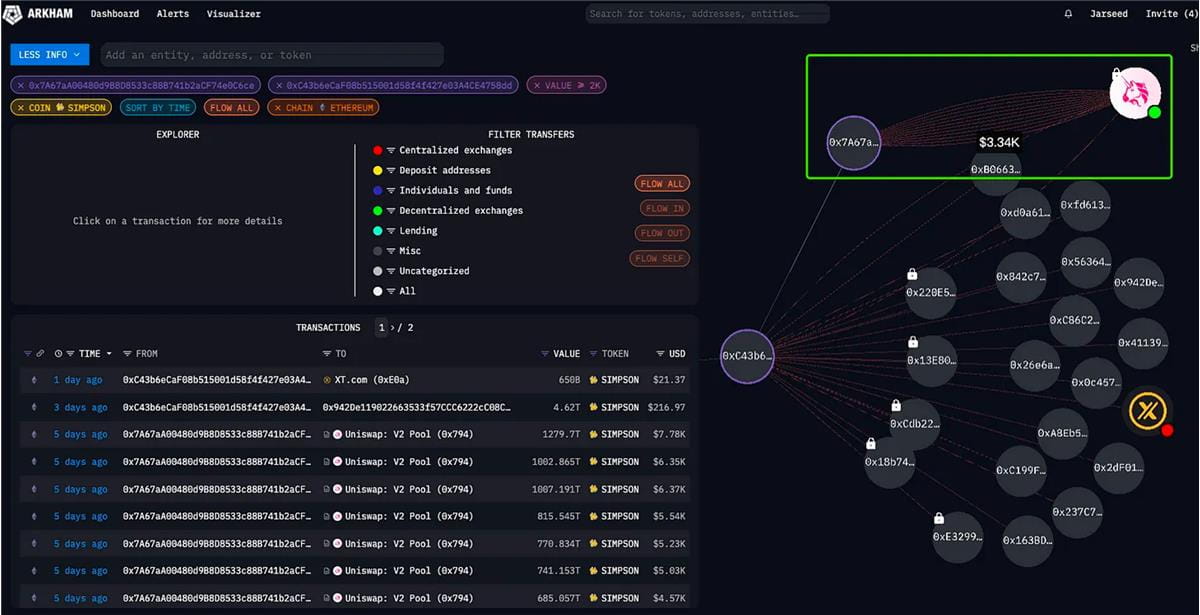
In addition to token distribution, we also have another angle to observe, which is the interaction of trading pools.
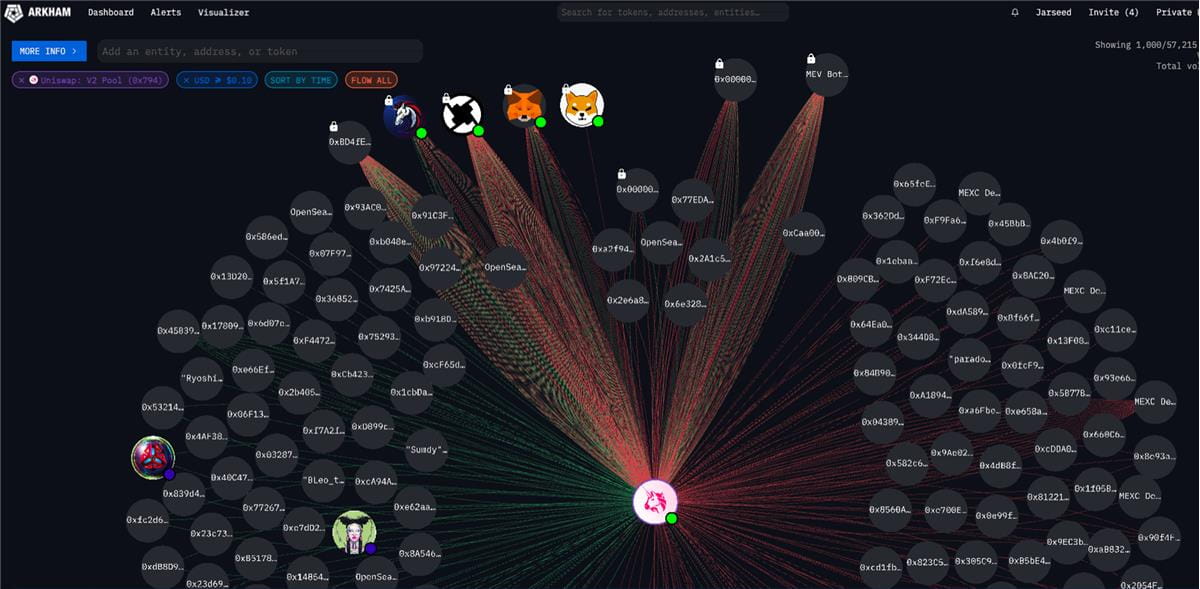
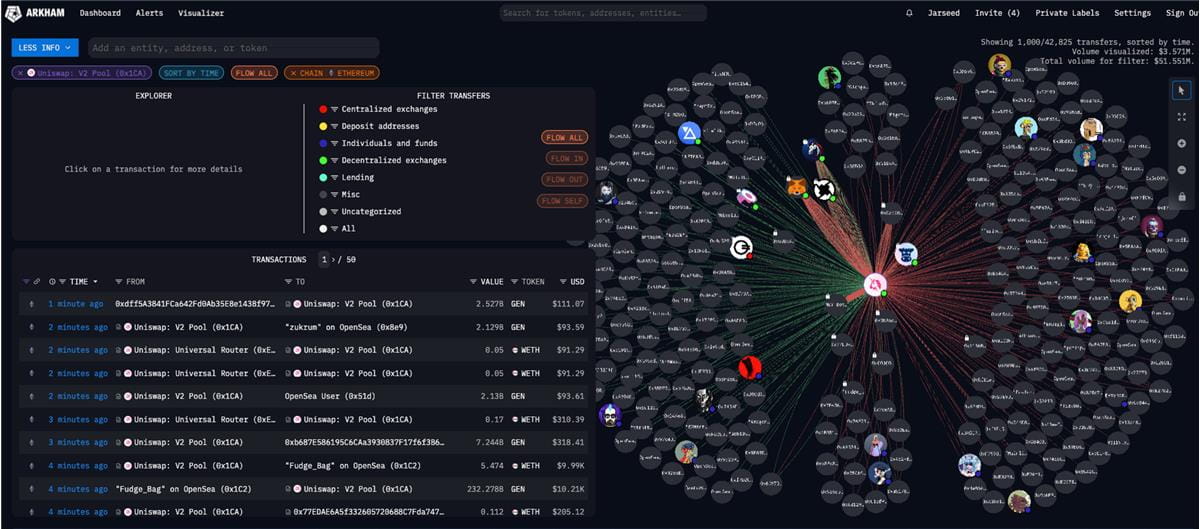
We can see that in addition to some common retail transactions and trading aggregators, there are also some participants who are fueling the MEME craze, that is MEV Bot.
The daily average trading volume of various MEME tokens has easily exceeded one million and has risen to tens of millions of US dollars, mainly due to MEV Bot. It can be said that basically 90% of the trading volume of most MEME tokens comes from MEV Bot, because some tokens have a transaction tax mechanism, in this case traders have to increase the transaction slippage, and then become the fat sheep of MEV.
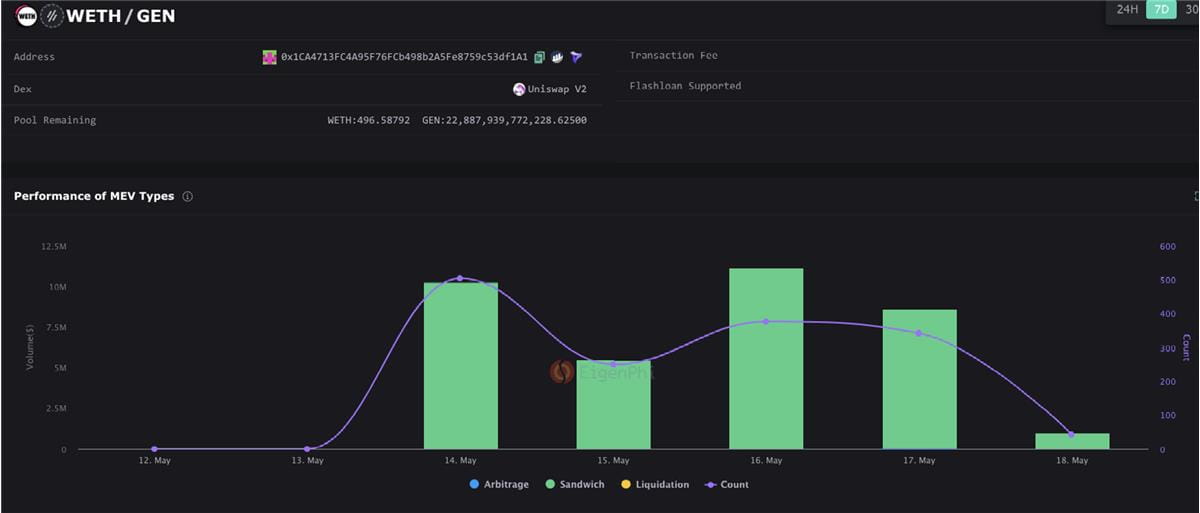
Here I recommend a tool called Eigenphi. You can enter the transaction pool address of the token you want to trade, and you can see the MEV transaction volume counted by Eigenphi, so as to estimate the transaction volume of the real purchase intention, and further compare the situation between various MEME tokens horizontally.
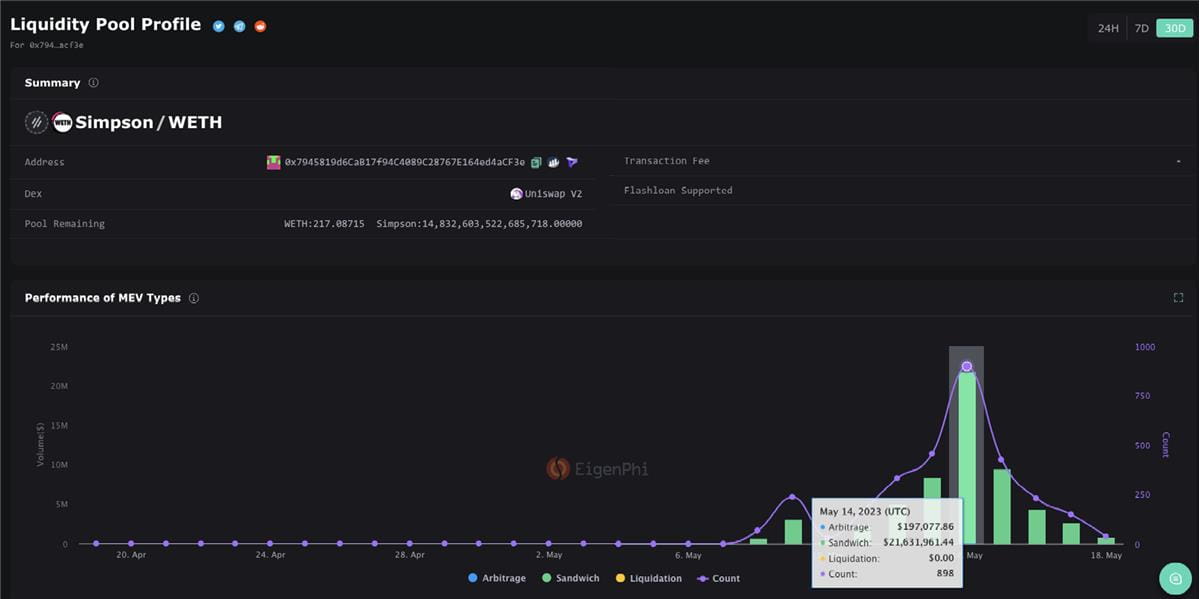
Summarize:
In the Simpson case, we can summarize the following two points:
In order to play a good game with the project party, we need to calculate the cost of the project party. In this project, the project party spent 6 ETH as the initial liquidity pool, spent 2 ETH as Gas to use CoinTool to create 800 currency holding addresses for themselves, and then add the cost of publicity and pulling the market, we can roughly get the cost of the project party.
Concentrated shipment. It can be seen that the 20 addresses that distributed the tokens early concentrated on May 13th to cash out. If you continue to participate in this game at this time, it may not be a good choice.
Case 2:
GenerationalWealth(GEN)
Contract address: 0xcae3faa4b6cf660aef18474074949ba0948bc025
Main transaction pool: 0x1ca4713fc4a95f76fcb498b2a5fe8759c53df1a1
Contract deployment address: 0x6579116367e0090d1cA6F5F712e172996E527E4c
Total Tokens: 420,690,000,000,000
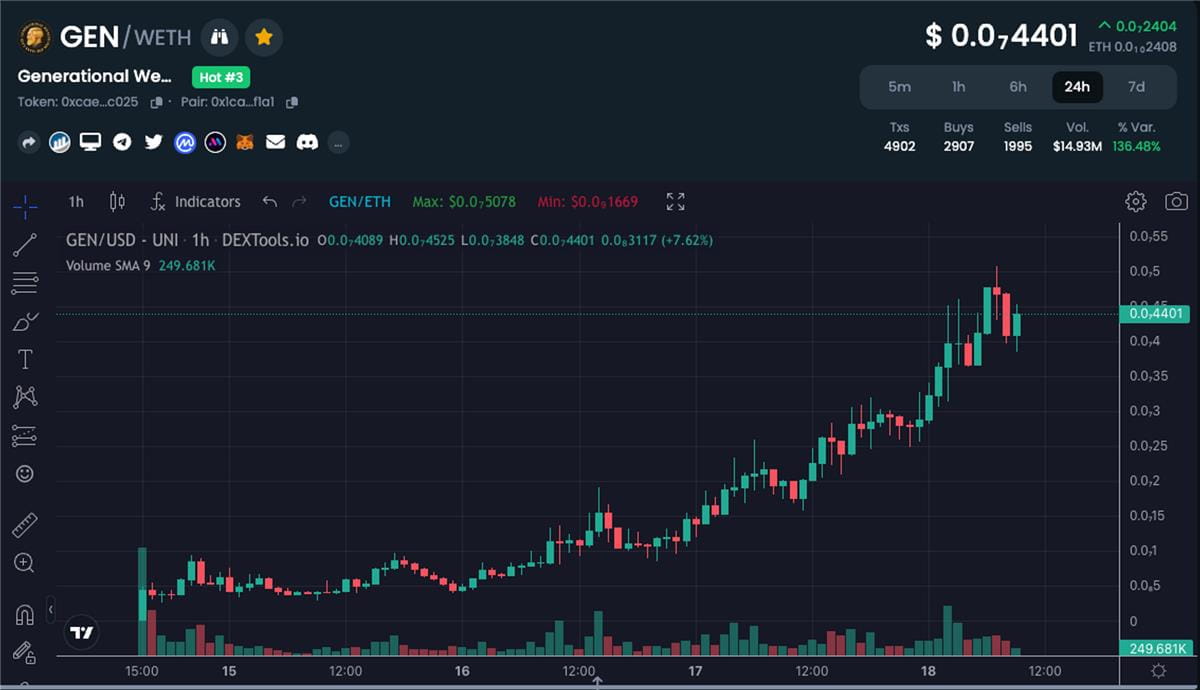
Let’s try to use the same method to interpret the initial distribution of the GEN token:
The initial distribution of the GEN token has a Presale process. We first need to find the Presale contract address (contract address link)
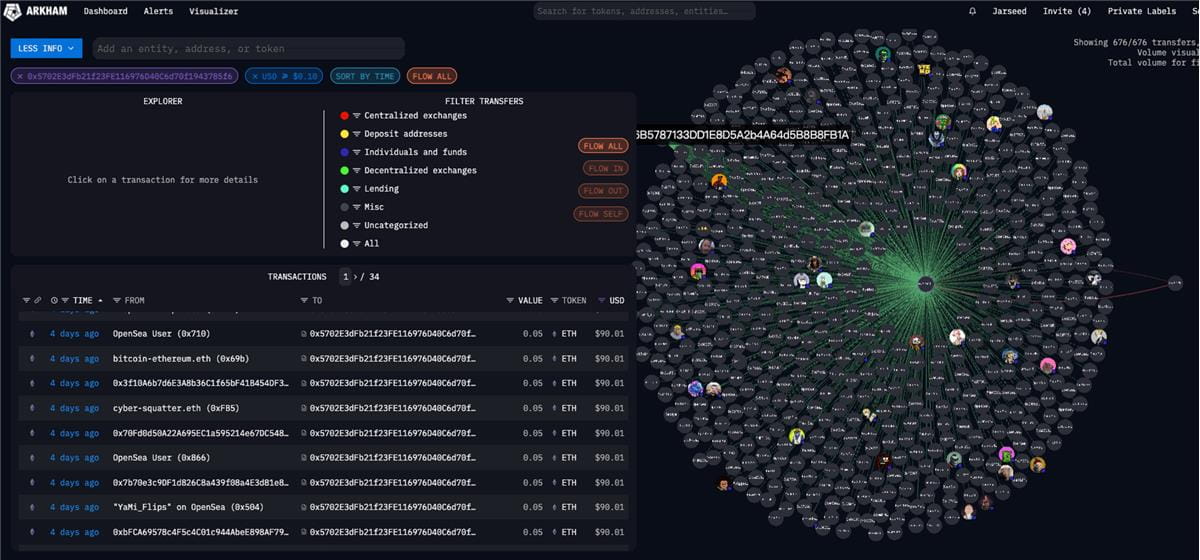
According to the project's description, 15% of the GEN tokens will be initially sold through Presale. From the on-chain data, we can see that a total of 672 people participated in the Presale, each paying 0.05ETH and receiving 105B GEN tokens.
Here we can see that among the addresses participating in the pre-sale, there are a large number of addresses with ENS domain names, and many are also marked as Opensea users by Arkham. The characteristics of these addresses are relatively diverse, and they have more or less active records on the chain. Such seed users are healthy and diverse, and are relatively successful in the initial token sales.
On the other hand, in the large-amount currency holding addresses, we can see that
The GEN token creator deployed 302T GEN tokens, accounting for 72% of the circulation, to the Uniswap liquidity pool.
The three associated addresses with larger holdings are 0x83Fae943b5381eCE611bda1fA44f744966Bc9552, 0xa0F06e6Ab3A999294E4b6B1EF8f4689c5D785482, and 0x7E0DaBBC101402880D281f86E51E439f897A752a, which respectively hold 6.9%, 3.68%, and 2% of the circulating tokens, totaling about 12.5%. It can be found that two of the addresses currently have no ETH and cannot transfer tokens.
So what do we find in the hype of such tokens? What should we pay attention to?
First of all, we found that the seed user group of this token may come from the NFT/Alpha community, or a certain NFT circle KOL. Users who participated in the Presale participated at a price of 0.05ETH and have now made more than 20 times the profit.
Next, we found that the project owner had retained 12.5% of the tokens on the surface, but because there was no ETH in the account, we could continue to observe their actions by monitoring these large-amount coin holding addresses.
Is it possible that the project will Rug? The token creator has put the LP Token into the GEN token contract. There is no next step yet, and it can be continuously monitored.
Using Eigenphi we found that GEN did see strong buying in some time periods.
The interaction level of the trading pool is also more active
Summarize:
In the GEN case, we can summarize the following two points:
The diversity of seed users can bring many surprises to the early stages of the project, especially when accompanied by a wealth-creating effect.
By excluding MEV trading volume, we can find the real demand trading volume, which makes it easier to make horizontal comparisons between MEME projects.