

What is zkSync?
zkSync is an Ethereum Layer 2 expansion solution launched by Matter Labs in 2019. Alex Gluchowski, the founder of Matter Labs, was an early Plasma researcher at the Ethereum Foundation (Plasma is a relatively early-stage expansion solution) and founded it in 2018. Matter Labs and zkSync have received investment from many well-known VCs such as a16z and Dragonfly.
The current number of transactions that Ethereum can process per second (TPS) is about 15. The current transaction volume is the optimal solution (Impossible Triangle) made by the Ethereum network considering the degree of decentralization and security. Based on the current Technology cannot increase the volume of transactions per second under the same conditions in the short term, so some people have proposed processing and executing transactions on the second layer (Layer 2), using Ethereum as the settlement and security protection layer. This design is also more in line with the current financial system. According to the settlement structure, the central bank will not record or execute the transactions of each bank to users, but each bank will handle it on its own. The central bank is only responsible for the final settlement, so the current Layer 2 solution is also regarded as the problem faced by Ethereum. Solution for large-scale user use.
As far as the development stage is concerned, zkSync has achieved the "scalable payment" and "smart contract" goals in the roadmap. Now the official focus is on upgrading version 2.0 (still in the test network stage), focusing on "smart contracts" and "composability". ” attempt should lead to more efforts and improvements.
In the future, zkSync will gradually unlock the "privacy" and "decentralization" stages. The ZK (zero-knowledge proof) part of ZK Rollup has natural advantages in privacy protection, and zkSync can release these features. Decentralization means that Matter Labs removes control of zkSync.
How does zkSync work?
zkSync introduces two roles: Validators and Guardians to improve scalability
Validators
The verifier is responsible for processing transactions and packaging blocks. The verifier also needs to provide a zero-knowledge proof of the transaction to prove that the transaction process is correct and without fraud. Since each verifier needs to pledge tokens, if the protected person (Guardians) ) is found to have done evil, the verifier will be punished and the pledged tokens will be confiscated. When the verifier correctly executes the transaction, the verifier will be rewarded with tokens.
Guardians
The protector is responsible for nominating the verifier of the next block and monitoring whether the block is processed correctly. To become a protector, you also need to pledge tokens. When the transaction is executed correctly, the protector will also receive a part of the token reward. If it is evil, the pledged Tokens will also be penalized.
ZkSync background and development
As we all know, Ethereum is one of the most popular smart contract platforms currently, but due to limitations of its underlying design, it can only handle 15 to 20 transactions per second. This means that when transaction volume surges, the Ethereum network can become congested and transaction fees can skyrocket. In order to solve this problem, many developers and teams began to explore second-layer expansion solutions.
ZkSync is one of them, which uses zero-knowledge proof technology to achieve efficient transaction verification and privacy protection. By packaging a large number of transactions into a batch and using zero-knowledge proofs to prove the validity of these transactions, ZkSync can increase transaction processing capacity to 2,000 to 3,000 transactions per second, or even higher. Moreover, because ZkSync is designed to be extremely flexible, it can easily adapt to different application scenarios and needs.
The development history of ZkSync can be traced back to 2019, when it was an experimental project developed by the Matter Labs team. After more than a year of research and development, they finally launched the first version in early 2020 and tested it on the Ethereum mainnet. Although this version still has some problems, it has proven the feasibility and potential of ZkSync.
On this basis, the Matter Labs team continues to improve and optimize ZkSync, introducing more functions and features, such as support for ERC-20 tokens, batch transfers, atomic swaps, etc. They are also working with other teams to integrate ZkSync into various applications and ecosystems, including wallets, exchanges, DeFi platforms, and more. These efforts have been widely recognized and supported, and ZkSync has become one of the leaders in the field of Ethereum's second-layer expansion.
zkSync on-chain data
TVL: $58.33 million. Among them, ETH and stablecoins are the main forces locking up the amount. The total locked-up value of the zkSync ecosystem is at a mid-to-low level among mainstream Layer 2.
Number of independent addresses: more than 330,000. The number of zkSync independent addresses ranks second in Layer 2, second only to Optimism, but the daily active ratio of addresses is very low, currently only about 0.04%.
In the past two weeks, the zkSync ecosystem has only had an average of a few hundred active addresses per day, and the number of daily transactions has only been a few hundred, which is far lower than Optimism's level of tens of thousands per day.
This shows that users are optimistic about the overall development of zkSync and have deployed zkSync addresses in advance, but the ecosystem has not yet developed to the stage where it continues to prosper and users trade every day.
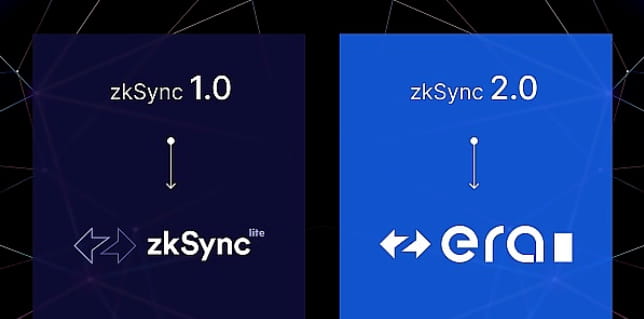
The main differences between zksync 1.0 and zksync 2.0:
Smart contract support: zkSync 1.0 focuses primarily on simplified payment and asset transfer scenarios and does not support Ethereum Virtual Machine (EVM) compatible smart contracts. In contrast, zkSync 2.0 provides full support for EVM-compatible smart contracts, meaning developers can easily deploy existing Ethereum smart contracts to zkSync 2.0.
Composability: zkSync 1.0 only supports limited cross-contract interactions, while zkSync 2.0 improves inter-protocol interoperability by retaining key EVM features such as smart contract composability. This makes zkSync 2.0 more suitable for building complex decentralized finance (DeFi) applications.
Account abstraction: zkSync 2.0 introduces new features of account abstraction, simplifying the interaction between users and smart contracts. Account abstraction improves user experience by allowing users to interact with smart contracts using any signature scheme.
More powerful development tools: zkSync 2.0 comes with a full set of development tools, including CLI (Command Line Interface) and SDK (Software Development Kit), making it easier for developers to build and deploy zkSync-based applications.
More than 200 projects—including Chainlink, SushiSwap, Uniswap, Aave, Argent, 1inch, Gnosis, and Curve—have registered interest in deploying on the zkSync Era.
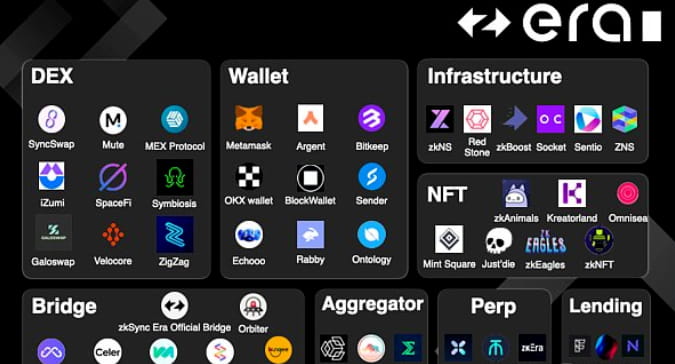
cross-chain bridge
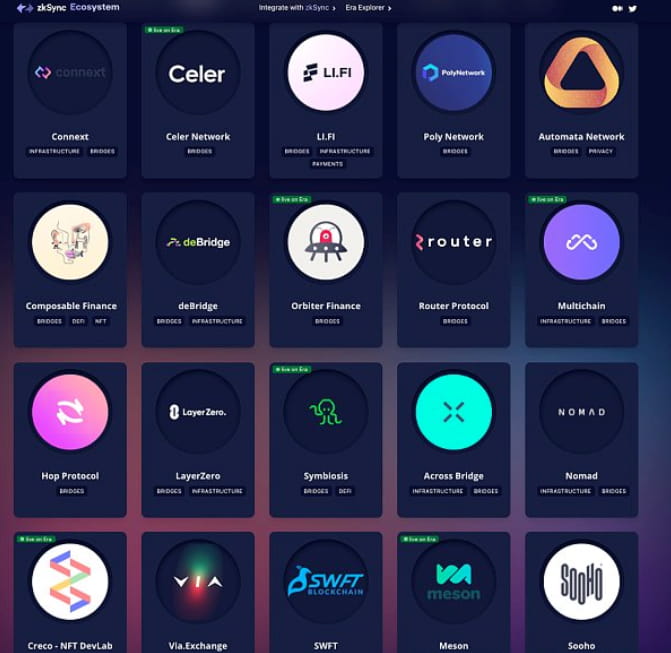
According to the officially disclosed zkSync ecological map, there are a total of 24 cross-chain bridges that are expected to support zkSync Era, of which there are a total of 7 cross-chain bridges that are fully supported and available online, namely the official website cross-chain bridge zkSync Era Bridge, Orbiter, Multichain, Celer Network, Meson, Creco and Bungee.
zkSync Team:
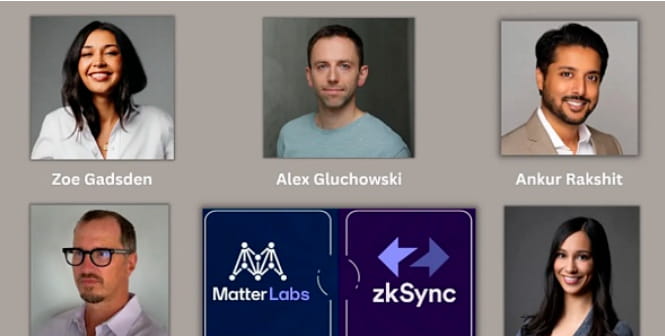
Matter labs is the company behind zkSync, a company from Germany founded by CEO Alex G. in 2018 and has grown to over 50 employees. The team consists of experienced developers, researchers and entrepreneurs as well as core members in communications such as Zoe Gadsden (COO), Ankur Rakshit (CFO), Steve Newcomb (CPO) and Shazia Hasan. They are working together to create a more efficient, cost-effective, and secure way to transact on Ethereum.
CEO: Alex Gluchowski --- He has over 15 years of development experience and continues to evolve as a CTO and entrepreneur. He is passionate about personal freedom, self-ownership and decentralization.
COO: Zoe Gadsden---Zoe is a former Googler with 10+ years of growth and product leadership
CFO: Ankur Rakshit --- has 15 years of experience in the financial field and served as Kraken's head of financial planning and analysis.
CPO: Steve Newcomb --- a successful entrepreneur and product manager with over 15 years of experience in the industry and accelerator programs.
Head of Marketing and Communications: Shazia Hasan --- Various experience in finance and communications
Thanks to their diverse backgrounds, the team is able to navigate multiple key aspects of building a blockchain and running a company. These are very important points as the project aims to be widely adopted.
zkSync financing:
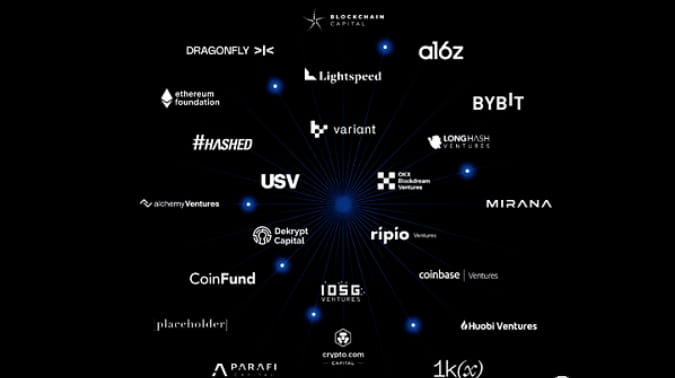
Matter Labs has raised $258 million across 5 rounds of funding since 2018, with BitDAO committing an additional $200 million in five tranches of $40 million to bootstrap the zkSync ecosystem.
$200 million Series C in November 2022 led by Dragonfly and Blockchain Capital
$200 million in committed funding from BitDAO in January 2022
$50 million Series B in November 2021 led by a16z
$6 million Series A in February 2021 led by Union Square Ventures
$2 million seed round led by Placeholder in September 2019
Summarize
As one of the leaders in the field of Ethereum's second-layer expansion, ZkSync has broad market prospects and commercial value. ZkSync is the most optimistic L2 project of Ethereum founder V God. With the continuous growth and development of the Ethereum ecosystem, Zkync uses Zk technology as an L2 solution. The first point of Zk technology is that the technical difficulty is very high, and it has solved the problem. arb and op cannot solve technical problems, and they are also the most promising solutions for V God and the Ethereum team.
The community is currently launching the ZkSync (ZKS) project, and the four kings of L2 have reached the second one. We missed OP and ARB. We must not miss ZKS this time.