

In 2013, developer Nicholas van Saberhagen (most likely a pseudonym) published a CryptoNote white paper, in which he stated that "privacy and anonymity are the most important aspects of electronic cash." This article attracted the attention of Bitcoin developers Gregory Maxwell and Andrew Poelstra, they subsequently published a paper exploring the impact of privacy- and anonymity-enhancing features on existing cryptocurrencies. Other developers used CryptoNote's ideas to create Bytecoin, the first privacy coin. It was then that the first iteration of Monero emerged.
“Thankful_for_today” is an anonymous user on the Bitcointalk forum who coded on Bitcoin to create a fork called BitMonero. Some users disagreed with this direction and eventually created another fork in the blockchain called Monero. Nearly a decade later, Monero (XMR) has become the largest privacy coin by market cap and sparked important discussions about the role of privacy and traceability in the blockchain ecosystem.
In this article, we will explore:
● Monero’s enhanced privacy features
● Practical application of Monero
● Monero market growth
● Monero mining rewards
● Darknet market activities
● Monero Ban and Regulation
● The future of Monero
What is Monero (XMR)?
Monero, also known as XMR, is a cryptocurrency with privacy-enhancing features encoded into its protocol. Most popular cryptocurrencies, such as Bitcoin and Ethereum, run on transparent, immutable ledgers that allow anyone to view and track transactions. Monero is also an open source blockchain, but its features are designed to reduce traceability and protect user anonymity.
Monero’s Privacy Enhancements
The main purpose of Monero is to provide a decentralized network that enhances transaction privacy and anonymity. As Justin Ehrenhofer, organizer of the Monero Space working group, explained, “We want to provide privacy and just plug some fundamental loopholes that exist in most cryptocurrency protocols… So Monero is really the only way to hide sending currency of the party, recipient and amount.”
The Monero blockchain employs a variety of privacy-focused methods to mask users’ transaction history:
● Ring signatures connect multiple users in a “ring” to hide their personal identities, making it more difficult to determine which user generated a given signature.
● In 2017, Ring Confidential Transactions (RingCT) was added to Monero and the transaction amount was hidden.
● By using stealth addresses, all Monero senders automatically generate new addresses each time they initiate a new transaction, obscuring the source and destination of funds. Stealth addresses are cryptographically tied to the public address that actually receives payments, but only the sender and receiver know the connection. The party has a private view key (used to display incoming transactions) and a private spend key (used to send payments).
● Transactions can be initiated through Tor/I2P, which uses an anonymous network to protect the privacy of the transaction source. This feature was started recently and is still considered experimental.
● dandelion++ hides the IP address associated with a node to reduce the risk of using sensitive information to expose the identity of the address.
How Monero works
Monero’s anonymity-enhancing properties have led to the belief that it is often used for illicit purposes such as money laundering. These activities do occur, but Monero is also used for many legitimate purposes. An analysis of Monero’s market growth, mining rewards, and darknet market activity helps us understand more fully how it is being used—for good and for bad. .
Monero market growth
Monero has experienced significant growth in recent years, with its market capitalization approaching $2.8 billion as of May 2023. This is significantly higher than the market caps of other popular privacy coins and privacy-preserving cryptocurrencies Zcash and Dash, which are approximately $600 million and $550 million respectively.
Since Monero’s inception in 2014, there have been approximately 32 million XMR transactions. In 2022, there were approximately 8.6 million XMR transactions, down slightly from the peak of 8.8 million in 2021. By comparison, during the same period, there were nearly 800 million Bitcoin transactions.
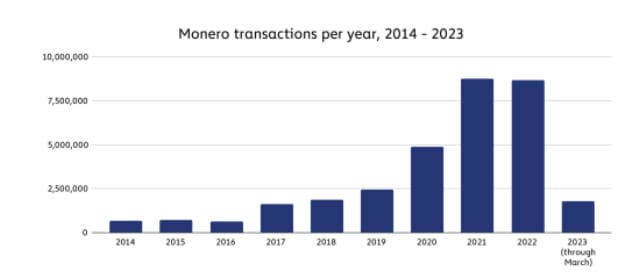
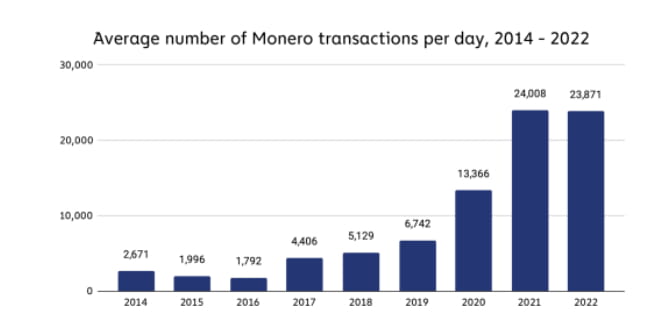
XMR activity doubled between 2019 and 2020 and experienced similar growth between 2020 and 2021. As shown in the chart below, there have been an average of approximately 24,000 transactions per day over the past two years.
Monero mining rewards
Similar to the Bitcoin blockchain, Monero uses a proof-of-work consensus mechanism. Its PoW algorithm RandomX is designed to maintain decentralized mining and resist specialized hardware such as ASICs. The issuance of XMR is unlimited to ensure continued mining incentives, with Monero generating a new block approximately every two minutes. Miners can decide whether to mine alone or in a pool, although the Monero project encourages solo mining as it helps improve network security.
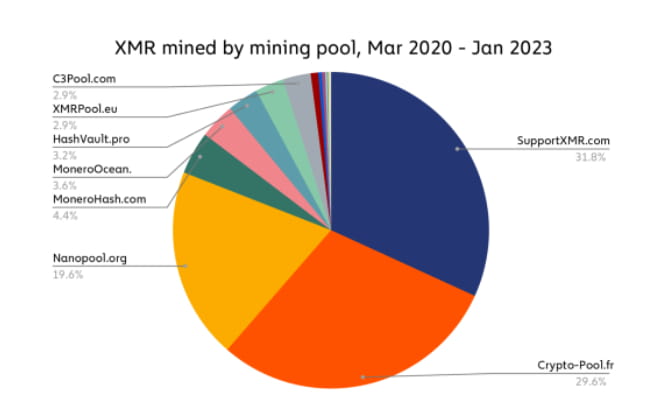
Chainanalysis identified a representative sample of Monero mining reward recipients between March 2020 and January 2023. In our sample, three major mining pools mined over 80% of the XMR.
● SupportXMR.com
● Crypto-Pool.fr
● Nanopool.org
Dark web marketing activity
Over the past few years, many darknet markets have adopted Monero to reduce traceability. For example, White House Market, one of the most active darknet markets before being shut down, encouraged its users to switch from Bitcoin to Monero for transactions, and eventually transitioned to only accepting Monero. Other darknet markets, such as AlphaBay and prototype, have adopted a similar model. However, Bitcoin remains the most commonly used digital currency on darknet markets.
Monero Ban and Regulation
Given Monero’s growth and popularity, it is often the main focus of conversations about privacy coin bans and regulation. Major world economies such as Japan and South Korea have banned Monero from exchanges to curb money laundering and reduce organized crime. In 2020, reports showed that Australian regulators and banks encouraged cryptocurrency exchanges to delist XMR or risk being “disconnected from banking services.” Dubai is one of the latest countries to follow suit, banning Monero under its new digital asset regulatory framework.
Many cryptocurrency exchanges have also taken action to end support for Monero for similar reasons. Bittrex, BitBay, and Huobi are three of these exchanges. Likewise, U.S.-based cryptocurrency exchange Kraken delisted Monero for its UK customers in 2021 to comply with the country’s evolving regulations.
The future of Monero
Although many bad actors use Monero to conceal transactions, they do not adopt Monero as much as one would expect. The main reason is that Monero has lower liquidity compared to other cryptocurrencies, making large transactions more difficult to execute. Regulatory uncertainty and XMR bans have also reduced its accessibility in some countries.
As Monero’s developers continue to innovate and ecosystem players explore its use cases, these will be important considerations. Regardless, all cryptocurrencies – including privacy coins – run on immutable block ledgers, meaning evidence of transactions, whether legal or illegal, will always exist.