


Summarize:
1 Lens is the most popular decentralized social protocol with the most active users. Lens Protocol is a social network protocol based on smart contracts on Polygon. As the underlying protocol, Lens encourages developers to develop social applications based on it.
2 Lens, as a social protocol based on smart contracts, has two core advantages: composability and scalability, as well as the ability to regularly add new modules. This enables Lens to continuously adapt to changing market demands, such as their launch of a feature that allows creators to transfer their income directly to the Aave deposit pool for financial management.
3 Lens is currently in the beta stage and has not opened account applications. It now has 117,000 profiles. Before February 2023, the number of new followers was about 20,000 per day, the number of accounts followed involved 6,000, the number of articles published per day was between 8,000 and 12,000, and the number of comments per day was about 2,000. Due to the influence of blur and arb airdrops, various data have increased several times since February 2023, and the monthly active profiles have reached more than 60,000. Various data have begun to decline in May, and will continue to remain active in the future, which requires time to observe.
4 Lens currently has more than 100 ecological projects, and is still increasing. Its main products include tools, content, social platforms, music, etc. Its ecological projects such as Phaver and Lenster have reached hundreds of thousands of active users.
2 Project Introduction
Lens Protocol is a social networking protocol for smart contracts built on Polygon. It is designed to enable creators to own their connections with others, forming a fully composable, user-owned social graph. The protocol is built from the ground up with modularity in mind, allowing new features and fixes to be added while ensuring immutable user-owned content and social relationships.
Lens is a low-level protocol that encourages developers to develop social applications based on it.
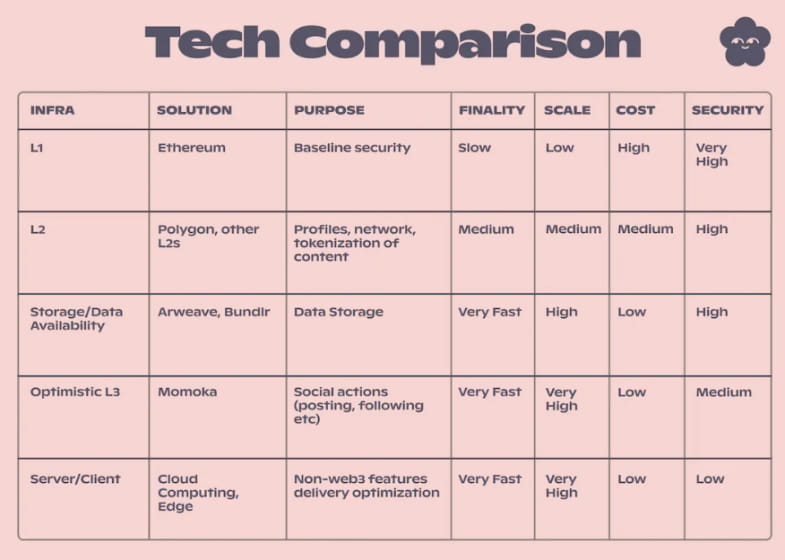
Lens recently launched the Optimistic L3 expansion solution Momoka, which will handle ultra-large-scale transactions and aims to support the next generation of Web3 social users.
2.1 Basic structure of Lens
Profile NFT
Profile NFT is the most basic and core object in Lens, allowing users to control all their content. A personal wallet address holds ProfileNFT, and one address can contain multiple ProfileNFTs, which contain the history of all the user's posts, images, comments, and other content. The difference between Profile NFT and other on-chain identities is the ability to publish Publications.
Publication
Publications are mainly divided into three types: posts, comments, and mirrors. Posts are the base object, and mirrors and comments provide additional functionality. Publications are published directly to the user's Profile NFT; this ensures that all content created by the user is owned by the user and saved in their wallet.
A Publication is not an NFT. However, it has two additional modules, a collection module and a reference module. The collection module contains the logic that allows other users to mint your Publication into an NFT.
A Publication has a ContentURI that points to the specific content that the Publication contains. This can include text, images, videos, or other arbitrary content stored on a decentralized protocol (such as IPFS or Arweave) or a centralized storage provider (such as AWS S3).
Comment
Allows users to provide comments on other people's Publications. Like Publications, comments exist in the user's NFT and are therefore completely owned by the user.
Mirror
Mirrors are the management tool of Lens Protocol. They are equivalent to the protocol for republishing or re-amplifying content. Mirrors are treated the same as Publications, but with some additional checks and some minor features added.
Since mirrors reference other publications, they are subject to the conditions of the original publication's reference module. If a publication has a reference module that restricts mirroring to only accounts that follow the original publisher, and the mirrored account does not hold a Follow NFT, the mirror transaction will fail.
Collect
Collections allow creators to monetize their content. Because creators own their content through the Lens Protocol, they are able to allow their followers to purchase that content.
When a user posts a Publication to their profile NFT, they have the option to set up a collection module. This module will allow other users to create NFTs linked to the ContentURI of the Publication. This module can contain any logic applicable to the minting process and the generated NFTs.
Follow
“Following” on Lens Protocol is different from following in Web2 social applications. When users follow a profile on Lens Protocol, they will receive a Follow NFT, which the creator and community can encode to increase value.
2.2 Core Advantages of Lens
As a social protocol based on smart contracts, Lens has two core advantages: composability and scalability, as well as the ability to regularly add new modules.
First, one of the core advantages of Lens lies in its composability and extensibility. This means that developers are free to implement Lens extensions that interface with any other smart contract protocol. This provides developers with greater flexibility, allowing them to more easily deploy other protocols that interact with Lens, such as decentralized finance (DeFi) or decentralized autonomous organization (DAO) tools. By interacting with other smart contract protocols, Lens can achieve richer functions and a wider range of application scenarios, thereby bringing higher value to users.
To illustrate, let's assume that a development team wants to build a decentralized voting platform with social interaction as its core. They can use Lens in combination with the existing DAO protocol to quickly build the platform while reducing overall development costs and time. Users can participate in various voting activities through the platform, exert their influence, and promote the common development of the community. This flexibility makes Lens highly valuable and market competitive.
Secondly, another advantage of Lens is that new modules can be added regularly. This allows Lens to continuously adapt to changing market demands and provide users with new features and services at any time. For example, creators can transfer their income tokens directly to the Aave deposit pool for financial management. This modular design gives Lens greater vitality and sustainable competitiveness in the future development process.
2.3 Lens stores the user’s social capital
In the digital age, the importance of financial capital and social capital has gradually become prominent. Among them, Bitcoin, as a cryptocurrency, enables users to own their own financial capital and value storage. The Lens protocol enables users to own their own social capital and social existence.
First of all, as a decentralized cryptocurrency, Bitcoin enables users to achieve self-management in the financial field. Through Bitcoin, users can transfer, trade and invest assets without relying on traditional financial institutions. This means that users have their own financial capital, which is not controlled by third-party institutions, and realizes the autonomy of value storage.
However, financial capital is not easily accessible to everyone, especially for poor areas and vulnerable groups. In contrast, social capital is something that everyone can accumulate and own. In this regard, the Lens protocol just makes up for the shortcomings of Bitcoin and helps users realize their social capital and social existence.
As a social protocol based on smart contracts, Lens Protocol allows users to create, develop and manage their own social networks in a decentralized environment. Users can participate in various social activities based on their interests, needs and abilities to accumulate social capital. This decentralized social model enables users to fully realize their potential, build personal brands, and gain recognition and influence in social networks.
To illustrate with a specific example, suppose a user participates in an environmental protection community through the Lens protocol and actively expresses opinions, participates in discussions and organizes activities. Over time, the user accumulates a certain reputation and influence in the community and becomes an opinion leader in this field. This accumulation of social capital not only helps personal growth, but also brings users a wider range of opportunities and resources.
In terms of financial capital and social capital, Bitcoin and Lens Protocol each have their own advantages. Bitcoin allows users to manage their financial capital autonomously, while Lens Protocol enables users to own their own social capital and social existence. Both protocols bring unique value to users and promote the development of the digital world.
2.4
Lens users control their own digital identities and content, and their social connections to other content and identities. And we’re also seeing the rise of NFTs, which capture the value of digital goods and digital consumption into verified experiences. So far, NFTs have successfully completed their journey from art to music content. Lens turns any user-generated content — written text, music, or video, etc. — into an NFT that can be shared directly with the user base. This enables creators to monetize as they choose. As of today, Lens users have created and collected more than 3.4 million NFTs, with an average monetization income of approximately $50.
These contents store data on-chain, and although decentralized storage networks such as Arweave now have good performance. However, large-scale content storage is still expensive. In addition, high-demand social experiences peak at 25,000 TPS. Although Lens Protocol may not need the same level of capacity today, it is critical to consider scalability so that Lens can provide a social layer for web3 and support any social network use case. With Momoka, the scalability of Lens is no longer limited by block space.
Momoka is Lens's Optimistic-based Layer3 layer, which is used to process Polygon's off-chain transactions, achieve ultra-large scale and reduce transaction costs. While it is important to use blockchain to provide user ownership and control, Momoka adds a new solution to social networks, enabling Lens to provide greater scalability.
Instead of squeezing transactions to L1 like L2 solutions, Momoka sends transactions to the data availability layer to optimize costs and achieve the higher scalability required for social media networks, avoiding the limitations of block space or block time configurations.
3 Project data
3.1 Account Analysis
Before the analysis, let me explain the basic situation.
1) One wallet address can have multiple Profiles NFTs
2) Only those who own Profiles NFT can post
3) The official whitelist of Profile was stopped in November 2022, which means that only those who had the whitelist before can mint
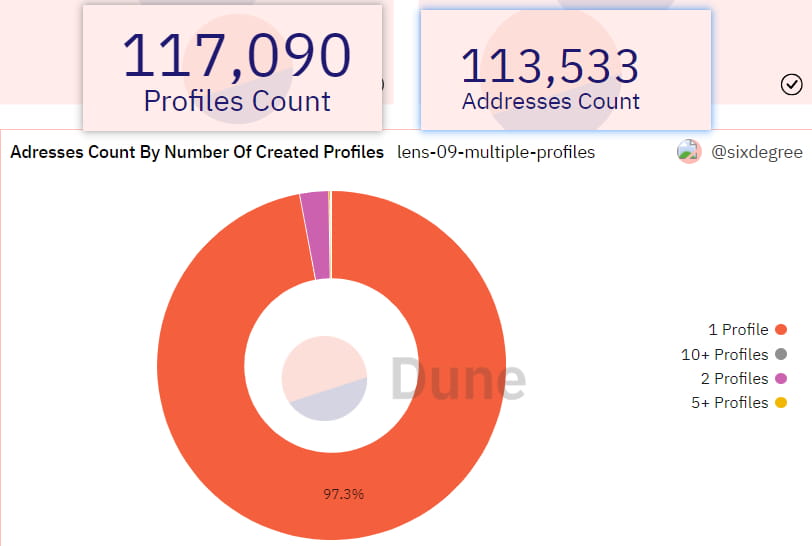
According to official data, the number of Profiles NFTs is 117,000, and the number of wallet addresses that own these Profiles is 113,000. It can be seen that most addresses only own one Profiles NFT. The specific data is that 93.1% of addresses have one Profile, and 2.55% of addresses have 2 profiles.
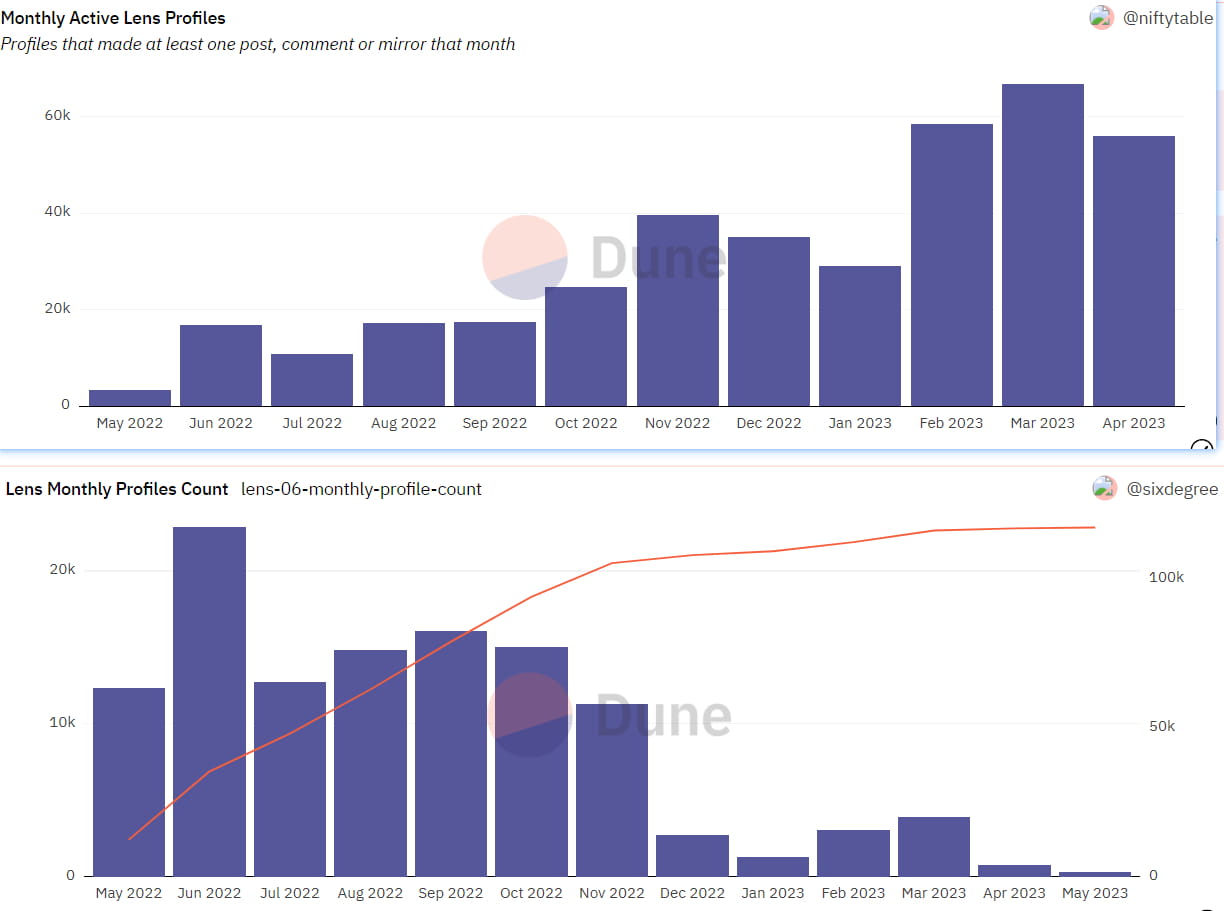
From the perspective of newly added profiles, the largest number of new profiles came from June 2022, and the number of new profiles remained relatively high before October 2022. Since 2023, the number of new profiles has been relatively high in February and March, and it has dropped to the lowest point in history in April. This phenomenon is normal, because Lens is now in the internal testing stage, and the official has stopped obtaining whitelists, that is, stopped minting new profiles. Therefore, as time goes by, the stability of the product is verified, and the price of profiles on opensea is soaring, the official is expected to open the whitelist profile casting again.
From the perspective of monthly active users (first picture), the number of active profiles in the past 23 years is very high, with the highest reaching 66,800 in March and 55,900 in April. Since the number of new mint profiles in March and April is less than 5k, this shows that a large number of previously mint profiles have become active.
3.2 Followers
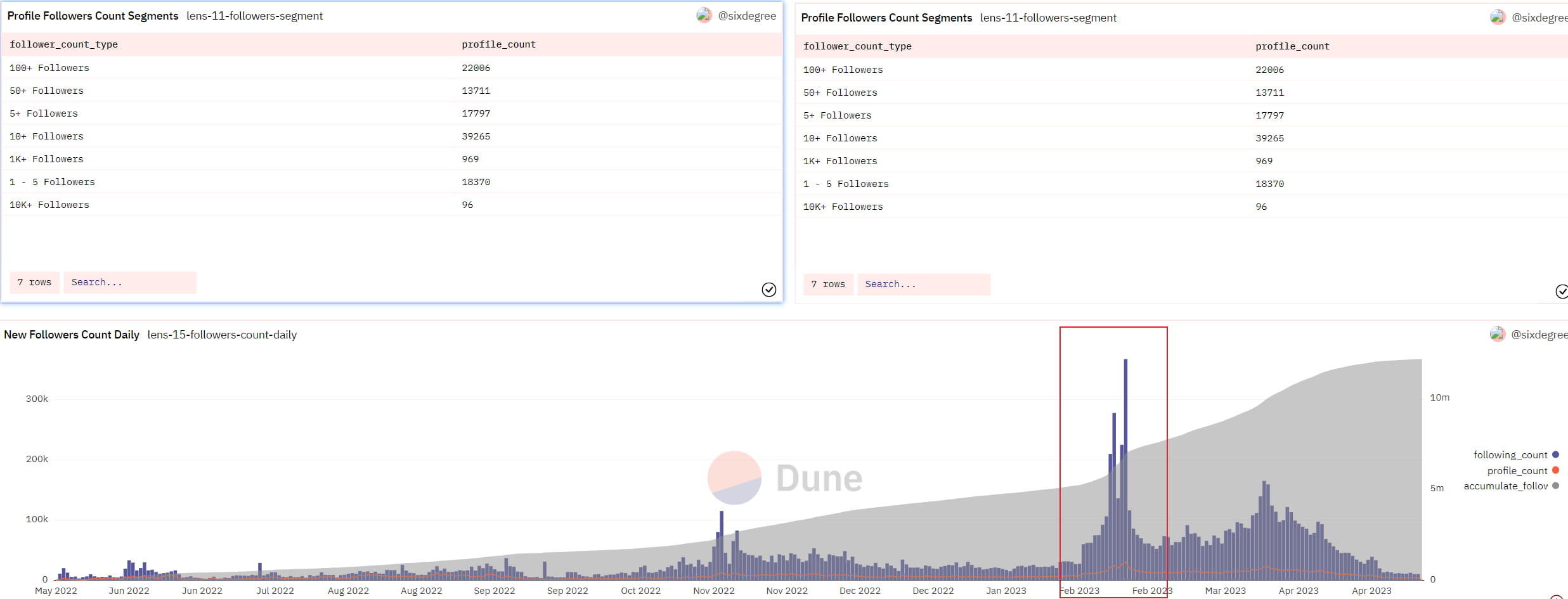
Among the 117,000 profiles, there are a total of 11.41 million followers, with an average of 97.5 followers per account. In terms of the distribution of followers, the most accounts have 10 to 50 followers, followed by more than 100 followers. The next most accounts have 1 to 5 followers. This means that the vast majority of accounts have more than 10 followers.
According to the daily new followers data, before February 23, the daily new followers were around 20,000, and the accounts followed involved 6,000. Around February 14, due to the stimulation of airdrops, a large number of new followers appeared. This is most likely that the LuMao studio is increasing the activity of its own account.
3.3 Analysis of articles and comments
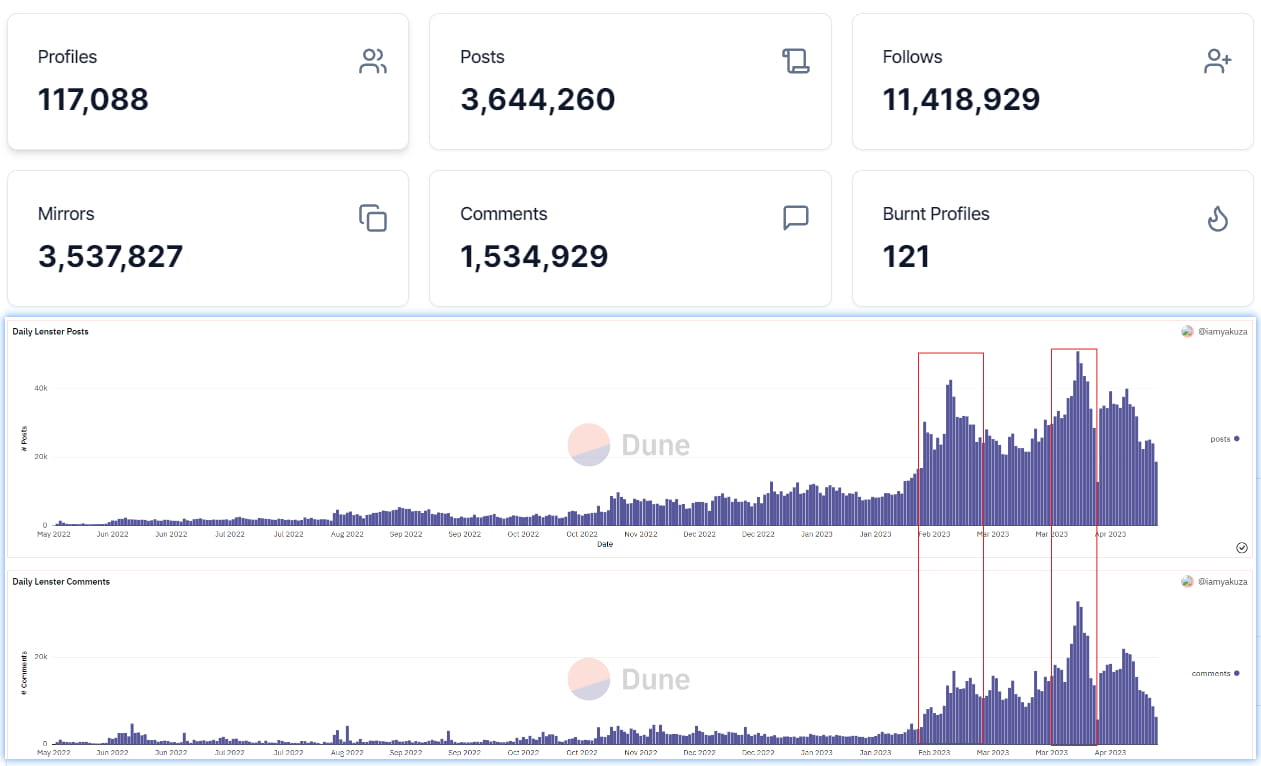
Lens has a total of 117,000 profiles, 90,000 of which have published articles, which means that 27,000 profiles have not published any articles at all. The number of articles published on lens is 3.64 million, with an average of 40.4 articles published per account. Judging from the articles published, the users of lens are very active.
From the number of daily published articles, we can see that for a long period of time before February 1, 2023, the number of articles published on Lens was between 8,000 and 12,000. After February, there were two peaks of articles published, one around February 14 and the other around March 27, which corresponded to the airdrops of Blur and ARB respectively. This shows that the large increase was mainly due to users' expectations of the airdrop.
Judging from the comments, there are 1.53 million comments, which is much less than the 3.64 million articles. This data is quite strange. Generally, an article can have several comments on average, which means that the number of comments should be several times the number of articles. The current situation is just the opposite. This may be because a large proportion of lens accounts are for the purpose of brushing airdrops, rather than real social purposes.
A similar conclusion can be drawn from the daily comment data. Around the time of Blur's airdrop and ARB's airdrop, the daily comments increased significantly compared to before. Before February 2023, the number of daily comments was stable at around 2,000.
3.4 Data Summary
Lens is currently in the beta stage and has not opened account applications. It now has 117,000 profiles. Before February 2023, the number of new followers was about 20,000 per day, the number of accounts followed involved 6,000, the number of articles published per day was between 8,000 and 12,000, and the number of comments per day was about 2,000. Due to the influence of blur and arb airdrops, various data have shown several times growth since February 2023. The monthly active profile has reached more than 60,000. It will continue to be active in the future and needs to be observed.
In addition, the growth of lens users is limited by the whitelist of the new profile mint. We look forward to further relaxation of the project.
4 Main Ecosystems
4.1 Ecological Statistics
According to statistics from Builder DAO,
There are 143 products in the Lens ecosystem, of which dApps account for the majority (119, accounting for 86%), which means that most products are based on the Lens protocol to develop application scenarios. Some developers have further expanded the functions of existing modules (7, accounting for 5%), as well as some middleware products (17, accounting for 9%).
We further classified and counted dApps, as shown in the following figure:
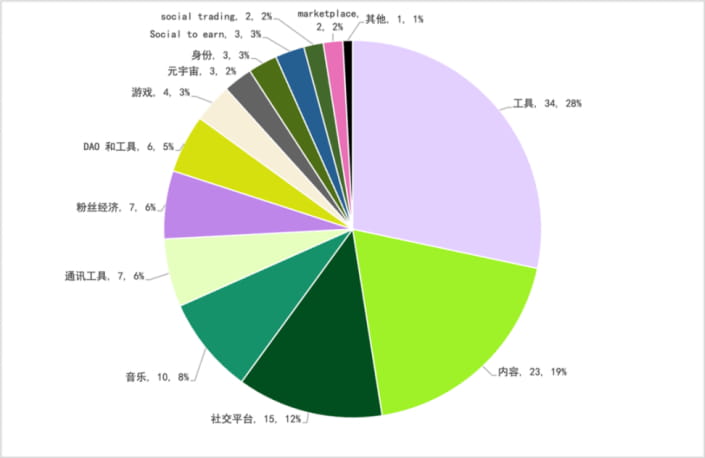
dApp classification statistics
It can be seen that the application products in the ecosystem basically cover most categories.
Among them, tool-type products with relatively simple development and clearer ideas ranked first (34, accounting for 28%), followed by content (23, accounting for 19%), social platforms (15, accounting for 12%) and music (9, accounting for 7%), etc. At the same time, there are also a small number of trading platforms (2, accounting for 2%) and social trading (2, accounting for 2%).
Among them, most products are still in a relatively early stage, and the functional experience is relatively simple.
4.2 Introduction to important ecosystems
1 Paver
Phaver is a Web3-based social application that allows users to interact with their favorite creators, connect their NFTs, earn rewards, etc. Phaver is the largest application of Lens Protocol, with iOS and Android applications, and users can log in through wallets or emails. The format of Phaver is very similar to Twitter, and users can post text, pictures, videos and other content, and get feedback such as likes, comments, and reposts.
2 lenses
Lenster is a decentralized and permissionless social media application built on Lens Protocol, which allows users to create and share content while being immutable. The application is built on the Polygon network, which users can interact with. Lenster also supports multiple NFT types, allowing users to display and trade their digital collections. Lenster is the first decentralized social media application of Lens, so it is very famous in the community.
3 Lenstube
Lenstube is a decentralized video sharing social media platform powered by Lens Protocol. It has a layout similar to Youtube and has an explore page for finding videos. Lenstube uses Livepeer and IPFS to store videos and publish them as NFTs on Lens Protocol. Lenstube allows users to upload and watch videos freely while earning revenue and rewards.
4 Orb
Orb.ac is a blockchain-based social media application that gives users true ownership and control over their identity, content, and earnings. It combines all the best features of existing social media applications into a convenient, easy-to-use super app. Orb is a decentralized, permissionless, censorship-resistant application built on the Lens protocol. This application allows users to own their own identity and they are able to receive all the earnings generated by their content.
5 Lensta
Lensta is a photo social application based on Lens Protocol, designed to help users better manage and share their photos. It can be downloaded and used on iOS and Android. Lensta users can easily explore, collect and share photos, and earn income through the application.