
AI is taking center stage in this wave of transformative technologies—from GPT-4 to Midjourney V5 to Runway’s Gen-2, AI innovations across text, images, and video are becoming the virtual paintbrush of human creativity.
The integration of AI and Web3 is revolutionizing digital art and NFTs, bringing new possibilities to creators, changing the way digital assets interact, and shaping the future of digital art creation. Will this rapid advancement in AI lead to increased adoption and demand for digital art and NFTs?
To better understand the impact of Web3+AI, let’s take a deep dive into some of the most promising use cases currently emerging in the digital art and NFT space.
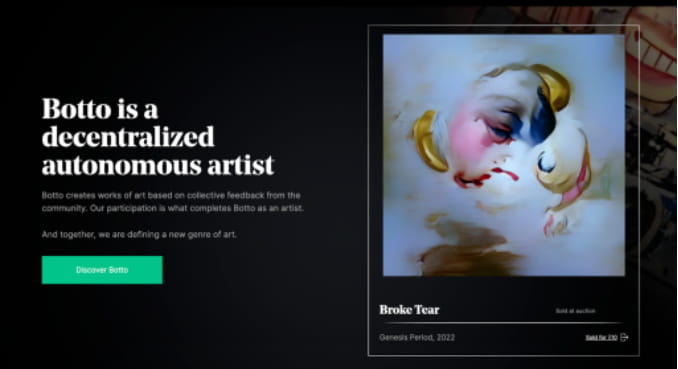
Botto is a generative AI art project governed by a DAO around the $BOTTO token, pushing the boundaries of community-driven creativity at the intersection of AI, DAOs, and DeFi. Since October 2021, Botto's art engine has produced 350 drafts, also known as "shards," each week. The DAO community votes for their favorite "shards" to be minted and sold on SuperRare each week. The voting data is then fed back to the AI, which learns from it to generate artwork that is more in line with the community's tastes. Botto generates revenue through weekly artwork sales, royalties from secondary transactions, and project collectibles sales. Revenue is distributed within the community in accordance with $BOTTO's revenue distribution method to reward the community for participating in the growth and evolution of the project. To date, Botto has generated over 944 ETH in revenue and 1,264 ETH in total sales.
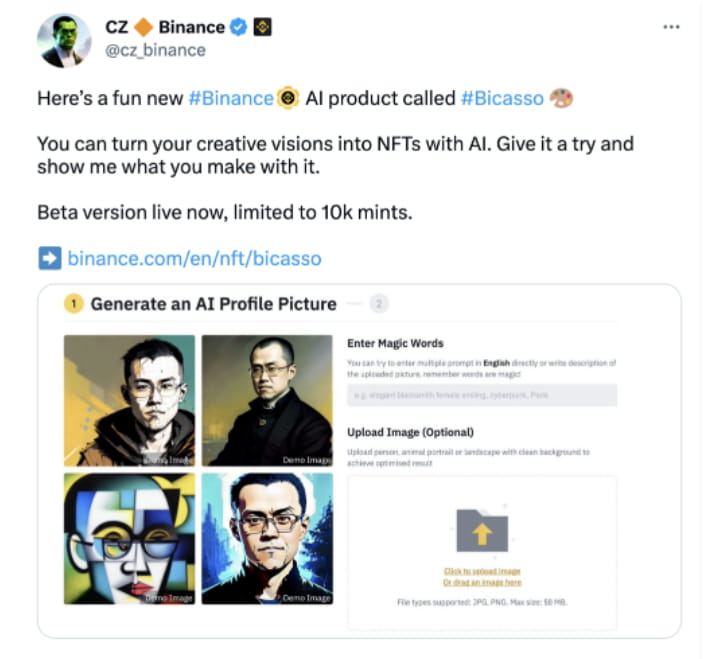
Bicasso is a new AI art tool developed by Binance that was recently launched to users, providing a whole new way to create images and mint them as NFTs. Drawing inspiration from popular AI art programs such as Midjourney and DALL-E, Bicasso enables users to generate images by inputting text, or upload existing images to iterate. What makes Bicasso different is that it seamlessly integrates with Binance's BNB Chain, allowing these AI-generated images to be minted as NFTs directly on the chain. As an art tool that can demonstrate the potential of Web3+AI, the 10,000 NFTs in the beta test were minted by 9,212 users in less than three hours, further demonstrating users' enthusiasm for this innovative method of art creation.
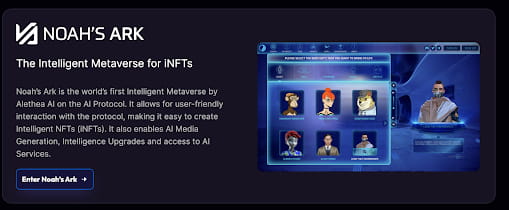
Alethea AI is also making waves in the Web3+AI space, developing a decentralized protocol that allows users to generate and create interactive and intelligent NFTs (iNFTs) using a multimodal AI system based on language descriptions. Alethea AI is opening up a whole new world of digital assets. The team has raised $31 million to date and is committed to redefining storytelling and interactivity in the metaverse, enabling creators to develop unique and engaging experiences for users while increasing interest in NFTs as a medium for artistic expression. However, Alethea AI has seen relatively small adoption compared to other platforms, with only 1,402 daily active wallets according to Dune Analytics.
In the GameFi world, companies like Scenario, Mirror World, and Altered State Machine (ASM) are leveraging AI to generate game assets and transform the Web3 gaming experience.
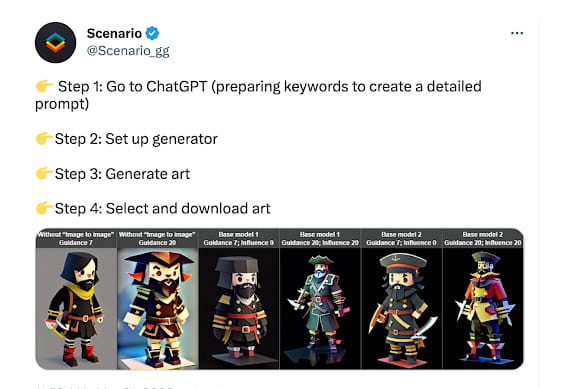
Scenario is a game art generator that enables game artists to automatically generate thousands of new assets in their unique style. This AI-driven approach not only streamlines the game development process, but also preserves the individual artist’s voice, ensuring that their creative vision is not diluted by general-purpose AI tools. After announcing Scenario’s $6 million seed round, co-founder Emmanuel de Maistre shared that 5,000 creators have signed up for the platform, with 20,000 more on the waitlist. Pricing for the tool will be based on usage, starting at $20 per month, with plans to serve a higher number of customers. Their mission is to unlock the opportunities that AI brings to the gaming industry: exponentially increased output, drastically reduced workload, and completely unrestricted creativity for AI-powered artists.
Mirror World is changing the landscape of GameFi by enabling AI-powered NFTs as assets for game characters. "Mirror World is the first AI-powered virtual playground that brings crypto rewards to people," said Chris Zhu, founder and CEO of Mirror World. "We want to build the 'Nintendo of Web3' with characters that players love." The company recently raised a $4 million seed round of funding from Galaxy Interactive and Republic Crypto, as well as many other investors. Mirror World plans to use this round of funding to accelerate the launch of its first three games - ARPG (action role-playing game), PvP Arena (player vs. player), and SLG (simulation game). Mirror World's overall NFT trading volume hovers at 179.75 ETH and has been struggling to scale since 2022. Mirror World is currently working with Republic Crypto's economic team to design token economics and DAOs around the gameplay of the three games. The goal is to bring better gaming experiences to players while promoting more sustainable economic benefits and a "well-framed" economic system. The ultimate goal is to become an open, autonomous, sustainable, and asset-interoperable gaming world.
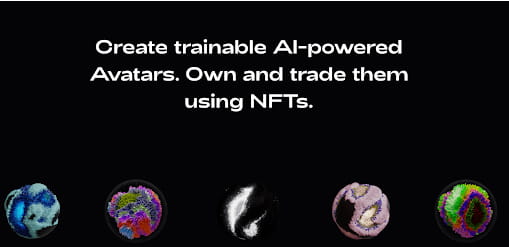
Altered State Machine (ASM) is pioneering a new AI ownership model with a decentralized protocol that allows users to own, train, and trade AI-powered "brain" NFTs that can be used as avatars in Web3 games and the metaverse. FIFA recently launched a beta version of its "World Cup AI League," a mobile strategy game powered by ASM that leverages AI to create its characters and game components. ASM raised $11 million in seed funding in 2022 from top investors including TCG, Coinbase Ventures, WMG, 6th Man Ventures, Delphi Digital, Outlier Ventures, and Flamingo DAO.
While AI-driven projects and use cases in the NFT space are still in their early stages, their impact extends far beyond current applications, laying the foundation for future innovation. AI-generated content platforms, decentralized AI protocols, community-driven art auctions, and interoperable gaming assets each offer unique opportunities for the development and advancement of the digital art and gaming space.
While some current criticisms of AI art may be fear-based, there are ethical questions surrounding the creation and use of these tools. The convergence of AI and NFTs raises questions about ownership of creative output, the potential for plagiarism, and the manipulation of AI-generated content. Recent allegations against companies like Stability AI and Midjourney for alleged copyright infringement during the training of their algorithms have only heightened concerns. Addressing these issues will require collaboration between technologists, policymakers, and the broader community to develop ethical guidelines that strike a balance between innovation and accountability.
As AI and NFTs continue to merge, they will undoubtedly reshape digital art, gaming, and more, opening up new possibilities and inspiring people to further explore the vibrant and evolving world of Web3.