
Randomly washing the market to harvest investors, transferring financing funds without authorization, and launching inferior imitation projects... This is the story behind Huang Licheng's rise to notoriety in the crypto world.
Jeffrey Huang, known as Machi Big Brother by netizens, is a former Taiwanese-American musician and technology entrepreneur. He embezzled 22,000 ETH from Formosa Financial in 2018, and launched more than a dozen failed coin issuance and NFT projects in the four years after its collapse. This article will introduce Huang Licheng’s many “black histories” in the field of cryptocurrency, including a brief introduction to Formosa and his many subsequent projects, other participants, and other factual basis.

In the past year, “Machi Big Brother” (aka Jeff Huang), as one of the largest BAYC holders, has made a name for himself in the NFT field. Having said that, few people know his "black history" in the field of cryptocurrency...
background
Jeffrey Huang, also known as "Michi Big Brother", is a Taiwanese-American musician and technology entrepreneur living in Taiwan. Wong first came to attention as a founding member of the pop/rap trio L.A. Boyz, formed in 1991. Active from the early to late 1990s, L.A. Boyz released 13 albums and grew in popularity in Asia before eventually disbanding in 1997.
After the success of L.A. Boyz, Huang formed the hip-hop group MACHI in 2003 and took this opportunity to make another fortune. Subsequently, Huang Licheng and his friends began to form a multi-Asian hip-hop/rap record company called MACHI, which was affiliated with Warner Music. Eventually, Huang transitioned from the music industry to the technology field, founding 17 Media (M17) in 2015 and going on to become one of the most popular live streaming apps in Asia.
In 2017, Huang Licheng began to enter the cryptocurrency field through Mithril, which was also the beginning of his participation in the launch of the "Leek Cutting Project". The team members of these projects have more or less professional ethics issues, and they often have the practice of pumping and selling. The following article will provide an in-depth introduction to these "cutting leeks" projects.
Project 1: Mithril
At the end of 2017, Huang Licheng founded Mithril, a decentralized social media platform that aims to directly reward content creators through its native token MITH. Mithril conducted a private token sale on February 21, 2018, raising $51.6 million (60,000 ETH), equivalent to 30% of the total token supply. 70% of these private sale tokens were unlocked on TGE in February 2018, with the remaining 30% scheduled to be unlocked over the next three months. In April 2018, Mithril was listed on the centralized exchange Bithumb. After the token was fully unlocked in May 2018, 89% of the circulating supply of MITH tokens were sold intensively, and the huge selling pressure led to a crash.


Project 2: Formosa
Back in early 2018, Huang partnered with Taiwanese politicians George Hsieh, Czhang Lin, and Ryan Terribilini to found Formosa Financial, a financial management platform for blockchain companies. And in the last week of April 2021, it completed an angel round of financing with a total amount of 22,000 ETH. Subsequently, on May 31, a further 22,000 ETH was raised through a private placement round, accounting for 30% of the total token supply. The two rounds of fundraising raised a total of $23 million (44,000 ETH). Famous investment institutions include: Binance, QCP Capital, Lemnis Cap, Block One, Mithril/Huang Licheng Huang (emphasis here), Maicoin, Wilson Huang, Leo Cheng's Syndicate, Blockstate and Block One.


The team had vowed to assure investors that FMF was on the fast track to a top CEX listing.

Our next step?
All FMF tokens from our private sale have been distributed to users. There are currently 939 addresses holding FMF tokens and growing, with the hope of adding 1,000 addresses before the first major exchange listing.
Over the next few weeks, we aim to list on the five major exchanges and provide a more detailed look at our product roadmap. "


Machi later denied this
FMF was listed on IDEX in June 2018 and plummeted immediately after landing. It was not listed on centralized exchanges (IDCM, UEX) until September 2018.

In addition, 17 Media was originally scheduled to have an IPO on the New York Stock Exchange on June 7, 2018, but due to unspecified settlement issues with investors, the IPO launch was postponed after the plan to raise US$115 million failed. . ZachXBT contacted an unnamed person familiar with the matter and revealed the secret behind it: "M17's suspension of trading has little to do with regulatory restrictions as a private entity or Citibank's faulty operations. The reason for the failure should be attributed to M17's inability to Meeting auditing and reporting requirements also fails to overcome the shortcomings of threshold bidding, which also means people cannot adapt to this business model.”
After the listing failed, Huang expressed his frustration on Facebook and scolded Citibank and Deutsche Bank, which participated in the IPO.

Just three weeks after the FMF ICO, the story of Formosa Financial quickly took a bad turn - two withdrawals of 11,000 ETH each appeared in its wallet. Co-founder George Hsieh, as the sole director of the company, secretly sold his shares and kept investors in the dark.


Subsequently, George Hsieh, Huang Lichen and Yalu Lin stepped down, leaving only co-founders Ryan Terribilini as CEO and Lorne Lantz as CTO.

This chart shows the inflow of ETH from angel and private equity rounds via multi-signature before Huang Licheng and George twice withdrew 11,000 ETH on June 22, 2018.
On June 29, 2018, George transferred 10,500 ETH to his Binance account. The KYC authenticity of this Binance account is currently unknown.
As for Huang Licheng, his 11,000 ETH remained untouched in a wallet until 4,980, 1,997, 1,400, 500, and 103 ETH were transferred to different Binance accounts in late June and early July. 2,000 ETH was transferred to czhang.eth, and 20 ETH was transferred to an EOA wallet.
The above questions remain unresolved. Regarding the ownership of these Binance accounts and wallets, let us start with the flow of ETH and take a closer look:
1. From July 26 to July 29, 2018, 4980 ETH were transferred. Records show that this Binance account had frequent funding sources from two sources – FTX and littlebang.eth

a) Searching for the owner of littlebang.eth on OpenSea will find that the username is "Bun919tw"

b) A quick Google search revealed that "bun919tw" is actually Bun Hsu, the core engineer of Cream Finance, and Cream happens to be another project of Huang Licheng.

c) Bun Hsu’s Twitter avatar is BAYC #7066, which was gifted to him by machibigbrother.eth (Huang Licheng’s public wallet).



d) Bun Hsu happened to have transactions in several projects under Huang Laicheng such as FMF, SWAG, CREAM, SQUID, PHOON, MCX and MIS/MIC.
So why did a person who was not on the Formosa Financial team receive 4,980 Ethereum just 3 weeks after the ICO, and have "money transactions" with Huang Licheng's project and even himself?
2. On-chain records show that the 2,000 ETH transferred out on July 11, 2018, ultimately directed to Czhang Lin (czhang.eth), who had been an advisor to Formosa Financial until June 22.


a) Three weeks after receiving 2,000 ETH, Czhang sent 150 ETH to his brother Yalu Lin (Formosa COO) on July 22, 2018.
Or a similar question, why were Formosa Financial's advisors and COO receiving project construction funding?
3. Regarding the 1997 ETH outflow on July 28, 2018: The only revenue stream for this Binance account came from harrisonhuang.eth, a wallet with w9g.eth (Wilson, Mithril’s VP of Engineering and current founder of XY Finance and GalaXY Kats Huang) has frequent interactions.


a) A quick search for harrisonhuang.eth on Twitter reveals his Twitter handle as he tweeted his ENS address and responded to Wilson.


Harrison is not publicly listed as a team member in the Formosa Financial white paper or website. Here again, a personal account with no public connection to Formosa received project funds.
The remaining Binance accounts that received funds from Huang were a backwater: they had not had any recent interactions with other external or personal addresses, and transactions were only moves between CEXs.
On July 26, 2018, Huang and Mithril were caught trying to defraud Binance’s monthly Community Coin voting. A user named Lucky found evidence that Mithril received more than 80,000 votes, all of which came from two or three addresses. The principle of community currency voting is that 1 BNB is equivalent to 1 vote, and the maximum vote limit for each account is 500 BNB. Therefore, a voter can obtain the maximum 500 votes as long as he holds 500 BNB. However, Binance states in its rules that creating fake accounts is equivalent to mass distribution of BNB, and offenders will be disqualified from competing.

Huang Licheng was still using the same address at the time of the Formosa ICO. This address was closely related to amateur Mithril and held $8.6 million in MITH. The picture below shows that a large number of BNB transfer accounts at that time received fees from the largest Mithril whale wallet.
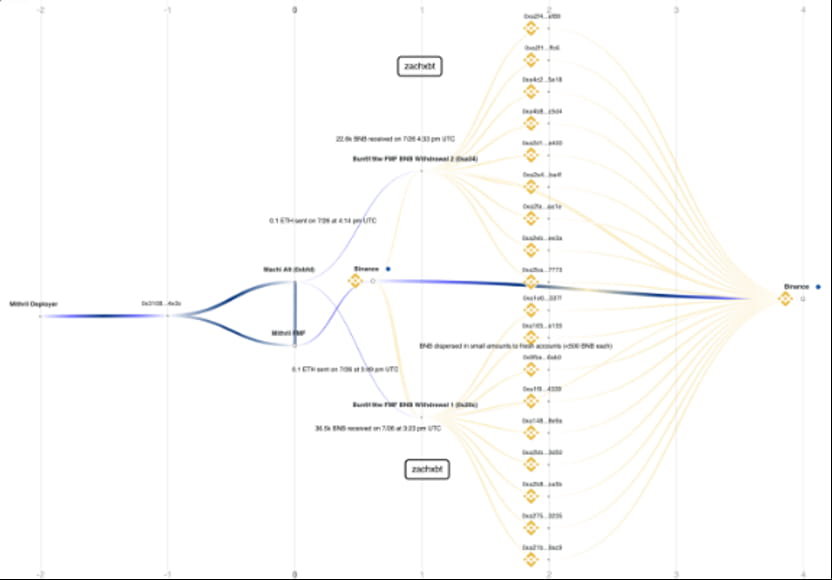
What’s even more shocking is that the large number of BNB transfer records used for vote fraud coincided with the day when Bun Hsu received 1980 ETH, which was actually deposited into his Binance account less than an hour before the vote.

When examining on-chain transactions, even more BNB was distributed to additional Binance accounts in volumes less than 500, a timeline consistent with the theft of FMF funds.
1a) At 3:25 am on July 28, Bun Hsu Binance account received a transfer of 2000 ETH

1b) At 4:43 a.m. on July 28 (UTC time), the Binance account transferred 43.8k BNB (probably also done by Bun)

2a) Harrison Huang’s Binance account deposited 1994 ETH at 7:08 AM on July 28

2b) At 7:28 AM on July 28, 30k BNB was withdrawn from the Binance account

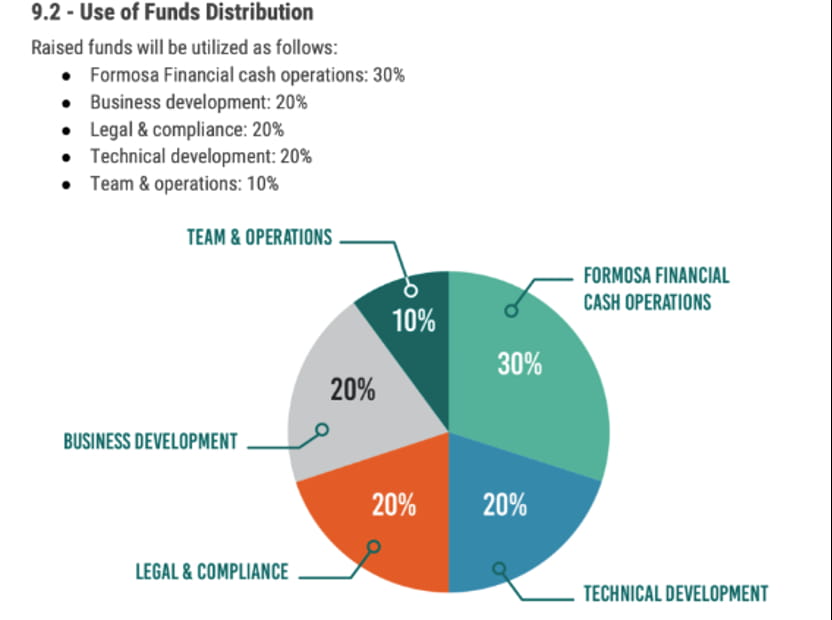
In summary, connecting these addresses, Huang Licheng, and Mithril may be the final destination of Formosa Financial’s large sums of money.


Again, maybe that's what Formosa is raising money for.

In the fall of 2018, investors began to suspect something was amiss when there was growing alienation from Huang, Czhang and other key FMF team members, with no proper explanation or project progress update from anyone. FMF continued to plummet, and there were sudden abandonments by key team members, which put the project in trouble.


Project 3: Machi X
In October 2018, Huang Licheng and Leo Cheng launched the intellectual property social market Machi X. However, due to the performance of the previous project Mithril and the Formosa incident, his reputation plummeted, making it difficult for Machi X to obtain funding.
It wasn’t until more than a year after the Formosa incident that investors finally learned what had happened to their money. On August 12, 2019, Formosa investors received an anonymous email containing internal documents for support, which stated that just three weeks after the end of the 2018 ICO, 22000/44000 ETH was withdrawn from the Formosa Financial ICO private sale wallet. Stolen. Attached to the email are various internal documents proving this

In this leaked audio from 2019, former Formosa CEO Ryan Terribilini shares his thoughts on the funds embezzled by Huang and George and the events that followed.
As for why no legal measures were taken against Huang Licheng and George at that time, the answer given by many venture capital companies and angel investors who invested in the project was that Huang Licheng and George were really well-known figures in Taiwan. At the same time, the incident occurred in In multiple jurisdictions, investors have reached an agreement to simply handle this incident and avoid unnecessary trouble.
Project 4: Cream Finance
In 2020, the cryptocurrency market started to heat up again. Huang Licheng dismantled the decentralized peer-to-peer lending platform Compound Finance and established Cream Finance with Leo Cheng in early July 2020. Bun Hsu, Jeremy Yang, and Stanley Yang are part of Cream's development team. As of today, Cream Finance has been exploited three times for more than $192m USD due to negligence. As of today, Cream Finance has been exploited three times for more than $192m USD due to negligence. profit.

Project 6: Swag Finance
Swag Finance is an adult entertainment website founded by Machi. and launched its governance token in early October 2020. When Swag was quietly listed as collateral for Cream Finance, the lack of transparency in the listing sparked a huge controversy on Twitter, with the token going from cultivating to dumping in a matter of weeks. process and eventually exit from Cream.


Project 7: Mith Cash
On December 30, 2020, Wong and Mithril returned with a new project. Mith Cash is a fork of the Basis Cash protocol, an algorithmic stablecoin. In just a few days after launch, Mith Cash’s TVL grew to $1 billion before quickly collapsing as investors redeemed their rewards. Mith Cash ended up meeting the same fate as Basis Cash. Similar to Huang Licheng's other projects, the project team is also so-called "anonymous", and Huang Licheng also declared that he is "just a consultant."


Project 8: Typhoon Cash
Shortly after the collapse of Mith Cash, Machi returned once again in the form of Typhoon Cash (an offshoot of Tornado Cash). The group claims to have a "secret force," but it seems to be common knowledge that Huang and his friends are the driving forces behind the group. Starting from various signs at the press conference, it is an exaggeration for this project to be called "cutting leeks" - anyone can invest in the anonymous pool and remain anonymous. However, in order to receive rewards, one must invest in the anonymous pool. . This means that in order to receive rewards, bonus deposits will be disclosed, a logic that makes the concept of privacy coins worthless. The project was abandoned just weeks after it started, and the mess was ultimately left to the staff of the Telegram and Discord channels.


**Typhoon Cash vulnerability was disclosed by Avner and verified by Nick.
For example:


Since February 2021, there haven’t been any scam updates posted on Discord, Telegram or Twitter.
Project 9: Mud Games
With the sudden popularity of the random game asset Loot for Adventurers on the chain at the end of August 2021, Machi, who has a quick eye and quick hands, immediately released his own version, called Heroes of Evermore, which quickly earned the "anonymous team" a profit of 533.92ETH. . Unlike Loot, Heroes of Evermore is not randomly generated. The team members have already secretly minted the rarest NFT from the collection without telling the holder.


Team members Huang Licheng & Penguin cast No. 2 and No. 3.
Project 10: Squid DAO
In October 2021, another "anonymous team" established Squid DAO, a replica of OHM/Nouns DAO. MachiBigBrother.eth was one of its early holders, and in January 2022, the project was shut down at the behest of Machi.


Today, Machi has moved on to X, XY Finance, and most recently his latest creation: Ape Finance.


Among Huang Licheng’s many projects, the same keywords are always the same: anonymous team, imitation project, new wallet funded through FTX and short life cycle. The participants in each project are also the same: Wilson, Leo, and Huang Licheng. As for why VCs like Andrew Kang turn a blind eye to this matter, he himself said this:


Even in February when Cream Finance was already on the verge of death, Andrew helped Huang Licheng again. When it comes to money, it's tragic to turn a blind eye to one's actions causing significant financial harm to others, and that's true to helping launch a dozen less-than-smart projects, and that's true to helping to misappropriate 22,000 ETH.


After his wrongdoings were made public, Huang Li-cheng spoke out in response to the bad impact on Taiwan. However, he and his "anonymous team" continued to shame Taiwan and the crypto space. I hope that one day, all those who have suffered losses due to Huang Licheng's projects will see justice.
C3 Tip: The views, thoughts and opinions expressed here are solely those of the author. This article does not contain investment opinions or recommendations. Every investment and transaction involves risk. There are three realms of investment: seeing, understanding, and holding. Entrepreneurship also has three realms: thinking, doing, and completing. Each level seems to be about the same on paper, but in fact it is much different. Each level can eliminate more than 90% of the people.